
WeGreened Approval Statistics: Week of March 16, 2026
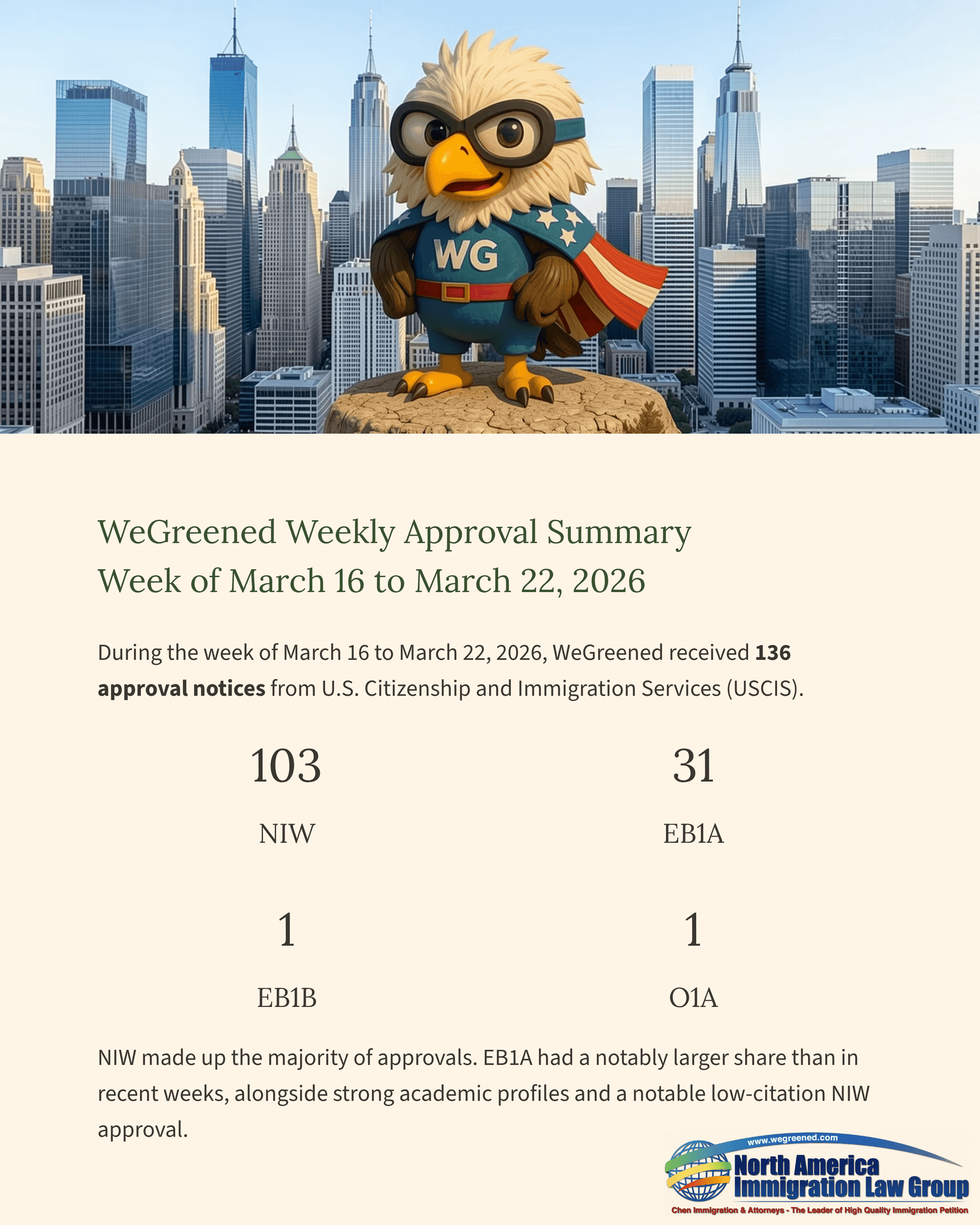
During the week of March 16 to March 22, 2026, WeGreened received 136 approval notices from U.S. Citizenship and Immigration Services (USCIS). Of the 136 approvals, 103 were for NIW (National Interest Waiver), 31 were for EB1A (Alien of Extraordinary Ability), 1 was for EB1B (Outstanding Professors or Researchers), and 1 was for O1A (Individuals with Extraordinary Ability or Achievement).
NIW again represented the majority of approvals, while EB1A accounted for a meaningfully larger share of the week’s results than in several recent batches, in a week that included both conventionally strong academic profiles and one especially instructive low-citation NIW approval.
EB1A and NIW Credential Analysis
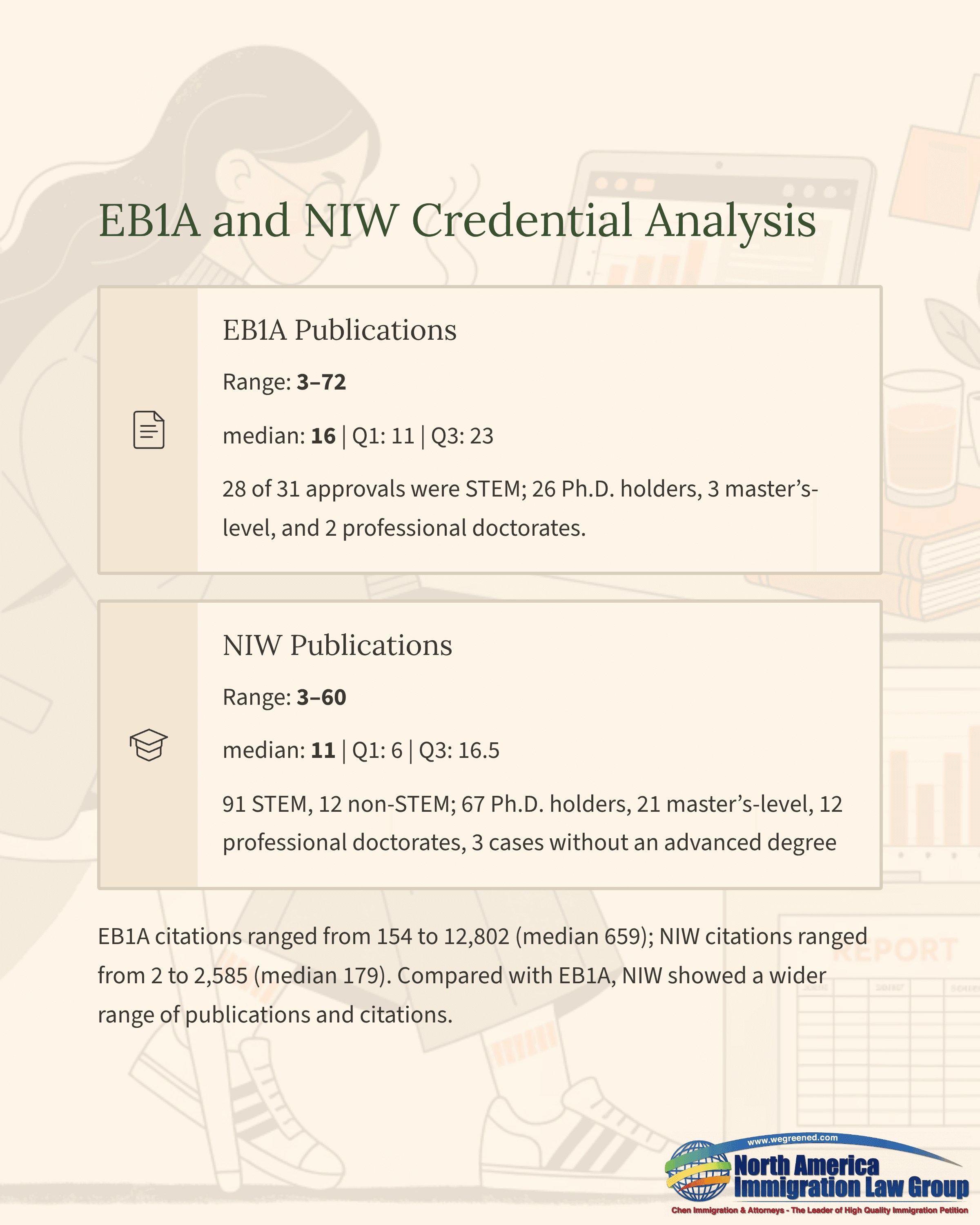
EB1A petitioners this week showed strong and somewhat top-heavy impact metrics. Publications ranged from 3 to 72 (Q1: 11, median: 16, Q3: 23), and citations ranged from 154 to 12,802 (Q1: 359.5, median: 659, Q3: 1,288.5). EB1A remained overwhelmingly STEM-oriented (28 of 31), and the degree mix was still Ph.D.-heavy, with 26 Ph.D. holders, 3 master’s-level petitioners, and 2 professional doctorates.
NIW petitioners reflected a broader range of profiles. Publications ranged from 3 to 60 (Q1: 6, median: 11, Q3: 16.5), and citations ranged from 2 to 2,585 (Q1: 75.5, median: 179, Q3: 359.5). NIW also remained heavily STEM-weighted (91 STEM and 12 non-STEM approvals), with a broader degree mix including 67 Ph.D. holders, 21 master’s-level petitioners, 12 professional doctorates, and 3 cases without an advanced degree. Compared with EB1A, NIW again showed a wider spread across both publications and citations.
Insights on Petitioner Backgrounds and Fields
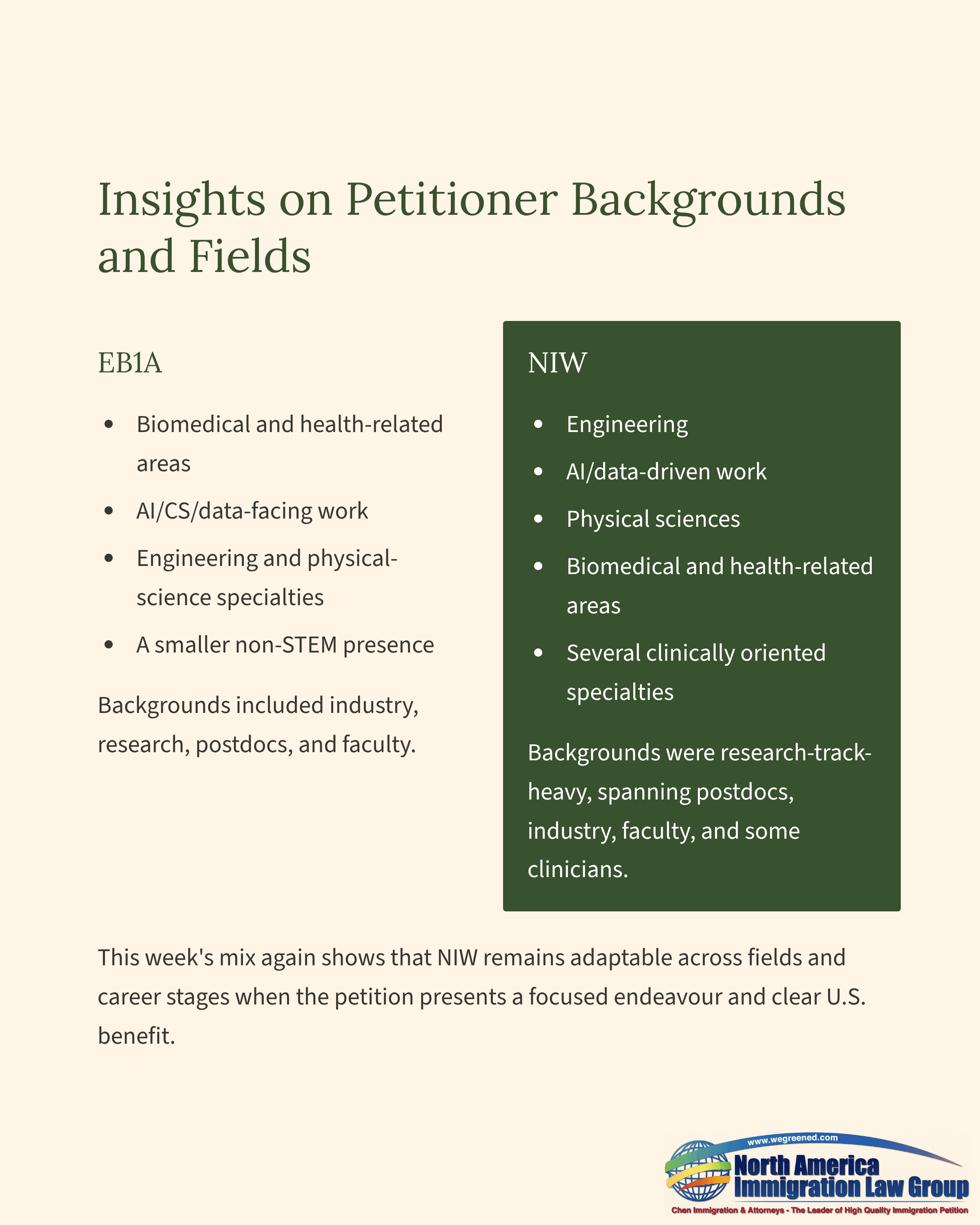
EB1A approvals this week clustered in biomedical and health-related areas, AI/CS/data-facing work, and engineering and physical-science specialties, with a smaller non-STEM presence. Employment backgrounds included industry professionals, research staff, postdoctoral researchers, and faculty, reinforcing that EB1A is not limited to a conventional academic path.
NIW approvals were again research-track-heavy and included postdoctoral researchers, Ph.D. students and candidates, industry professionals, research staff, faculty, and a smaller clinician group. Fields spanned engineering, AI/data-driven work, biomedical and health-related areas, physical sciences, and several clinically oriented specialties. This week’s mix again shows that NIW remains adaptable across fields and career stages when the petition presents a focused endeavor and clear U.S. benefit.
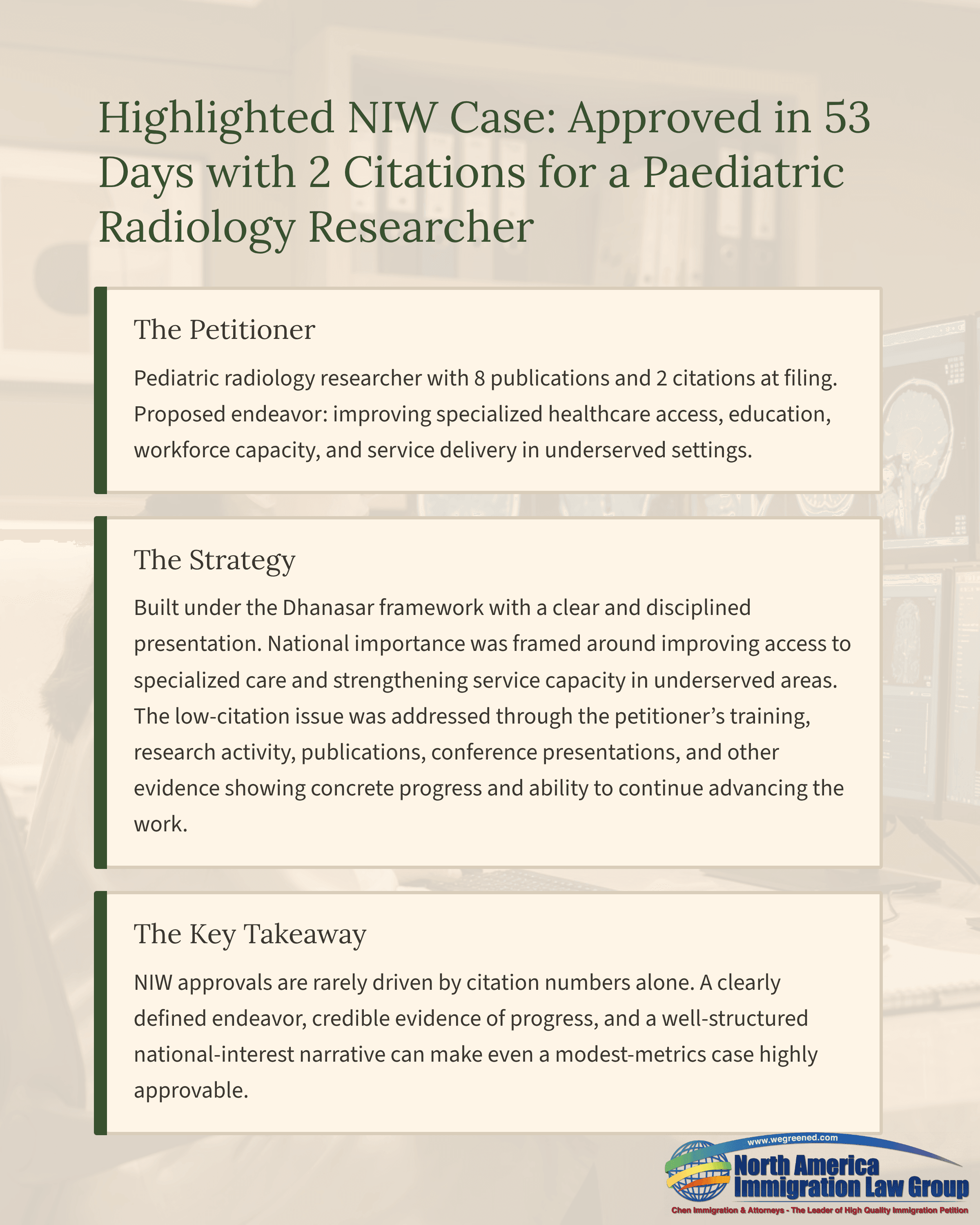
Highlighted NIW Case: Approved in 53 Days with 2 Citations for a Pediatric Radiology Researcher
One of the most instructive approvals this week was an NIW case for a pediatric radiology researcher whose record did not follow the usual high-citation pattern. At filing, the case included 8 publications and 2 citations, and it was approved in 53 days. Even so, the petition succeeded, showing how NIW can work when the case is built around the national importance of the endeavor and the petitioner’s ability to advance it, rather than citation volume alone.
What made the case work was not volume-based academic evidence, but a clear and disciplined Dhanasar presentation. The filing focused on a proposed endeavor tied to improving specialized healthcare access, education, workforce capacity, and service delivery in underserved settings, while addressing the low-citation issue through the petitioner’s training, research activity, publications, conference presentations, and other evidence of concrete progress.
In a case with only 2 citations, the petition could not rely on metrics alone, so the filing used qualitative evidence and a tightly structured legal narrative to show both national importance and future value. This approval is a useful reminder that not every approvable NIW case looks numerically strong on paper.
Adjudication Trends and Policy Observations
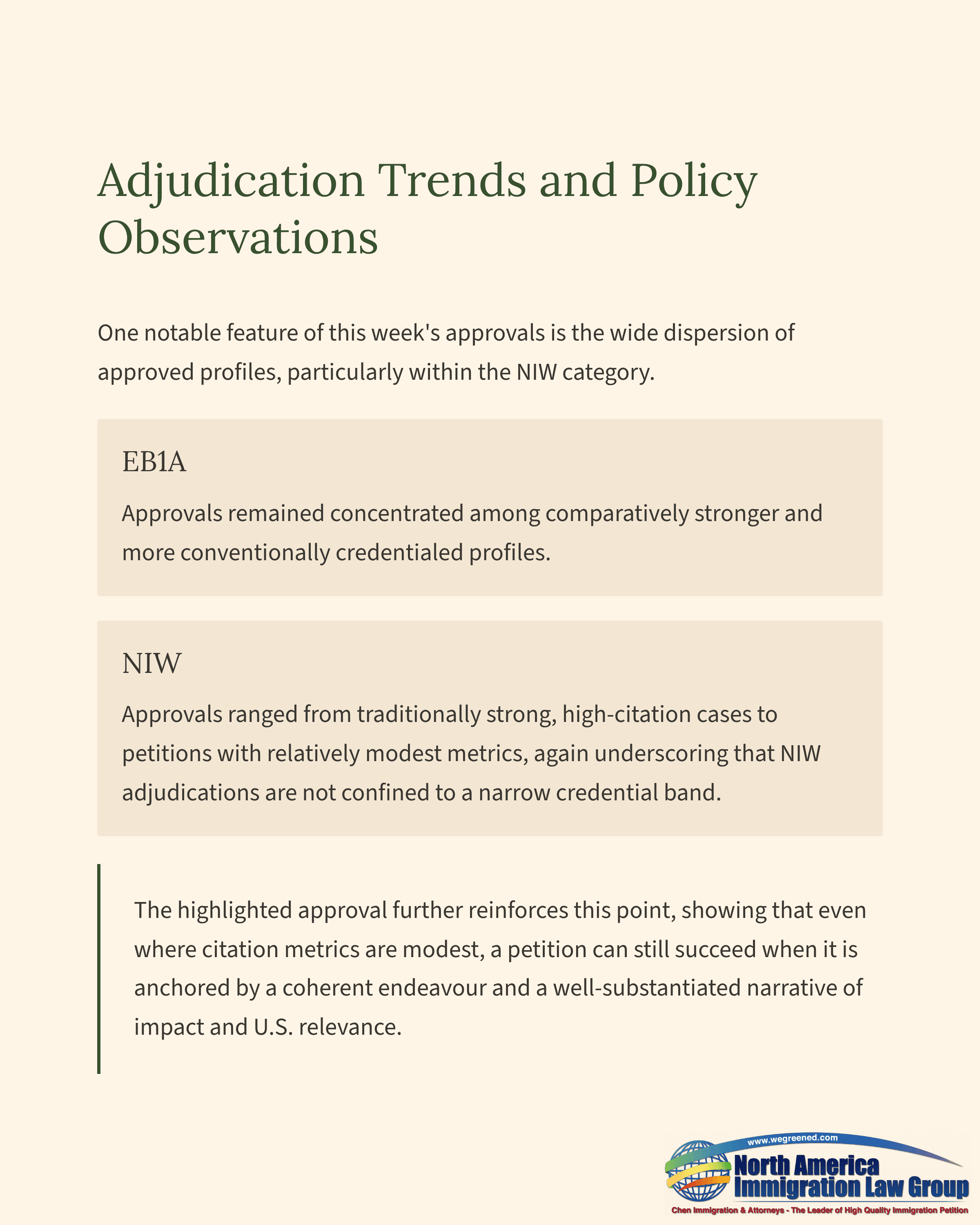
One notable feature of this week’s approvals is the wide dispersion of approved profiles, particularly within the NIW category. While EB1A approvals remained concentrated among comparatively stronger and more conventionally credentialed profiles, NIW approvals ranged from traditionally strong, high-citation cases to petitions with relatively modest metrics, again underscoring that NIW adjudications are not confined to a narrow credential band.
The highlighted approval further reinforces this pattern, showing that even where citation metrics are modest, a petition can still succeed when it is anchored by a coherent endeavor and a well-substantiated narrative of impact and U.S. relevance.