

WeGreened Approval Statistics: Week of March 23, 2026
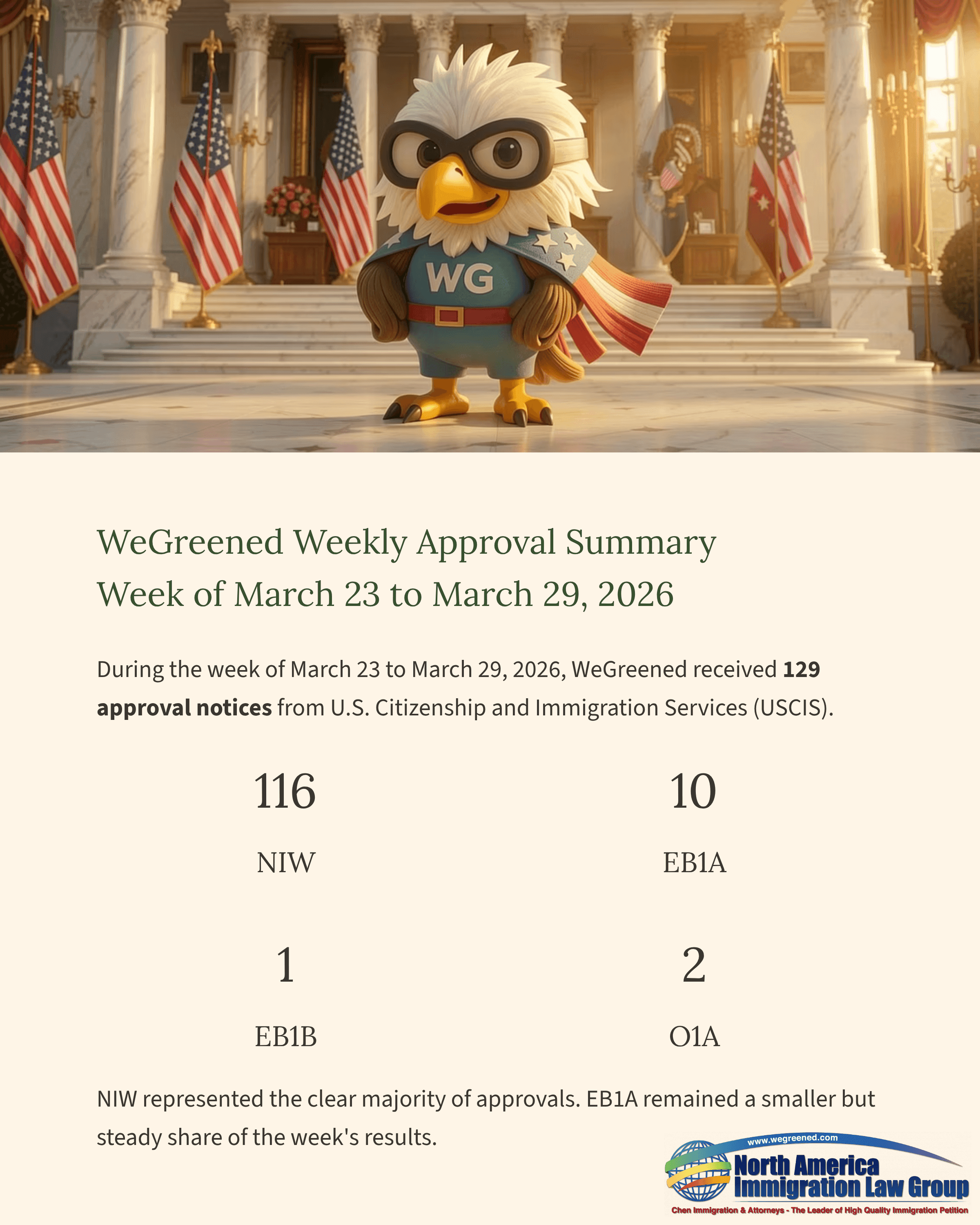
During the week of March 23 to March 29, 2026, WeGreened received 129 approval notices from U.S. Citizenship and Immigration Services (USCIS). Of the 129 approvals, 116 were for NIW (National Interest Waiver), 10 were for EB1A (Alien of Extraordinary Ability), 1 was for EB1B (Outstanding Professors or Researchers), and 2 were for O1A (Individuals with Extraordinary Ability or Achievement).
NIW again represented the majority of approvals, while EB1A remained a smaller but steady share of the week’s results.
EB1A and NIW Credential Analysis
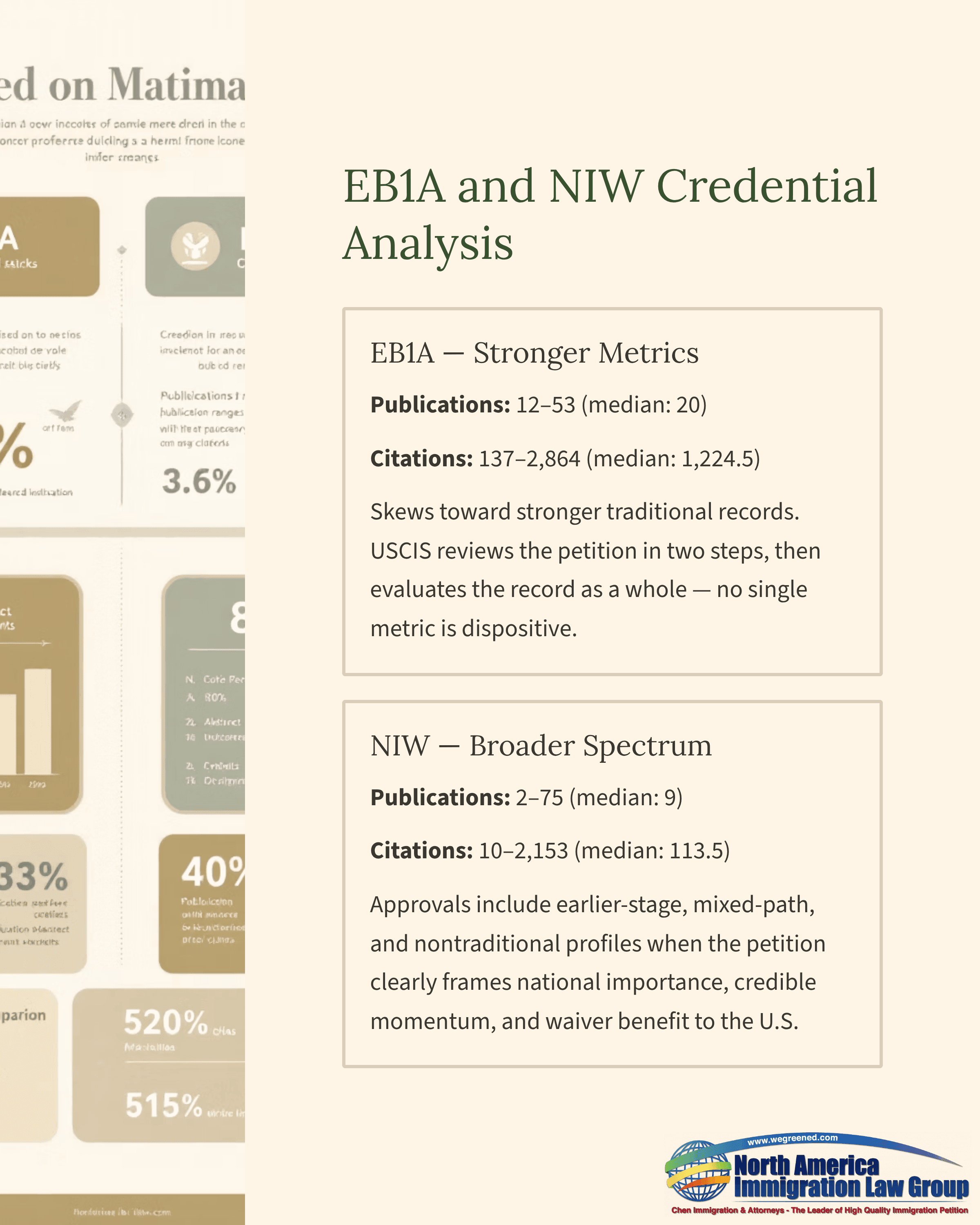
EB1A petitioners this week showed concentrated but still varied impact metrics. Publications ranged from 12 to 53 (Q1: 14, median: 20, Q3: 32.25), and citations ranged from 137 to 2,864 (Q1: 710.75, median: 1,224.5, Q3: 1,955). That profile is consistent with a category that still skews toward stronger traditional records overall, but where current USCIS guidance makes clear that officers ultimately review the petition in two steps and then evaluate the record as a whole at final merits, rather than treating any single metric as dispositive.NIW petitioners again reflected a much broader spectrum of credential profiles. Publications ranged from 2 to 75 (Q1: 6, median: 9, Q3: 14), and citations ranged from 10 to 2,153 (Q1: 44.5, median: 113.5, Q3: 280.25). Compared with EB1A, NIW again showed a broader spread across both publications and citations, reinforcing the point that approvals can include earlier-stage, mixed-path, and nontraditional profiles when the petition clearly frames national importance, shows credible momentum, and explains why waiver flexibility benefits the United States.
Insights on Petitioner Backgrounds and Fields
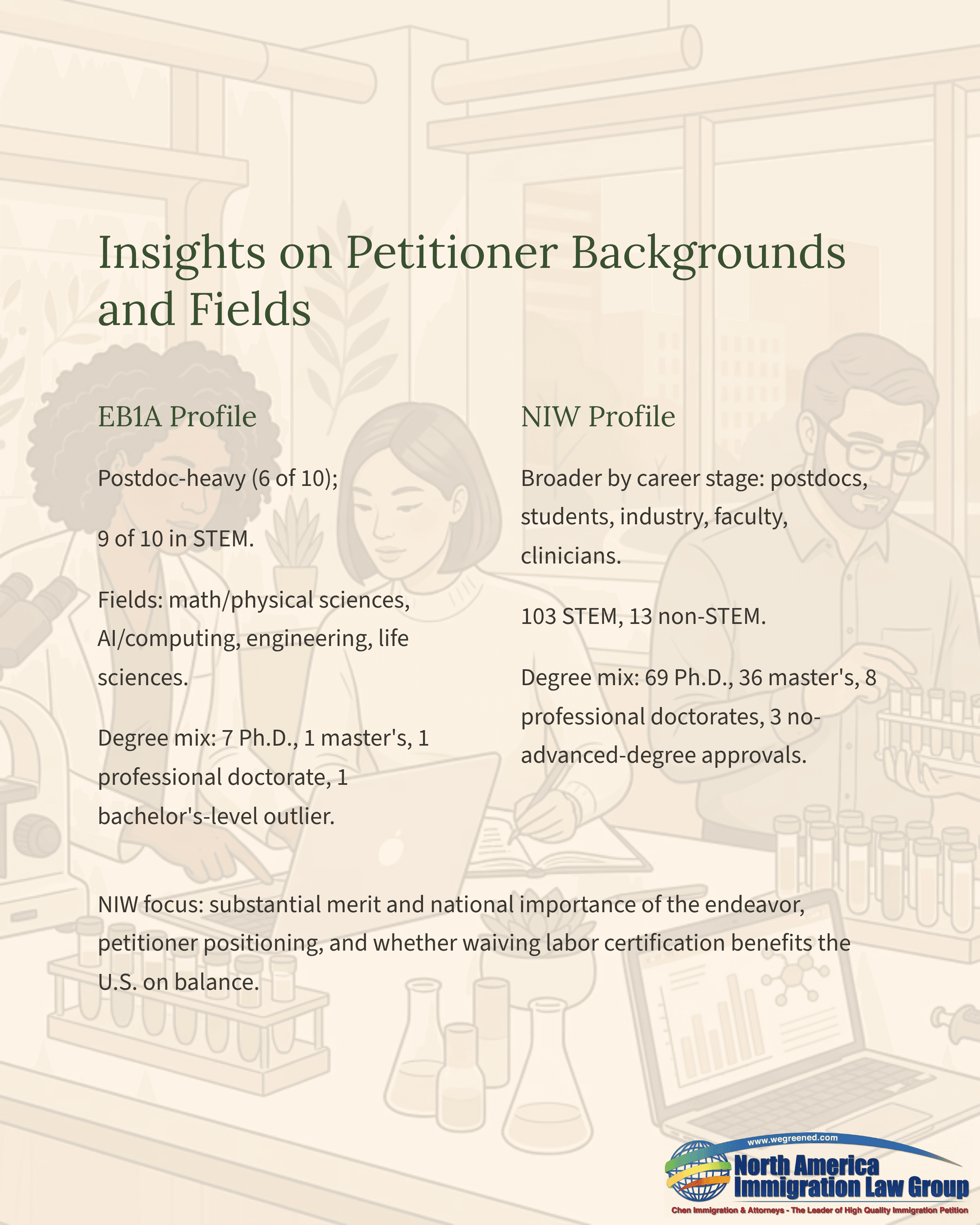
EB1A approvals this week were postdoc-heavy and clustered most visibly in math- and physical-science-facing work, with additional approvals across AI/computing, engineering, life sciences, and clinically oriented work. Employment backgrounds were mixed but still tilted toward research-intensive profiles: six postdocs, two industry professionals, one faculty member, and one student/trainee record. EB1A also remained heavily STEM-oriented, with 9 of 10 approvals in STEM fields. The degree mix was still Ph.D.-heavy, with 7 Ph.D. holders, 1 master’s-level petitioner, 1 professional doctorate, and 1 bachelor’s-level industry-facing outlier. That mix suggests that EB1A remained strongest where the file could present a record of sustained recognition at a relatively high level, regardless of whether the petitioner was in academia or industry.NIW approvals were again broader by both career stage and field. Postdocs formed the largest employment group, but the week also included a substantial student/candidate share, a meaningful industry share, faculty cases, research staff, and a smaller clinician group. By field grouping, AI/computing/electrical-engineering-adjacent work and engineering together accounted for nearly half the NIW approvals, with additional strength in biomedical/public-health work, life sciences, math/physical sciences, and a smaller but real social-science/education presence. NIW also remained heavily STEM-weighted, with 103 STEM and 13 non-STEM approvals, while showing a wider degree mix that included 69 Ph.D. holders, 36 master’s-level petitioners, 8 professional doctorates, and 3 approvals flagged as no-advanced-degree cases. That distribution fits the way USCIS currently describes NIW analysis: the focus is not the prestige of a title by itself, but whether the proposed endeavor has substantial merit and national importance, whether the petitioner is well positioned to advance it, and whether waiving the labor-certification process would benefit the country on balance.
Highlighted NIW Cases: Three Approvals Without an Advanced Degree
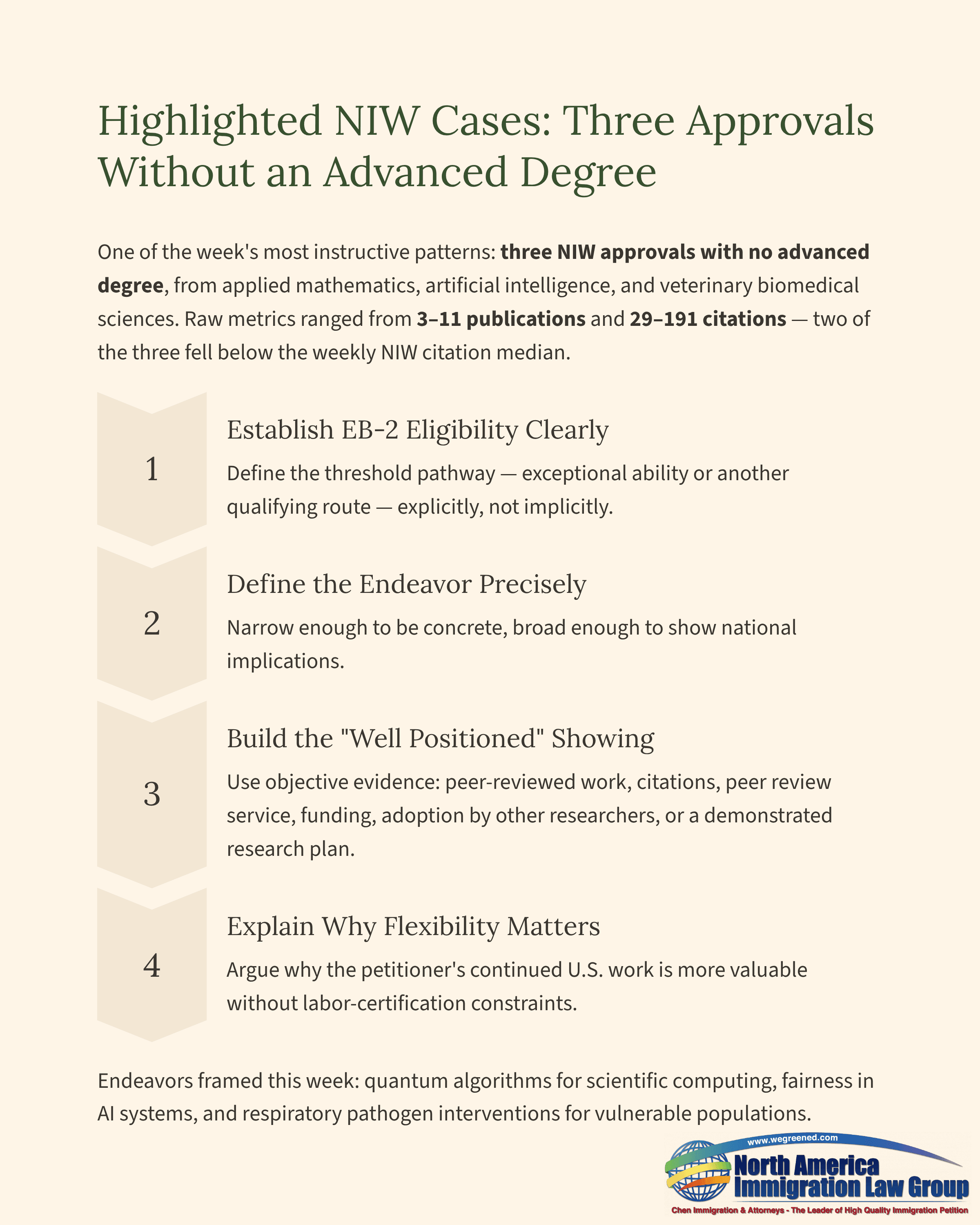
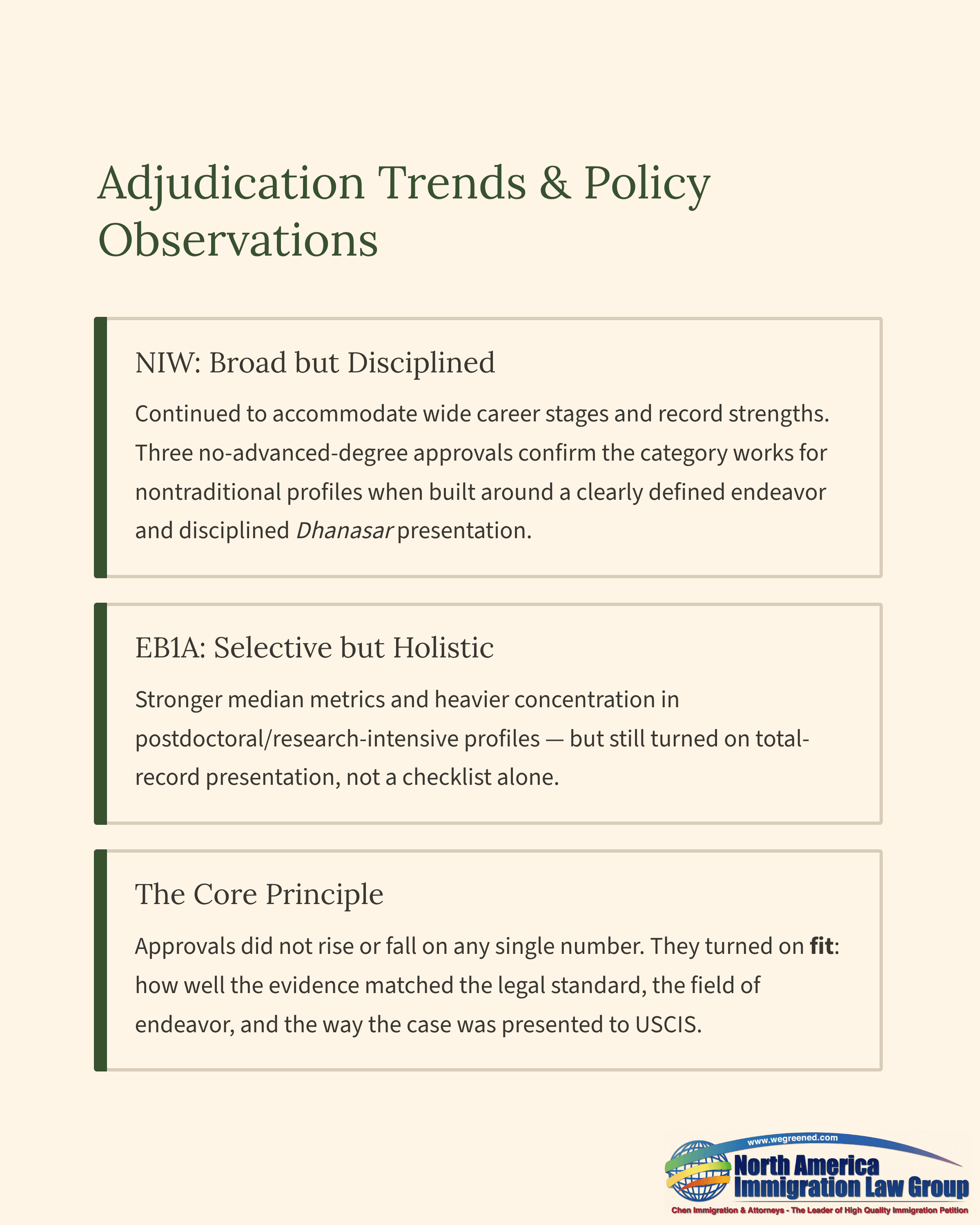
One of the most instructive patterns in this week’s data was the presence of three NIW approvals flagged as no-advanced-degree filings. The three profiles came from applied mathematics, artificial intelligence, and veterinary biomedical sciences. Their records were not identical, but together they show that a nontraditional NIW can still succeed when the petition is organized around the right theory of the case rather than around degree level alone. In raw metrics, these three approvals ranged from 3 to 11 publications and from 29 to 191 citations. That puts two of the three below the NIW median on citations this week, which is precisely why the underlying strategy matters.The common strategic lesson from the attached petition letters is not that USCIS ignores threshold eligibility, but that nontraditional NIW filings need a particularly disciplined structure. In practice, the strongest versions of these cases do four things well. First, they establish the underlying EB-2 eligibility pathway clearly, whether through exceptional ability or another qualifying route, instead of leaving the threshold theory implicit. Second, they define the proposed endeavor narrowly enough to be concrete but broadly enough to show national implications. Third, they build the “well positioned” showing through objective evidence already in the record such as peer-reviewed work, citations, peer review service, memberships, adoption by other researchers, funding support, or a demonstrated research plan. Fourth, they explain why flexibility matters: why the person’s continued U.S. work would be more valuable if it were not constrained by the labor-certification framework.
That approach is visible across the attached materials. In one filing, the endeavor was framed around quantum algorithms for large-scale scientific computing and operations research; in another, around socially representative datasets and fairness in artificial intelligence systems; and in another, around targeted interventions for respiratory pathogens affecting vulnerable populations. Despite very different fields, the petitions share the same practical drafting logic: precise endeavor definition, objective proof of past traction, and an on-balance argument that links the petitioner’s flexibility to broader U.S. benefit.