

WeGreened Approval Statistics: Week of March 30, 2026
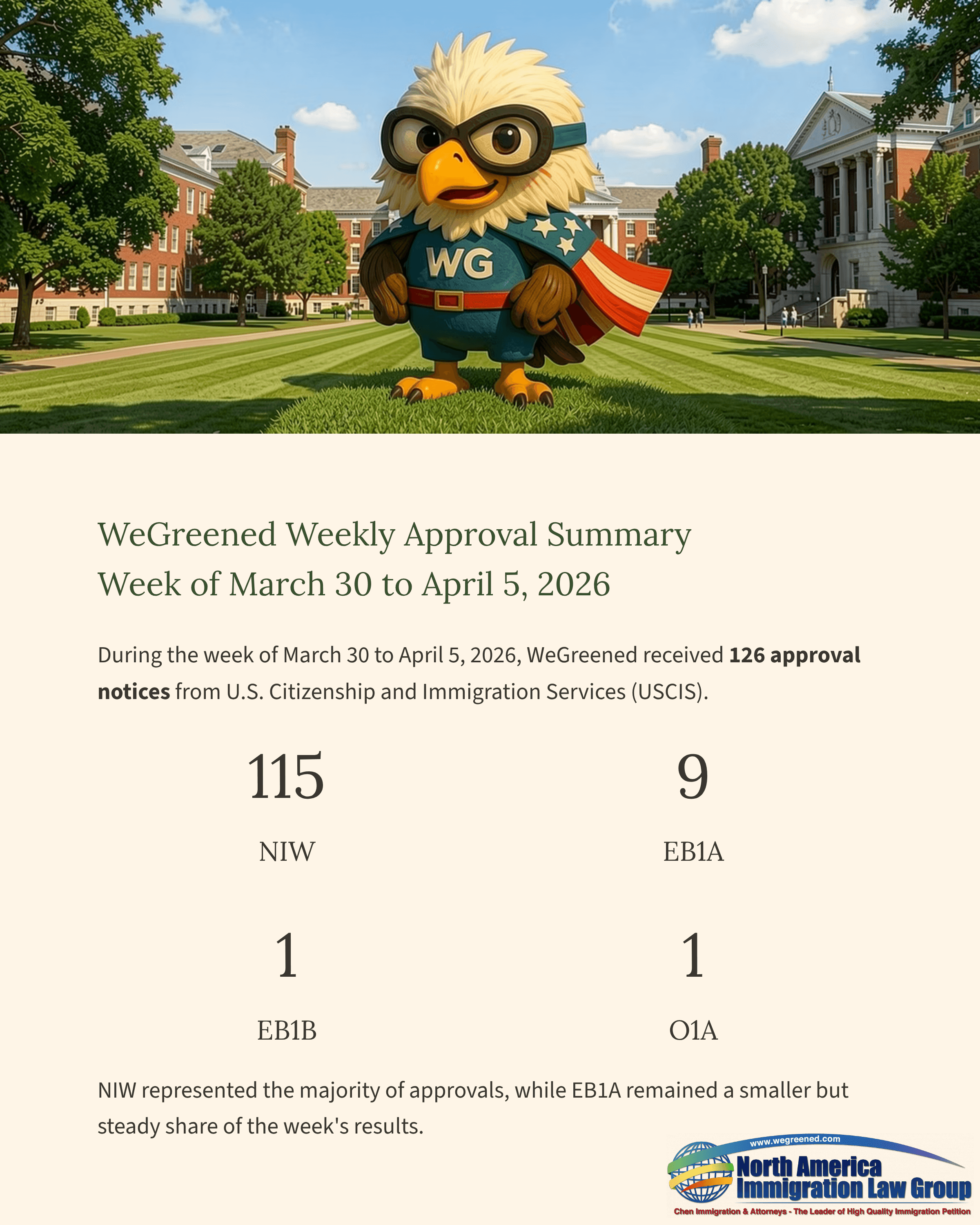
During the week of March 30 to April 5, 2026, WeGreened received 126 approval notices from U.S. Citizenship and Immigration Services (USCIS). Of the 126 approvals, 115 were for NIW (National Interest Waiver), 9 were for EB1A (Alien of Extraordinary Ability), 1 was for EB1B (Outstanding Professors or Researchers), and 1 was for O1A (Individuals with Extraordinary Ability or Achievement).
NIW again represented the majority of approvals, while EB1A remained a smaller but steady share of the week’s results.
EB1A and NIW Credential Analysis
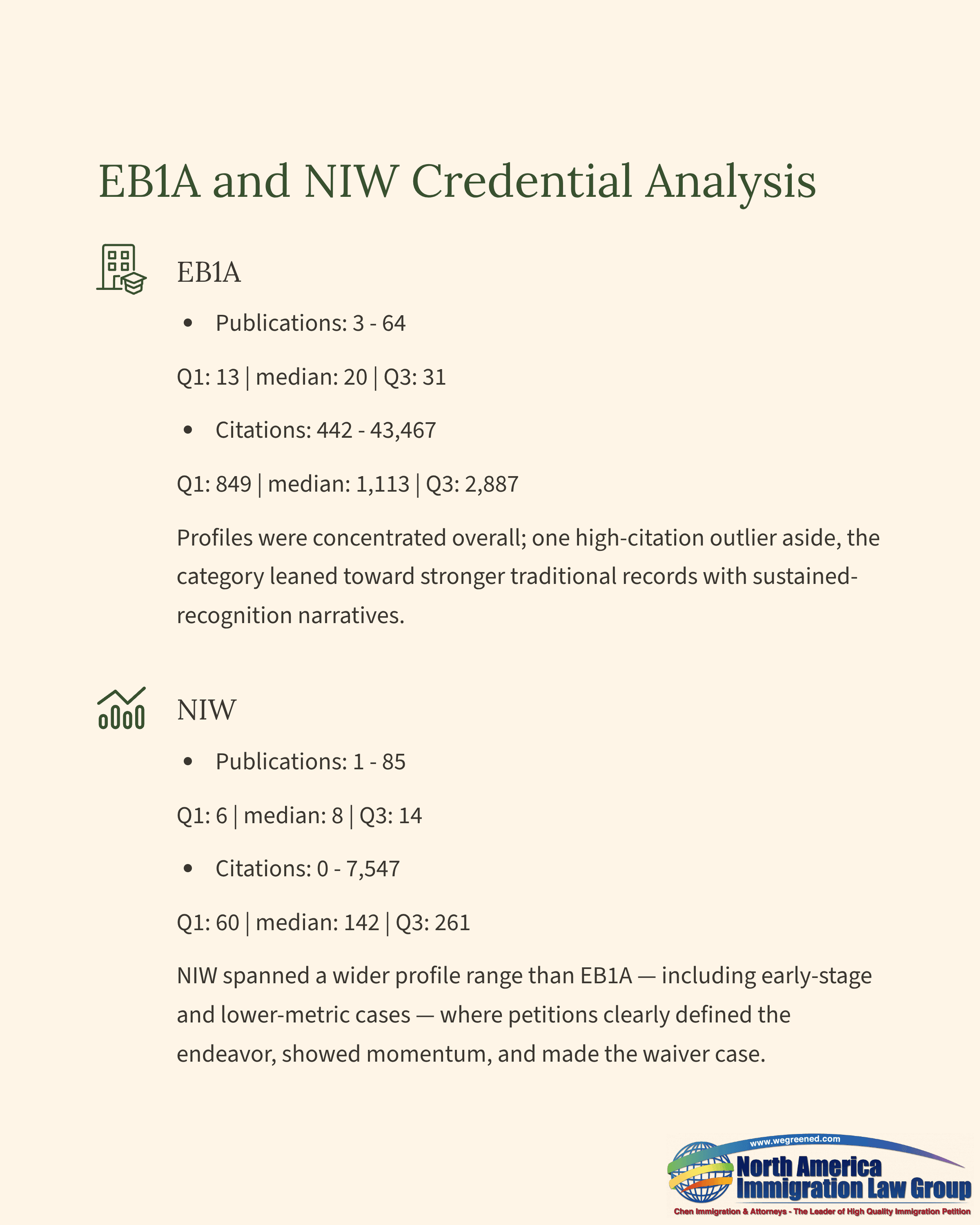
EB1A petitioners this week showed a relatively concentrated profile, although one extremely high-citation case widened the upper end of the range. Publications ranged from 3 to 64 (Q1: 13, median: 20, Q3: 31), and citations ranged from 442 to 43,467 (Q1: 849, median: 1,113, Q3: 2,887). Even with that outlier, the category still leaned toward stronger traditional records, especially where the evidence could support a broader final-merits narrative of sustained recognition.NIW petitioners again reflected a much broader spectrum of credential profiles. Publications ranged from 1 to 85 (Q1: 6, median: 8, Q3: 14), and citations ranged from 0 to 7,547 (Q1: 60, median: 142, Q3: 261). Compared with EB1A, NIW again showed a wider spread across both publications and citations, reinforcing that approvals can include earlier-stage, mixed-path, and lower-metric profiles when the petition clearly defines a nationally important endeavor, shows credible forward momentum, and explains why waiver flexibility benefits the United States.
Insights on Petitioner Backgrounds and Fields
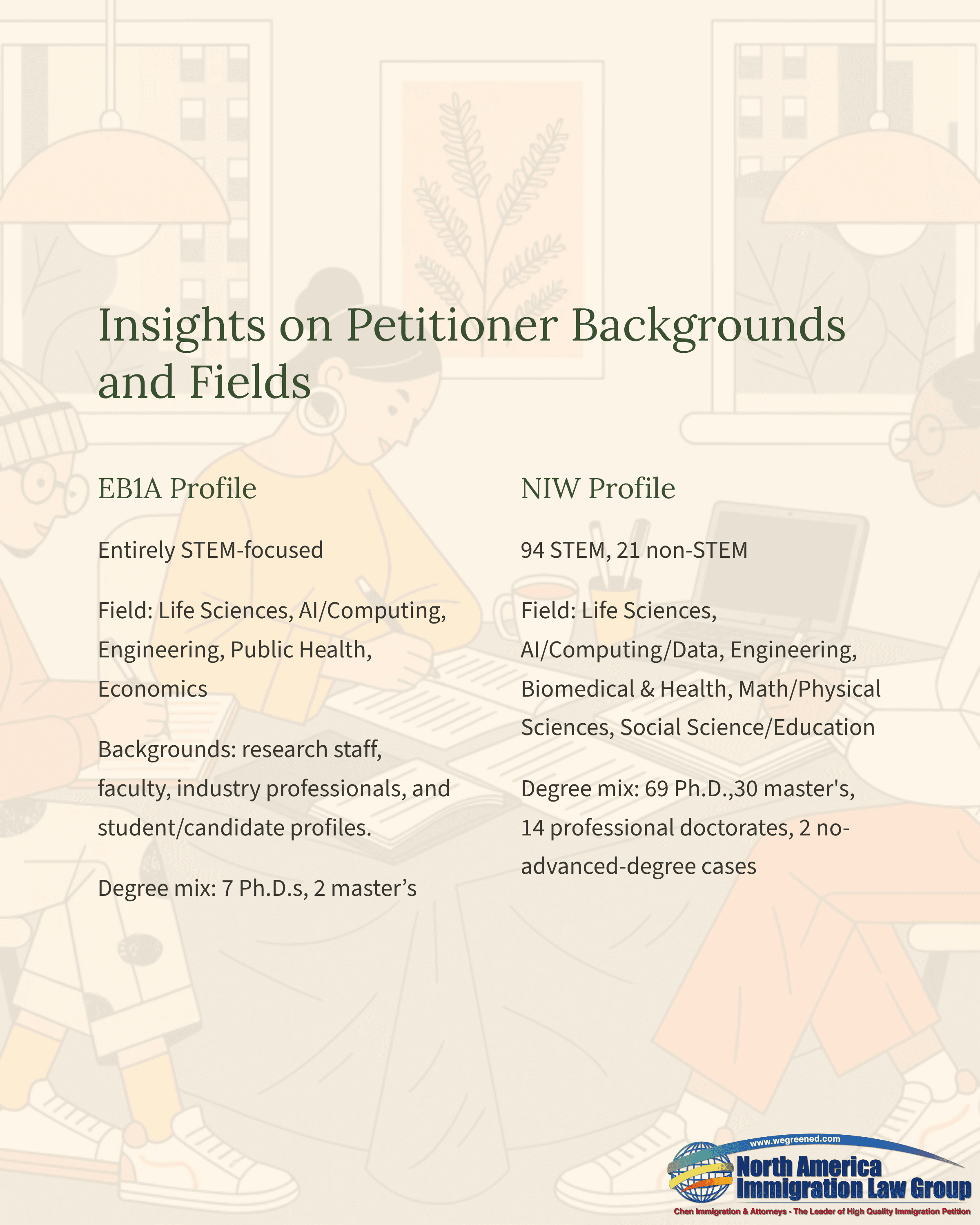
EB1A approvals this week were distributed across life sciences, AI/computing, engineering, public-health-related work, and one economics case. Employment backgrounds were mixed, including research staff, faculty, industry professionals, and one student/candidate profile. EB1A also remained entirely STEM-designated, with a Ph.D.-heavy degree mix of 7 Ph.D. holders and 2 master’s-level petitioners.NIW approvals were broader across both field and career stage. Life sciences, AI/computing/data-facing work, and engineering made up the largest field groupings, with additional representation in biomedical and health-related work, math/physical sciences, and social science/education. NIW remained heavily STEM-weighted, with 94 STEM and 21 non-STEM approvals, and showed a wider degree mix of 69 Ph.D. holders, 30 master’s-level petitioners, 14 professional doctorates, and 2 no-advanced-degree cases.
Highlighted NIW Case: Approval at the Zero-Citation Stage for a Cybersecurity Researcher
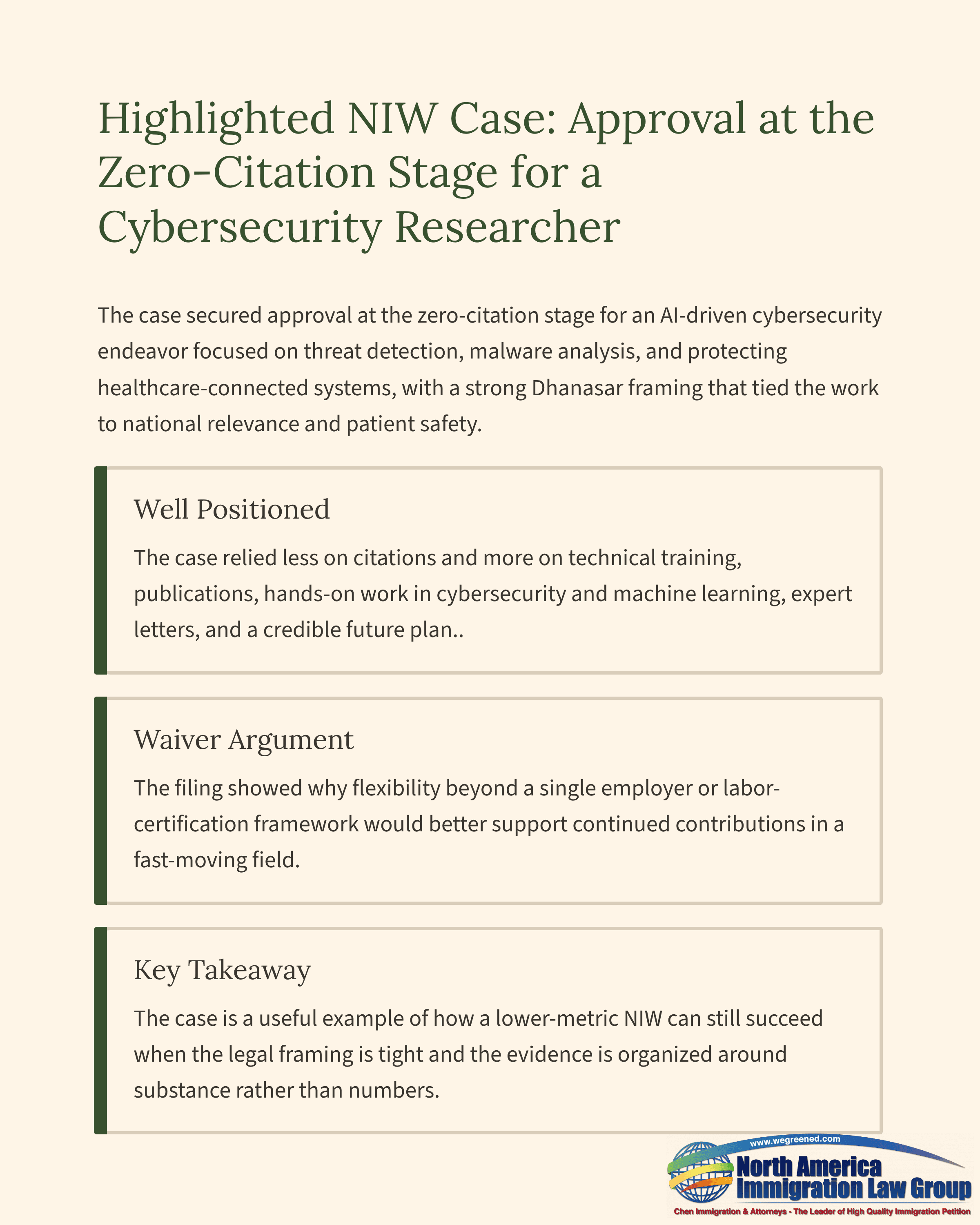
One of this week’s more revealing NIW approvals involved a cybersecurity case with only 3 publications and 0 citations at filing. The proposed endeavor focused on AI-driven threat detection, malware analysis, and the protection of healthcare-connected systems, especially where cybersecurity failures can affect critical medical infrastructure. Despite the modest metrics, the case was approved, showing again that NIW viability does not depend on citation volume alone.What strengthened the filing was a focused Dhanasar presentation. The petition defined the endeavor with enough specificity to show clear national relevance, tying the work to healthcare cybersecurity risks, patient safety, and broader U.S. digital-security priorities. For the “well positioned” prong, the case relied less on citation-based impact and more on technical training, peer-reviewed publications, concrete work in cybersecurity and machine learning, expert support letters, and a credible future plan. On balance, the filing also explained why flexibility beyond a single employer or labor-certification framework would better support continued contributions in a fast-moving field. The case is a useful example of how a lower-metric NIW can still succeed when the legal framing is tight and the evidence is organized around substance rather than numbers.
Adjudication Trends and Policy Observations
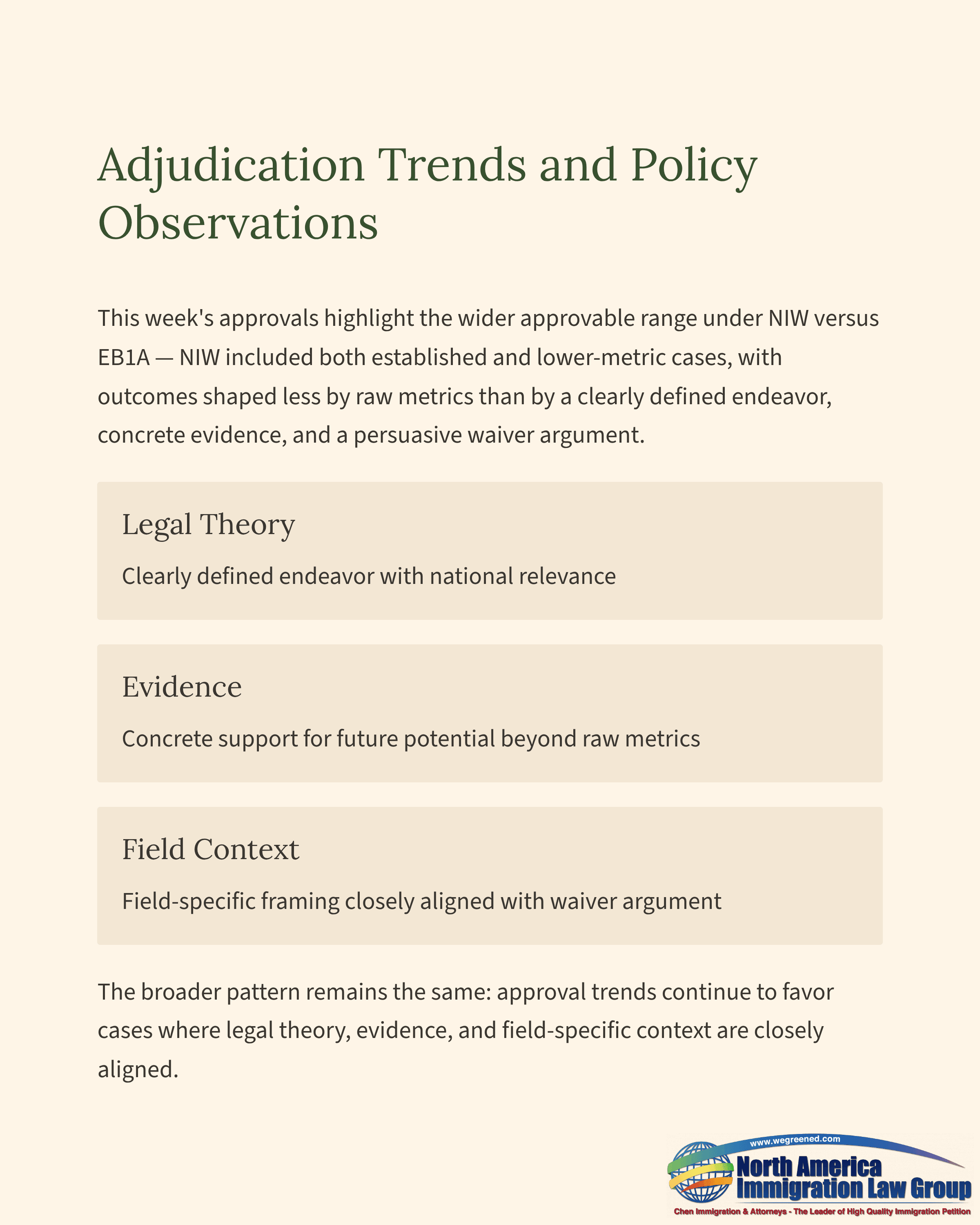
This week’s approvals again highlight the wider range of approvable profiles under NIW compared with EB1A. EB1A remained more concentrated in stronger conventional records, while NIW continued to include both established and lower-metric cases.The highlighted approval is especially useful in that context. It suggests that this week’s NIW outcomes were shaped less by raw publication or citation counts than by whether the petition clearly defined the endeavor, supported future potential with concrete evidence, and made a persuasive waiver argument. The broader pattern remains the same: approval trends continue to favor cases where legal theory, evidence, and field-specific context are closely aligned.