

WeGreened Approval Statistics: Week of January 26, 2026
During the week of January 26 to February 1, 2026, WeGreened received 123 approval notices from U.S. Citizenship and Immigration Services (USCIS). Of the 123 approvals, 84 were for NIW (National Interest Waiver), 32 were for EB1A (Alien of Extraordinary Ability), 6 were for EB1B (Outstanding Professors or Researchers), and 1 was for O1A (Individuals with Extraordinary Ability or Achievement).
NIW again represented the majority of approvals, while EB1A remained strong among petitioners whose records could be presented as sustained, field-recognized excellence under a totality-of-the-evidence review.
EB1A and NIW Credential Analysis
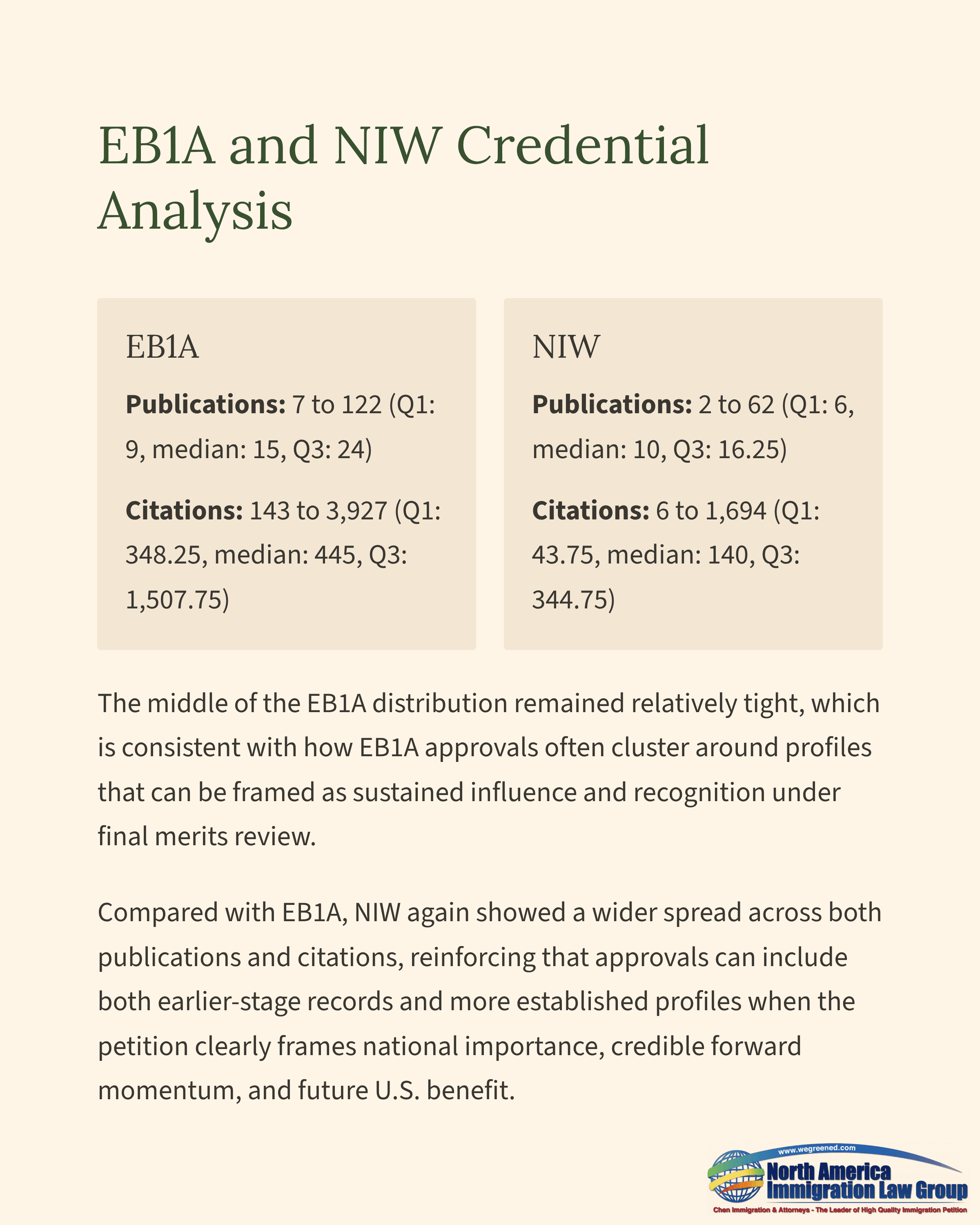
EB1A petitioners this week showed concentrated impact metrics. Publications ranged from 7 to 122 (Q1: 9, median: 15, Q3: 24), and citations ranged from 143 to 3,927 (Q1: 348.25, median: 445, Q3: 1,507.75). The middle of the EB1A distribution remained relatively tight, which is consistent with how EB1A approvals often cluster around profiles that can be framed as sustained influence and recognition under final merits review.NIW petitioners reflected a broader spectrum of credential profiles. Publications ranged from 2 to 62 (Q1: 6, median: 10, Q3: 16.25), and citations ranged from 6 to 1,694 (Q1: 43.75, median: 140, Q3: 344.75). Compared with EB1A, NIW again showed a wider spread across both publications and citations, reinforcing that approvals can include both earlier-stage records and more established profiles when the petition clearly frames national importance, credible forward momentum, and future U.S. benefit.
Insights on Petitioner Backgrounds and Fields
EB1A approvals this week were anchored primarily in biomedical and health-related fields and computer or data-facing specialties, with additional approvals across physical sciences and engineering. Employment backgrounds also reflected a meaningful mix, including industry-facing leaders, faculty and research staff, and trainees. The common thread across EB1A approvals was not job setting, but whether the record could be organized into clear, externally validated evidence of sustained, field-recognized excellence.NIW approvals spanned biomedical and health sciences, AI and data-driven work, and multiple engineering tracks. Many NIW petitioners were on research-intensive pathways such as PhD student, postdoctoral, or research roles, with a substantial subset in industry. Across these profiles, the strongest NIW outcomes tended to be those where the endeavor was defined with precision, the record showed concrete progress, and the petition explained how a waiver would expand U.S. benefit through flexibility and scale.
Highlighted NIW Case: Approved Without RFE for a Computer Science Research Assistant With 7 Citations
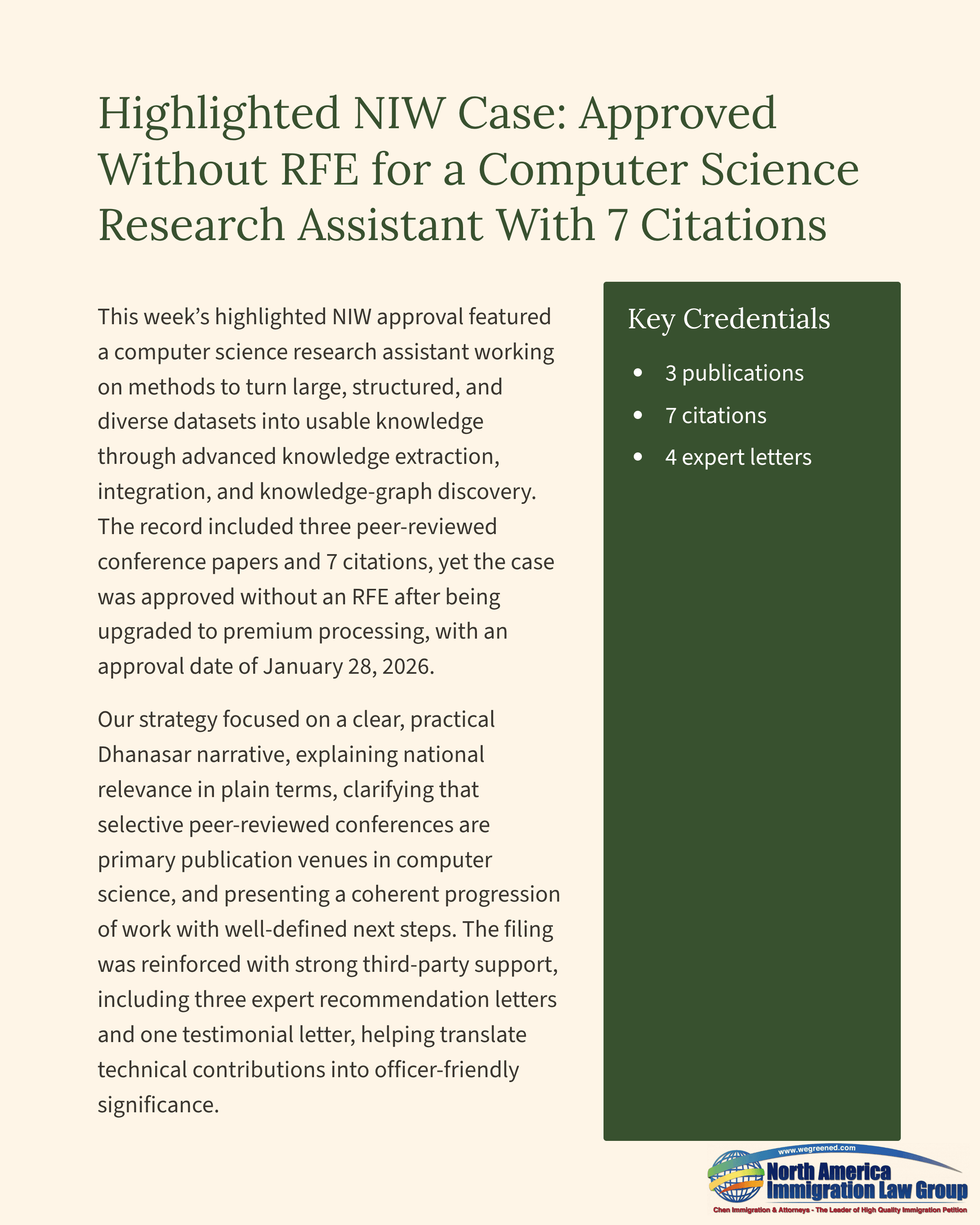
One notable NIW approval this week involved a computer science research assistant whose work targets a fundamental challenge across modern research and industry: turning large volumes of structured, heterogeneous data into usable knowledge. The petitioner’s proposed direction focused on developing advanced algorithms and computational models for knowledge extraction and integration, supporting graph-based knowledge discovery with downstream value in high-impact domains such as biomedical research and other data-intensive decision workflows.At the time of filing, the record reflected compact but credible momentum, including three peer-reviewed conference papers and 7 citations. The petition was approved without an RFE, with the case upgraded to premium processing and approved on January 28, 2026, in just over two months.
From a strategy perspective, we built a Dhanasar narrative that was both technically grounded and officer-friendly. We framed national importance in practical terms by tying the work to the accelerating growth of complex data systems and the need for more reliable extraction and integration methods that improve how knowledge graphs can be used in real applications. We also clarified field context so the record would be evaluated fairly, explaining that selective peer-reviewed conferences often function as primary scholarly venues in computer science and can be the right indicator of research quality.
To support the “well-positioned” prong, we emphasized a coherent progression of work showing the petitioner’s ability to execute in this technical area and extend the research through clearly defined next-step projects, including graph-based approaches that strengthen biomedical knowledge discovery workflows. We strengthened third-party validation with three expert recommendation letters plus one testimonial letter from a senior leader at a nationally funded research institute, reinforcing the technical significance, real-world relevance, and credibility of the petitioner’s contributions.
This case highlights a recurring NIW lesson: strong outcomes are driven less by any single metric and more by how clearly the endeavor is defined, how well the evidence is organized, and how effectively the petition translates technical value into a persuasive national-benefit narrative.
Adjudication Trends and Policy Observations
This week’s statistics support a few observations that help differentiate the trend section from prior weeks. On the EB1A side, approvals again turned on sustained acclaim and final merits, where meeting three criteria is only the starting point and the total record must add up to sustained, field-recognized excellence. Procedurally, EB1A approvals this week continued to lean more toward premium processing used as an upgrade after filing rather than primarily as an upfront request, which aligns with a more conservative approach when the record is still being finalized.On the NIW side, this batch offers a clearer reminder that low citation totals do not necessarily limit approvability when the petition is framed correctly. The highlighted case, approved without an RFE with only 7 citations, reflects a pattern we often see in strong NIW filings: the petition defines a focused, nationally relevant endeavor, explains why the work matters in practical terms, and then supports the “well positioned” showing with coherent progress and credible third-party validation. This week’s approvals also continued to show premium processing frequently used as an upgrade after filing, alongside a meaningful share of approvals without premium processing. Across the dataset, the consistent throughline remained unchanged: NIW outcomes tracked best to petitions that precisely defined a nationally important endeavor, organized concrete evidence to demonstrate forward momentum, and clearly explained how a waiver would expand U.S. benefit through flexibility, collaboration, and scale.