
WeGreened Approval Statistics: Week of March 2, 2026
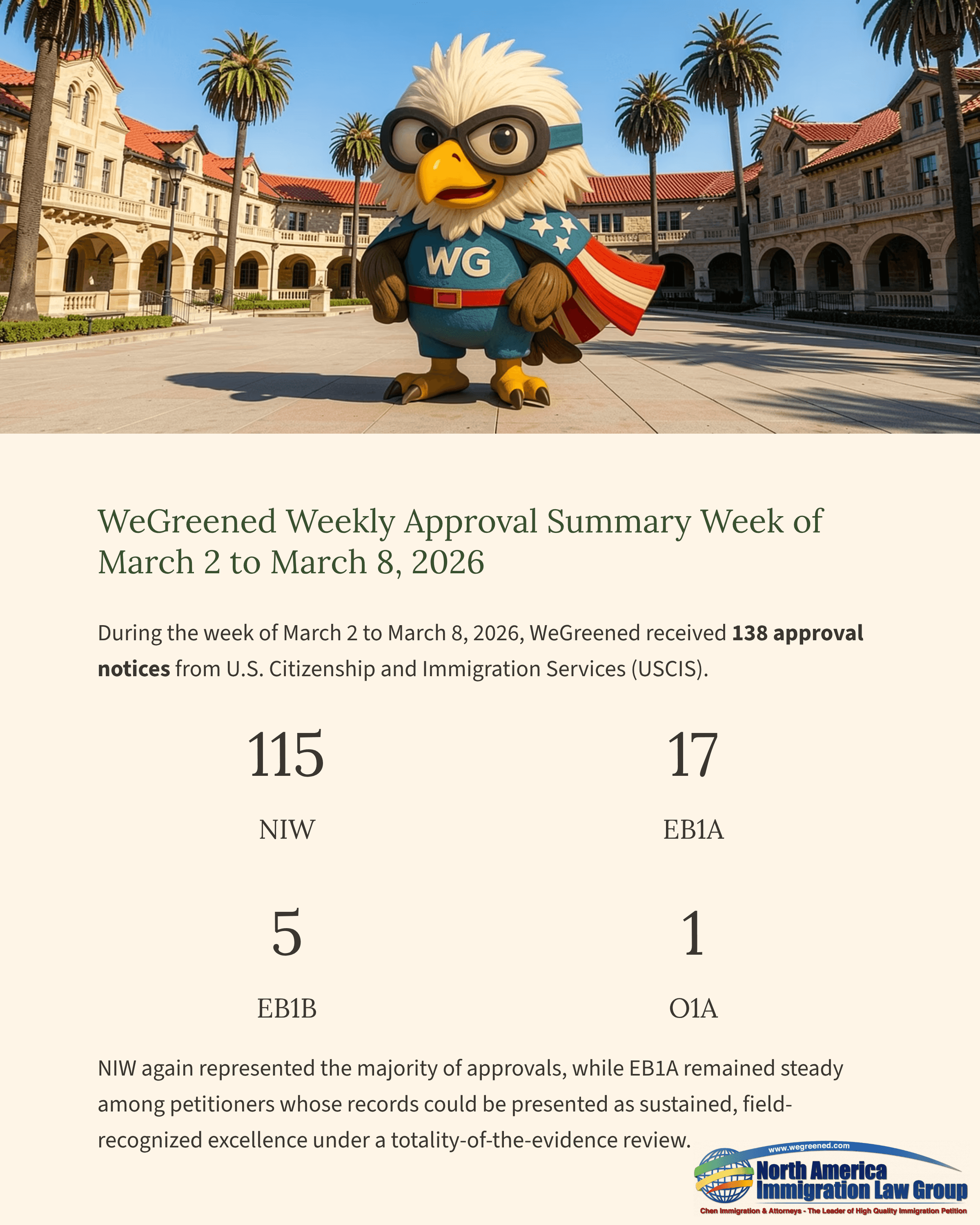
During the week of March 2 to March 8, 2026, WeGreened received 138 approval notices from U.S. Citizenship and Immigration Services (USCIS). Of the 138 approvals, 115 were for NIW (National Interest Waiver), 17 were for EB1A (Alien of Extraordinary Ability), 5 were for EB1B (Outstanding Professors or Researchers), and 1 was for O1A (Individuals with Extraordinary Ability or Achievement).
NIW again represented the majority of approvals, while EB1A remained steady among petitioners whose records could be presented as sustained, field-recognized excellence under a totality-of-the-evidence review.
EB1A and NIW Credential Analysis
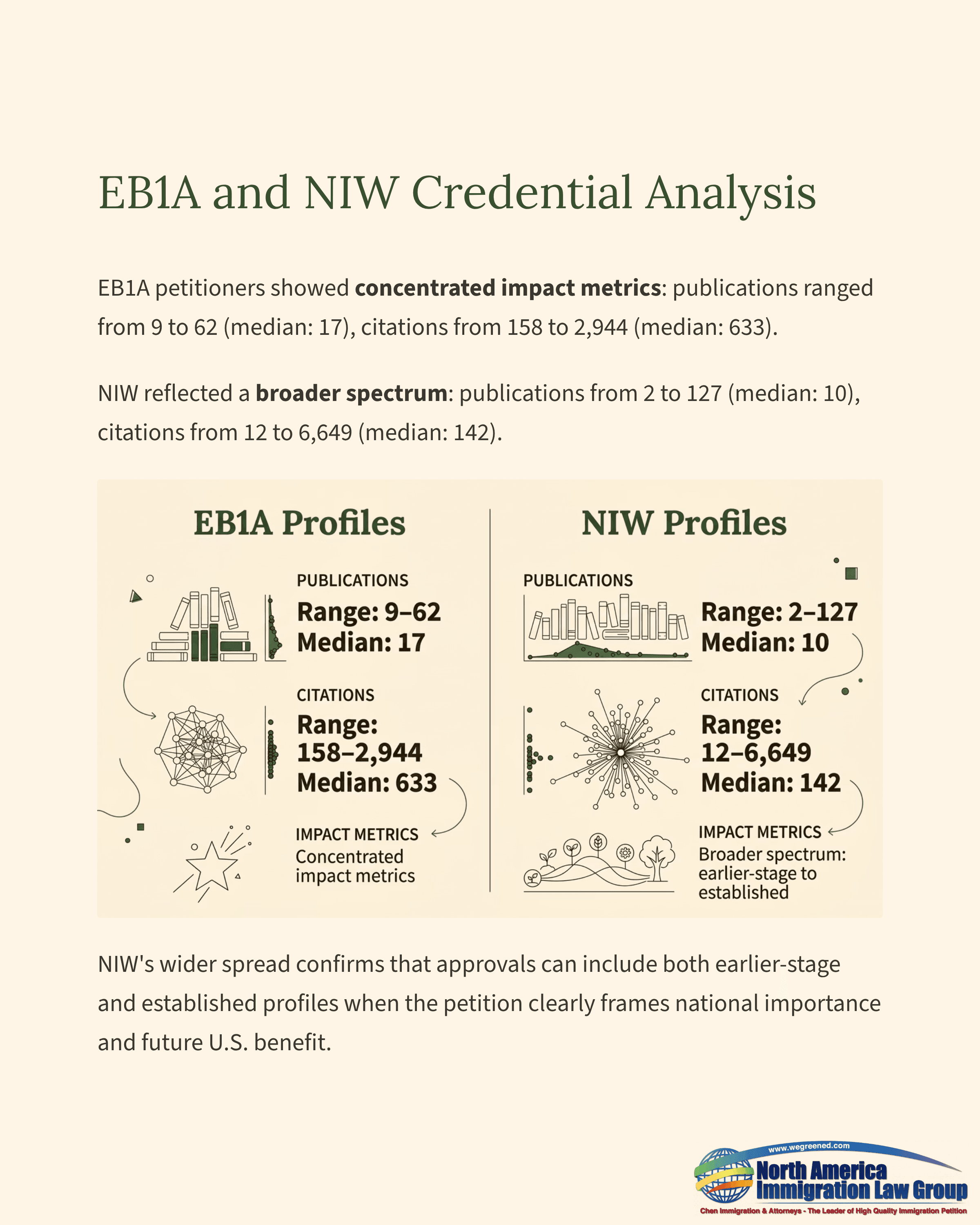
EB1A petitioners this week showed concentrated impact metrics. Publications ranged from 9 to 62 (Q1: 14, median: 17, Q3: 23), and citations ranged from 158 to 2,944 (Q1: 506, median: 633, Q3: 1,186). Even with variation at the high end, EB1A approvals continued to cluster around profiles that can be framed as sustained influence and recognition under final merits review.NIW petitioners reflected a broader spectrum of credential profiles. Publications ranged from 2 to 127 (Q1: 6, median: 10, Q3: 18), and citations ranged from 12 to 6,649 (Q1: 59, median: 142, Q3: 441.5). Compared with EB1A, NIW again showed a wider spread across both publications and citations, reinforcing that approvals can include both earlier-stage records and more established profiles when the petition clearly frames national importance, credible forward momentum, and future U.S. benefit.
Insights on Petitioner Backgrounds and Fields
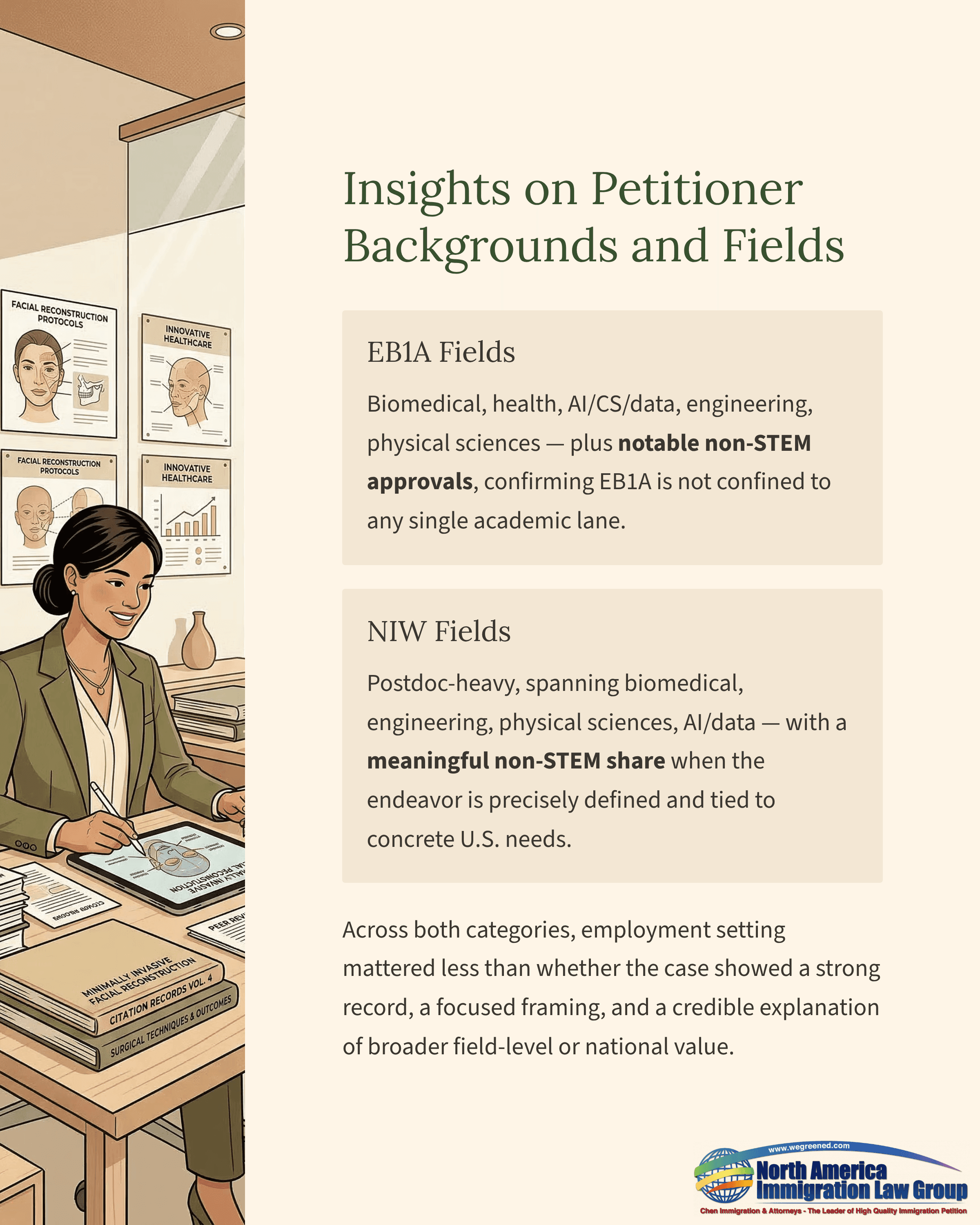
EB1A approvals this week continued to cluster in biomedical and health-related areas and AI/CS/data-facing specialties, with additional approvals across engineering and physical sciences. A notable week-specific detail, however, is the visible presence of non-STEM EB1A approvals in the dataset, reinforcing that EB1A is not confined to any one academic lane when the record can be organized into clear, externally verifiable evidence of sustained, field-recognized excellence. Employment backgrounds again reflected a practical mix, industry-facing leaders alongside postdoctoral and research staff profiles, showing that setting matters less than whether the achievements translate into credible, field-level recognition.NIW approvals were postdoc-heavy and spanned a broad mix across biomedical/health, engineering, physical sciences, and AI/data-driven work. This week also included a meaningful non-STEM NIW share, underscoring that the NIW framework remains adaptable when the petition defines the endeavor precisely and ties it to concrete U.S. needs. Across both research-track and industry-track profiles, the strongest outcomes aligned with filings that presented a focused endeavor, documented real progress, and clearly explained how a waiver supports broader U.S. benefit through flexibility and scale.
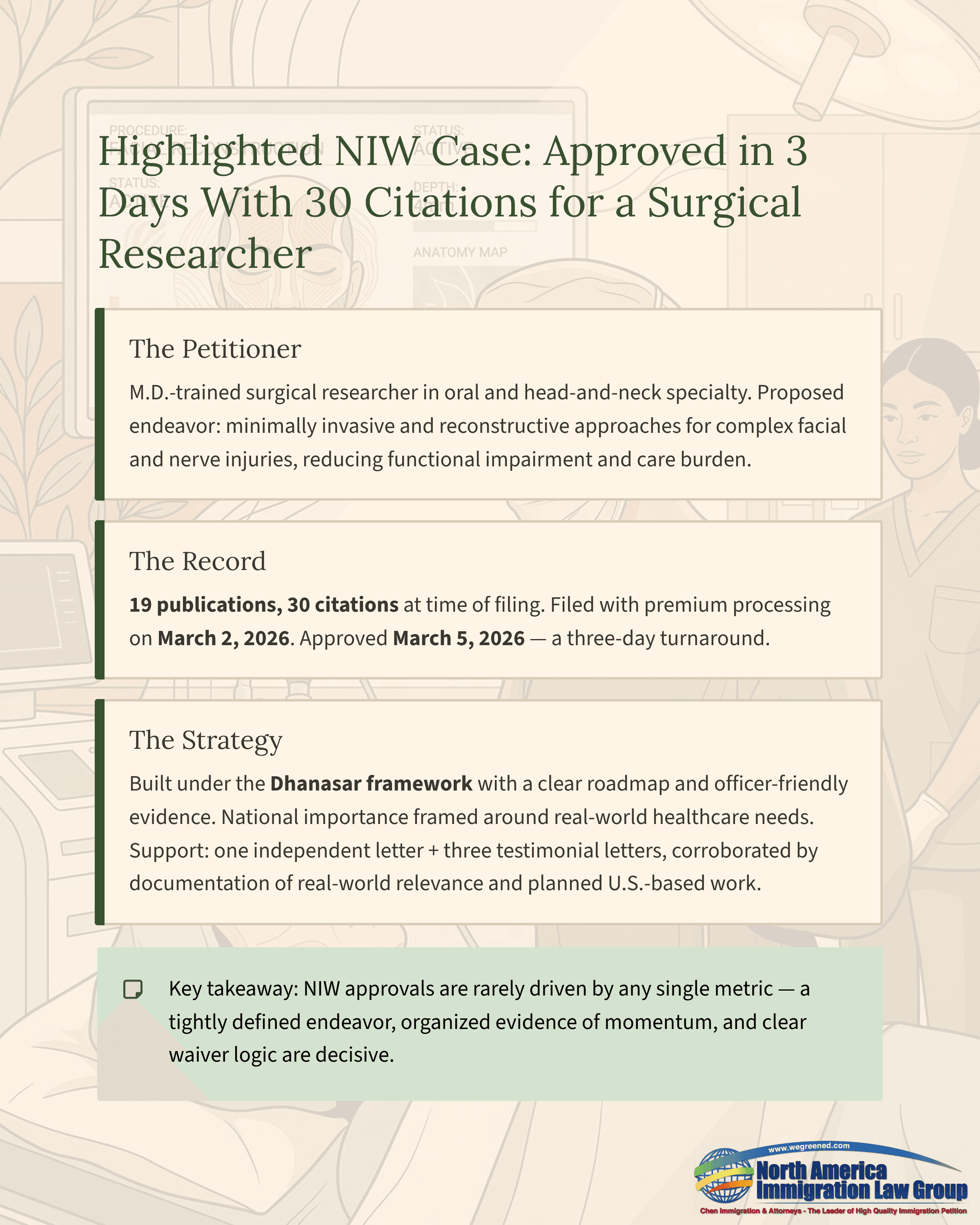
Highlighted NIW Case: Approved in 3 Days With 30 Citations for a Surgical Researcher
One notable NIW approval this week involved an M.D.-trained, clinically oriented surgical researcher in an oral and head-and-neck specialty area. The proposed endeavor focused on combining advanced clinical training with research to improve minimally invasive and reconstructive approaches for complex facial and nerve injuries, with an emphasis on reducing downstream functional impairment and overall care burden. At the time of filing, the record included 19 publications and 30 citations. The case was filed with premium processing on March 2, 2026 and approved on March 5, 2026, in only three days. The three-day turnaround is consistent with a petition that was organized for fast review, with a clear Dhanasar roadmap and evidence presented in an officer-friendly way.From a strategy perspective, we built the petition under the Dhanasar framework in a way that kept the officer’s review structured and evidence-driven, while remaining faithful to how impact is often demonstrated in clinically focused fields. We framed national importance around real-world healthcare needs tied to serious injury and disease management, and we presented the “well positioned” showing through the petitioner’s specialized training trajectory, relevant research output, and a credible plan for continued U.S.-based work in the same technical direction. For third-party support, the filing relied on one independent recommendation letter and three testimonial letters, paired with documentation that corroborated real-world relevance, the petitioner’s role, and the practical value of the planned work. The outcome is a strong reminder that NIW approvals are rarely driven by any single metric; the decisive factor is a tightly defined endeavor, organized evidence of momentum, and a clear explanation of why waiver flexibility strengthens the U.S. benefit.
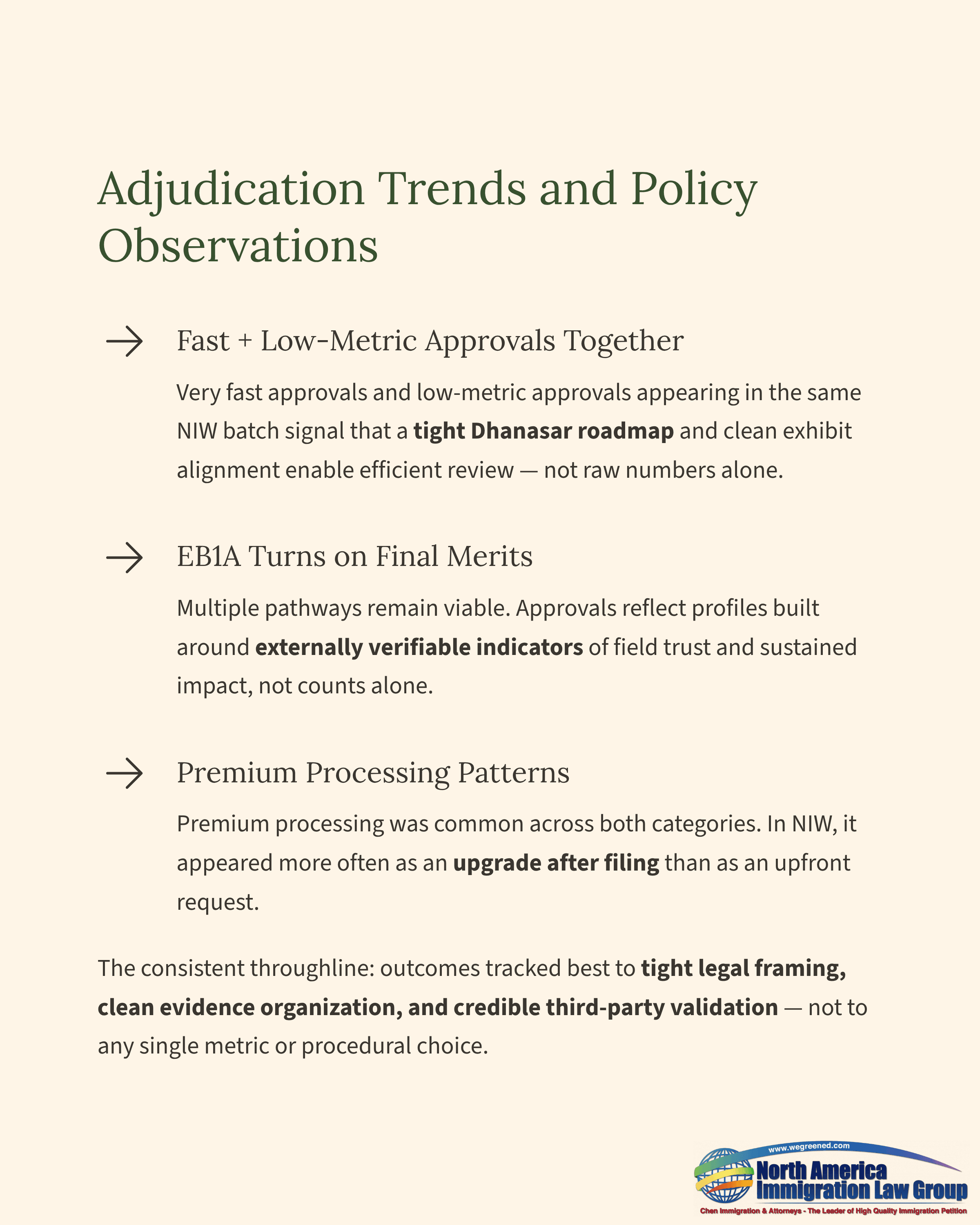
Adjudication Trends and Policy Observations
This week’s NIW dataset again shows a wide range of citation profiles, but a more distinctive signal comes from the combination of very fast approvals and low-metric approvals appearing in the same batch. That pattern is consistent with what we see when a petition is packaged for efficient review: a tight Dhanasar roadmap, exhibits that line up cleanly with each prong, and third-party support that helps an adjudicator evaluate significance on substance rather than on a single metric. At the same time, the dataset still includes high-citation profiles, reinforcing that NIW approvals are driven by how well the endeavor, evidence, and waiver logic are aligned, not by a single threshold.On EB1A, approvals again turned on final merits. While EB1A metrics were more concentrated than NIW, this week’s approvals also reflect that multiple pathways remain viable, including profiles where the case is built around externally verifiable indicators of field trust and sustained impact rather than counts alone. Procedurally, premium processing remained common across both categories, and in NIW it continued to appear more often as an upgrade after filing than as an upfront request. Even so, the consistent throughline remained the same: outcomes tracked best to tight legal framing, clean evidence organization, and credible third-party validation, not to any single metric or procedural choice.