

WeGreened Approval Statistics: Week of March 9, 2026
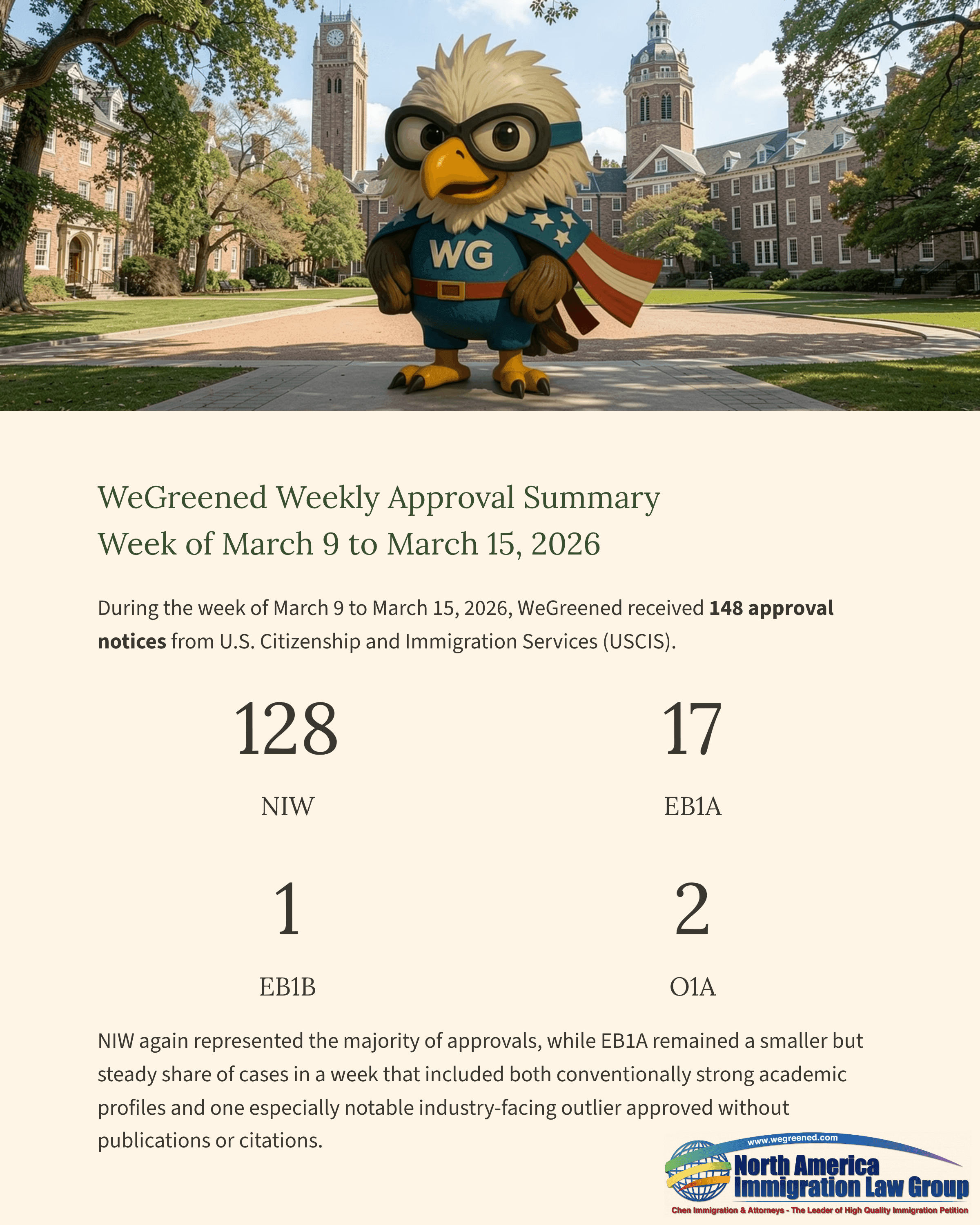
During the week of March 9 to March 15, 2026, WeGreened received 148 approval notices from U.S. Citizenship and Immigration Services (USCIS). Of the 148 approvals, 128 were for NIW (National Interest Waiver), 17 were for EB1A (Alien of Extraordinary Ability), 1 was for EB1B (Outstanding Professors or Researchers), and 2 were for O1A (Individuals with Extraordinary Ability or Achievement).
NIW again represented the majority of approvals, while EB1A remained a smaller but steady share of cases in a week that included both conventionally strong academic profiles and one especially notable industry-facing outlier approved without publications or citations.
EB1A and NIW Credential Analysis
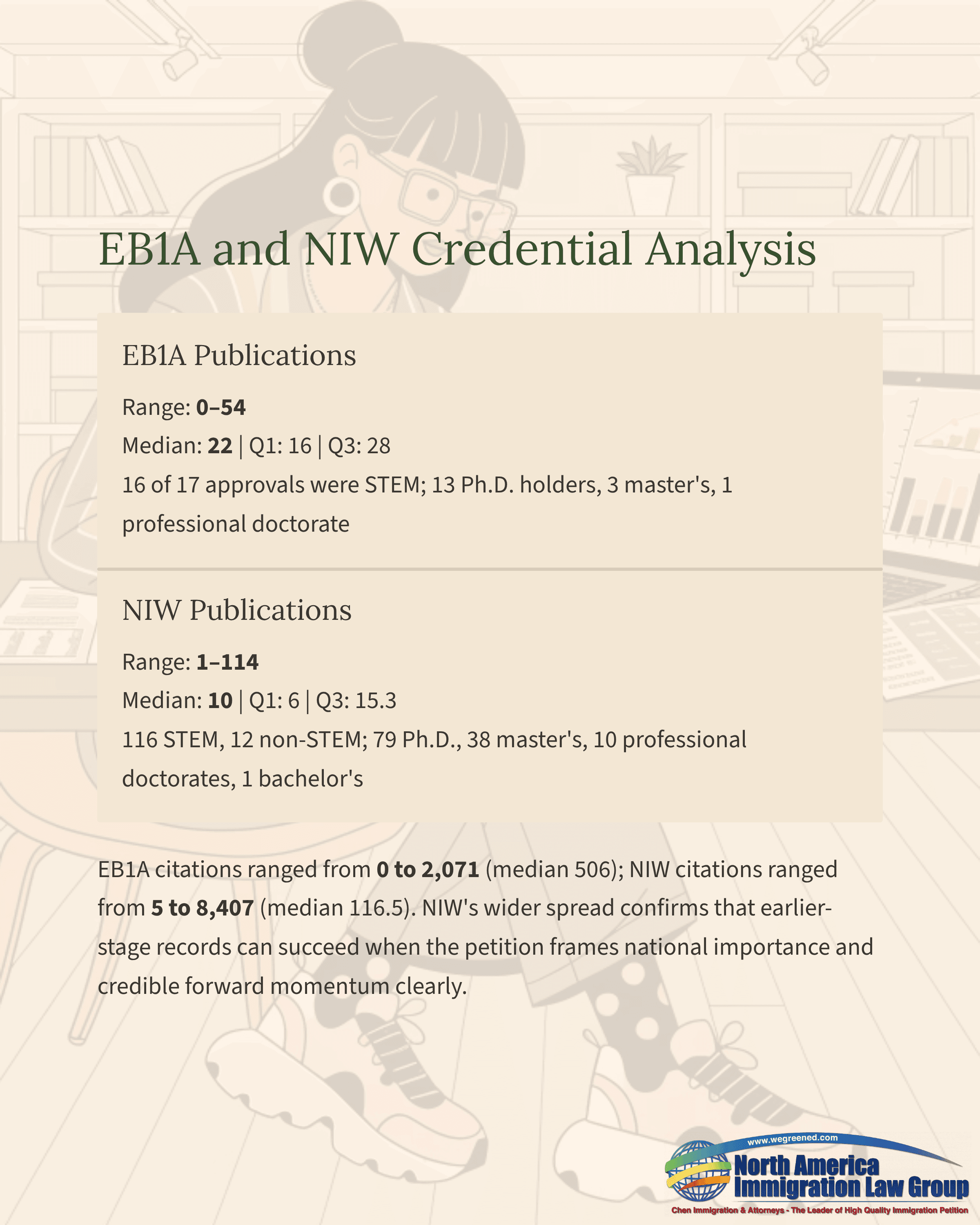
EB1A petitioners this week showed a wider spread at the low end than usual because the dataset included an approval with no publications and no citations. Publications ranged from 0 to 54 (Q1: 16, median: 22, Q3: 28), and citations ranged from 0 to 2,071 (Q1: 331, median: 506, Q3: 1,017). EB1A was still overwhelmingly STEM-oriented (16 of 17), and the degree mix remained Ph.D.-heavy, with 13 Ph.D. holders, 3 master’s-level petitioners, and 1 professional doctorate.NIW petitioners reflected a broader spectrum of credential profiles. Publications ranged from 1 to 114 (Q1: 6, median: 10, Q3: 15.3), and citations ranged from 5 to 8,407 (Q1: 57.5, median: 116.5, Q3: 302.8). NIW also remained heavily STEM-weighted (116 STEM and 12 non-STEM approvals) while showing a broader degree mix, including 79 Ph.D. holders, 38 master’s-level petitioners, 10 professional doctorates, and 1 bachelor’s-level case. Compared with EB1A, NIW again showed a wider spread across both publications and citations, reinforcing that approvals can include both earlier-stage records and more established profiles when the petition clearly frames national importance, credible forward momentum, and future U.S. benefit.
Insights on Petitioner Backgrounds and Fields
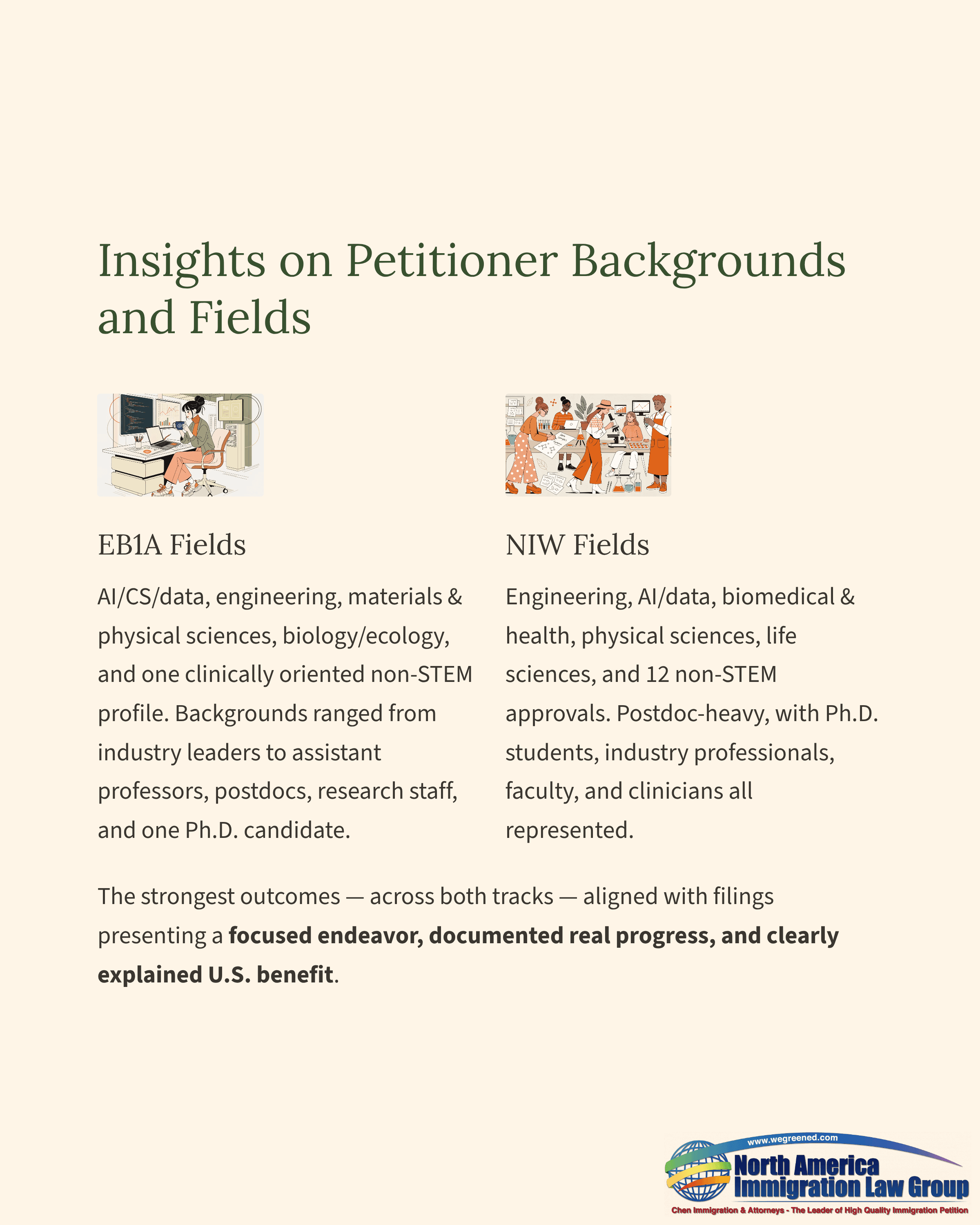
EB1A approvals this week clustered in AI/CS/data-facing work and engineering-, materials-, and physical-science-focused specialties, with additional approvals across biology/ecology and one clinically oriented non-STEM profile. Employment backgrounds again reflected a practical mix, with industry-facing leaders alongside assistant professors, postdoctoral researchers, research staff, and even one Ph.D. candidate. A notable week-specific detail is the presence of an industry-side EB1A approval in technology strategy with no publications or citations, reinforcing that EB1A is not confined to a conventional academic lane when the record can be organized into clear, externally verifiable evidence of original contributions, trusted roles, and field-level recognition.NIW approvals were again postdoc-heavy and also included a large share of Ph.D. students and candidates, industry professionals, research staff, faculty, and a smaller clinician group. Fields spanned engineering, AI/data-driven work, biomedical and health-related areas, physical sciences, and life sciences. This week also included 12 non-STEM NIW approvals, underscoring that the NIW framework remains adaptable when the petition defines the endeavor precisely and ties it to concrete U.S. needs. Across both research-track and industry-track profiles, the strongest outcomes aligned with filings that presented a focused endeavor, documented real progress, and clearly explained how a waiver supports broader U.S. benefit through flexibility and scale.
Highlighted EB1A Case: Approved Without Publications or Citations for a Technology Strategy Professional
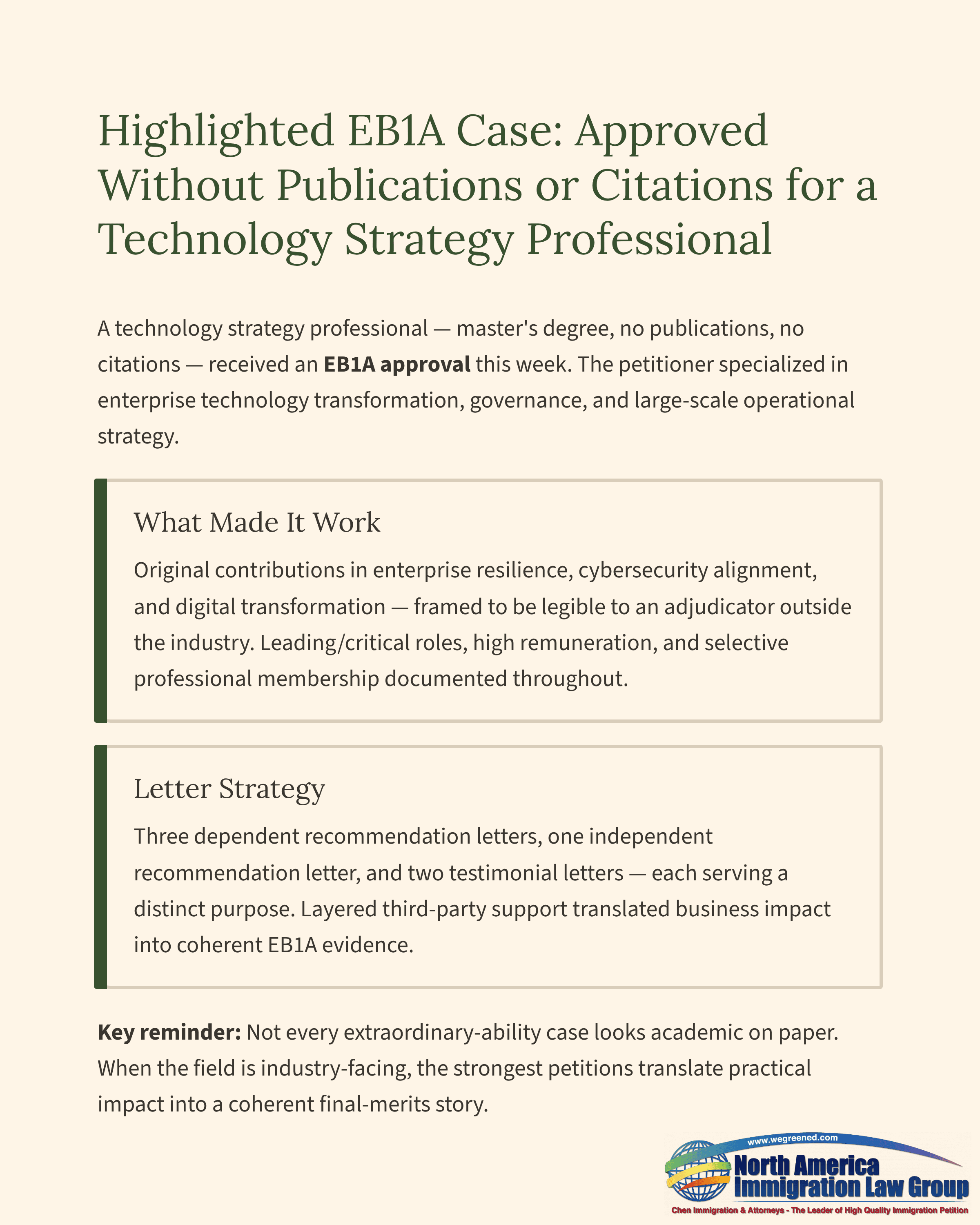
One of the most instructive approvals this week was an EB1A case for a technology strategy professional whose record did not follow the usual academic pattern. The petitioner held a master’s degree and worked in enterprise technology transformation, governance, and large-scale operational strategy. At the time of filing, the case included no publications and no citations. Even so, the petition was approved, making it a useful example of how EB1A can succeed when the evidence is organized around real-world influence rather than scholarly metrics.What made the case work was not volume-based academic evidence, but a strong showing that the petitioner’s work carried unusual significance inside major organizations and in high-stakes operational settings. The filing focused on original contributions tied to enterprise resilience, governance, cybersecurity alignment, and digital transformation, and presented those contributions in a way that made their significance legible to an adjudicator outside the industry. We also documented leading and critical roles, high remuneration, and selective professional membership to show that the petitioner was not simply performing well, but operating at a level that reflected sustained recognition in the field.
The supporting letter strategy was also important. The case included three dependent recommendation letters, one independent recommendation letter, and two testimonial letters, each serving a distinct purpose in explaining the petitioner’s influence, credibility, and real-world value. In a case without publications or citations, that kind of layered third-party support becomes especially important because it helps translate business and operational impact into evidence that fits the EB1A framework. This approval is a strong reminder that not every extraordinary-ability case looks academic on paper. When the field is industry-facing, the strongest petitions are often the ones that translate practical impact into a coherent final-merits story.
Adjudication Trends and Policy Observations
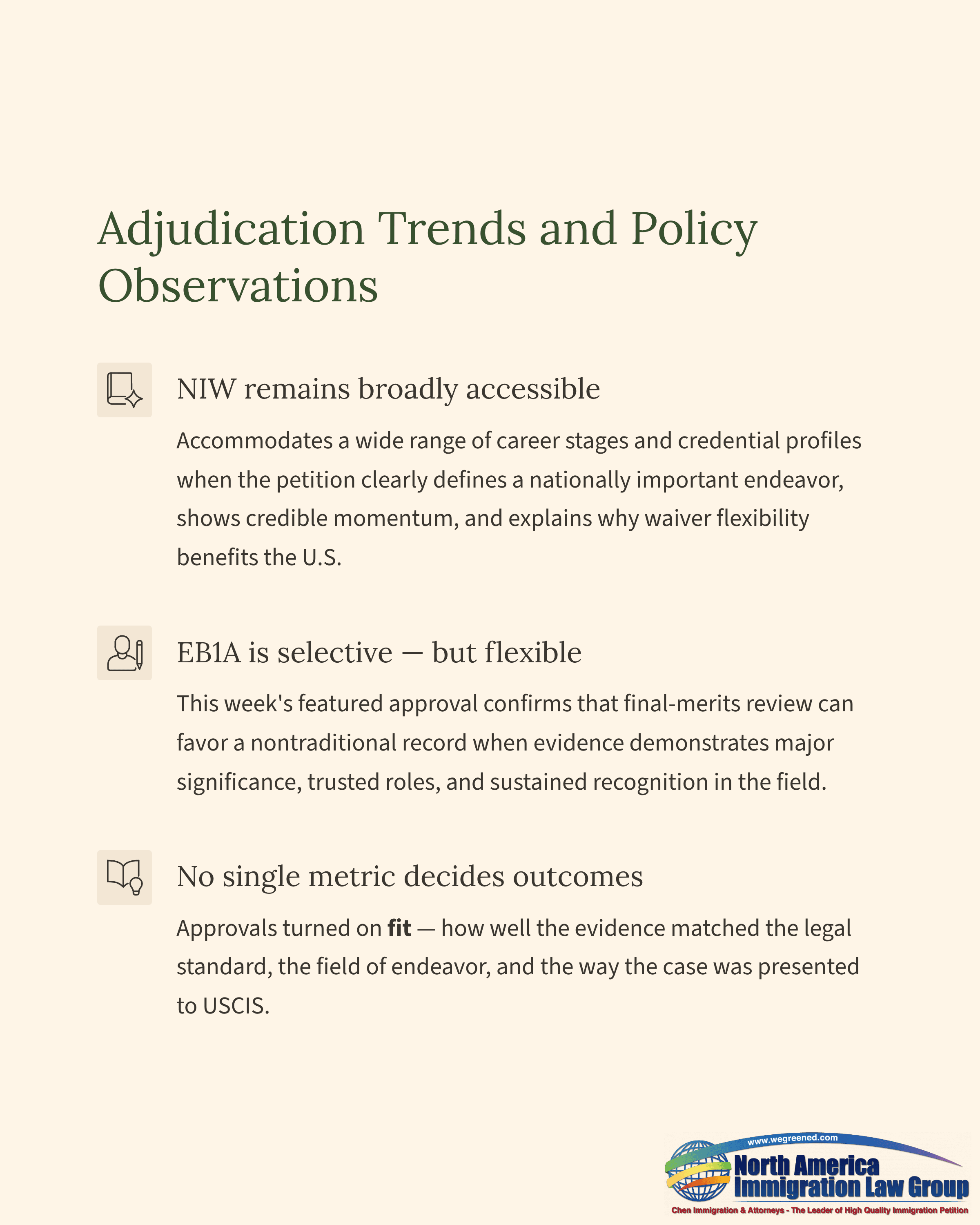
This week’s approvals reinforce a useful distinction between NIW and EB1A. NIW continued to accommodate a broad range of career stages and credential profiles when the petition clearly defined a nationally important endeavor, showed credible momentum, and explained why waiver flexibility would benefit the United States. EB1A remained the more selective category overall, but this week’s featured approval also shows that final merits review can still favor a nontraditional record when the evidence demonstrates major significance, trusted roles, and sustained recognition in the field.The practical takeaway is that approvals did not turn on any single metric. They turned on fit: how well the evidence matched the legal standard, the field of endeavor, and the way the case was presented to USCIS.