

WeGreened Weekly Approval Summary: Week of August 31 to September 6, 2026
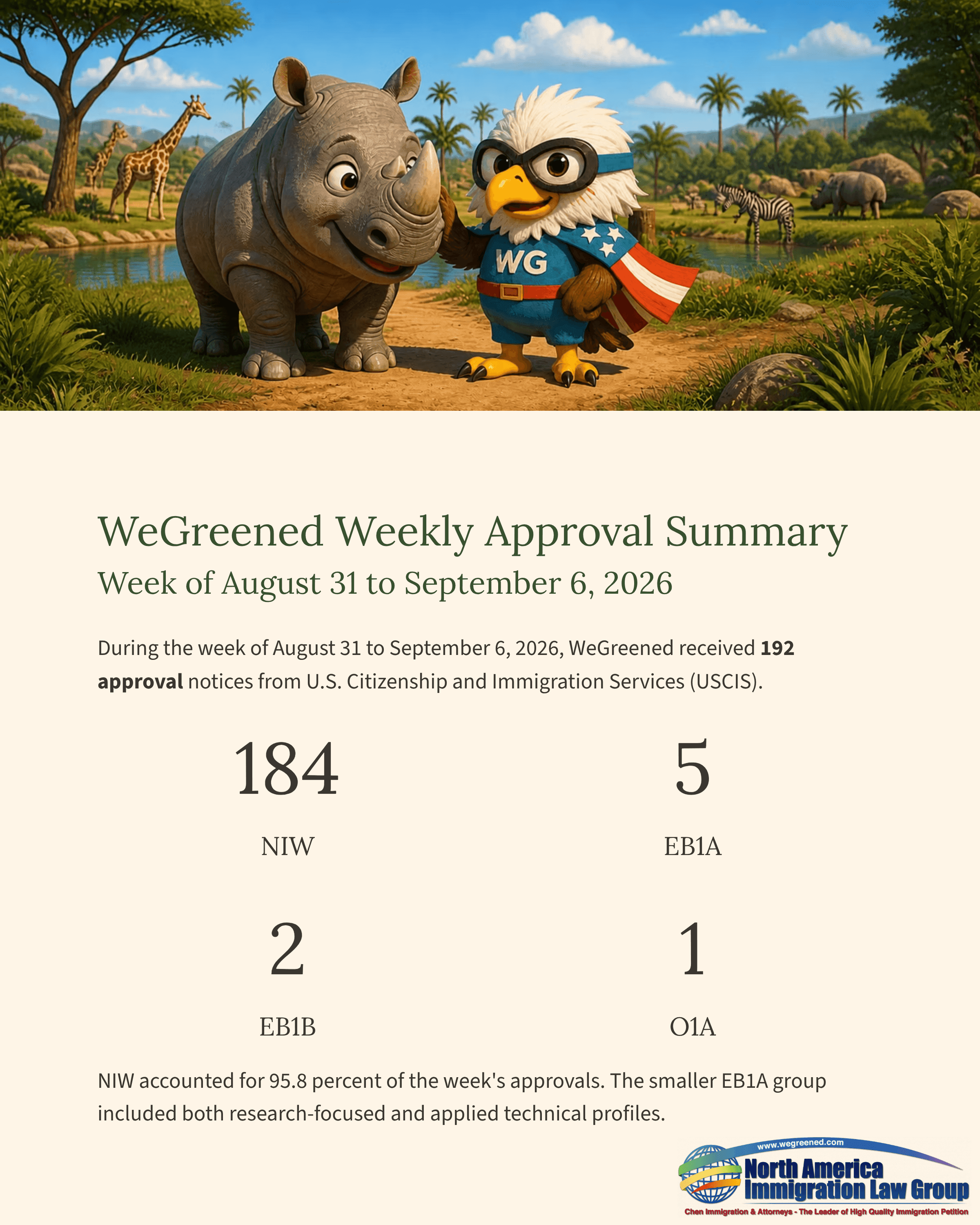
During the week of August 31 to September 6, 2026, WeGreened received 192 approval notices from U.S. Citizenship and Immigration Services (USCIS). Of these approvals, 184 were for NIW (National Interest Waiver), 5 were for EB1A (Alien of Extraordinary Ability), 2 were for EB1B (Outstanding Professors or Researchers), and 1 was for O1A (Individuals with Extraordinary Ability or Achievement).
EB1A and NIW Credential Analysis
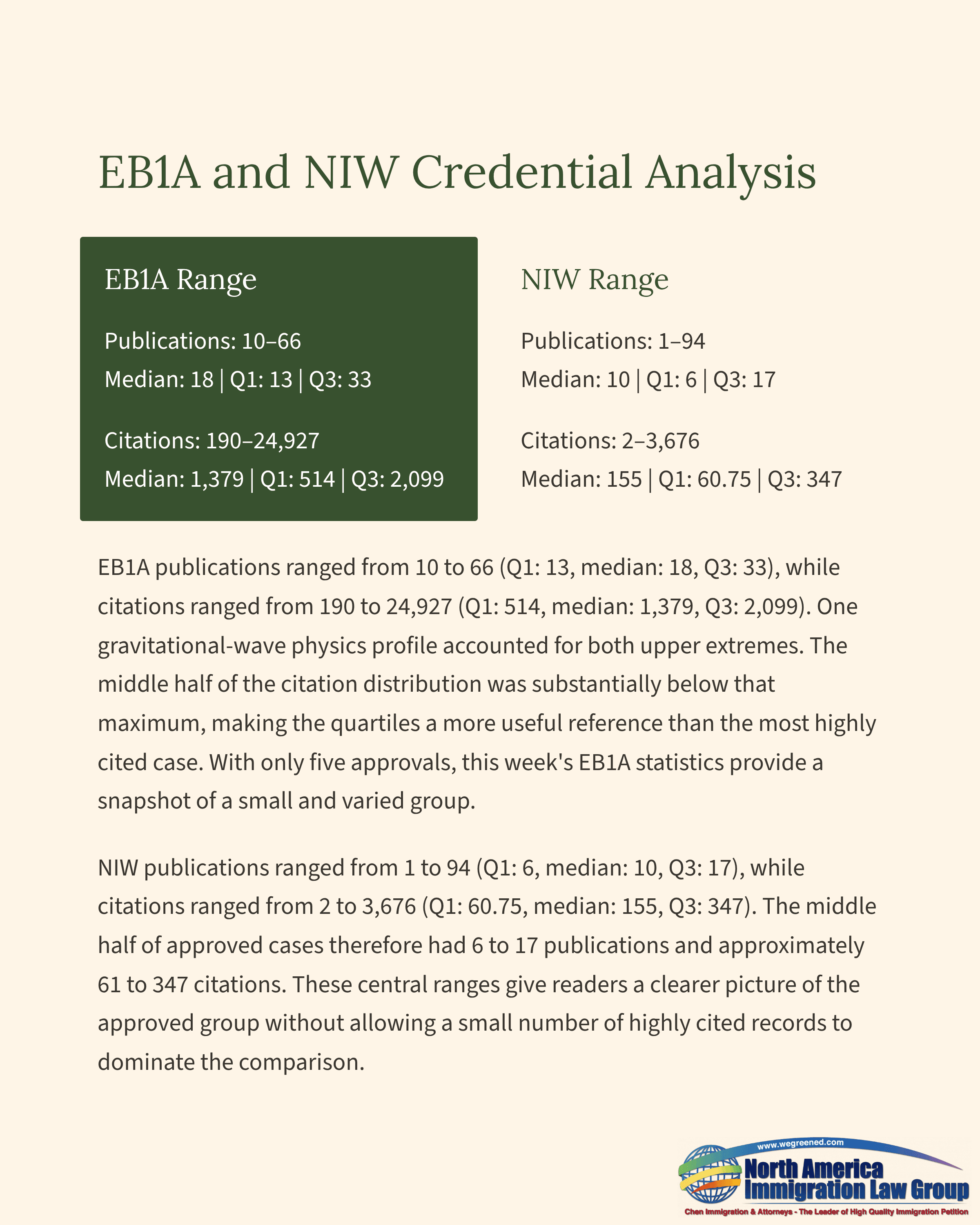
EB1A publications ranged from 10 to 66 (Q1: 13, median: 18, Q3: 33), while citations ranged from 190 to 24,927 (Q1: 514, median: 1,379, Q3: 2,099). One gravitational-wave physics profile accounted for both upper extremes. The middle half of the citation distribution was substantially below that maximum, making the quartiles a more useful reference than the most highly cited case. With only five approvals, this week’s EB1A statistics provide a snapshot of a small and varied group.
NIW publications ranged from 1 to 94 (Q1: 6, median: 10, Q3: 17), while citations ranged from 2 to 3,676 (Q1: 60.75, median: 155, Q3: 347). The middle half of approved cases therefore had 6 to 17 publications and approximately 61 to 347 citations. These central ranges give readers a clearer picture of the approved group without allowing a small number of highly cited records to dominate the comparison.
Insights on Petitioner Backgrounds and Fields
All five EB1A approvals were recorded as STEM cases, spanning artificial intelligence, computer science, electrical and computer engineering, materials chemistry, and gravitational-wave physics. Three petitioners held Ph.D. degrees and two held master's qualifications. Current titles ranged from applied scientist and engineer to assistant scientist, illustrating the different professional settings represented even within this small group.
NIW’s career-stage distribution varied considerably by field. Students and graduate trainees accounted for 19 of the 48 engineering, energy, and materials approvals, while postdoctoral researchers accounted for 17 of the 29 life sciences, agriculture, and environmental cases. Biomedical, clinical, and public health fields formed the largest cluster with 56 approvals, combining clinical practice and research backgrounds. Overall, the NIW group included 145 STEM and 39 non-STEM approvals. The educational backgrounds comprised 99 Ph.D. holders, 45 petitioners with master’s qualifications, 35 with medical or dental qualifications, and five petitioners without advanced degrees.
Highlighted EB1A Case: AI Professional Approved After RFE With 190 Citations
One of this week’s highlighted EB1A approvals involved an industry artificial intelligence researcher specializing in large language models and generative AI. The petitioner held a master’s degree and had 10 peer-reviewed publications, 190 citations, and substantial peer-review experience. The record covered research in foundation-model reliability, large-scale question answering, and structured information extraction. USCIS accepted the judging and scholarly authorship criteria but issued an RFE challenging original contributions of major significance and high remuneration, while also requiring the overall record to satisfy the Final Merits Determination.
For original contributions, our response focused on demonstrating exactly how the petitioner’s work influenced subsequent research. We organized the evidence around three major areas of contribution and paired specific research achievements with independent studies that adopted the petitioner’s methods, used the work as benchmarks, or extended the underlying approaches. The citation record had increased to 225 by the time of the response, but we did not rely on the total alone. We placed individual publications in field and publication-year context and supported the technical significance of the documented research use with three independent expert letters. This structure created a clear progression from the petitioner’s original contribution to independent use and broader field impact.
For high remuneration, we addressed USCIS’s concern about the comparison group by focusing on professionals performing comparable work at a similar seniority level and within the relevant labor market. We separated base salary from additional compensation and presented the comparisons in a way that directly addressed the officer’s stated concern rather than relying on broad occupational averages.
Finally, the response brought the previously accepted criteria together with the strengthened evidence for original contributions and high remuneration under the Final Merits Determination. By organizing each argument around the officer’s specific concern and linking the supporting evidence directly to the applicable standard, the response presented a cohesive record of sustained recognition and field-level impact.
Adjudication Trends and Policy Observations
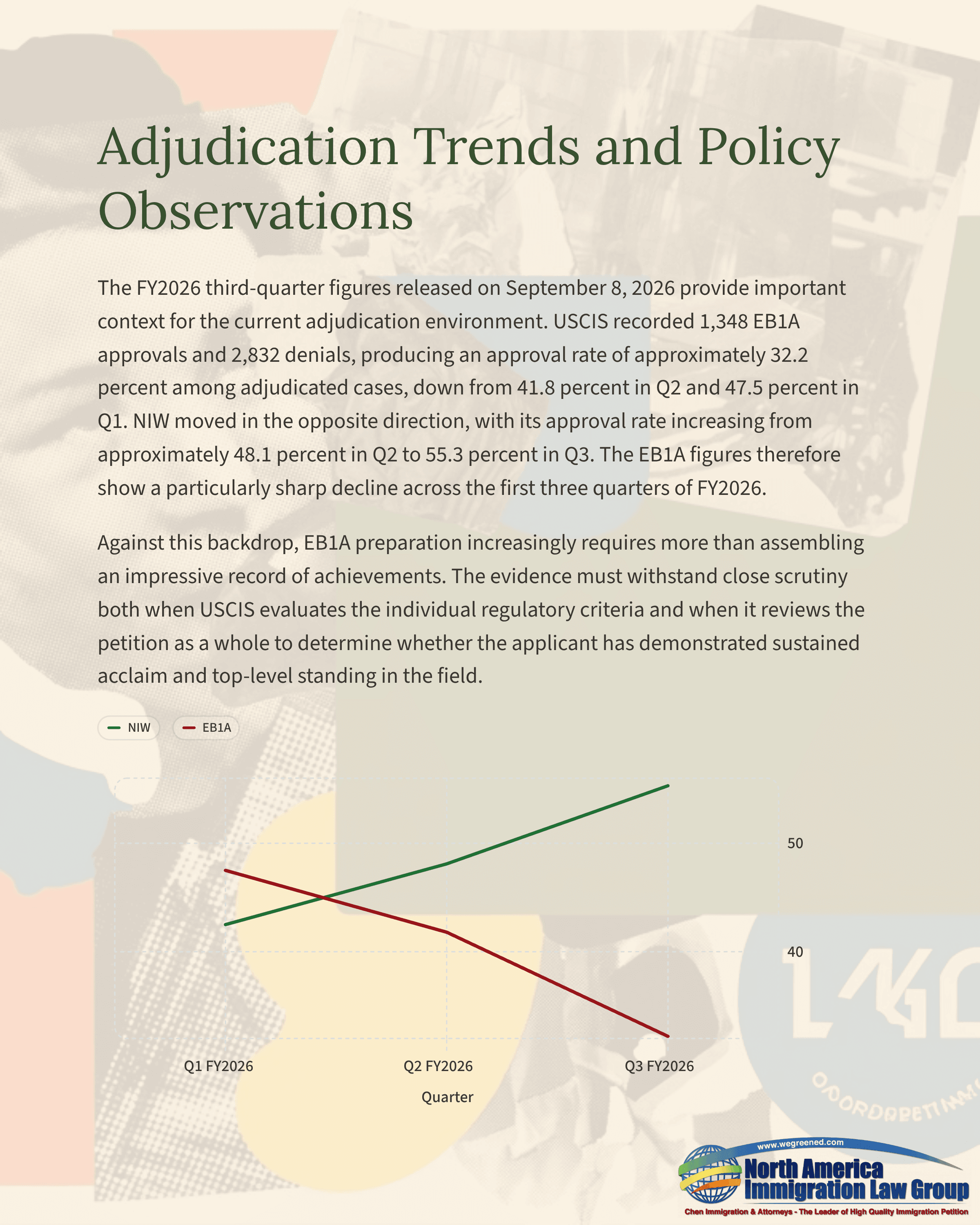
The FY2026 third-quarter figures released on September 8, 2026 provide important context for the current adjudication environment. USCIS recorded 1,348 EB1A approvals and 2,832 denials, producing an approval rate of approximately 32.2 percent among adjudicated cases, down from 41.8 percent in Q2 and 47.5 percent in Q1. NIW moved in the opposite direction, with its approval rate increasing from approximately 48.1 percent in Q2 to 55.3 percent in Q3.