

WeGreened Weekly Approval Summary: Week of July 13, 2026
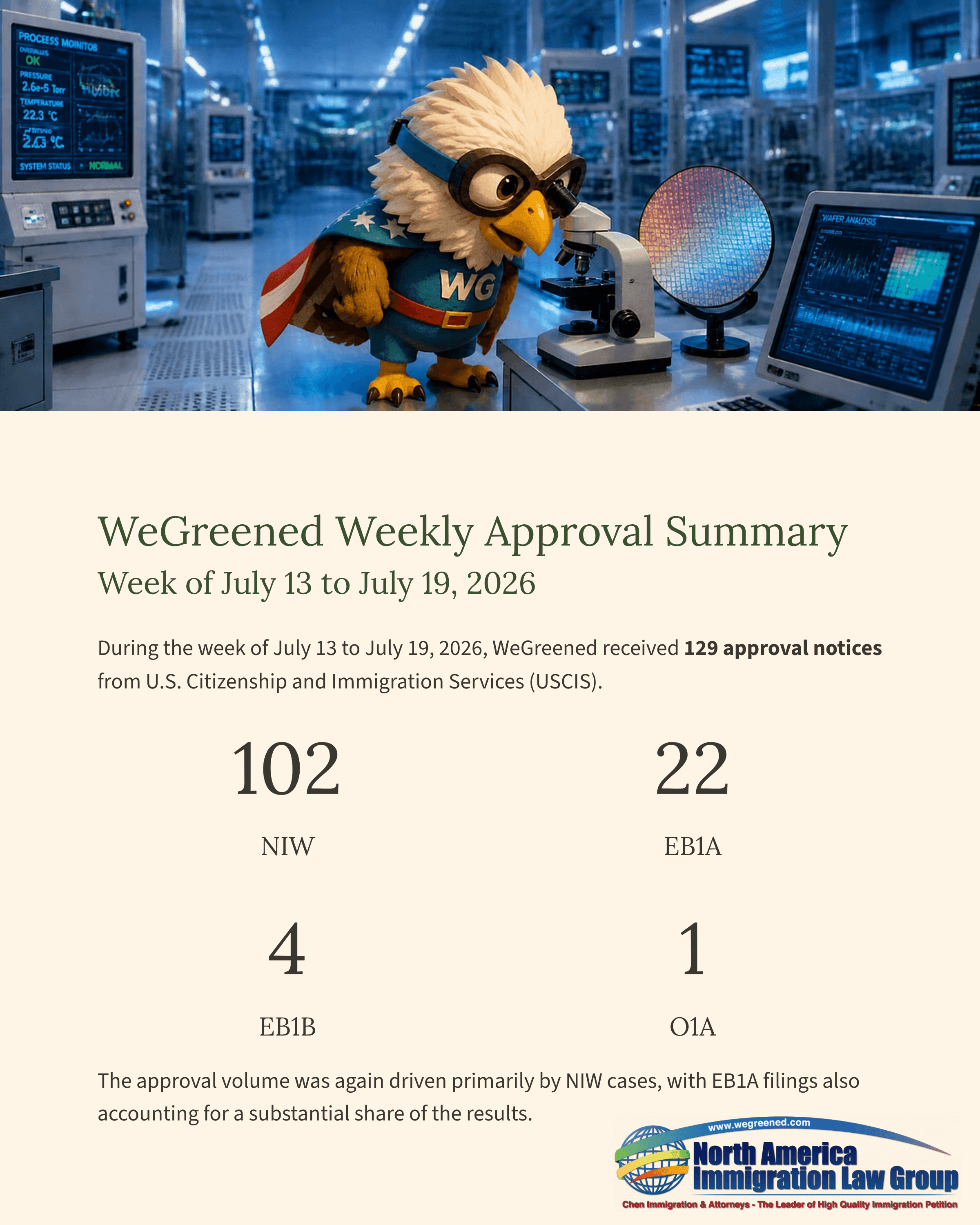
During the week of July 13 to July 19, 2026, WeGreened received 129 approval notices from U.S. Citizenship and Immigration Services (USCIS). Of the 129 approvals, 102 were for NIW (National Interest Waiver), 22 were for EB1A (Alien of Extraordinary Ability), 4 were for EB1B (Outstanding Professors or Researchers), and 1 was for O1A (Individuals with Extraordinary Ability or Achievement).
The approval volume was again driven primarily by NIW cases, with EB1A filings also accounting for a substantial share of the results. EB1B approvals remained limited but steady, and O1A approvals were comparatively few.
EB1A and NIW Credential Analysis
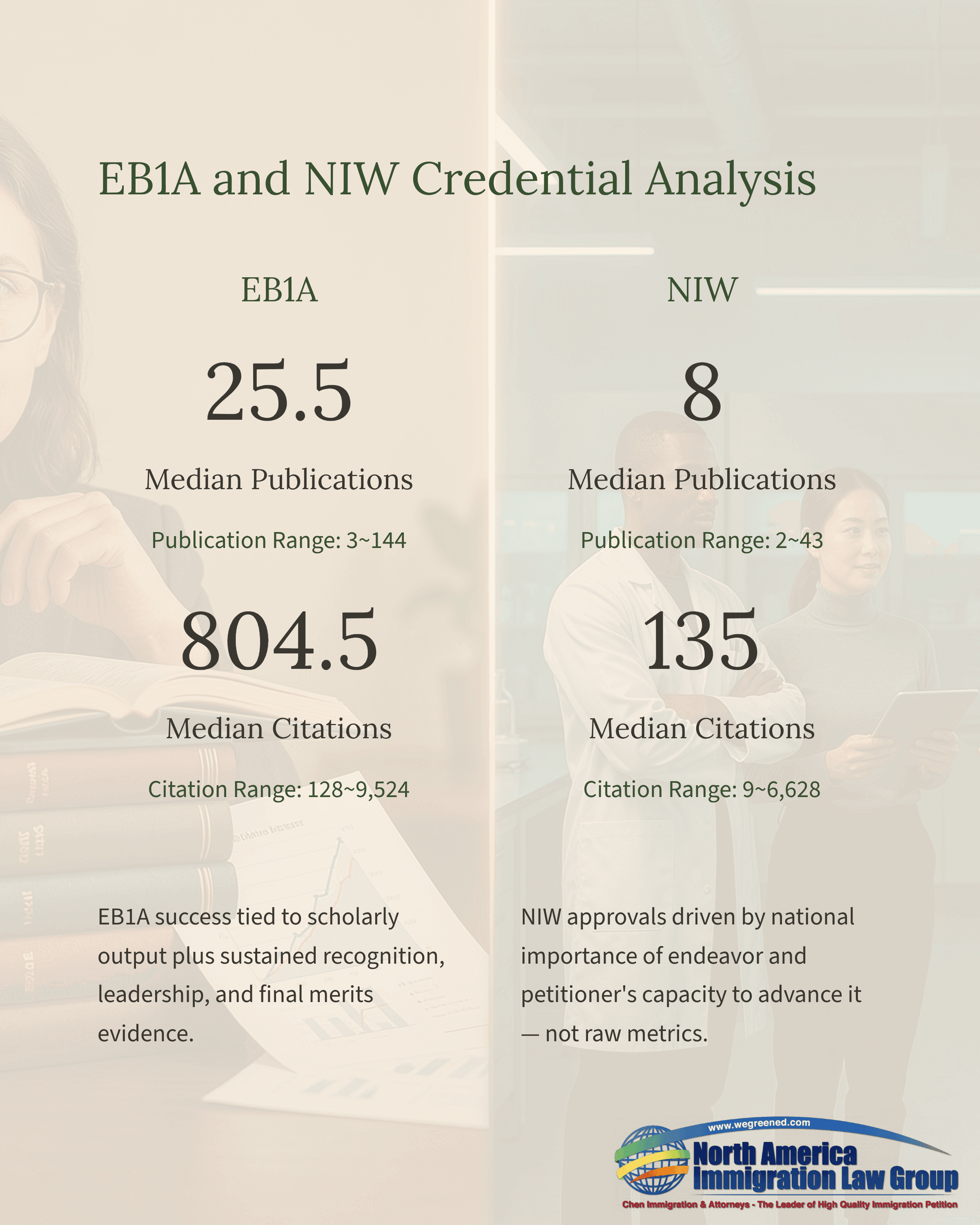
EB1A petitioners this week again presented recognition-oriented profiles while spanning a relatively broad range of traditional academic metrics. Publications ranged from 3 to 144 (Q1: 16.25, median: 25.5, Q3: 34.75), while citations ranged from 128 to 9,524 (Q1: 326.5, median: 804.5, Q3: 2,838.25). As in recent weeks, successful EB1A petitions combined scholarly output with broader evidence of sustained professional recognition, leadership, and achievements sufficient to satisfy final merits review.
NIW petitioners again demonstrated a much broader evidentiary spectrum. Publications ranged from 2 to 43 (Q1: 5, median: 8, Q3: 13), while citations ranged from 9 to 6,628 (Q1: 62, median: 135, Q3: 259). Compared with EB1A, the NIW group once again included a larger proportion of early-career researchers, physicians, and industry professionals. This week's approvals continue to reinforce that NIW adjudications are focused on the national importance of the proposed endeavor and the petitioner's position to advance the work, rather than solely on their numerical academic credentials.
Insights on Petitioner Backgrounds and Fields
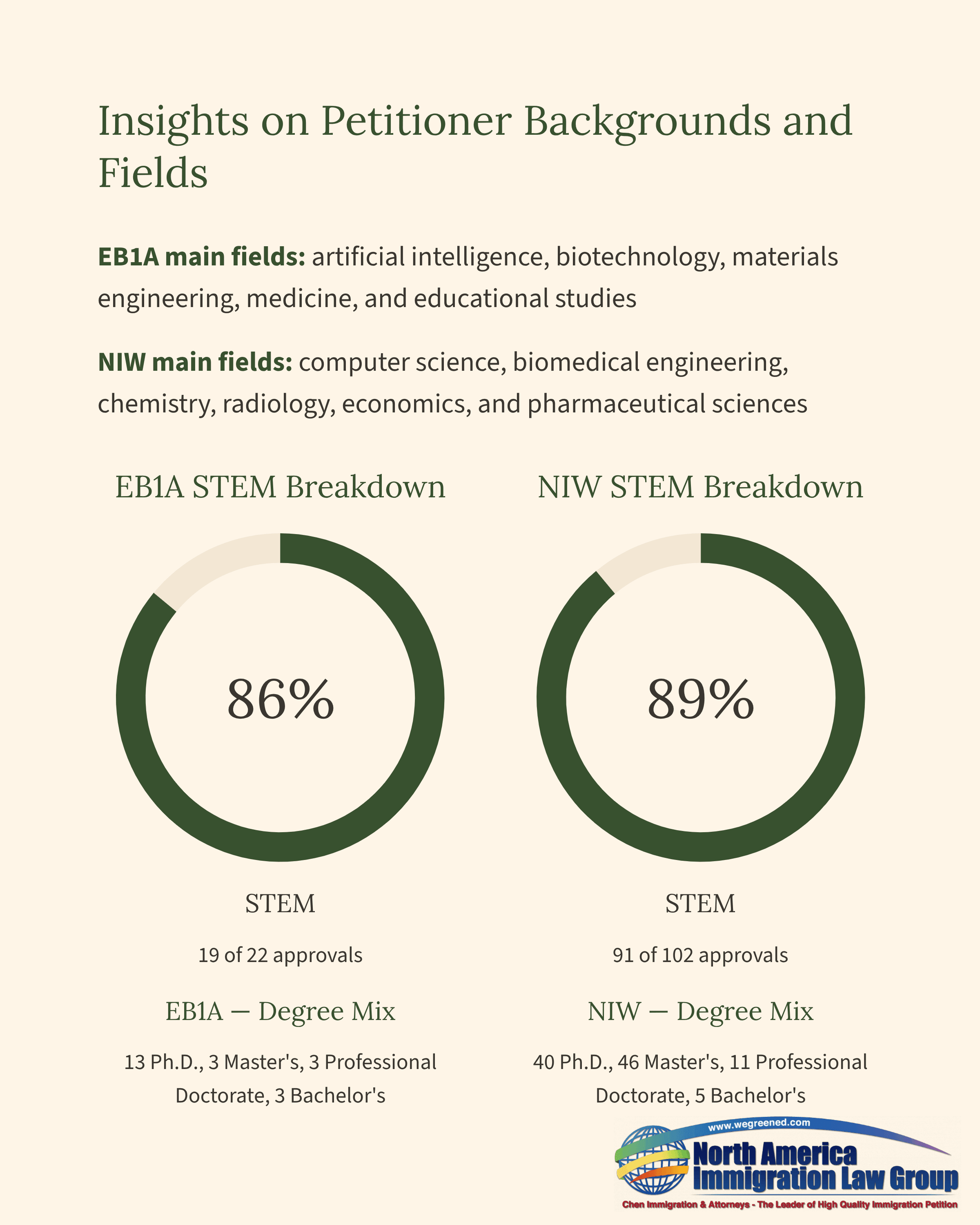
EB1A approvals remained concentrated in STEM disciplines, with 19 STEM approvals and 3 non-STEM approvals. Approved fields included artificial intelligence, biotechnology, materials engineering, medicine, and educational studies. The approved petitioners represented diverse professional roles, including postdoctoral researchers, professors, research engineers, medical directors, and industry research leaders. The degree mix included 13 Ph.D. holders, 3 master's-level petitioners, 3 bachelor's-level petitioners, and 3 professional doctorate holders, illustrating that EB1A approvals continued to favor petitioners with strong evidence of sustained recognition across both academia and industry.
NIW approvals again covered a remarkably broad range of scientific, engineering, medical, and interdisciplinary fields while remaining predominantly STEM-focused, with 91 STEM approvals and 11 non-STEM approvals. Major approved fields included computer science, biomedical engineering, chemistry, radiology, economics, and pharmaceutical sciences. The approved group included Ph.D. students, postdoctoral fellows, physicians, engineers, and industry specialists. The degree mix consisted of 40 Ph.D. holders, 46 master's-level petitioners, 5 bachelor's-level petitioners, and 11 professional doctorate holders, reinforcing that NIW continues to accommodate applicants from a wide variety of educational and professional backgrounds when the proposed endeavor is clearly connected to important U.S. national interests.
Highlighted NIW Case: Approval for a Semiconductor Materials Engineer with 6 Publications and 9 Citations
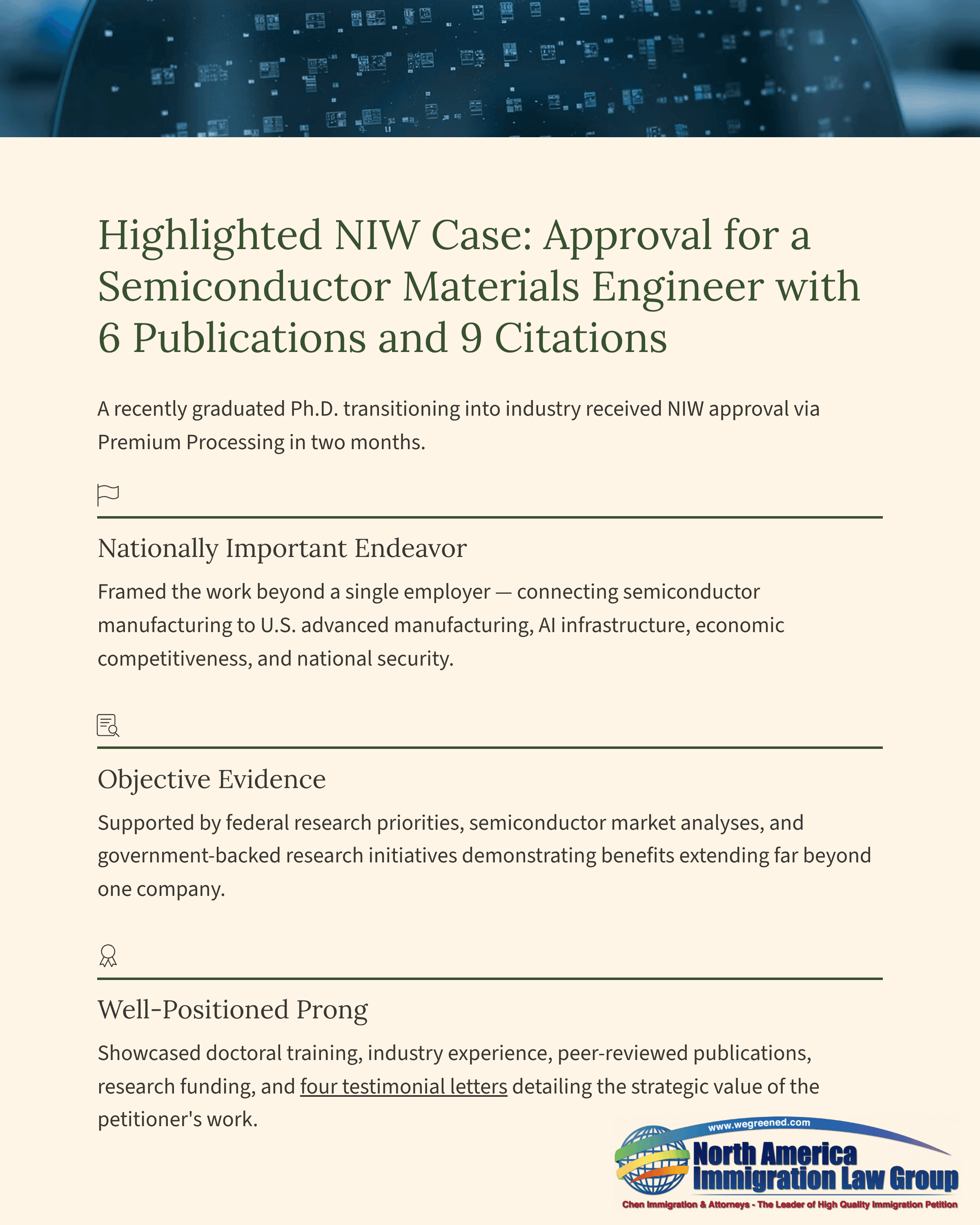
This week’s highlights include an NIW case for a semiconductor engineering professional who received an approval in two months through direct Premium Processing. The petitioner, who had recently completed their Ph.D. and moved into industry, had 6 peer-reviewed publications and only 9 citations at filing. The proposed endeavor focused on optimizing materials engineering to improve the scalability and reliability of U.S. semiconductor devices. By emphasizing the national importance of the proposed endeavor, we successfully established that the petitioner’s work serves broader critical priorities beyond any single employer and addressed strategically important national priorities.
The central legal strategy focused on framing the endeavor itself—not simply the petitioner's current employment—as nationally important. Rather than emphasizing proprietary work performed for one company, the petition explained how advances in semiconductor manufacturing support broader U.S. objectives involving advanced manufacturing, artificial intelligence infrastructure, economic competitiveness, and national security. The filing relied extensively on objective evidence, including federal research priorities, semiconductor market analyses, and government-supported research initiatives, to demonstrate that the proposed endeavor would generate benefits extending far beyond an individual employer.
The petition successfully met the "well-positioned" prong by presenting a comprehensive narrative of the petitioner's capabilities, prioritizing substantive technical expertise over citation metrics. We showcased a blend of doctoral training, relevant industry experience, impactful peer-reviewed publications, and high-level research funding. Combined with four testimonial letters that detailed the national importance of the petitioner's work for U.S. semiconductor manufacturing, the evidence effectively demonstrated that the petitioner is uniquely qualified to advance their proposed endeavor.
The petition argued that semiconductor manufacturing is a rapidly advancing strategic priority, requiring a level of professional flexibility that goes beyond the standard labor certification process. We maintained that insisting on a permanent job offer would unnecessarily delay work directly supporting nationally significant semiconductor initiatives. This case highlights that success in an NIW petition does not require high citation counts. Instead, it relies on clearly defining the proposed endeavor, linking it to objective national priorities, proving future potential, and systematically meeting the Dhanasar criteria rather than focusing on conventional academic metrics.
Adjudication Trends and Policy Observations
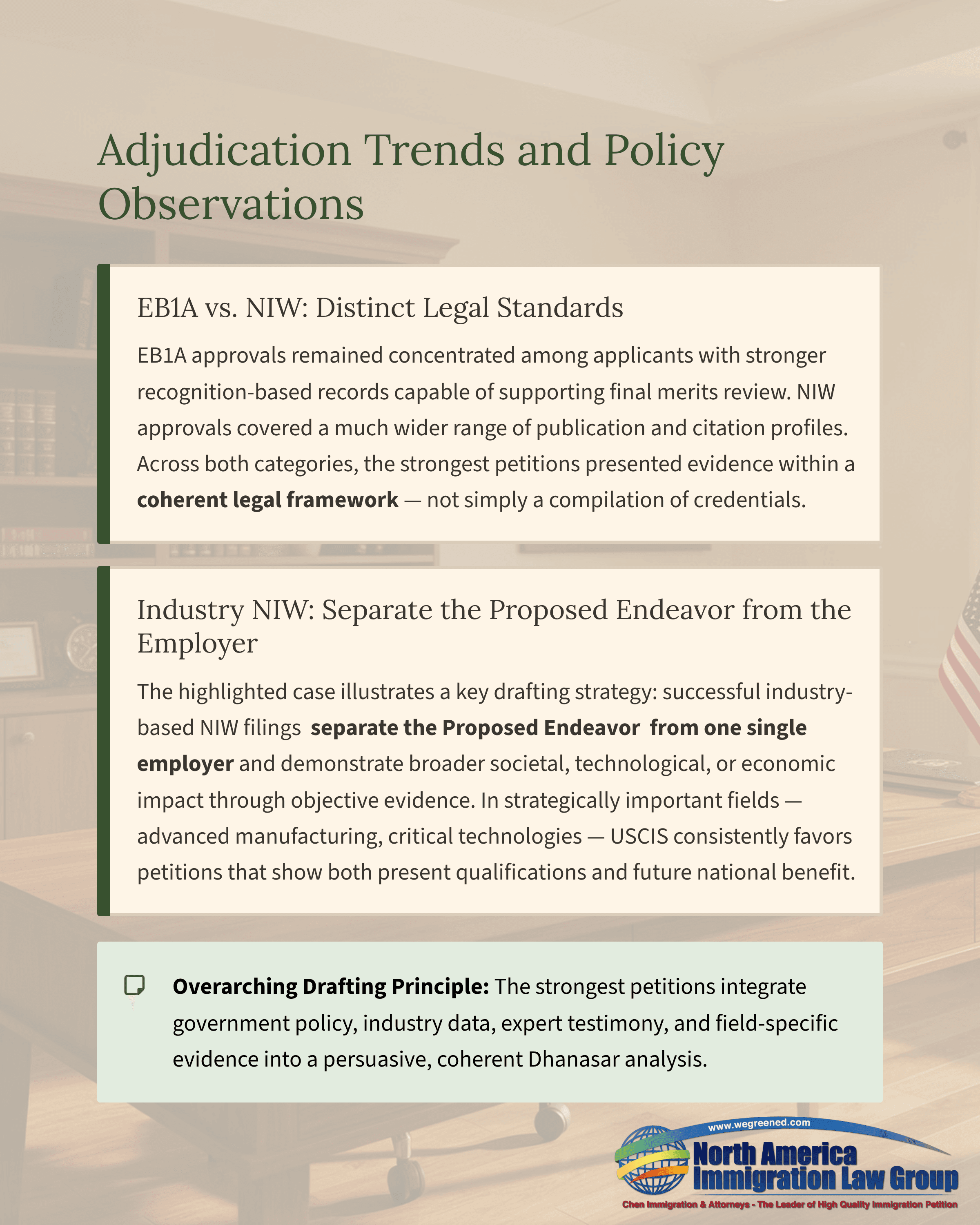
This week's approvals again demonstrate that USCIS continues to distinguish clearly between the legal standards governing EB1A and NIW petitions. EB1A approvals generally remained concentrated among applicants with stronger recognition-based records capable of supporting final merits review, while NIW approvals covered a much wider range of publication and citation profiles. Across both categories, however, the strongest petitions were those that presented evidence within a coherent legal framework rather than simply compiling credentials.
The highlighted semiconductor case also illustrates an increasingly important drafting strategy for industry-based NIW petitions. As USCIS continues placing greater emphasis on the national importance of the proposed endeavor, successful filings increasingly separate the endeavor from the petitioner's current employer and demonstrate broader societal, technological, or economic impact through objective evidence. Particularly in strategically important fields such as advanced manufacturing and critical technologies, approvals continue to favor petitions that integrate government policy, industry data, expert testimony, and field-specific evidence into a persuasive Dhanasar analysis showing both present qualifications and future national benefit.