

WeGreened Weekly Approval Summary: Week of July 20, 2026
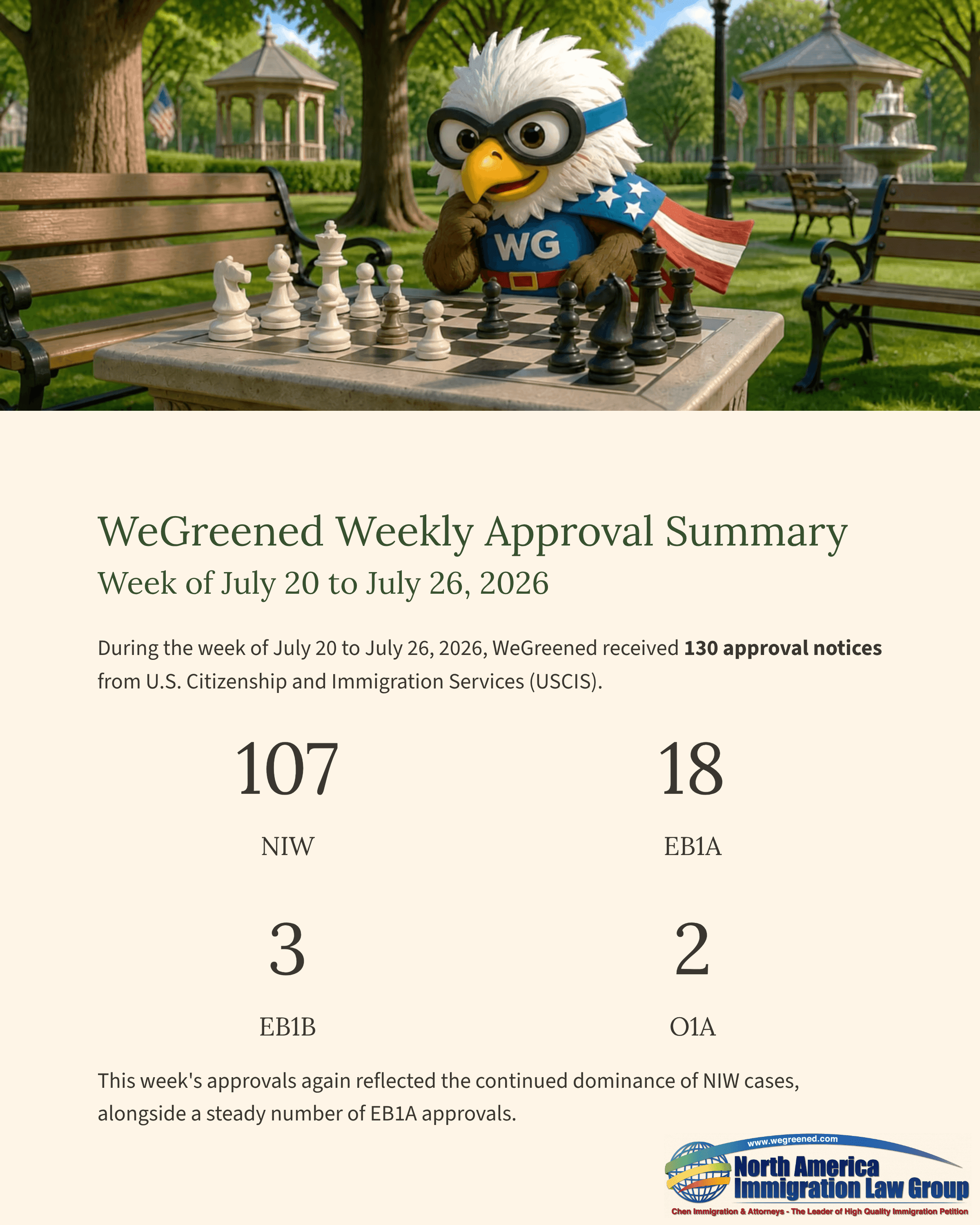
During the week of July 20 to July 26, 2026, WeGreened received 130 approval notices from U.S. Citizenship and Immigration Services (USCIS). Of the 130 approvals, 107 were for NIW (National Interest Waiver), 18 were for EB1A (Alien of Extraordinary Ability), 3 were for EB1B (Outstanding Professors or Researchers), and 2 were for O1A (Individuals with Extraordinary Ability or Achievement).
This week's approvals again reflected the continued dominance of NIW cases, alongside a steady number of EB1A approvals, a small number of EB1B approvals, and a limited number of O1A approvals.
EB1A and NIW Credential Analysis
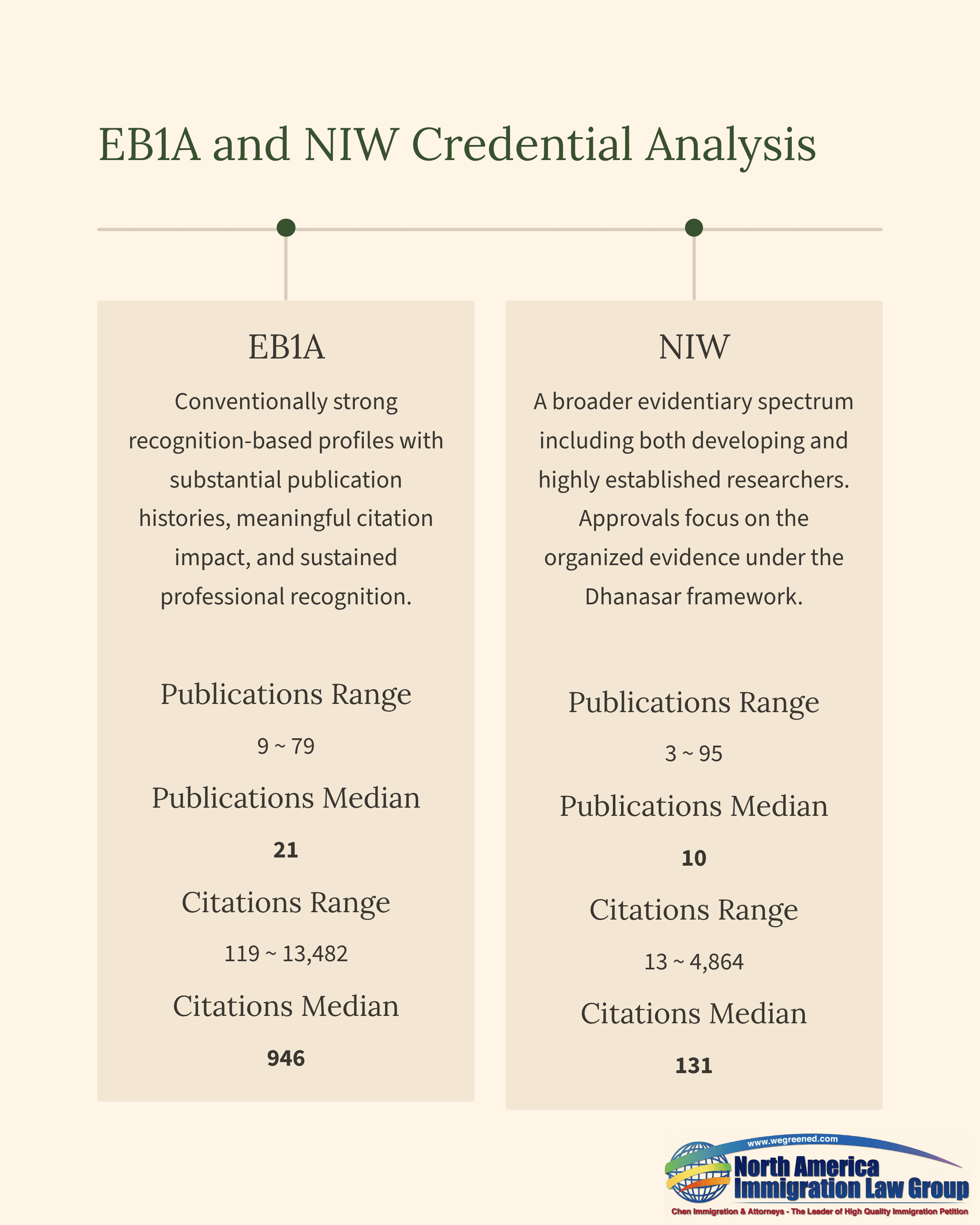
EB1A petitioners this week continued to present conventionally strong recognition-based profiles. Publications ranged from 9 to 79 (Q1: 15, median: 21, Q3: 34), while citations ranged from 119 to 13,482 (Q1: 576, median: 946, Q3: 1,351). As in previous weeks, EB1A approvals remained concentrated among petitioners with substantial publication histories, meaningful citation impact, and evidence of sustained professional recognition capable of supporting final merits review.
NIW petitioners again demonstrated a much broader evidentiary spectrum. Publications ranged from 3 to 95 (Q1: 6, median: 10, Q3: 17), while citations ranged from 13 to 4,864 (Q1: 56, median: 131, Q3: 437). Compared with EB1A, NIW continued to include both developing and highly established researchers, reinforcing that approvals remain focused less on numerical credentials alone and more on whether the petition persuasively establishes a nationally important proposed endeavor, demonstrates that the petitioner is well positioned to advance that endeavor, and explains why waiving the labor certification requirement benefits the United States.
Insights on Petitioner Backgrounds and Fields
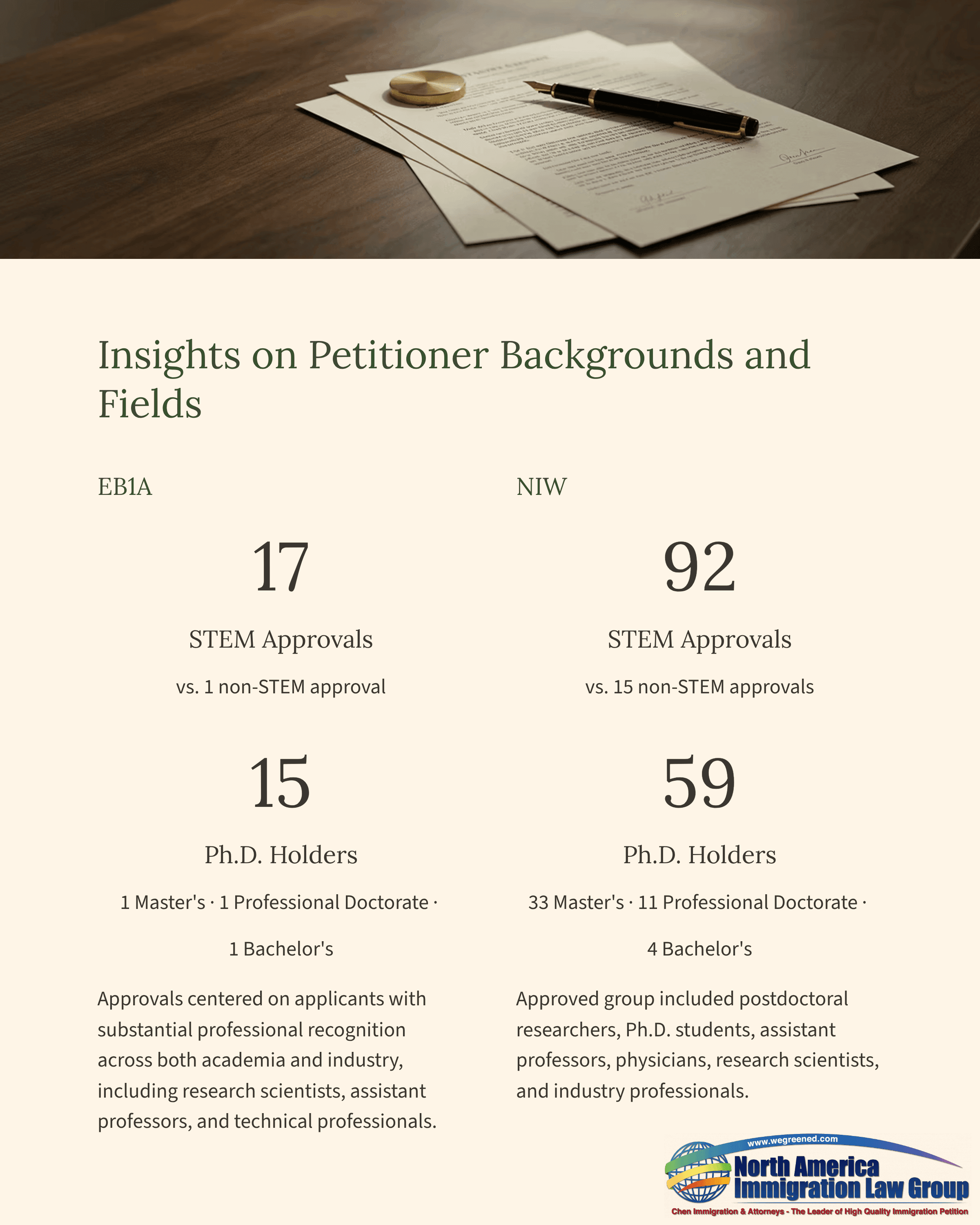
EB1A approvals this week remained overwhelmingly STEM-oriented, with 17 STEM approvals and 1 non-STEM approval. Approved fields included artificial intelligence, chemistry, biomedical engineering, and condensed matter physics. The approved petitioners represented both academic and industry backgrounds, including research scientists, assistant professors, and technical professionals. The degree mix consisted of 15 Ph.D. holders, 1 master's-level petitioner, 1 professional doctorate holder, and 1 bachelor's-level petitioner, illustrating that EB1A approvals continued to center on applicants with substantial professional recognition across both academia and industry.
NIW approvals again covered a much broader range of disciplines and career stages while remaining predominantly STEM-focused, with 92 STEM approvals and 15 non-STEM approvals. Major approved fields included biomedical engineering, computer science, materials science, civil engineering, bioinformatic, and pharmaceutical sciences. The approved group included postdoctoral researchers, Ph.D. students, assistant professors, physicians, research scientists, and industry professionals. The educational background was likewise broad, including 59 Ph.D. holders, 33 master's-level petitioners, 11 professional doctorate holders, and 4 bachelor's-level petitioners, reinforcing that NIW continues to accommodate a wide variety of educational and professional backgrounds when the proposed endeavor is clearly tied to important national interests.
Highlighted NIW Case: Approval for a Bioengineering Ph.D. Student with 3 Publications and 13 Citations
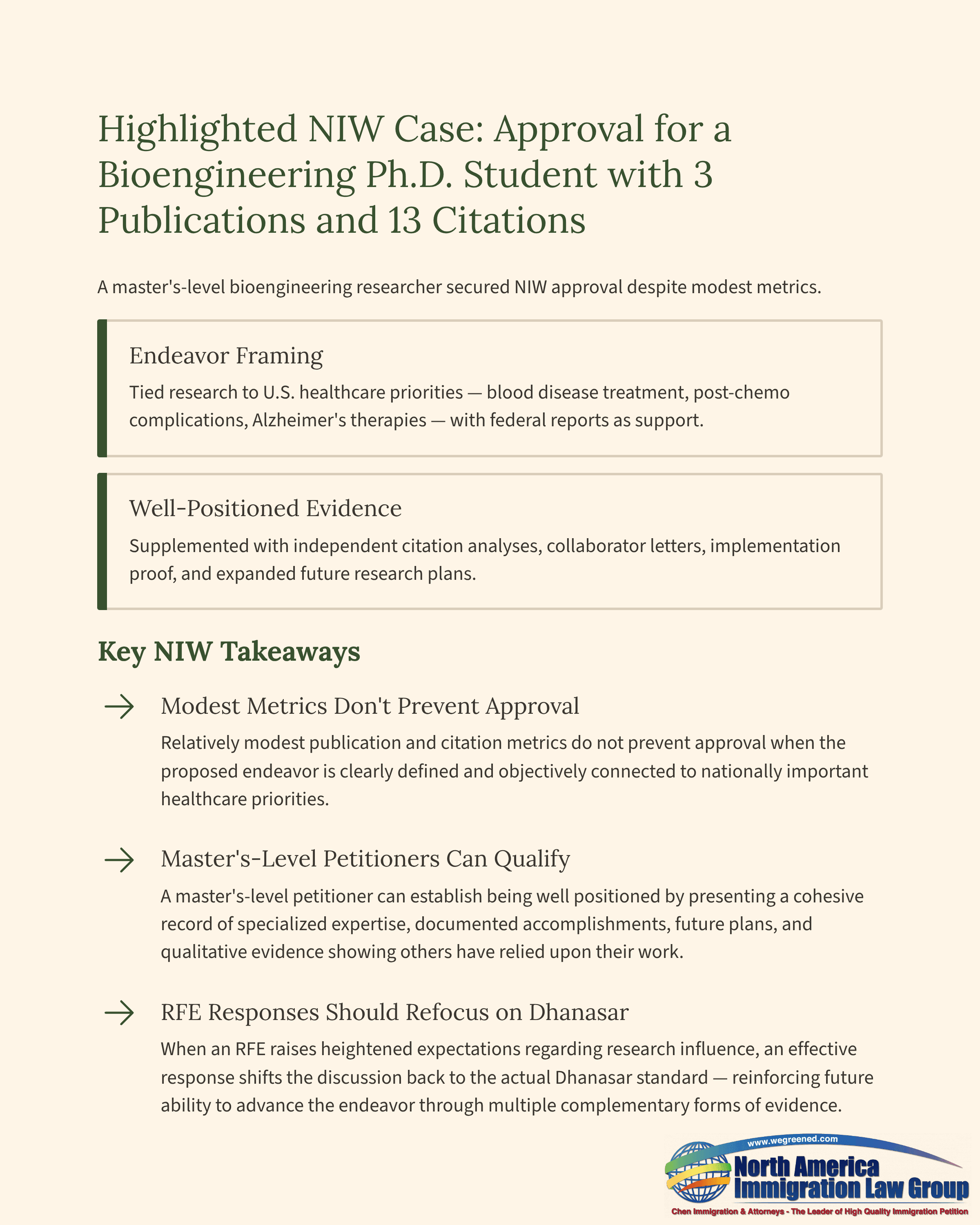
This week's highlighted approval involved a bioengineering researcher whose petition presented a profile that would traditionally be viewed as relatively modest from a numerical perspective. At filing, the petitioner held 3 peer-reviewed journal publications and 13 citations. The petitioner also held a master's degree, rather than a Ph.D., making this a particularly instructive NIW case example.
The proposed endeavor focused on developing technologies to improve treatment for blood-related diseases, reduce post-chemotherapy complications, and advance therapeutic approaches for Alzheimer's disease. Rather than emphasizing laboratory accomplishments alone, the petition consistently framed the endeavor around broader U.S. healthcare priorities, biomedical innovation, and federally recognized critical and emerging technologies. Government reports and healthcare statistics were incorporated to demonstrate that the proposed endeavor would generate benefits extending well beyond any individual employer.
The case received a Request for Evidence (RFE) after filing. Rather than attempting to satisfy an implicit requirement for extraordinary scholarly influence, the response emphasized that Dhanasar requires consideration of multiple factors—including education, experience, documented progress toward the endeavor, future plans, and evidence that the petitioner is well positioned to continue advancing the work. The strategy proposed supplementing the record with additional independent citation analyses, stronger implementation evidence, expanded discussion of how other researchers had adopted the petitioner's work, updated future research plans, testimonial letters from collaborators or government-related entities, and additional evidence demonstrating real-world implementation and national benefit.
This approval demonstrates several recurring NIW themes. First, relatively modest publication and citation metrics do not prevent approval when the proposed endeavor is clearly defined and objectively connected to nationally important healthcare priorities. Second, a master's-level petitioner can establish that they are well positioned by presenting a cohesive record of specialized expertise, documented technical accomplishments, future research plans, and qualitative evidence showing that others have already relied upon their work. Finally, when an RFE raises heightened expectations regarding research influence, an effective response often shifts the discussion back to the actual Dhanasar standard by reinforcing the petitioner's future ability to advance the endeavor through multiple complementary forms of evidence rather than citation metrics alone.
Adjudication Trends and Policy Observations
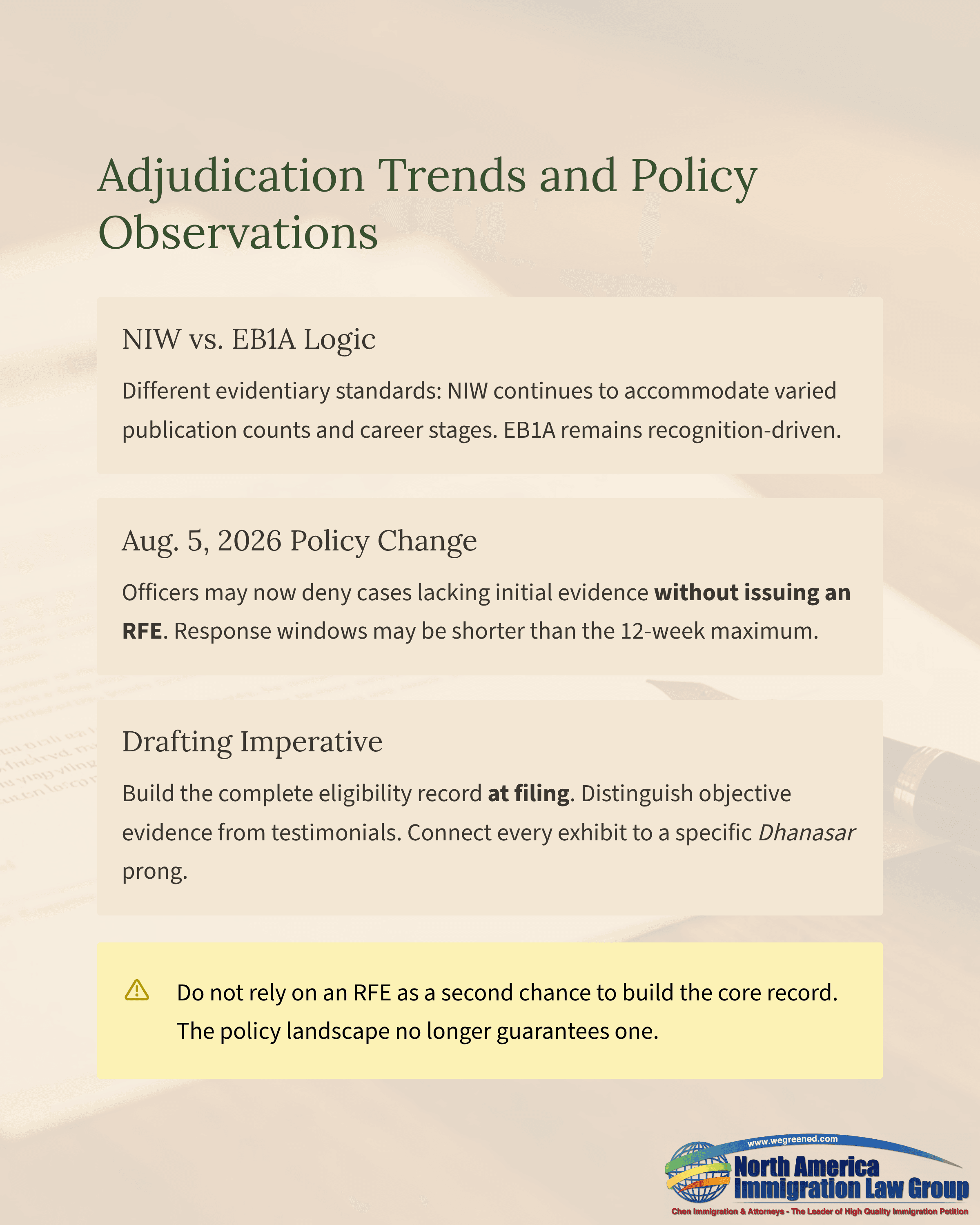
This week’s approvals again show that NIW and EB1A continue to operate under different evidentiary logic. EB1A remained more recognition-driven, while NIW continued to accommodate a wider range of publication counts, citation records, degree levels, and career stages when the petition clearly defined the proposed endeavor and organized the evidence under the Dhanasar framework. The highlighted NIW approval is particularly instructive because the case overcame modest publication and citation metrics, as well as an RFE challenge, by emphasizing specialized expertise, documented progress, qualitative citation impact, concrete future plans, and the national value of the petitioner’s research.
The August 5, 2026 USCIS policy update further increases the importance of submitting a complete and well-supported petition at the outset. USCIS has restored officers’ discretion to deny cases lacking required initial evidence without first issuing an RFE (Request for Evidence) or NOID (Notice of Intent to Deny), and it has clarified that RFE response periods may be shorter than the maximum 12 weeks. This development reinforces a central drafting lesson: petitioners should not rely on an RFE as an opportunity to build the core record later. Strong filings should include the principal evidence of eligibility at filing, clearly distinguish objective evidence from testimonial support, and directly connect each exhibit to the applicable NIW prong.