

WeGreened Weekly Approval Summary: Week of July 27 to August 2, 2026
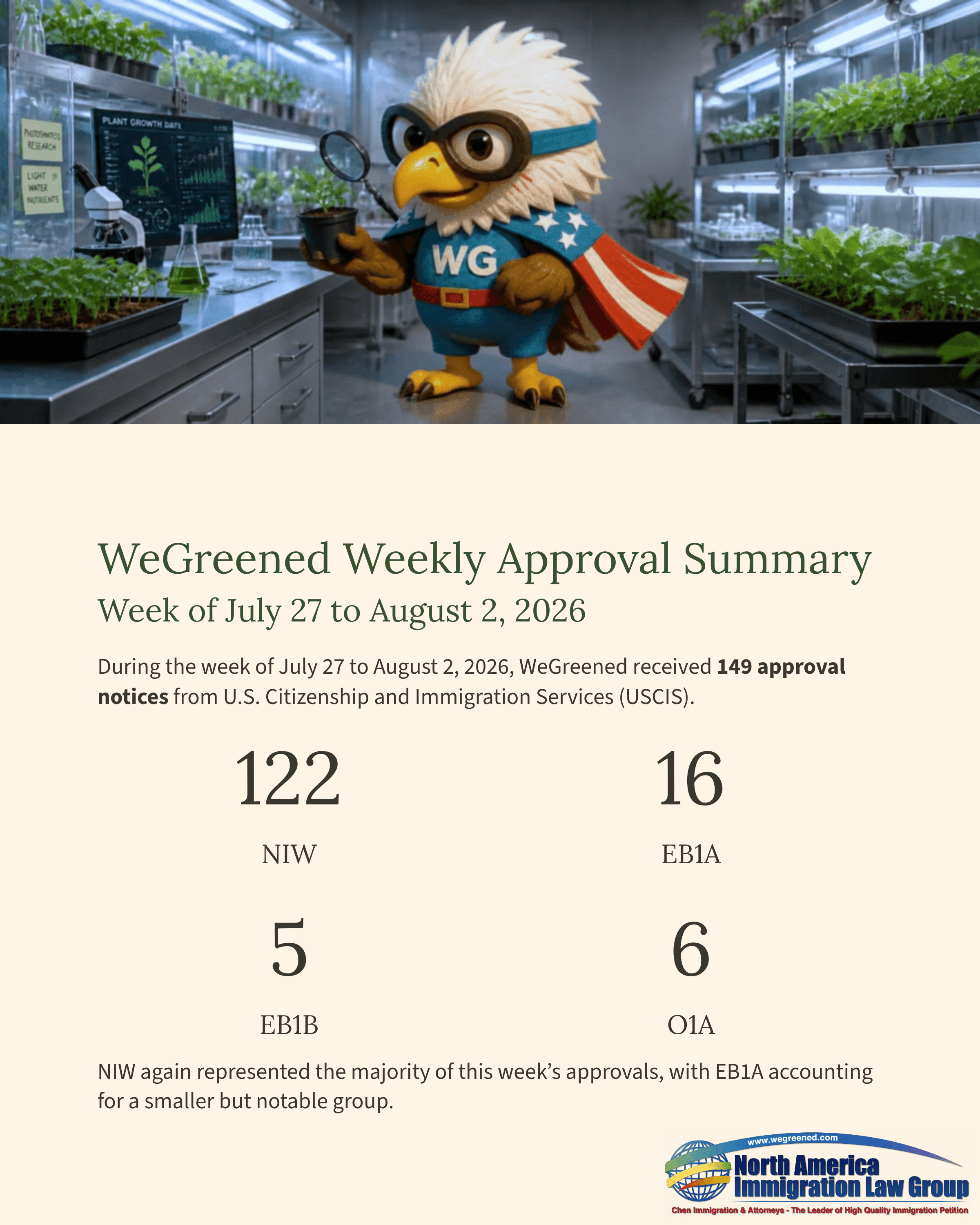
During the week of July 27 to August 2, 2026, WeGreened received 149 approval notices from U.S. Citizenship and Immigration Services (USCIS). Of the 149 approvals, 122 were for NIW (National Interest Waiver), 16 were for EB1A (Alien of Extraordinary Ability), 5 were for EB1B (Outstanding Professors or Researchers), and 6 were for O1A (Individuals with Extraordinary Ability or Achievement).
NIW again represented the majority of this week’s approvals, with EB1A accounting for a smaller but notable group. EB1B and O1A approvals appeared more visibly than in some recent weekly batches.
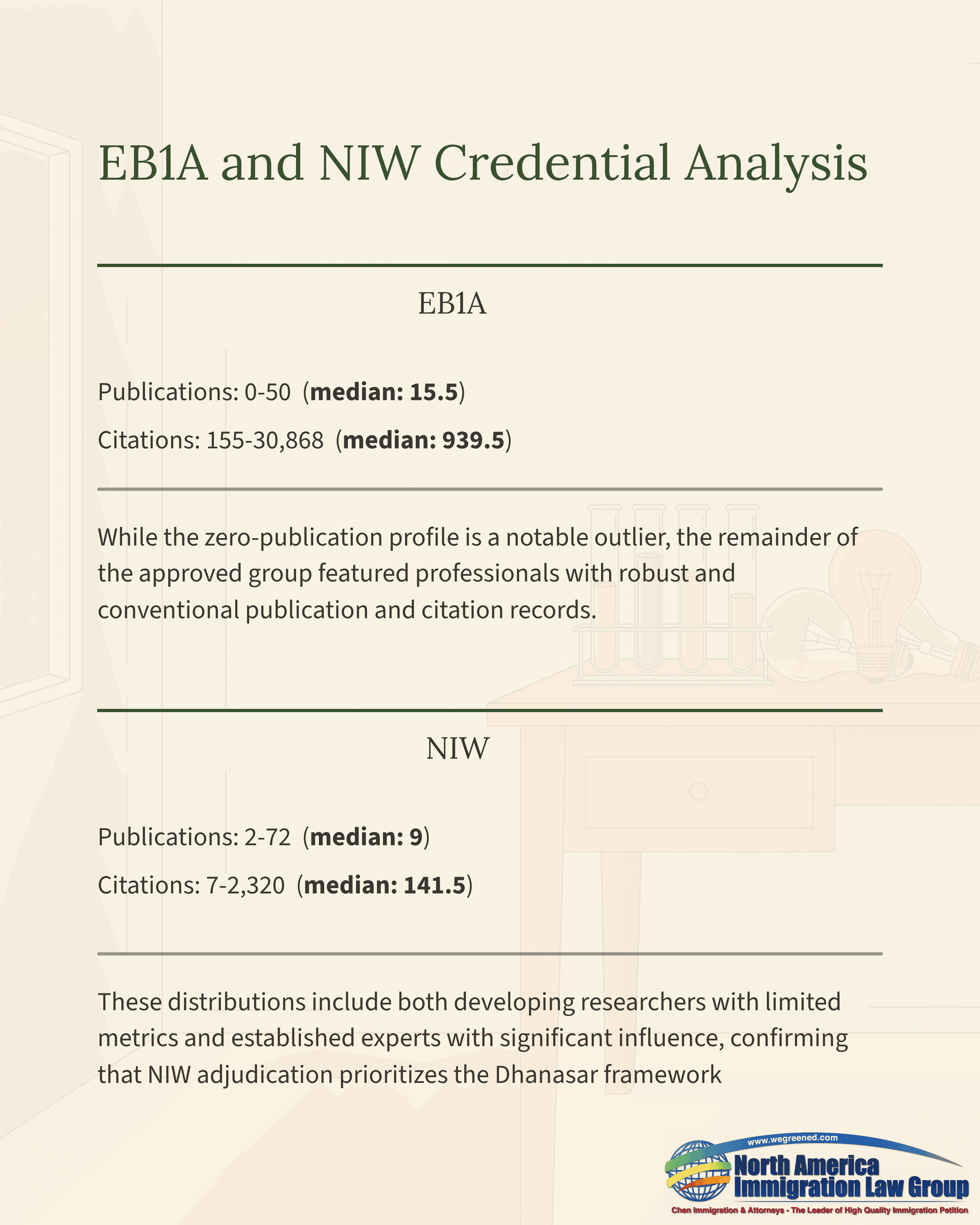
EB1A and NIW Credential Analysis
EB1A petitioners this week showed strong conventional recognition metrics overall, but the group also included an important nontraditional outlier. Publications ranged from 0 to 50 (Q1: 11.75, median: 15.5, Q3: 36.25), while citations ranged from 155 to 30,868 (Q1: 393.25, median: 939.5, Q3: 2,567.25). The zero-publication profile demonstrates that EB1A eligibility does not require traditional publishing metrics when alternative evidence proves a petitioner's influence and field-level standing. While this case is a notable outlier, the remainder of the approved group featured professionals with robust and conventional publication and citation records.
NIW approvals again reflected a considerably broader evidentiary spectrum. Publications ranged from 2 to 72 (Q1: 6, median: 9, Q3: 14), while citations ranged from 7 to 2,320 (Q1: 56.5, median: 141.5, Q3: 286.25). These distributions include both developing researchers with limited metrics and established experts with significant influence, confirming that NIW adjudication prioritizes the Dhanasar framework—the proposed endeavor and its national importance, the petitioner’s positioning to advance that endeavor, and the overall benefit of waiving the job offer and labor certification requirements—rather than relying on fixed publication or citation thresholds.
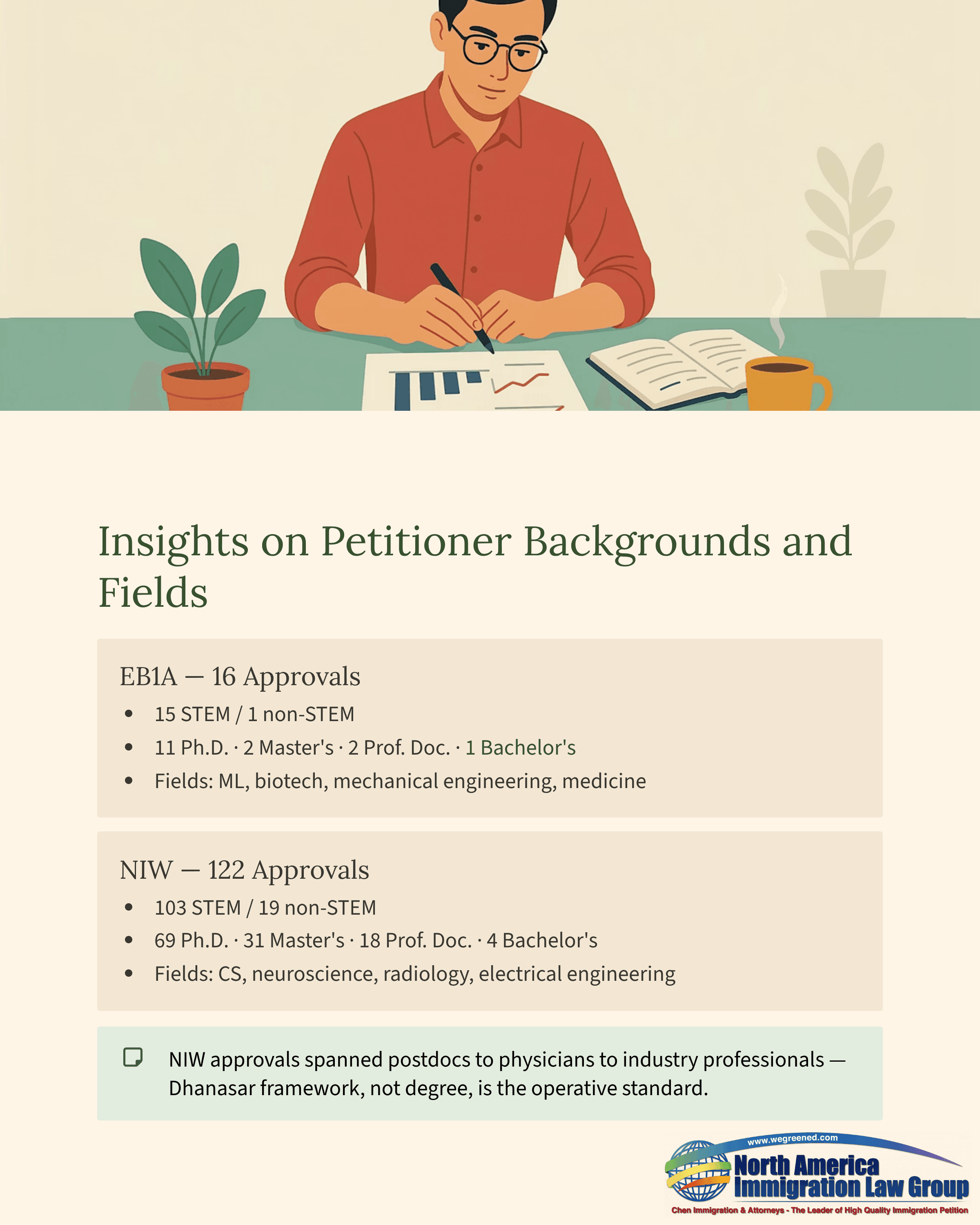
Insights on Petitioner Backgrounds and Fields
EB1A approvals this week were overwhelmingly STEM-oriented, with 15 STEM approvals and 1 non-STEM approval. Approved fields included machine learning, mechanical engineering, biotechnology, and medicine. The approved group included research scientists, faculty members, and other industry-facing technical professionals. The degree mix was also notable: the group included 11 Ph.D. holders, 2 master’s-level petitioners, 2 professional doctorate holders, and 1 bachelor’s-level petitioner. The bachelor’s-level approval is particularly instructive because it shows that advanced academic degrees are not themselves a prerequisite for EB1A when the overall evidence demonstrates extraordinary ability and sustained recognition.
NIW approvals were similarly STEM-heavy but substantially broader in educational background and career stage, with 103 STEM approvals and 19 non-STEM approvals. Major approved fields included computer science, electrical engineering, neuroscience, radiology, and mathematics. The degree mix included 69 Ph.D. holders, 31 master’s-level petitioners, 18 professional doctorate holders, and 4 bachelor’s-level petitioners. Approved petitioners included postdoctoral researchers, physicians, and industry professionals, demonstrating the considerably wider range of professional pathways represented in NIW approvals. USCIS evaluates the proposed endeavor and the petitioner’s positioning under the broader Dhanasar framework.
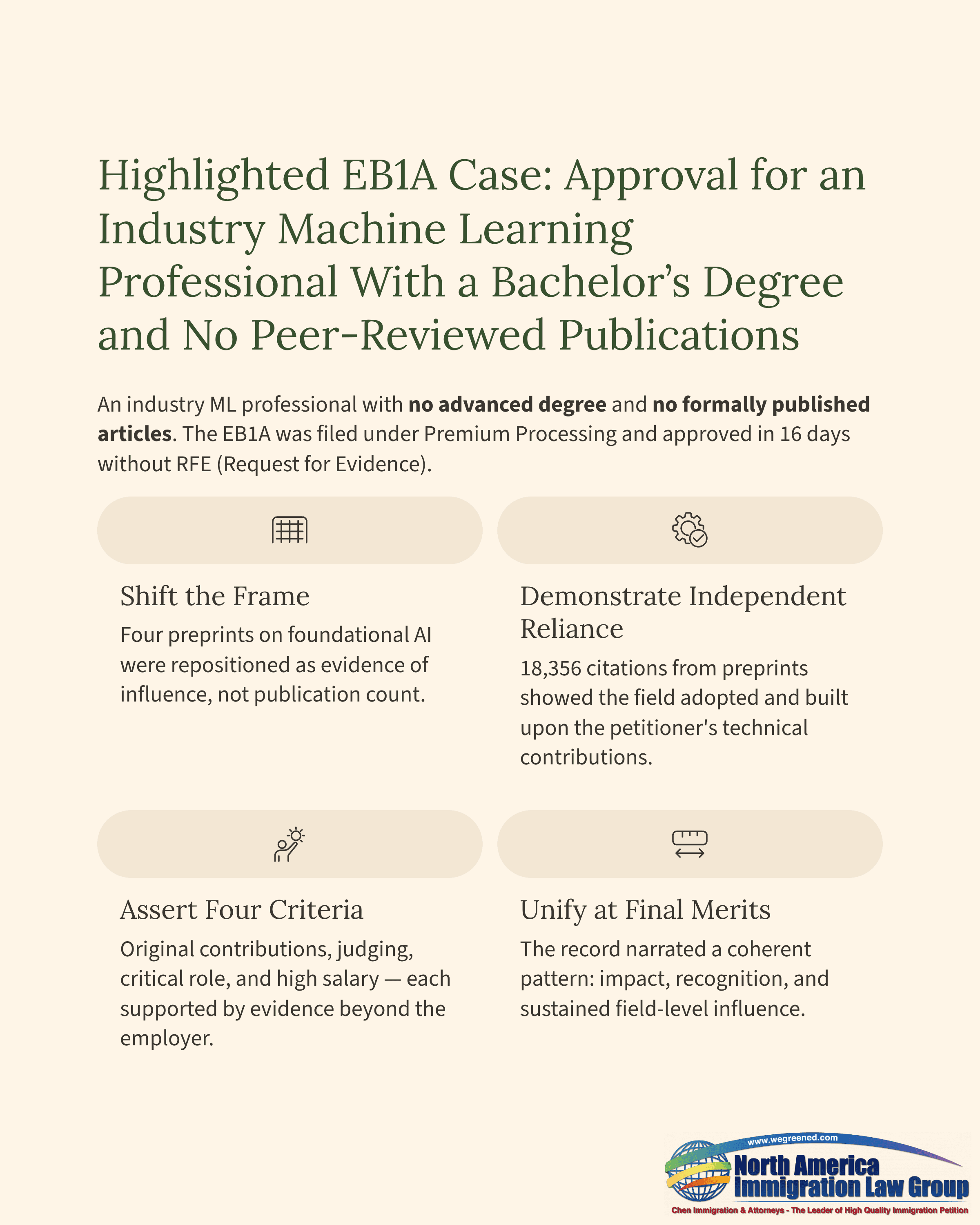
Highlighted EB1A Case: Approval for an Industry Machine Learning Professional With a Bachelor’s Degree and No Peer-Reviewed Publications
One of this week’s most notable EB1A approvals involved an industry machine learning professional with a bachelor’s degree, 0 peer-reviewed publications, and 18,356 citations. The petition letter separately documented four co-authored preprints concerning foundational AI models and long-context reasoning. This presented an unusual evidentiary profile because the petitioner lacked both an advanced degree and the conventional portfolio of peer-reviewed publications commonly associated with research-oriented EB1A cases.
Our strategy did not treat the mere existence of these preprints as proof of extraordinary ability. Because a preprint does not carry the same peer-review validation as a formally published scholarly article, the stronger evidence was what happened to the work after it became publicly available. The petition emphasized the extraordinary citation impact associated with the petitioner’s work and showed how independent researchers relied on the underlying technical contributions. It further connected the petitioner’s innovations in foundational and multimodal AI systems to adoption and real-world implementation. In other words, the argument shifted the focus from publication status to independently demonstrated influence.
This approach was particularly important given the petitioner’s bachelor’s degree, industry-based career, and lack of peer-reviewed publications. The petition asserted four regulatory criteria—original contributions of major significance, judging the work of others, leading or critical role for a distinguished organization, and high salary or remuneration—and used several forms of evidence to establish recognition beyond the petitioner’s immediate employer. Technical adoption and independent reliance supported the significance of the petitioner’s original contributions, while peer-review activity, technical leadership, and independent expert opinions provided complementary evidence of professional standing. Rather than trying to make an industry profile resemble a traditional academic record, the petition demonstrated extraordinary ability through the forms of impact most relevant to applied machine learning.
Finally, the petition brought these elements together under the Final Merits Determination. The central argument was not that 18,356 citations, or satisfaction of four regulatory criteria automatically established eligibility. Instead, the record showed a broader pattern: the petitioner developed important technical contributions, independent researchers relied on those contributions, the work achieved substantial influence and implementation, and the petitioner received additional recognition through judging, leadership, and compensation. The petition was filed directly with Premium Processing, and approved in 16 days without Request for Evidence (RFE). This approval illustrates an important lesson for nontraditional EB1A cases: the evidentiary value of research output depends not simply on whether it was formally published, but on the objective evidence showing what influence the work actually achieved.
Adjudication Trends and Policy Observations
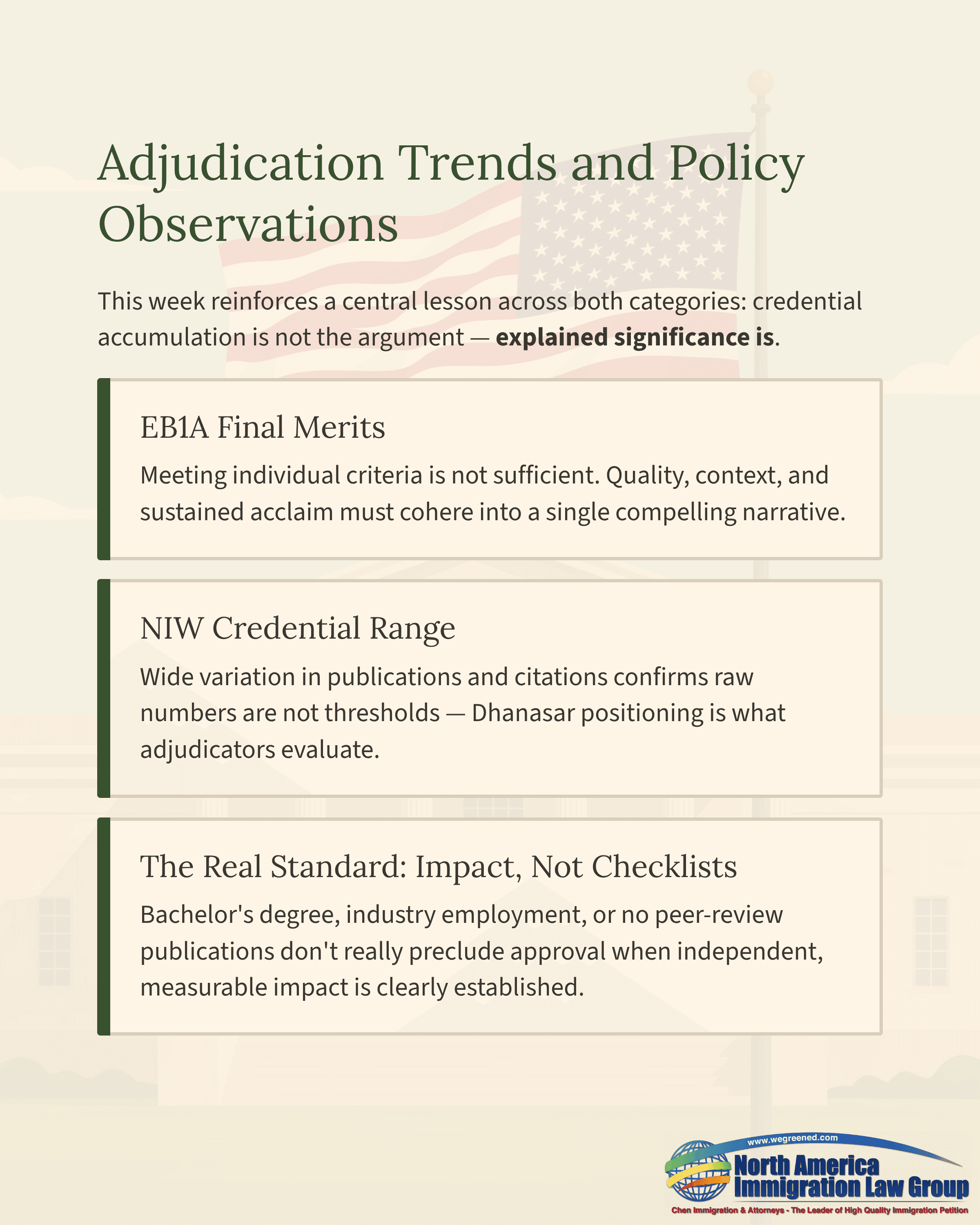
This week’s approvals reinforce the different evidentiary profiles of EB1A and NIW. EB1A cases generally showed stronger recognition metrics, while NIW approvals covered a much broader spectrum of publication counts, citations, career stages, and educational backgrounds. At the same time, broader recent commentary on EB1A adjudication has emphasized that meeting individual criteria should not be treated as a checklist: the quality, context, and significance of the evidence, and whether the total record demonstrates sustained acclaim, remain central to the Final Merits Determination.
The highlighted case demonstrates exactly why that distinction matters. A bachelor’s degree, industry employment, or an unconventional publication record does not by itself determine the outcome; what matters is whether the evidence clearly establishes individual impact and recognition beyond the petitioner’s immediate organization. This aligns with the broader emphasis on measurable impact, independent evidence, and a coherent narrative connecting each achievement to the EB1A standard. For NIW, meanwhile, this week’s wide credential range continues to show why raw publication and citation numbers should not be viewed as fixed thresholds. Across both categories, effective petition strategy depends less on accumulating evidence than on explaining why the evidence matters under the applicable legal standard.