
WeGreened Weekly Approval Summary: Week of June 29, 2026
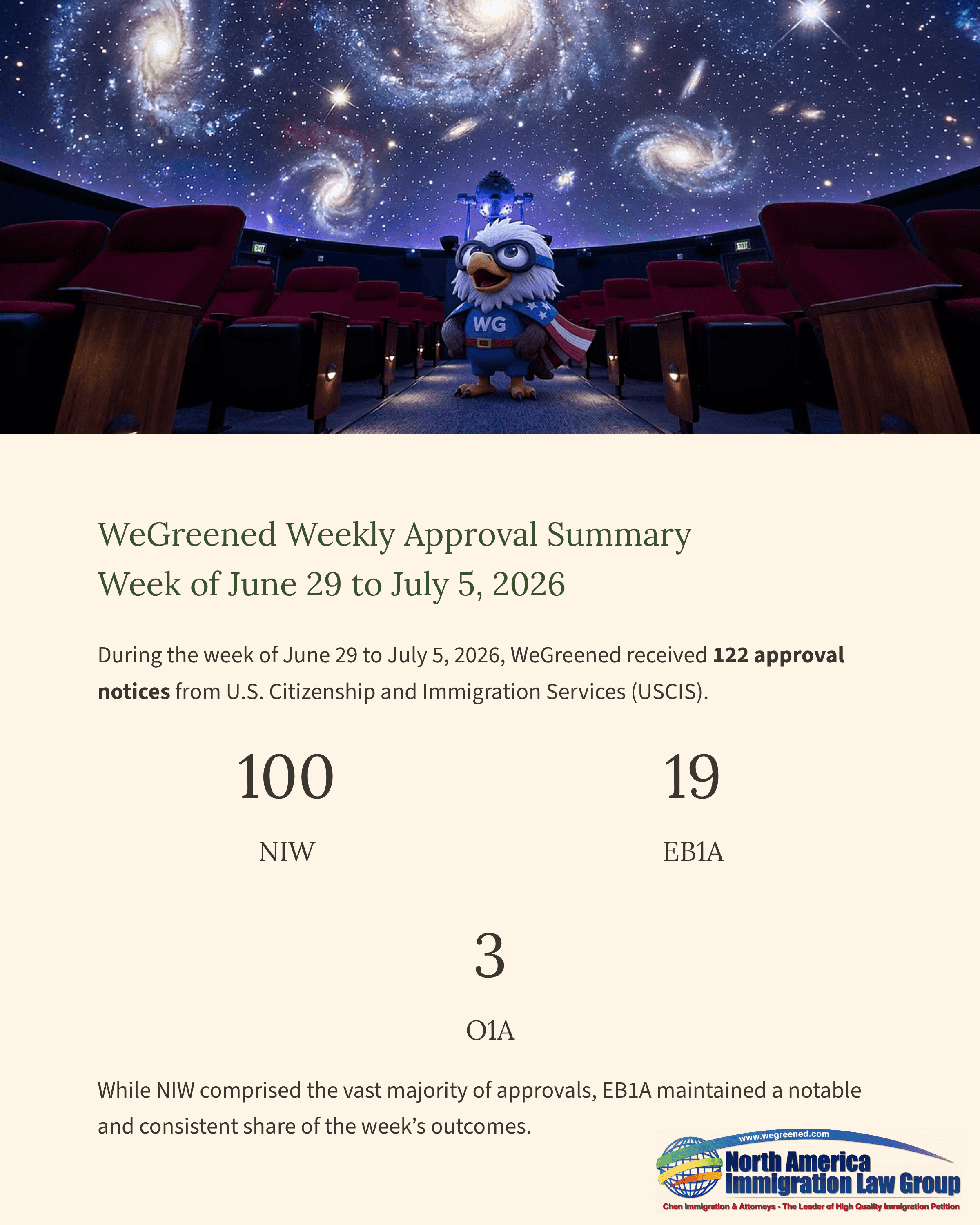
During the week of June 29 to July 5, 2026, WeGreened received 122 approval notices from U.S. Citizenship and Immigration Services (USCIS). Of the 122 approvals, 100 were for NIW (National Interest Waiver), 19 were for EB1A (Alien of Extraordinary Ability), and 3 were for O1A (Individuals with Extraordinary Ability or Achievement).
While NIW comprised the vast majority of approvals, EB1A maintained a notable and consistent share of the week’s outcomes. O1A approvals remained limited, and no EB1B (Outstanding Professors or Researchers) approvals were recorded in this week’s approval batch.
EB1A and NIW Credential Analysis
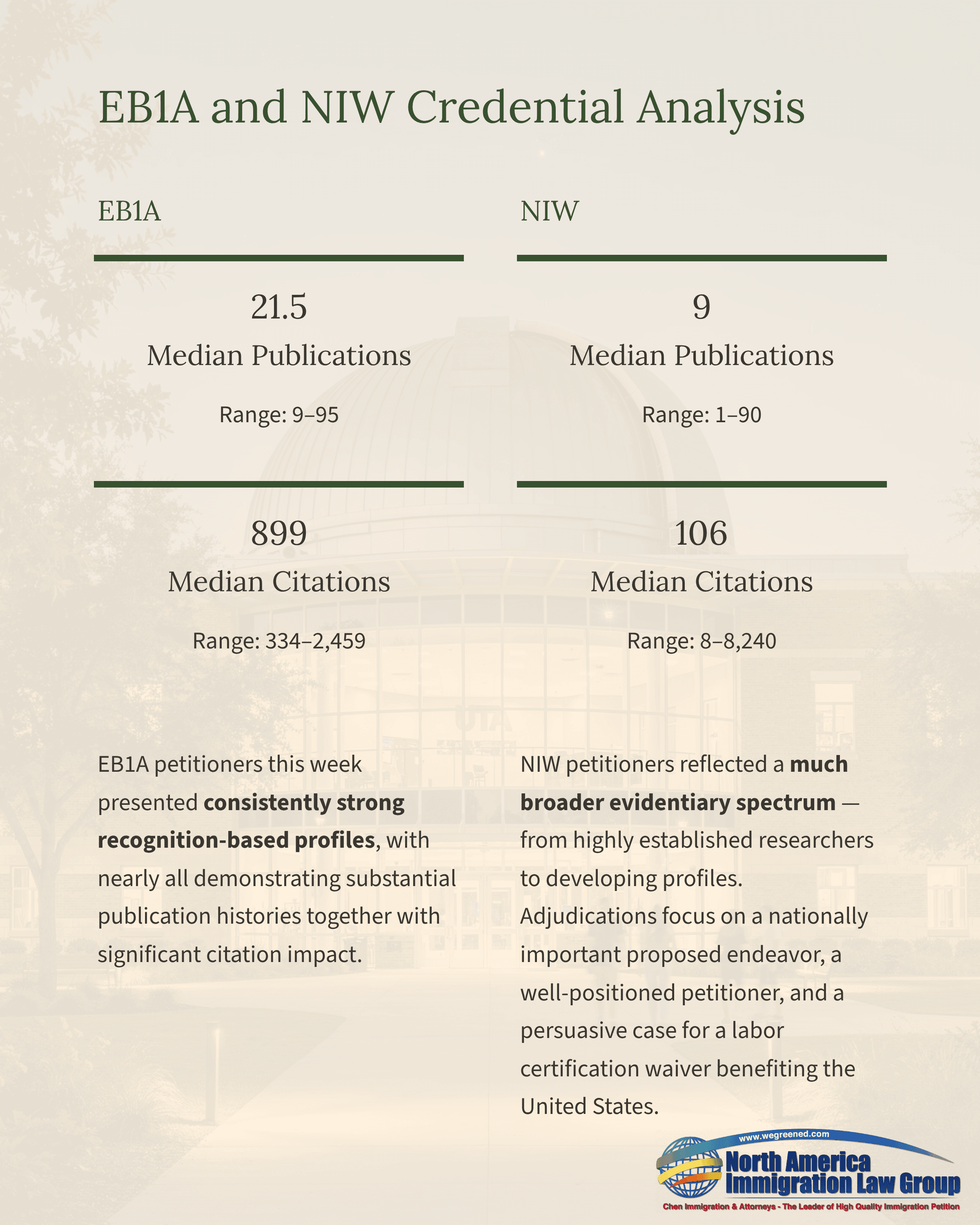
EB1A petitioners this week presented consistently strong recognition-based profiles. Publications ranged from 9 to 95 (Q1: 17.25, median: 21.5, Q3: 31.25), while citations ranged from 334 to 2,459 (Q1: 640.25, median: 899, Q3: 1,654). Compared with recent weeks, the EB1A group remained heavily concentrated in conventionally strong academic records, with nearly all petitioners demonstrating substantial publication histories together with significant citation impact.
NIW petitioners again reflected a much broader evidentiary spectrum. Publications ranged from 1 to 90 (Q1: 5, median: 9, Q3: 13), while citations ranged from 8 to 8,240 (Q1: 52, median: 106, Q3: 313). As in previous weeks, the approved NIW cases included both highly established researchers and developing profiles with relatively modest publication and citation records. The results continue to reinforce that NIW adjudications focus less on numerical metrics alone and more on whether the petition clearly establishes a nationally important proposed endeavor, demonstrates that the petitioner is well positioned to advance that endeavor, and persuasively explains why a labor certification waiver benefits the United States.
Insights on Petitioner Backgrounds and Fields
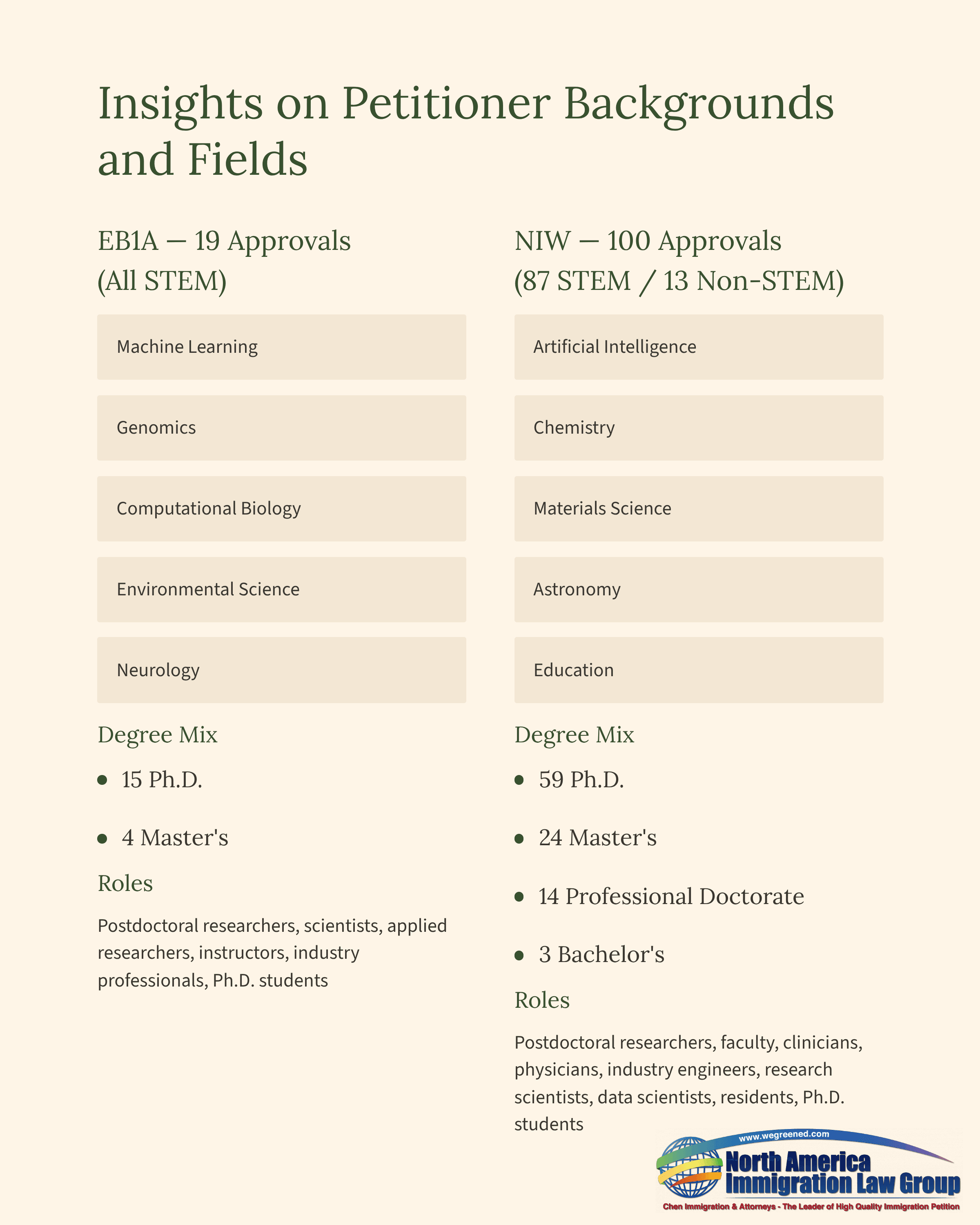
EB1A approvals this week were entirely STEM-oriented, with 19 STEM approvals and no non-STEM approvals. Approved fields included machine learning, genomics, computational biology, pharmacology, molecular biology, environmental science, neurology, and biochemistry. The approved petitioners represented a range of professional backgrounds, including postdoctoral researchers, scientists, applied researchers, instructors, industry professionals, and Ph.D. students. The degree mix consisted of 15 Ph.D. holders and 4 master's-level petitioners, reflecting another week in which EB1A approvals remained concentrated among advanced research profiles with strong records of professional recognition.
NIW approvals again covered a much broader range of disciplines and career stages while remaining predominantly STEM-focused, with 87 STEM approvals and 13 non-STEM approvals. Major approved fields included artificial intelligence, chemistry, materials science, neuroscience, public health, medicine, astronomy, and education. The approved group included postdoctoral researchers, faculty members, clinicians, physicians, industry engineers, research scientists, data scientists, residents, and Ph.D. students. The degree mix was also considerably broader than EB1A, including 59 Ph.D. holders, 24 master's-level petitioners, 14 professional doctorate holders, and 3 bachelor's-level petitioners, reinforcing that NIW continues to accommodate a wide variety of educational and professional backgrounds when the proposed endeavor is clearly tied to important national interests.
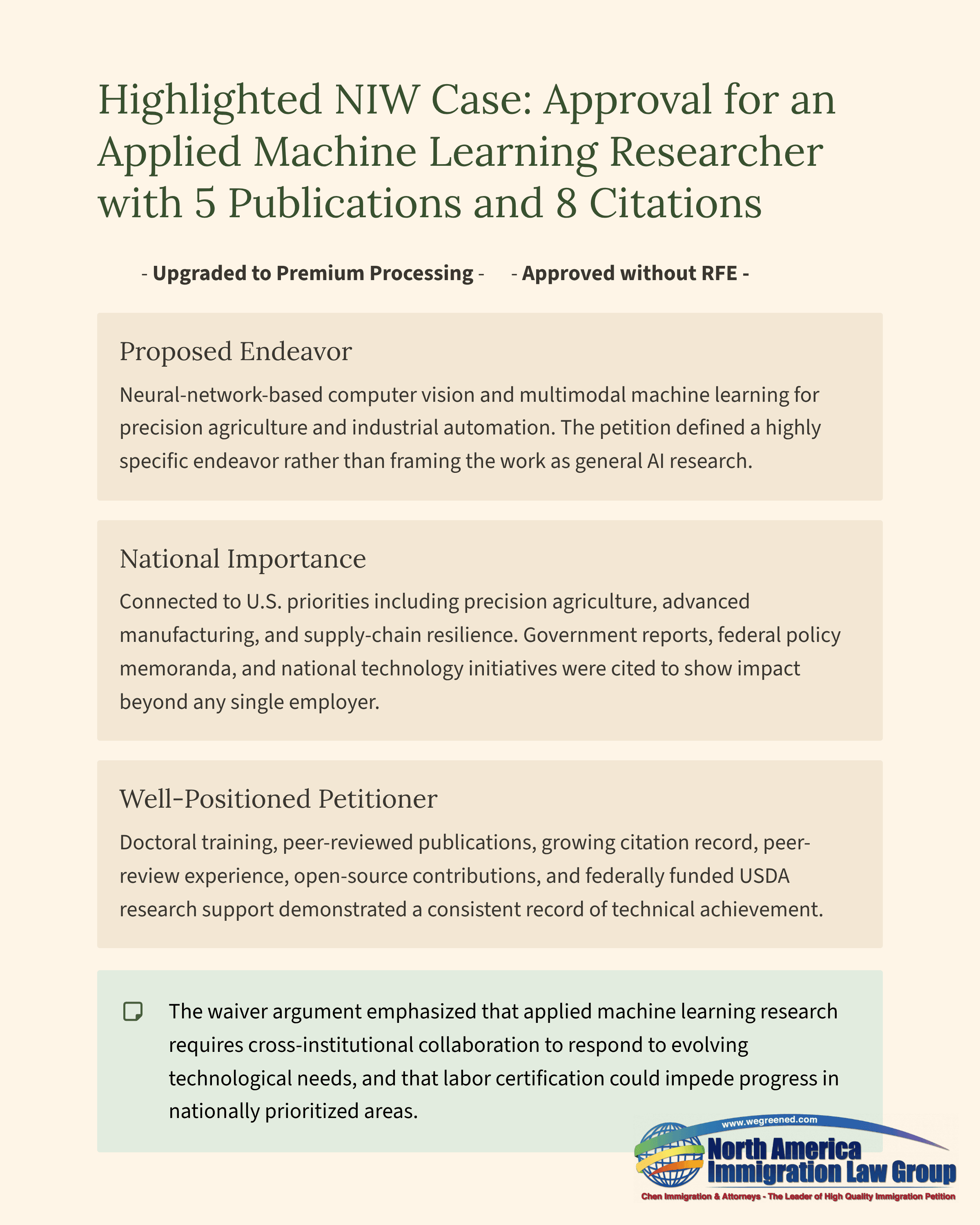
Highlighted NIW Case: Approval for an Applied Machine Learning Researcher with 5 Publications and 8 Citations
This week's highlighted NIW approval involved an applied machine learning researcher whose petition was approved with 5 publications and 8 citations at the time of filing. Rather than relying on traditional citation metrics, the petition centered on the petitioner's proposed endeavor of developing neural-network-based computer vision and multimodal machine learning methodologies for precision agriculture and industrial automation. The case was upgraded to Premium Processing after filing, and approved without Request for Evidence (RFE).
The principal strategy focused on defining a highly specific proposed endeavor instead of presenting the work as general artificial intelligence research. The petition explained how advanced computer vision and multimodal data analysis could improve agricultural automation and industrial monitoring. To establish national importance, the filing connected the research to multiple U.S. priorities, including precision agriculture, advanced manufacturing, and supply-chain resilience. Government reports, federal policy memoranda, and national technology initiatives were incorporated to demonstrate that the proposed work extended well beyond the interests of any individual employer.
The petition established the "well-positioned" prong by showcasing a comprehensive profile of technical accomplishment: doctoral training, peer-reviewed publications, publication quality, growing citation record, peer-review experience, open-source software contributions, and documented influence on subsequent research. We also highlighted federally funded research support from the U.S. Department of Agriculture, illustrating that the petitioner's work had already received recognition through competitive government-sponsored research efforts. Rather than relying on citation volume alone, the filing demonstrated a consistent record of technical achievement and clear future plans to continue advancing the proposed endeavor across both academia and industry.
The subsequent waiver analysis argued that applied machine learning research frequently requires collaboration across research institutions and industry to rapidly respond to evolving technological needs, and that labor certification could unnecessarily impede progress in areas identified as national priorities. This approval demonstrates that even developing research profiles can succeed under NIW when the petition clearly defines the proposed endeavor, connects it to national policy objectives, and organizes the evidence around the legal standards established under the Dhanasar framework rather than focusing primarily on publication or citation metrics.
Adjudication Trends and Policy Observations
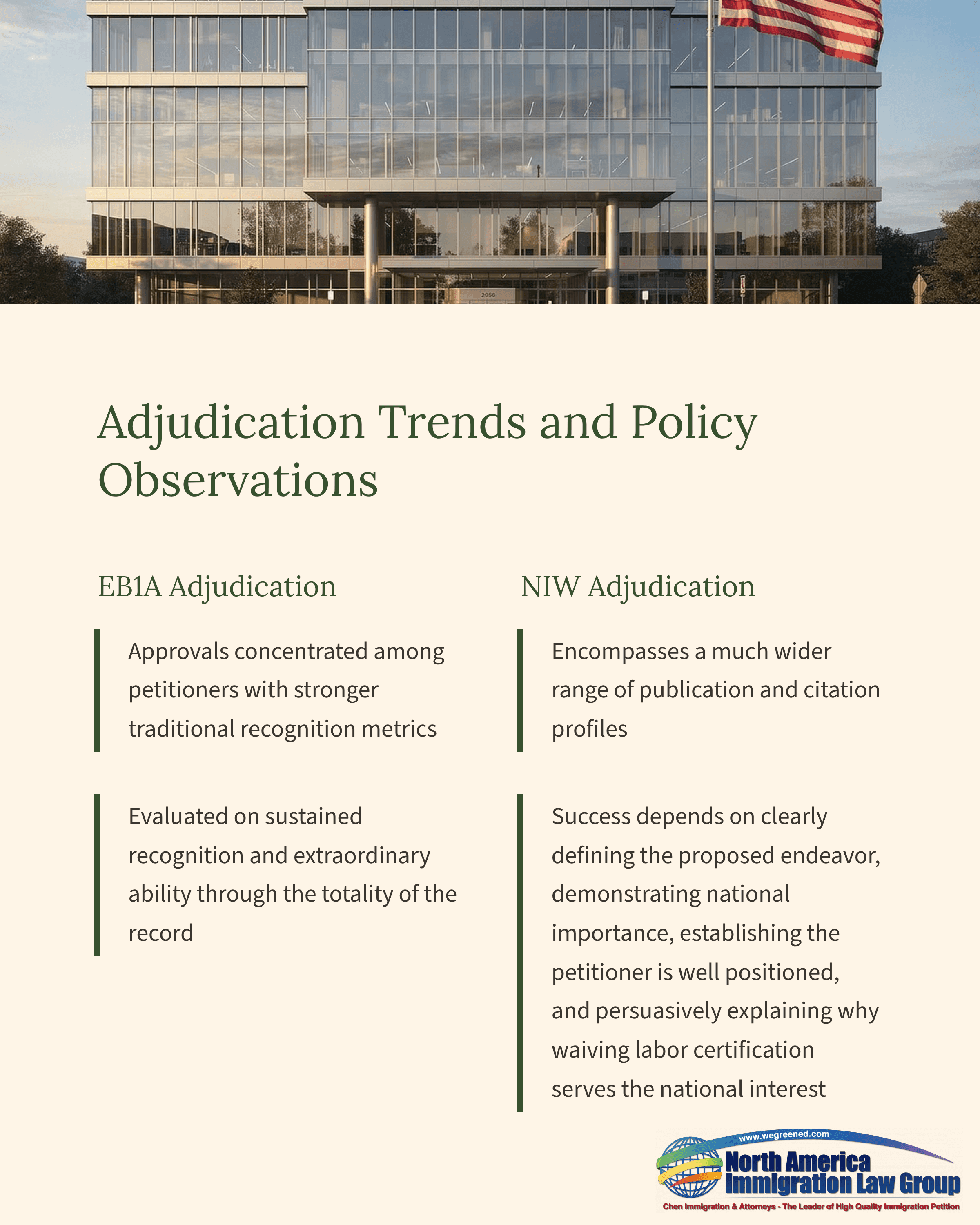
This week's approvals once again reinforce the distinction between EB1A and NIW adjudication standards. EB1A approvals remained concentrated among petitioners with stronger traditional recognition metrics, while NIW continued to encompass a much wider range of publication and citation profiles. The overall approval pattern confirms that USCIS continues to evaluate each category according to its distinct legal framework rather than applying a uniform academic threshold.
The highlighted case is particularly instructive because it demonstrates how lower citation counts can be successfully managed through careful legal framing. Taken together, this week's results continue to show that successful petitions depend on presenting evidence that directly matches the governing legal standard. EB1A petitions remain strongest when they establish sustained recognition and extraordinary ability through the totality of the record. NIW petitions continue to achieve success across a much broader range of credentials when they clearly define the proposed endeavor, demonstrate national importance, establish that the petitioner is well positioned to advance the work, and persuasively explain why waiving the labor certification requirement serves the national interest.