

WeGreened Weekly Approval Summary: Week of May 18, 2026
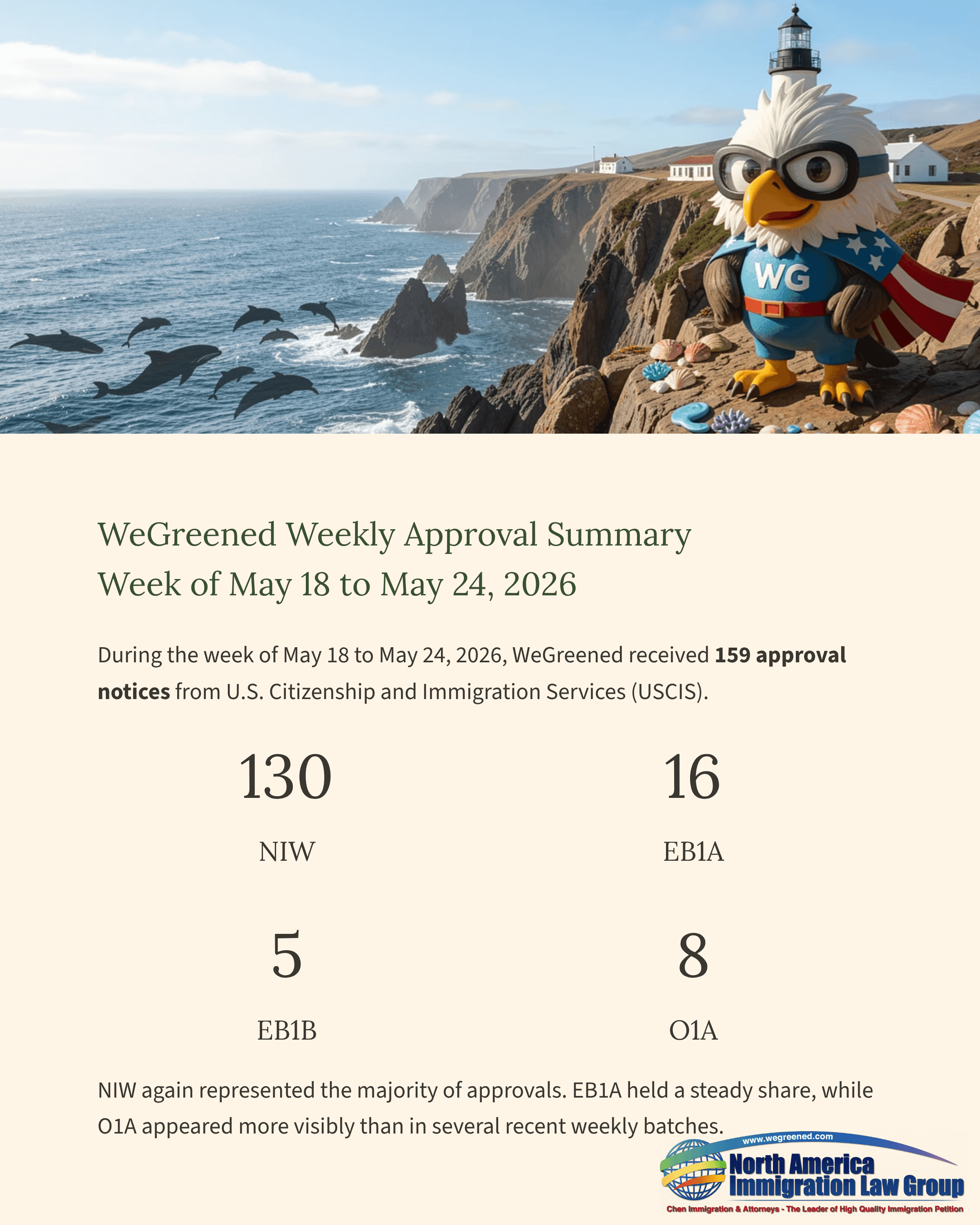


During the week of May 18 to May 24, 2026, WeGreened received 159 approval notices from U.S. Citizenship and Immigration Services (USCIS). Of the 159 approvals, 130 were for NIW (National Interest Waiver), 16 were for EB1A (Alien of Extraordinary Ability), 5 were for EB1B (Outstanding Professors or Researchers), and 8 were for O1A (Individuals with Extraordinary Ability or Achievement).
NIW again represented the majority of approvals this week. EB1A remained a smaller but steady share, while O1A appeared more visibly than in several recent weekly batches.
EB1A and NIW Credential Analysis
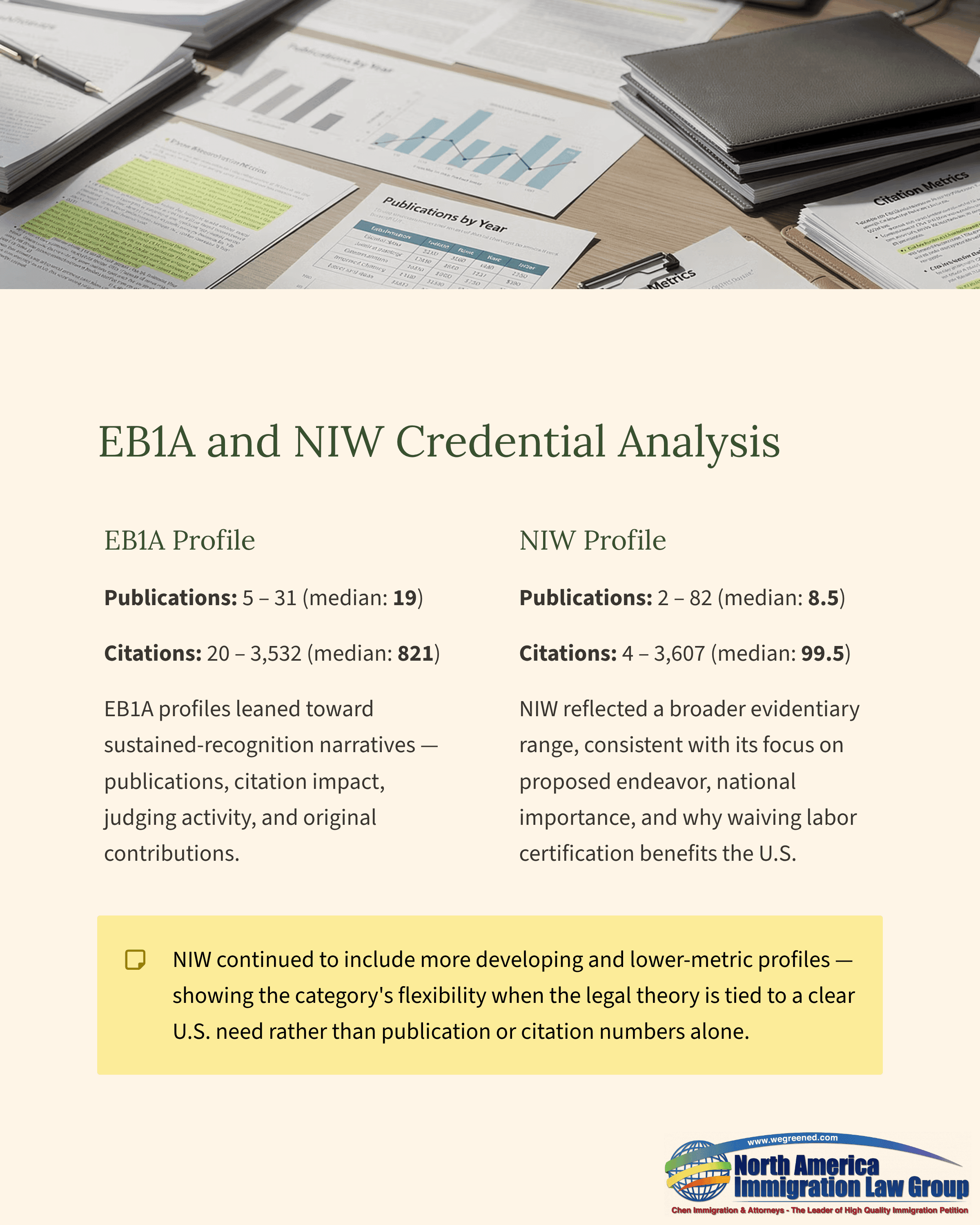
EB1A petitioners this week showed a moderately strong credential profile, with some variation across the group. Publications ranged from 5 to 31 (Q1: 14, median: 19, Q3: 22.5), and citations ranged from 20 to 3,532 (Q1: 248, median: 821, Q3: 1,143.75). Although one approval had a relatively low citation count, the EB1A group overall still leaned toward profiles that could support a sustained-recognition and final-merits narrative through publications, citation impact, judging activity, original contributions, or other field-recognition evidence.
NIW approvals again reflected a broader evidentiary range. Publications ranged from 2 to 82 (Q1: 5, median: 8.5, Q3: 13), and citations ranged from 4 to 3,607 (Q1: 50, median: 99.5, Q3: 271.5). Compared with EB1A, NIW continued to include more developing and lower-metric profiles, which is consistent with the category’s focus on the proposed endeavor, national importance, the petitioner’s ability to advance the work, and why waiving labor certification would benefit the United States.
Insights on Petitioner Backgrounds and Fields
The EB1A group was entirely STEM-designated this week. Approved fields included machine learning, artificial intelligence, computer science, electrical engineering, biotechnology, microbiology, computational biology, geosciences, cancer research, and environmental science. The degree mix was also advanced-degree-heavy, with 14 Ph.D. holders and 2 master’s-level petitioners. Although the group included several industry-facing profiles, the overall pattern still favored records that could be framed around recognized contributions, peer validation, and measurable field impact.
NIW remained strongly STEM-weighted, with 113 STEM approvals and 17 non-STEM approvals. Strong themes included artificial intelligence, computer science, mechanical engineering, materials science, chemistry, neuroscience, clinical medicine, civil and environmental engineering, economics, and ecology. The degree mix was broader than EB1A, including 74 Ph.D. holders, 41 master’s-level petitioners, 13 professional doctorate holders, and 2 bachelor’s-level petitioners. This range again shows that NIW can accommodate different career stages and educational backgrounds when the legal theory is tied to a clear U.S. need rather than to publication or citation numbers alone.
Highlighted EB1A Case: Industry-Based Advanced Computing Professional Approved With 6 Publications and 20 Citations
One of this week’s most instructive approvals was an EB1A case for an industry-based advanced computing professional whose record included 6 publications and 20 citations. The case was notable because it did not follow a traditional academic EB1A profile. The petitioner was not primarily presented as a university researcher with high citation metrics, but as a senior technology leader whose work centered on AI-driven database modernization, query optimization, vector search, open-source infrastructure, and enterprise-scale data systems.
The main challenge was translating industry impact into EB1A language. Instead of relying heavily on citation volume, our filing strategy emphasized objective, field-appropriate evidence of recognition and influence. The petition claimed multiple EB1A criteria, including judging the work of others, high salary, membership in a selective professional organization, and a leading or critical role for a distinguished organization. This allowed the case to be built around a broader record of professional authority, rather than forcing an industry computing profile into a conventional publication-and-citation framework.
For the leading or critical role criterion, the petition focused on the petitioner’s role in a major technology organization and tied that role to concrete product and platform impact. We emphasized leadership over large-scale data and AI initiatives, commercially implemented database improvements, open-source contributions, and agentic AI tools for enterprise database operations. These examples helped show that the petitioner’s contributions were not routine job duties, but were tied to high-value technical outcomes, product modernization, customer-facing capabilities, and broader influence in advanced computing.
The final merits strategy then connected these pieces into one cohesive theory: the petitioner had risen to the top of the field through recognized technical leadership, selective professional membership, peer-review service, high remuneration, and documented influence within major computing systems. This approval is a useful reminder that EB1A can succeed for industry-forward professionals with modest citation records when the petition identifies the correct impact indicators and translates product implementation, open-source adoption, leadership responsibility, and market-facing technical value into a persuasive extraordinary-ability narrative.
Adjudication Trends and Policy Observations
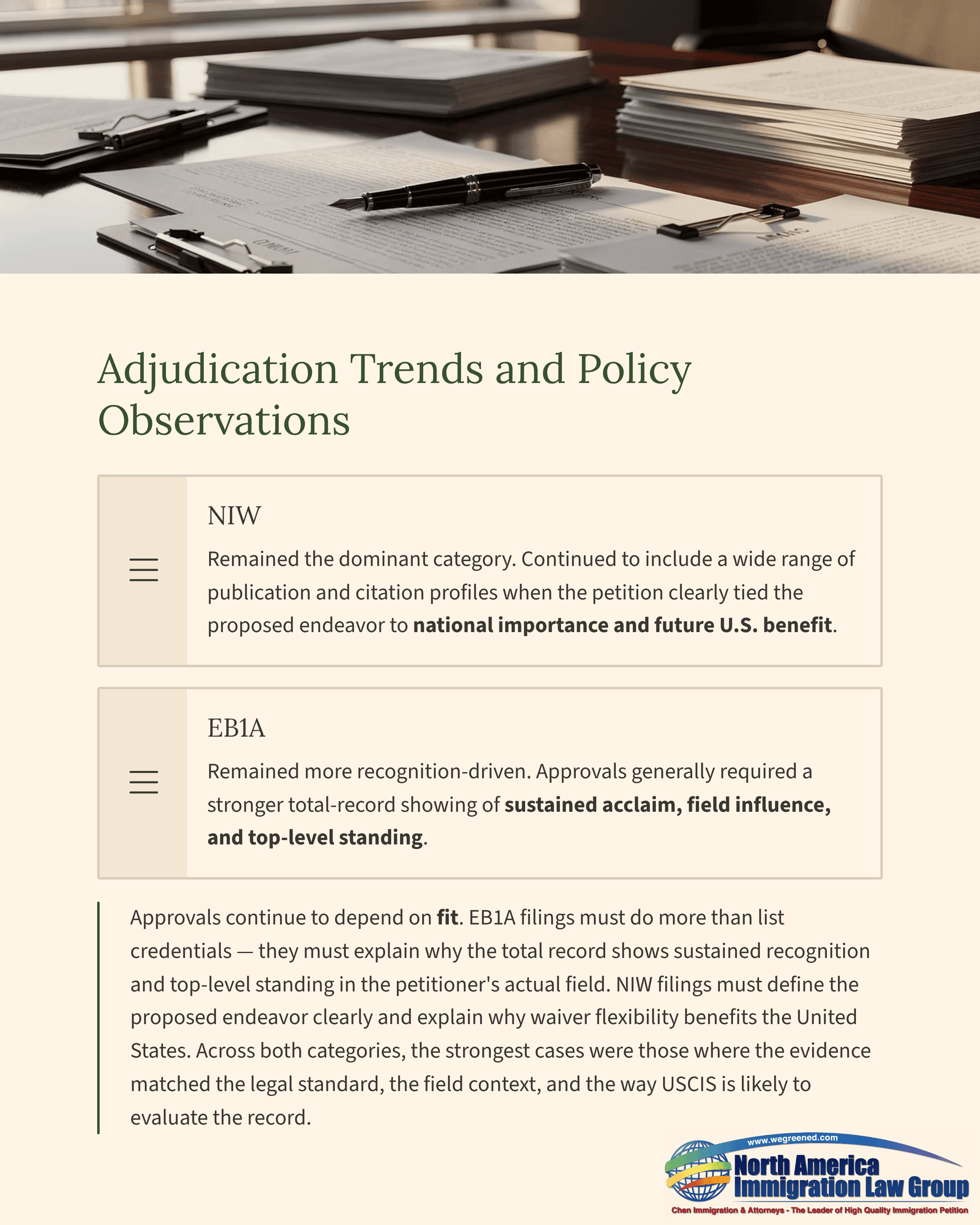
This week’s approvals again show that EB1A and NIW continue to operate under different evidentiary logic. NIW remained the dominant category and continued to include a wide range of publication and citation profiles when the petition clearly tied the proposed endeavor to national importance and future U.S. benefit. EB1A, by contrast, remained more recognition-driven, with approvals generally requiring a stronger total-record showing of sustained acclaim, field influence, and top-level standing.
The highlighted EB1A approval is especially useful because it shows how USCIS can credit nontraditional evidence when the petition is organized around the right legal theory. For industry professionals, especially in advanced computing and AI infrastructure, the most persuasive evidence may come from product implementation, open-source adoption, leadership over major technical systems, selective professional recognition, and high-value industry compensation. These forms of proof can be highly effective when they are connected to the EB1A criteria and then synthesized under final merits.
The broader drafting lesson is that approvals continue to depend on fit. EB1A filings must do more than list credentials; they must explain why the total record shows sustained recognition and top-level standing in the petitioner’s actual field. NIW filings must define the proposed endeavor clearly and explain why waiver flexibility benefits the United States. Across both categories, the strongest cases were those where the evidence matched the legal standard, the field context, and the way USCIS is likely to evaluate the record.