

WeGreened Weekly Approval Summary: Week of May 4, 2026
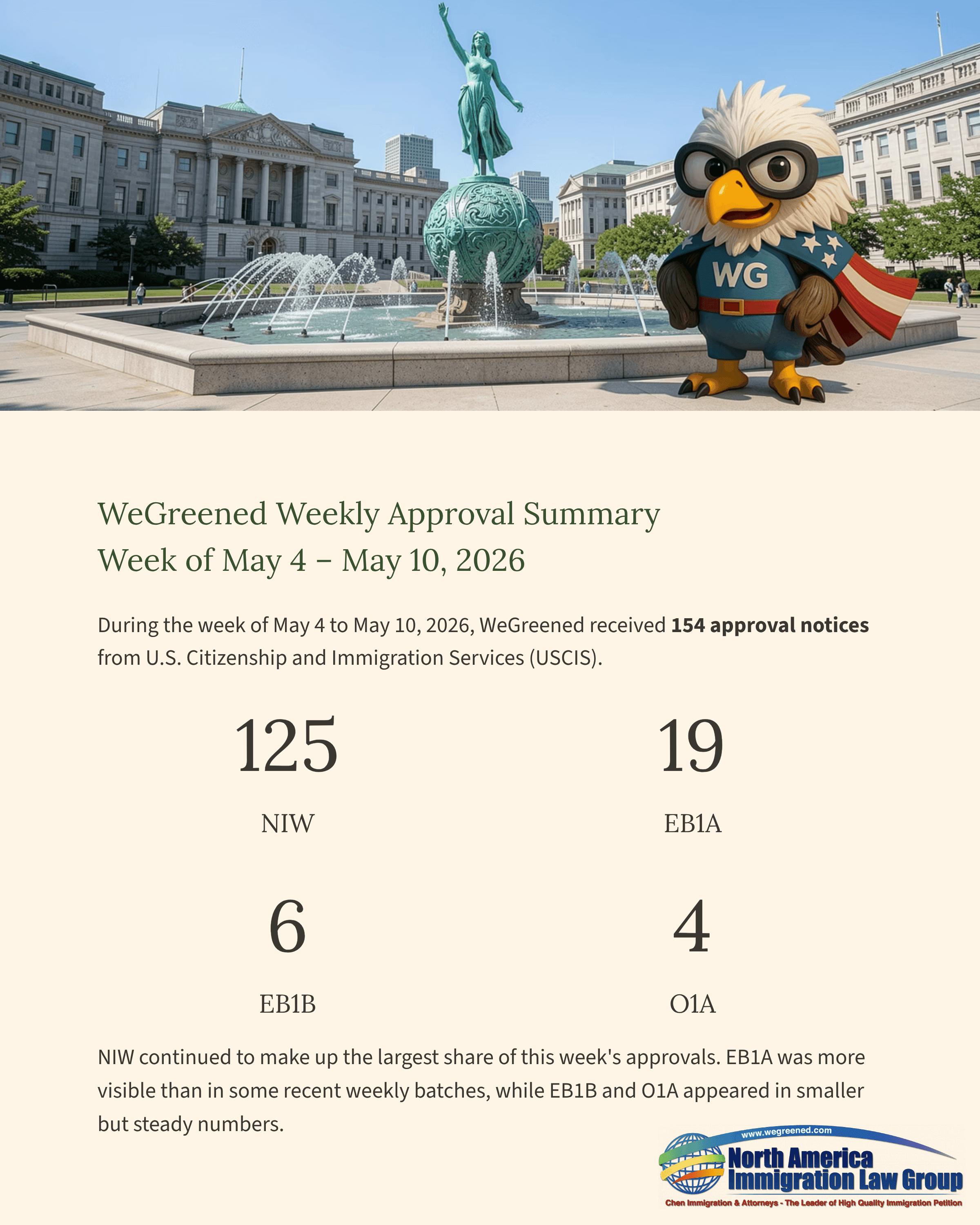
During the week of May 4 to May 10, 2026, WeGreened received 154 approval notices from U.S. Citizenship and Immigration Services (USCIS). Of the 154 approvals, 125 were for NIW (National Interest Waiver), 19 were for EB1A (Alien of Extraordinary Ability), 6 were for EB1B (Outstanding Professors or Researchers), and 4 were for O1A (Individuals with Extraordinary Ability or Achievement).
NIW continued to make up the largest share of this week’s approvals. EB1A was more visible than in some recent weekly batches, while EB1B and O1A appeared in smaller but steady numbers.
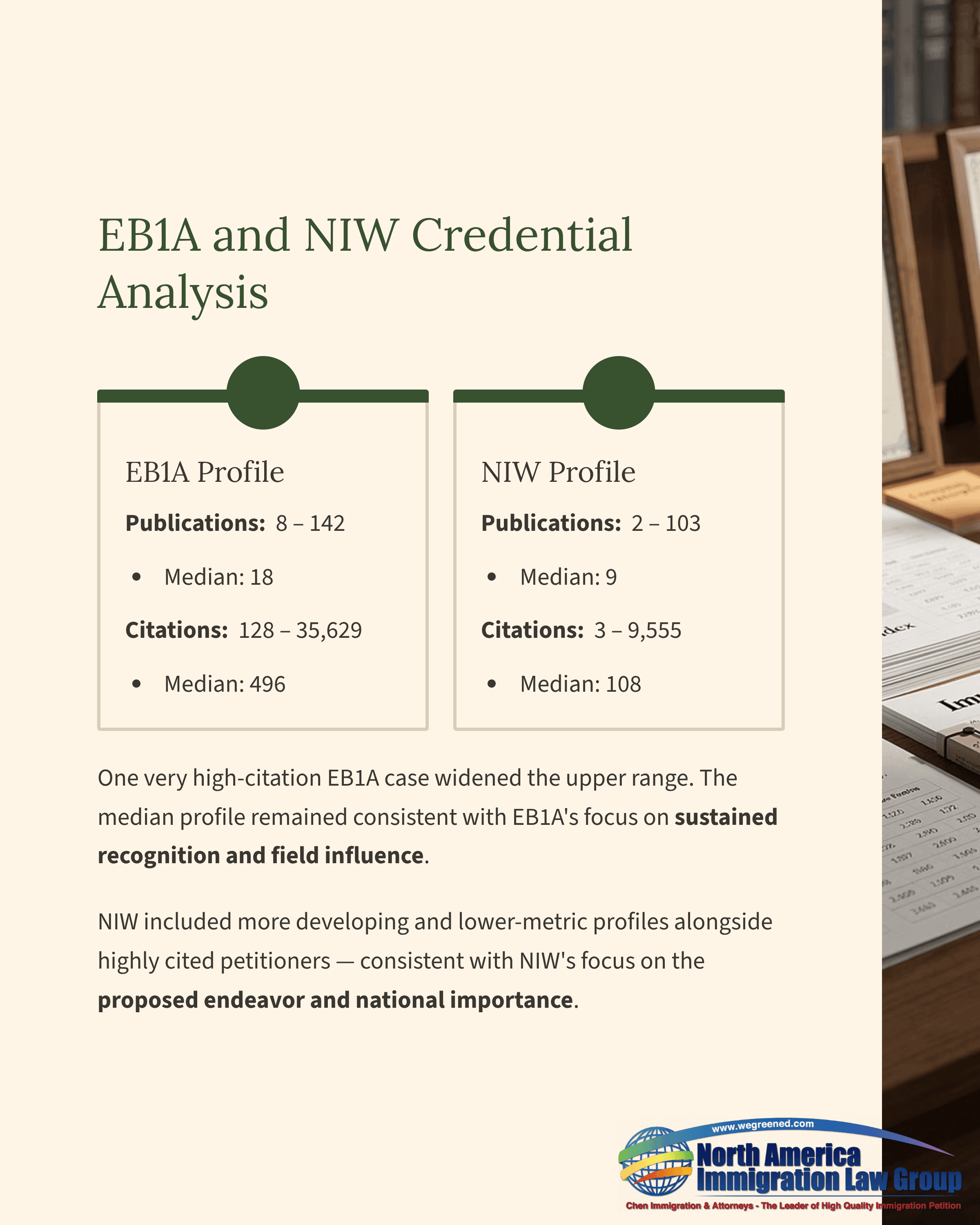
EB1A and NIW Credential Analysis
EB1A petitioners this week showed a generally strong credential profile, with one very high-citation case widening the upper end of the range. Publications ranged from 8 to 142 (Q1: 11, median: 18, Q3: 25), and citations ranged from 128 to 35,629 (Q1: 326, median: 496, Q3: 996). Even with variation across the group, the median profile remained consistent with EB1A’s focus on sustained recognition, field influence, and a record strong enough for final merits review.
NIW approvals again reflected a broader evidentiary range. Among the 125 NIW approvals, publications ranged from 2 to 103 (Q1: 5, median: 9, Q3: 14), while citations ranged from 3 to 9,555 (Q1: 49, median: 108, Q3: 344). Compared with EB1A, NIW continued to include more developing and lower-metric profiles, while also including highly cited petitioners. This spread is consistent with NIW’s focus on the proposed endeavor, national importance, the petitioner’s ability to advance the work, and the benefit of waiving the labor certification requirement.
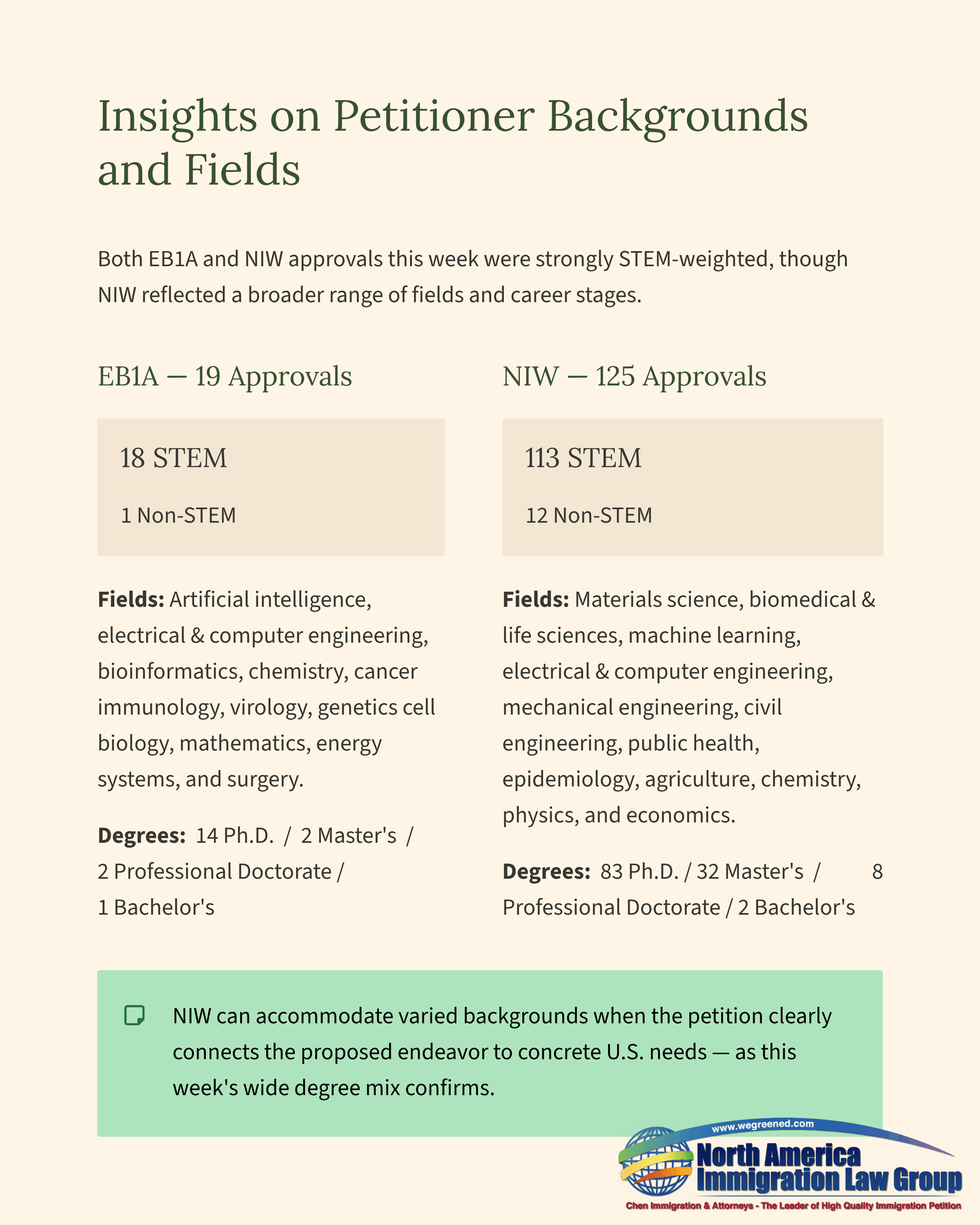
Insights on Petitioner Backgrounds and Fields
EB1A approvals this week were heavily STEM-oriented, with 18 STEM approvals and 1 non-STEM approval. Approved fields included artificial intelligence, medical AI, computer science, electrical and computer engineering, bioinformatics, chemistry, cancer immunology, virology, genetics, biotechnology, cell biology, mathematics, and energy systems, along with one surgery-related non-STEM case. The degree mix remained advanced-degree-heavy, including 14 Ph.D. holders, 2 master’s-level petitioners, 2 professional doctorate holders, and 1 bachelor’s-level petitioner. Overall, EB1A approvals continued to favor profiles that could support recognized contributions, sustained influence, and a strong final merits presentation across different professional settings.
NIW approvals were broader across both field and career stage, while still strongly STEM-weighted, with 113 STEM approvals and 12 non-STEM approvals. Major themes included materials science, biomedical and life sciences, AI, machine learning, data science, electrical and computer engineering, mechanical engineering, civil and structural engineering, public health, epidemiology, agriculture, chemistry, physics, economics, energy-related work, and autonomous systems. The degree mix was also wider than EB1A, including 83 Ph.D. holders, 32 master’s-level petitioners, 8 professional doctorate holders, and 2 bachelor’s-level petitioners, reinforcing that NIW can accommodate varied backgrounds when the petition clearly connects the proposed endeavor to concrete U.S. needs.
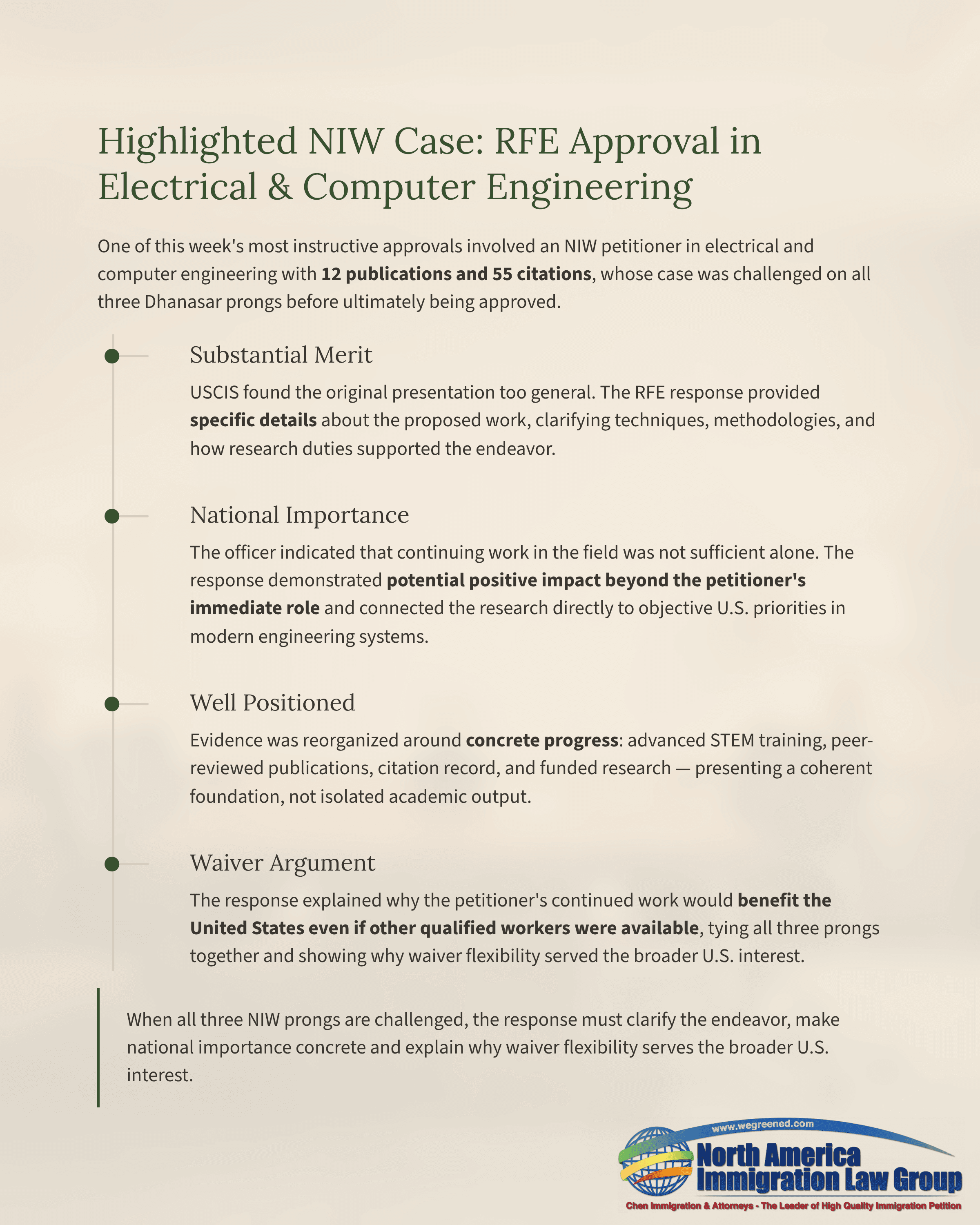
Highlighted NIW Case: Approval After RFE for an Electrical and Computer Engineering Researcher
One of this week’s most instructive approvals was an NIW case in electrical and computer engineering involving 12 publications and 55 citations. The proposed endeavor focused on advancing nonlinear dynamical system analysis and control-related tools with applications in modern engineering systems. Although the petitioner had a Ph.D. and a coherent research record, the case became more complex after USCIS challenged all three Dhanasar prongs, making the approval a useful example of how a carefully structured RFE response can turn a broadly questioned case into a successful one.
The main issue was not that the endeavor lacked value, but that USCIS found the original presentation too general. For substantial merit, the officer wanted more specific information about the proposed work. For national importance, the officer indicated that continuing work in the field was not enough by itself; the response needed to show potential positive impact beyond the petitioner’s immediate role, explain the relevant techniques and methodologies more clearly, and clarify how the petitioner’s research duties supported the endeavor. Our strategy therefore focused on sharpening the proposed endeavor and connecting it more directly to objective U.S. priorities, rather than changing the case theory.
For the “well positioned” prong, USCIS treated the record as insufficient and appeared to view the work as adding generally to the pool of knowledge rather than proving the petitioner’s specific ability to advance the endeavor. In response, we reorganized the evidence around concrete progress: advanced STEM training, peer-reviewed publications, citation record, funded research, and examples showing how other researchers had relied on the petitioner’s work. This helped present the record not as isolated academic output, but as a coherent foundation for continued contributions in a nationally important area.
The waiver argument then tied the response together by explaining why the petitioner’s continued work would benefit the United States even if other qualified workers were available. The approval shows that when all three NIW prongs are challenged, the response must do more than restate credentials. It must clarify the endeavor, make national importance concrete, show the petitioner’s progress with field-specific evidence, and explain why waiver flexibility serves the broader U.S. interest.
Adjudication Trends and Policy Observations
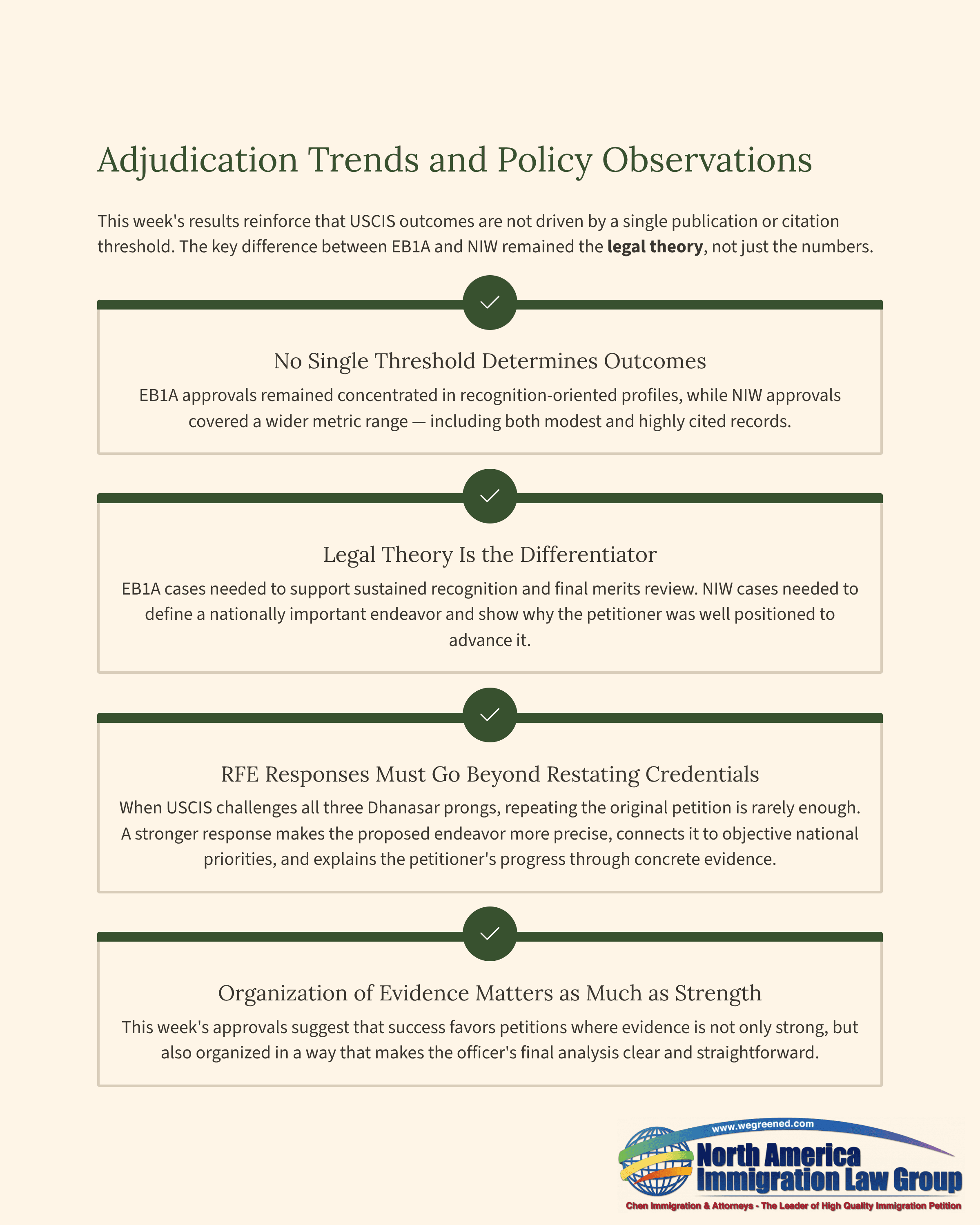
This week’s approvals again show that USCIS outcomes are not driven by a single publication or citation threshold. EB1A approvals remained more concentrated in recognition-oriented profiles, while NIW approvals covered a wider range of metrics, including both modest and highly cited records. The key difference remained the legal theory: EB1A cases needed to support sustained recognition and final merits review, while NIW cases needed to define a nationally important endeavor and show why the petitioner was well positioned to advance it.
The highlighted NIW approval also reinforces an important drafting lesson for RFE responses. When USCIS challenges all three Dhanasar prongs, repeating the original petition is rarely enough. A stronger response must make the proposed endeavor more precise, connect it to objective national priorities, explain the petitioner’s progress through concrete evidence, and show why the waiver benefits the United States on balance. This week’s results suggest that approvals continue to favor petitions where the evidence is not only strong, but also organized in a way that makes the officer’s final analysis clear.