

WeGreened Weekly Approval Summary: Week of September 14 to September 20, 2026
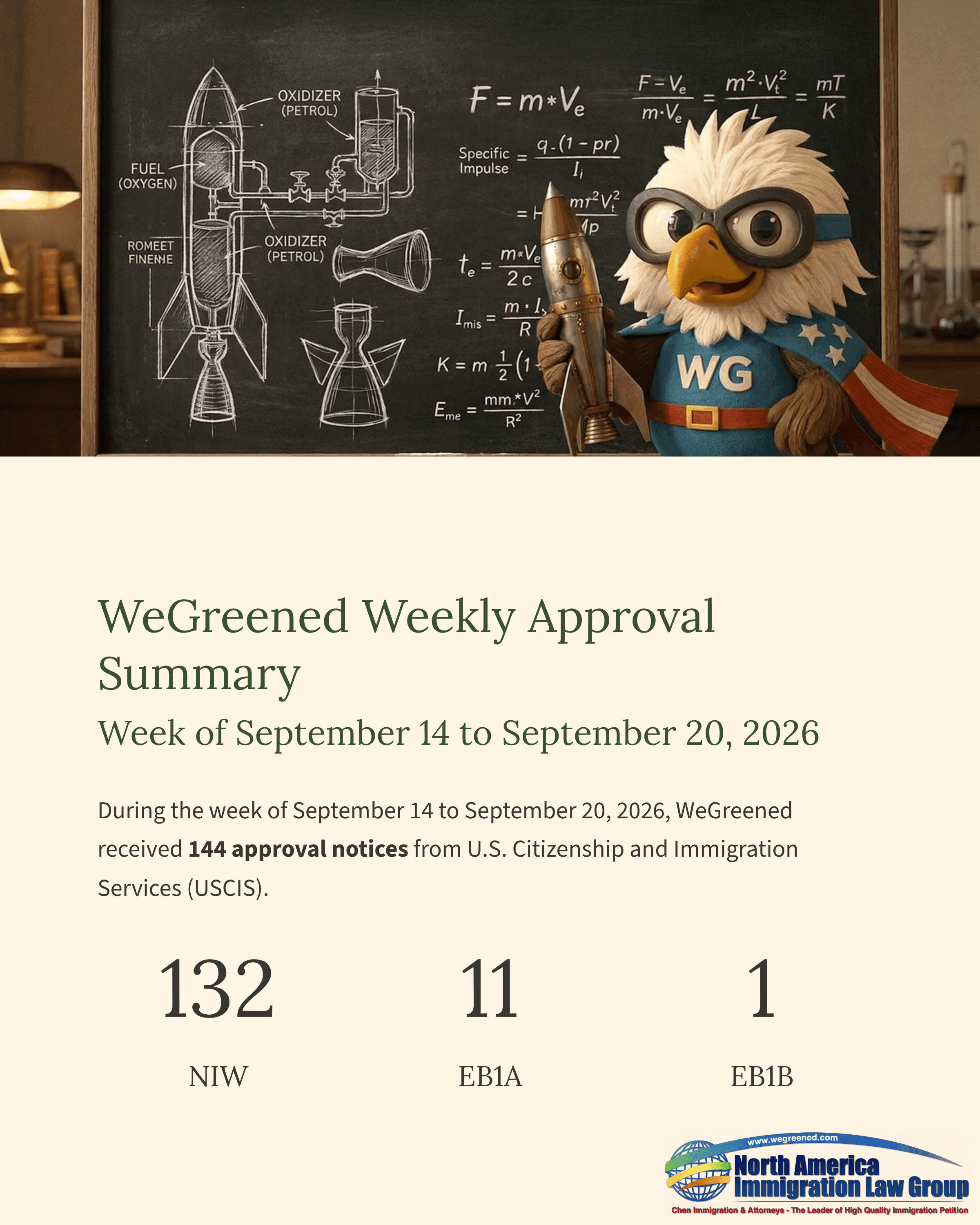
During the week of September 14 to September 20, 2026, WeGreened received 144 approval notices from U.S. Citizenship and Immigration Services (USCIS). Of these approvals, 132 were for NIW (National Interest Waiver), 11 were for EB1A (Alien of Extraordinary Ability), and 1 was for EB1B (Outstanding Professors or Researchers).
EB1A and NIW Credential Analysis
EB1A publications ranged from 8 to 63 (Q1: 10.5, median: 17, Q3: 29), while citations ranged from 353 to 15,907 (Q1: 519.5, median: 1,067, Q3: 3,908.5). A distinctive feature of this week’s group was that the applicant with the most publications also had the fewest citations. The highest citation total belonged to a different applicant in computational biology. These contrasting records show why publication volume and citation impact should be examined separately, particularly when comparing different disciplines.
NIW publications ranged from 1 to 180 (Q1: 5, median: 8, Q3: 15), while citations ranged from 4 to 6,250 (Q1: 49, median: 105.5, Q3: 292). The middle half of the group had 5 to 15 publications and 49 to 292 citations. The maximum publication count came from particle physics, while the highest citation count came from biochemistry. Neither upper extreme represented the typical record in this week’s NIW approvals.
Insights on Petitioner Backgrounds and Fields
The EB1A group included 10 STEM approvals and 1 non-STEM approval. The petitioners included 7 Ph.D. holders, 1 master’s-level petitioner, 1 petitioner with a medical qualification, and 2 bachelor’s-level petitioners. Research staff and fellows formed the largest employment group with five approvals. Three cases involved doctoral students, including the two bachelor’s-level petitioners. This combination is a reminder to distinguish a person’s current educational stage from the degree already held when evaluating their professional record.
NIW’s largest employment group was students and graduate trainees, with 41 approvals, followed by 28 postdoctoral researchers. The largest field cluster, biomedical, clinical, and public health, also contained 41 cases, but its composition was quite different: 11 clinical or residency profiles, 10 postdoctoral researchers, and 10 students, alongside other roles. This mix shows why a field label alone cannot describe the professional experience behind an approval. Overall, NIW included 112 STEM and 20 non-STEM approvals. The petitioners included 63 Ph.D. holders, 47 master’s-level petitioners, 21 with medical, veterinary, or pharmacy qualifications, and one who filed before obtaining an advanced degree.
Highlighted NIW Case: Energy-Storage Researcher Approved With 4 Citations
This week’s highlighted NIW approval involved an energy-storage researcher with a master’s degree and four citations at filing. The petition documented one peer-reviewed journal article and two conference papers, all first-authored. The proposed work focused on evaluating underground hydrogen storage options to diversify energy resources and reduce energy waste. We initially filed the petition under regular processing and later upgraded it to premium processing. USCIS approved the petition without issuing a Request for Evidence (RFE).
To explain national importance, our team connected the specific storage problem to broader U.S. energy needs. We described how identifying suitable underground formations and assessing their storage performance could support more reliable energy infrastructure. The petition linked the research plan to federal hydrogen initiatives and explained why findings from particular storage locations could have value beyond the immediate study area, rather than relying only on the general importance of clean energy.
To demonstrate the applicant’s ability to advance the work, we connected relevant engineering training and completed research to concrete plans for modeling, testing, and evaluating storage sites. The filing paired three recommendation letters with a testimonial letter supporting planned research and collaboration. We also discussed how other researchers had referenced the applicant’s findings in studies of underground storage. Each form of evidence served a different purpose: documenting preparation, explaining research relevance, or corroborating future plans.
Finally, we explained why waiving the job offer and labor certification requirements would support the continuation of this specialized work. The argument emphasized the applicant’s relevant expertise, research collaborations, and plans to share findings beyond a single employer. This approval illustrates an approach centered on a defined technical problem, demonstrated progress, and a practical research plan, rather than a large citation total.
Adjudication Trends and Policy Observations
Students, graduate trainees, and postdoctoral researchers together accounted for 69 of this week’s 132 NIW approvals, slightly more than half of the group. At the same time, the highlighted case was approved with a master’s degree and only four citations. These results show why we do not evaluate NIW readiness simply by asking whether someone has reached a senior academic rank or accumulated a large citation record.
From our firm’s perspective, the more useful question is whether the applicant already has enough evidence to build a complete NIW argument. After confirming the underlying EB2 qualification, we assess the proposed endeavor’s substantial merit and national importance, the applicant’s ability to advance it, and why waiving the job offer and labor certification requirements would benefit the United States. An early-career applicant may have a shorter publication history or fewer citations, but these metrics need to be evaluated together with the substance of the work, the applicant’s role in it, independent recognition, and a credible plan for what comes next. This week’s approvals illustrate why career stage should be treated as context rather than as a shortcut for deciding whether an NIW case is ready.