

WeGreened Weekly Approval Summary: Week of April 27, 2026
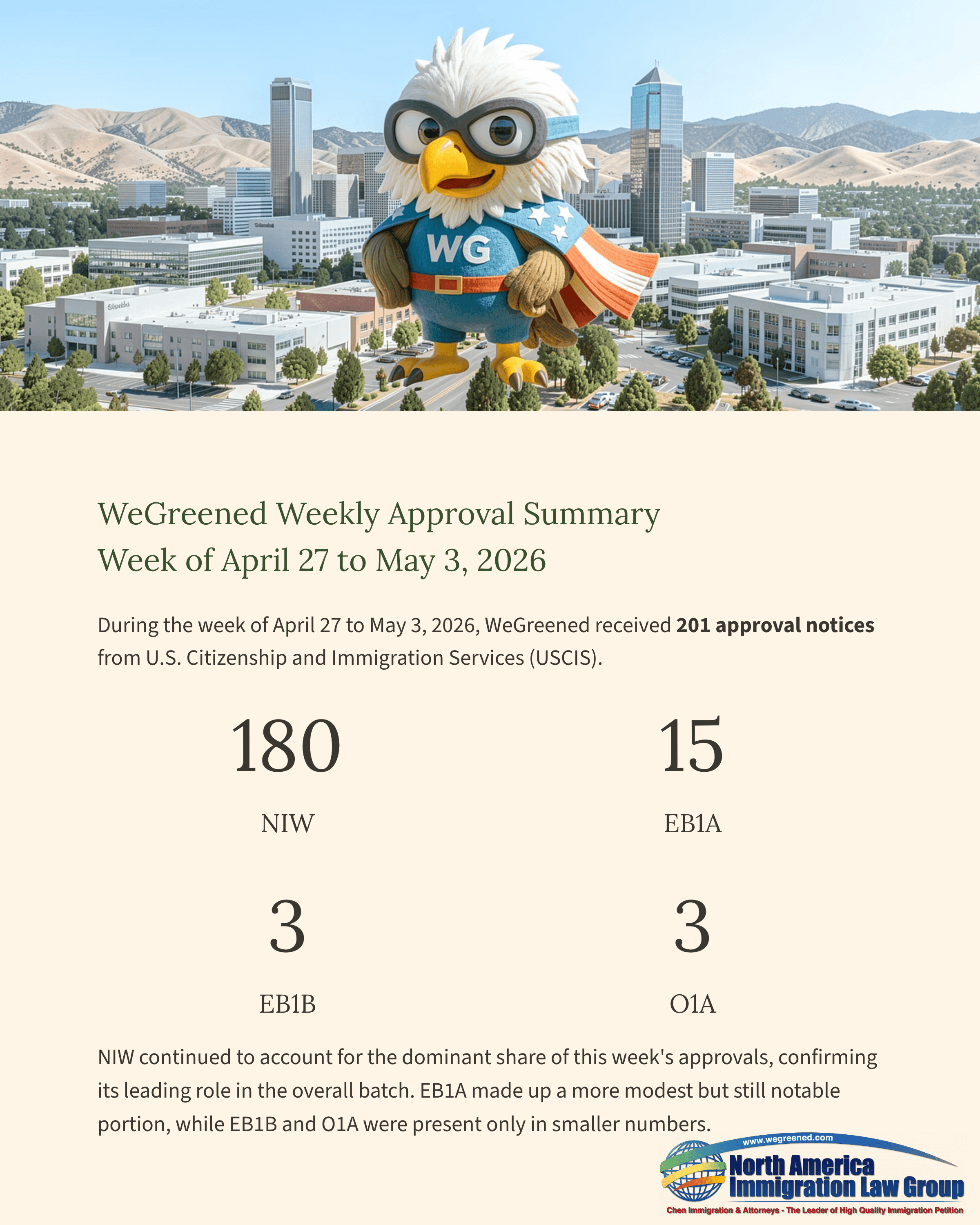
During the week of April 27 to May 3, 2026, WeGreened received 201 approval notices from U.S. Citizenship and Immigration Services (USCIS). Of the 201 approvals, 180 were for NIW (National Interest Waiver), 15 were for EB1A (Alien of Extraordinary Ability), 3 were for EB1B (Outstanding Professors or Researchers), and 3 were for O1A (Individuals with Extraordinary Ability or Achievement).
NIW continued to account for most of this week’s approvals, confirming its dominant role in the overall batch. EB1A made up a more modest but still notable portion, while EB1B and O1A were present only in smaller numbers.
EB1A and NIW Credential Analysis
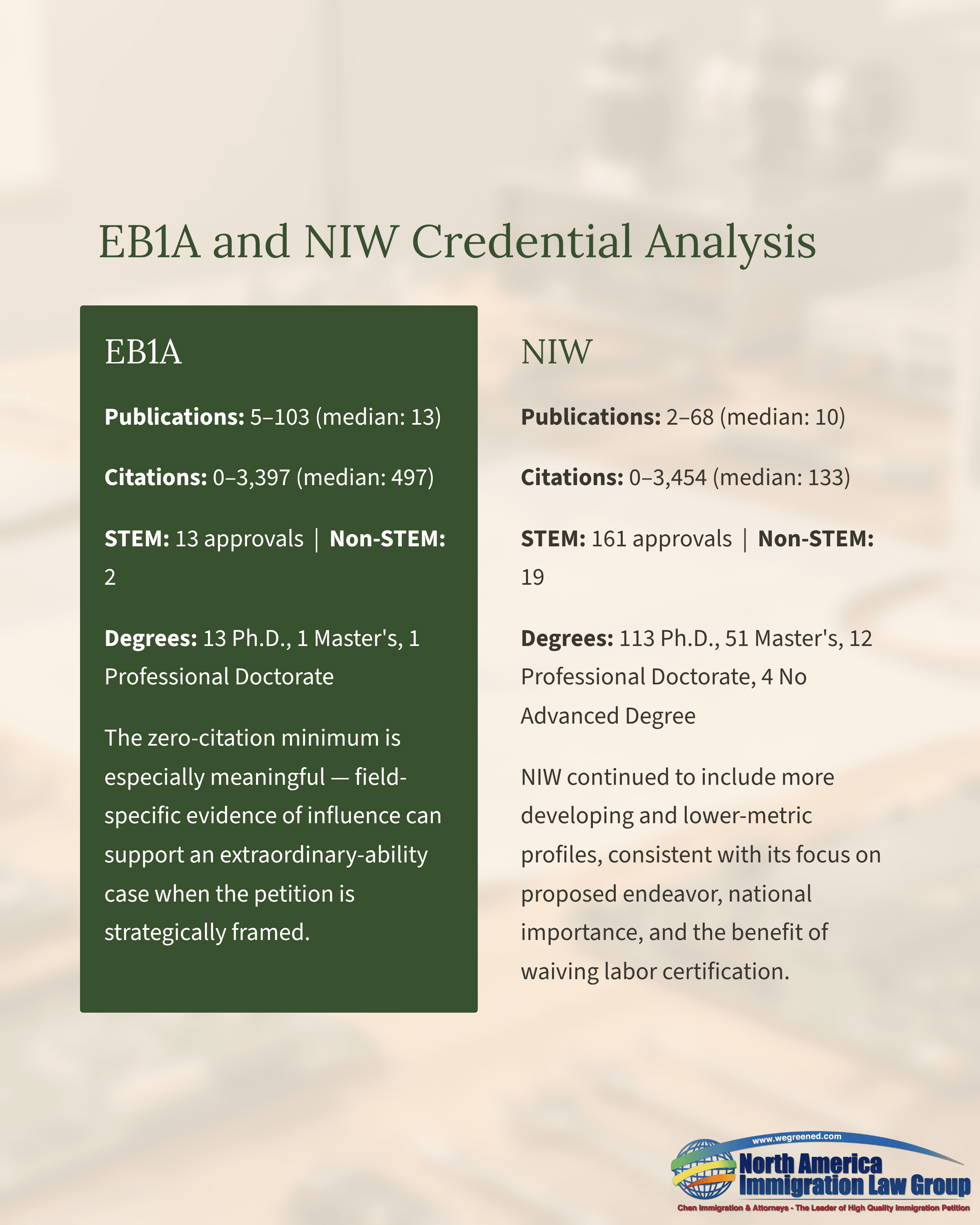
EB1A petitioners this week showed a generally strong credential profile, while still including one notably unconventional approval. Publications ranged from 5 to 103 (Q1: 10.5, median: 13, Q3: 20), and citations ranged from 0 to 3,397 (Q1: 221.5, median: 497, Q3: 1,200). The zero-citation minimum is especially meaningful because EB1A is often associated with stronger traditional recognition metrics, yet this week’s results show that field-specific evidence of influence can also support an extraordinary-ability case when the petition is strategically framed.
NIW approvals again reflected a broader evidentiary range. Publications ranged from 2 to 68 (Q1: 6, median: 10, Q3: 15), and citations ranged from 1 to 3,454 (Q1: 62.75, median: 133, Q3: 359). Compared with EB1A, NIW continued to include more developing and lower-metric profiles, which is consistent with the category’s focus on the proposed endeavor, national importance, the petitioner’s ability to advance the work, and the benefit of waiving labor certification.
Insights on Petitioner Backgrounds and Fields
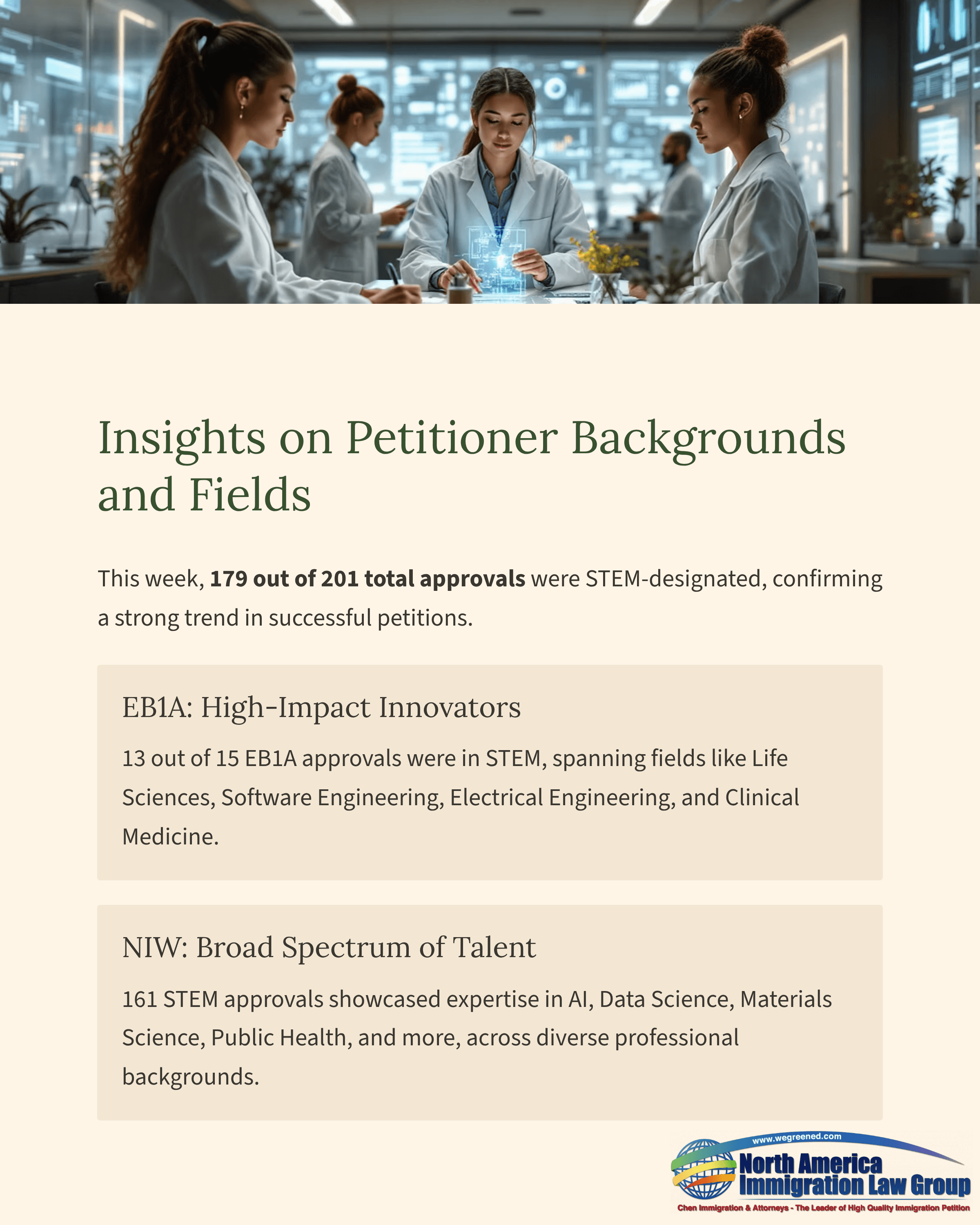
This week’s approvals were strongly STEM-centered, with 179 STEM-designated approvals out of 201 total approvals. EB1A included 13 STEM approvals out of 15, while NIW included 161 STEM approvals and 19 non-STEM approvals. EB1B and O1A also leaned STEM, with approvals in biomedical science, computer science engineering, artificial intelligence, materials science, and plant biology. Across EB1A, the approved cases covered life sciences, software engineering, electrical and computer engineering, mathematics, materials science, physics, earth and ocean sciences, clinical medicine, and biomedical science, showing that EB1A success remained possible across different STEM settings when the record supported recognized contributions and a strong final merits presentation.
Within NIW, the STEM distribution was even broader. Strong themes included AI and machine learning, computer science, data science, electrical and mechanical engineering, civil engineering, materials science, chemistry, environmental work, energy systems, agriculture, biomedical science, clinical medicine, public health, neuroscience, molecular biology, and bioinformatics. The batch included postdoctoral researchers, students, industry professionals, research staff, faculty or teaching professionals, clinicians, and engineers. NIW remained strongly STEM-weighted, with 161 STEM approvals and 19 non-STEM approvals, and showed a broader degree mix of 113 Ph.D. holders, 51 master’s-level petitioners, 12 professional doctorate holders, and 4 no-advanced-degree cases.
Highlighted EB1A Case: Approval With 5 Publications and 0 Citations for a Software Engineering Professional
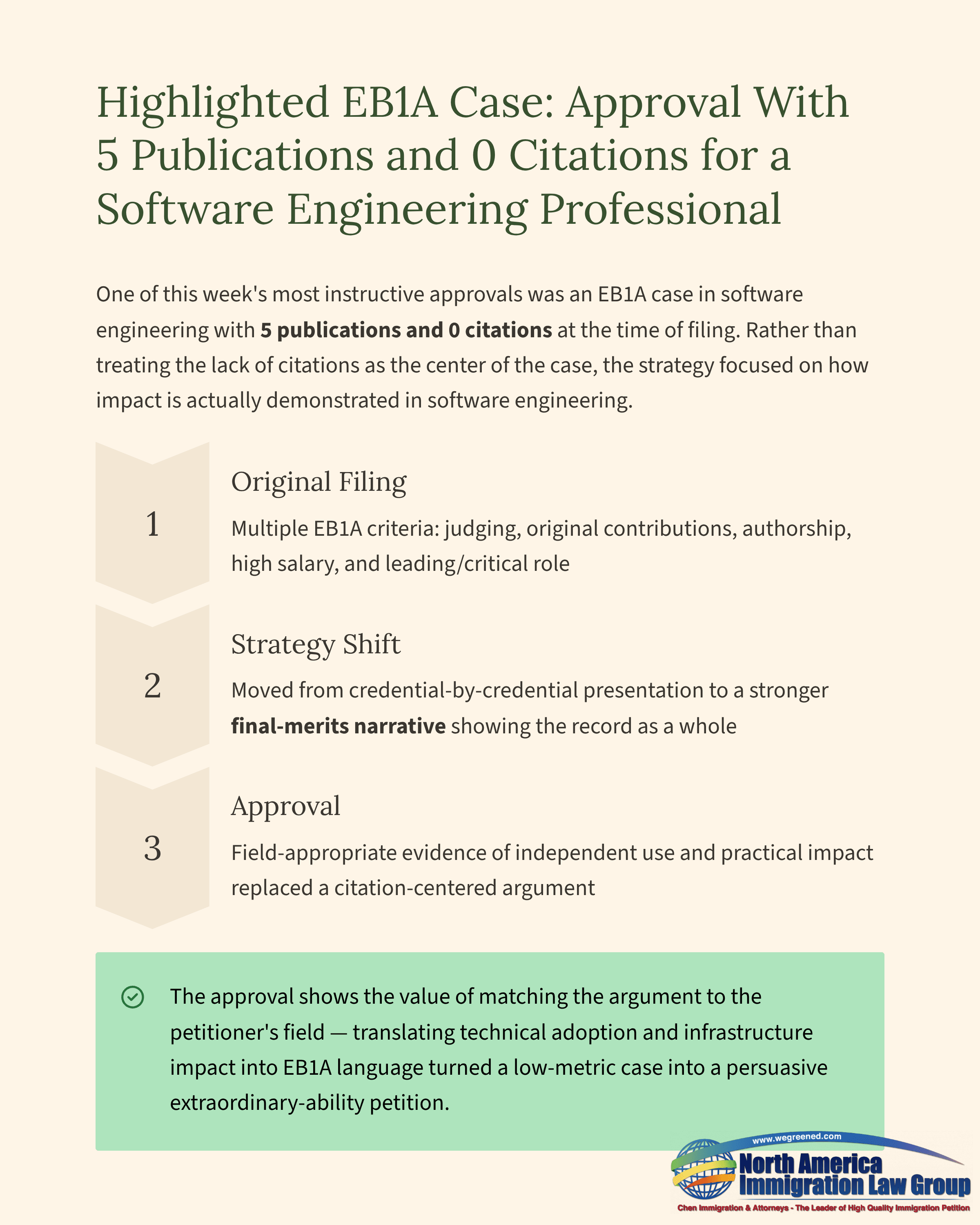
One of this week’s most instructive approvals was an EB1A case in software engineering involving 5 publications and 0 citations at the time of filing. The case was challenging because it did not fit the typical high-citation academic EB1A profile. Rather than treating the lack of citations as the center of the case, our filing strategy focused on how impact is actually demonstrated in software engineering: real-world deployment, open-source adoption, production reliability, and independent technical validation.
In the original filing, we presented multiple EB1A criteria, including judging the work of others, original contributions of major significance, authorship, high salary, and leading or critical role. When the original-contributions and high-salary evidence required further clarification, we adjusted the strategy by shifting the emphasis from a credential-by-credential presentation to a stronger final-merits narrative. The key was to show that the record, viewed as a whole, reflected sustained recognition and top-level influence in the field.
Our response sharpened the legal theory behind the case. For original contributions, we emphasized that major significance in software engineering may be shown through accepted open-source contributions, official release inclusion, large-scale platform usage, adoption metrics, and improvements that affect security, reliability, and operational efficiency for broad user communities. This allowed us to replace a citation-centered argument with field-appropriate evidence of independent use and practical impact.
The approval shows the value of matching the argument to the petitioner’s field rather than forcing an industry software profile into a traditional academic framework. By translating technical adoption, infrastructure impact, and independent validation into EB1A language, our team turned a seemingly difficult low-metric case into a persuasive extraordinary-ability petition.
Adjudication Trends and Policy Observations
This week’s approval data should be read against a broader EB1A environment in which public analyses of USCIS data have reported fluctuating EB1A approval rates, with growing attention on how officers apply the final merits determination. That context makes this week’s highlighted EB1A approval especially instructive: Although the petitioner had 5 publications and 0 citations, the case succeeded because the strategy did not stop at meeting baseline criteria. It focused on whether the evidence, viewed as a whole, could show sustained recognition, field-level influence, and prospective benefit to the United States. This approach aligns with the current adjudication pressure: simply satisfying three criteria may not be enough if the final merits narrative is not coherent and persuasive.
This week’s broader results show the same need for careful category-specific framing. The practical lesson is that both NIW and EB1A categories now reward petitions that make the officer’s final analysis clear: NIW filings must connect the proposed endeavor to national importance and future U.S. benefit, while EB1A filings must translate the petitioner’s achievements into sustained acclaim and top-level standing. For nontraditional profiles, especially industry-based software engineering cases, objective impact evidence such as open-source adoption, production deployment, critical-role documentation, and measurable technical implementation can be decisive when organized into a strong final merits strategy.