

WeGreened Weekly Approval Summary: Week of April 6, 2026
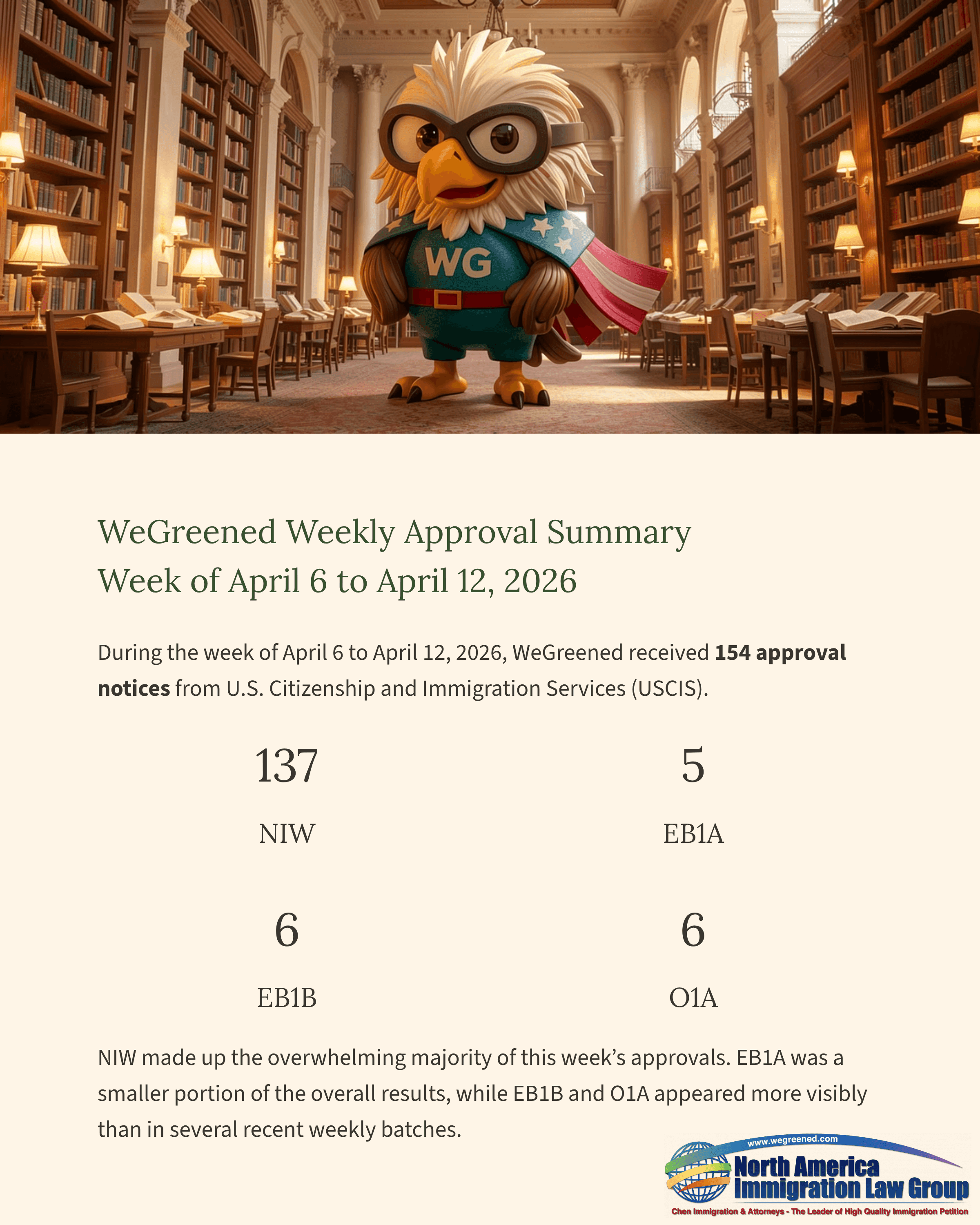
During the week of April 6 to April 12, 2026, WeGreened received 154 approval notices from U.S. Citizenship and Immigration Services (USCIS). Of the 154 approvals, 137 were for NIW (National Interest Waiver), 5 were for EB1A (Alien of Extraordinary Ability), 6 were for EB1B (Outstanding Professors or Researchers), and 6 were for O1A (Individuals with Extraordinary Ability or Achievement).
NIW made up the overwhelming majority of this week’s approvals. EB1A was a smaller portion of the overall results, while EB1B and O1A appeared more visibly than in several recent weekly batches. The week was also notable for a lower-metric NIW approval in semiconductor and electrical engineering, where the petition succeeded despite a modest publication and citation record.
EB1A and NIW Credential Analysis
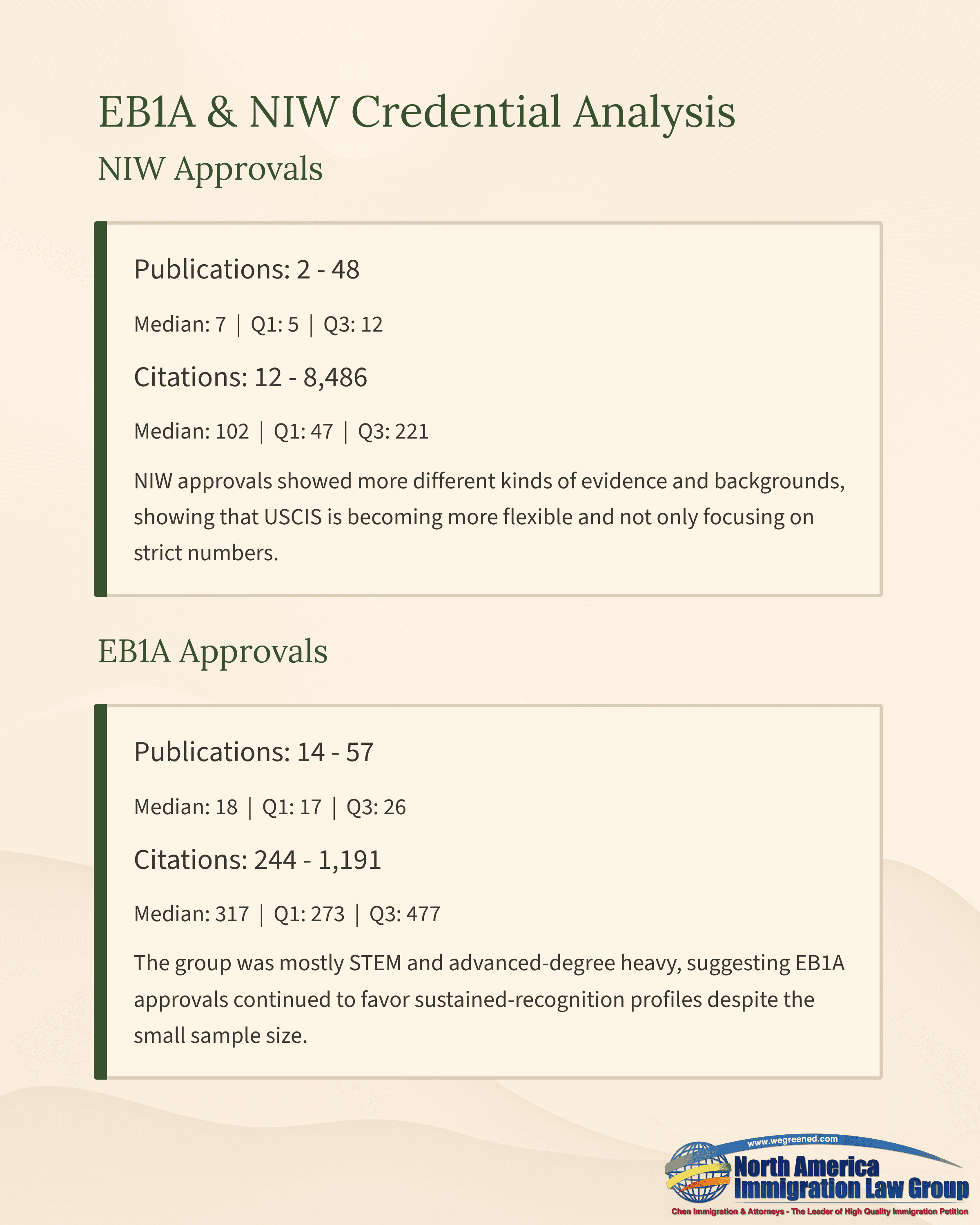
EB1A approvals this week were limited in number but still showed relatively solid conventional records. The 5 EB1A petitioners had 14 to 57 publications (Q1: 17, median: 18, Q3: 26) and 244 to 1,191 citations (Q1: 273, median: 317, Q3: 477). The group was mostly STEM-based and advanced-degree-heavy, suggesting that this week’s EB1A approvals continued to favor petitioners whose records could support a sustained-recognition narrative, even though the sample size was small.
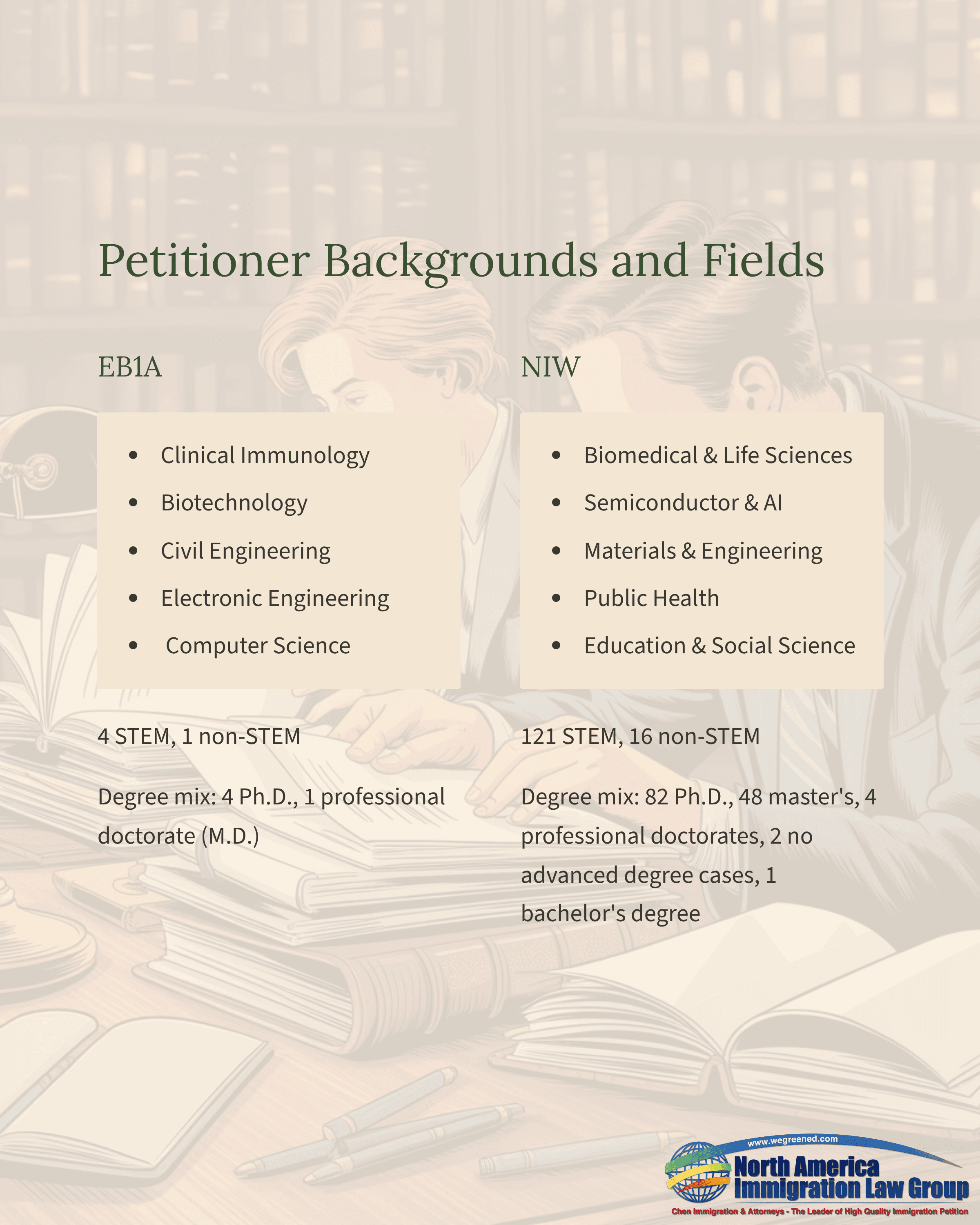
NIW approvals covered a wider evidentiary range. Among the 137 NIW approvals, publications ranged from 2 to 48 (Q1: 5, median: 7, Q3: 12), while citations ranged from 12 to 8,486 (Q1: 47, median: 102, Q3: 221). The category remained strongly STEM-oriented, with 121 STEM and 16 non-STEM approvals, and included 82 Ph.D. holders, 48 master’s-level petitioners, 4 professional doctorates, 2 no-advanced-degree cases, and 1 bachelor’s-level case.
Insights on Petitioner Backgrounds and Fields
EB1A approvals this week were spread across clinical immunology, biotechnology, civil engineering, electronic engineering, and computer science. Although the batch was small, the approved profiles included clinical, industry, research staff, and postdoctoral backgrounds. EB1A remained mostly STEM-designated, with 4 STEM approvals and 1 non-STEM approval, and continued to reflect an advanced-degree-heavy profile.
NIW approvals were broader across both fields and career stages. Biomedical, health-related, life-science, engineering, materials, semiconductor, AI, computing, and data-facing work were all well represented. The week also included approvals in public health, education, social science, and other applied fields, reinforcing that NIW remained adaptable when the endeavor was clearly tied to concrete U.S. needs.
Highlighted NIW Case: Approved with 2 Publications and 12 Citations for a Semiconductor Researcher
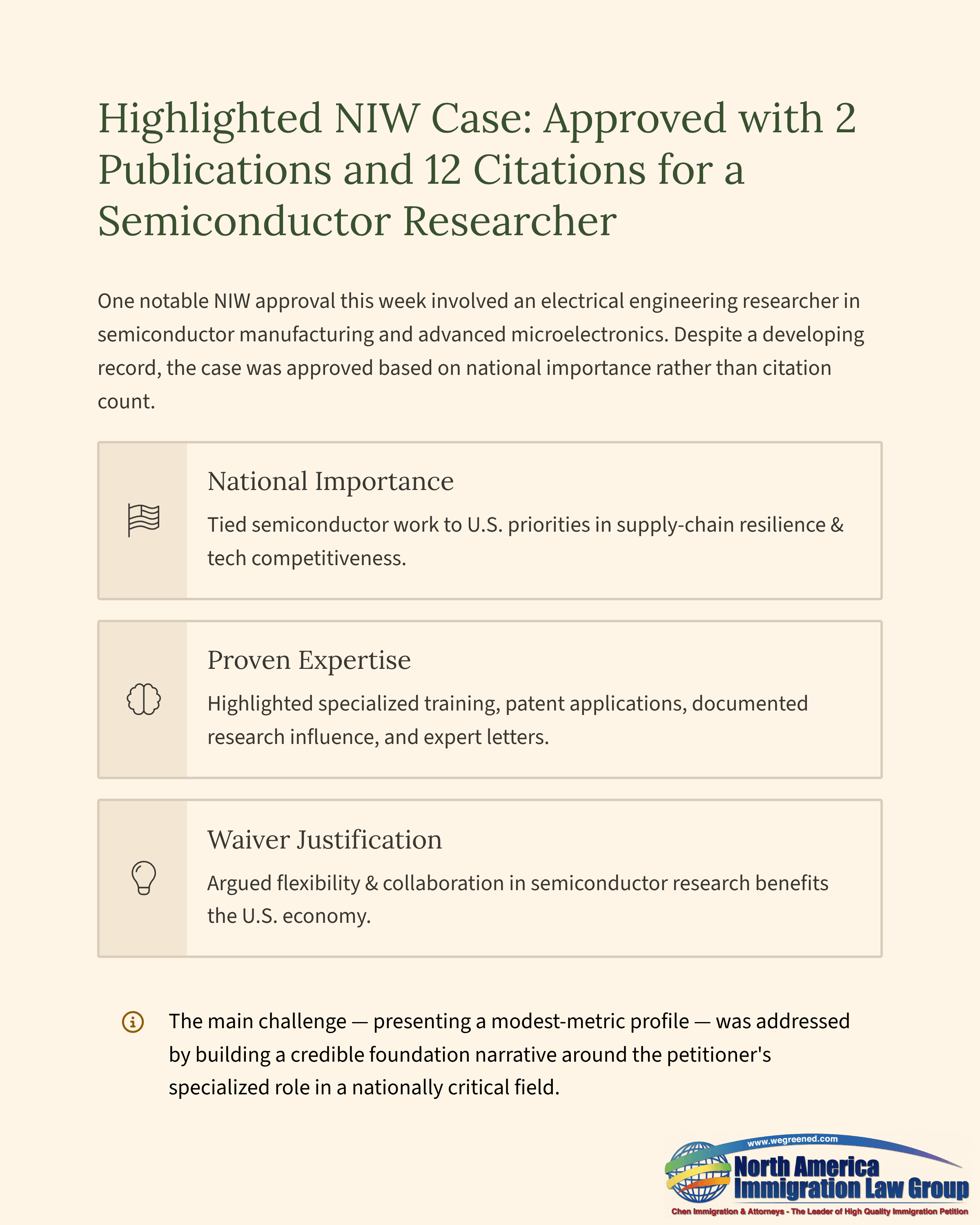
One of the most instructive approvals this week was an NIW case for an electrical engineering researcher in semiconductor manufacturing and advanced microelectronics. At the time of filing, the case included 2 publications and 12 citations. Although the petitioner’s record was still developing, the case was approved because the petition focused on the national importance of the proposed semiconductor-related endeavor rather than relying on citation volume alone.
The main challenge was presenting a modest-metric profile in a way that still showed clear future value. The filing addressed this by tying the petitioner’s work to U.S. priorities in semiconductor manufacturing, advanced microelectronics, supply-chain resilience, and technological competitiveness. For the “well positioned” prong, the petition emphasized the petitioner’s specialized training, peer-reviewed work, patent applications, documented research influence, and expert support letters. These materials helped show that the petitioner had already built a credible foundation to continue advancing the proposed endeavor.
The waiver argument also played an important role. The petition explained that continued work in semiconductor research benefits from flexibility, collaboration, and the ability to respond quickly to emerging technical needs, making a labor-certification waiver beneficial to the United States.
Adjudication Trends and Policy Observations
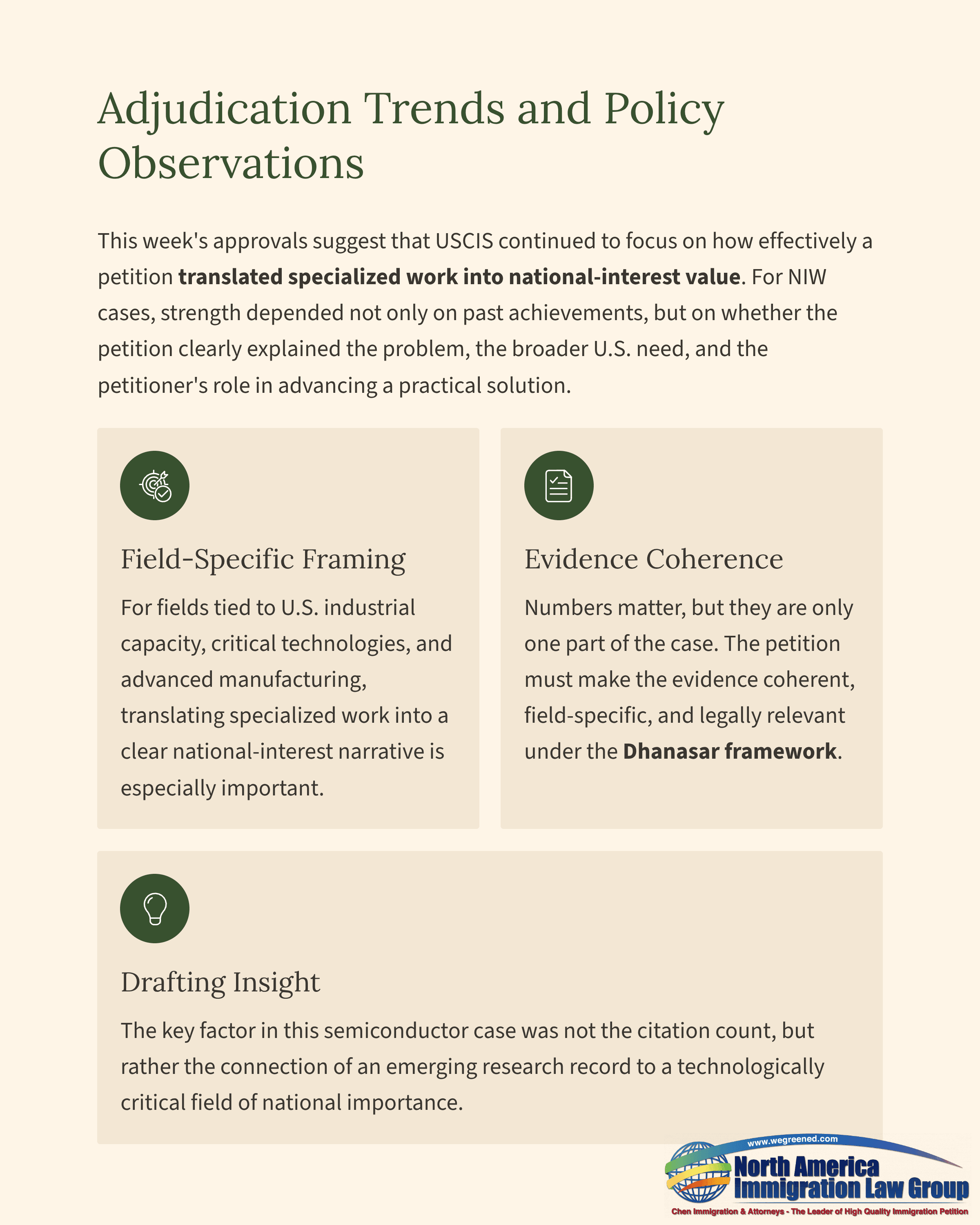
This week’s approvals suggest that USCIS continued to focus on how effectively a petition translated specialized work into national-interest value. For NIW cases in particular, the strength of the filing depended not only on the petitioner’s past achievements, but also on whether the petition clearly explained the problem being addressed, the broader U.S. need, and the petitioner’s role in advancing a practical solution.
The highlighted semiconductor approval fits this pattern well. Its strength came less from raw citation impact than from the way the petition connected a developing research record to a nationally important technical area. For fields tied to U.S. industrial capacity, critical technologies, supply-chain resilience, and advanced manufacturing, the petition’s ability to translate specialized work into a clear national-interest narrative remains especially important.
This week’s results therefore reinforce a practical drafting lesson: numbers matter, but they are only one part of the case. The petition must make the evidence coherent, field-specific, and legally relevant under the Dhanasar framework.