

WeGreened Weekly Approval Summary: Week of August 10 to August 16, 2026
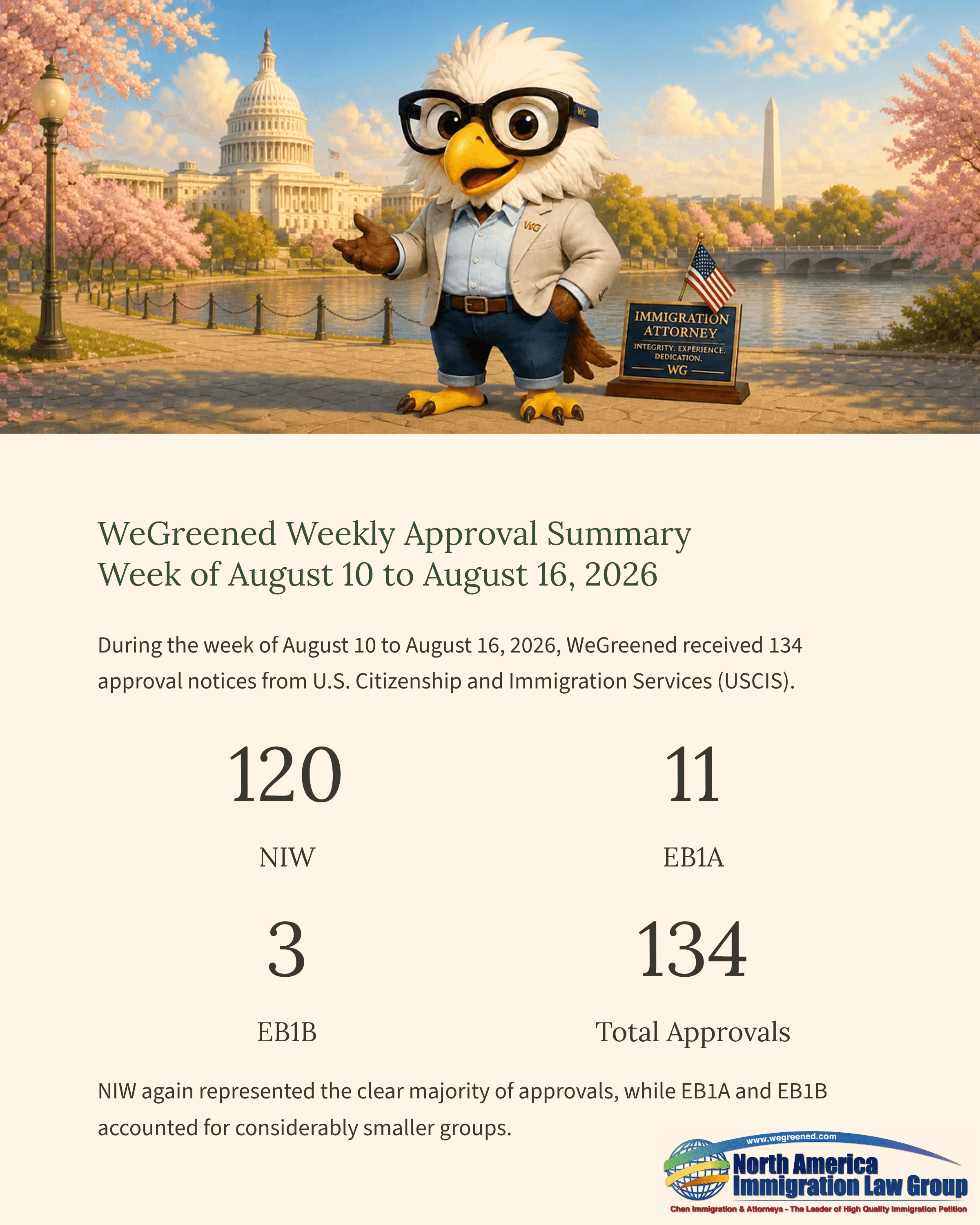
During the week of August 10 to August 16, 2026, WeGreened received 134 approval notices from U.S. Citizenship and Immigration Services (USCIS). Of the 134 approvals, 120 were for NIW (National Interest Waiver), 11 were for EB1A (Alien of Extraordinary Ability), and 3 were for EB1B (Outstanding Professors or Researchers).
NIW again represented the clear majority of approvals, while EB1A and EB1B accounted for considerably smaller groups.
EB1A and NIW Credential Analysis
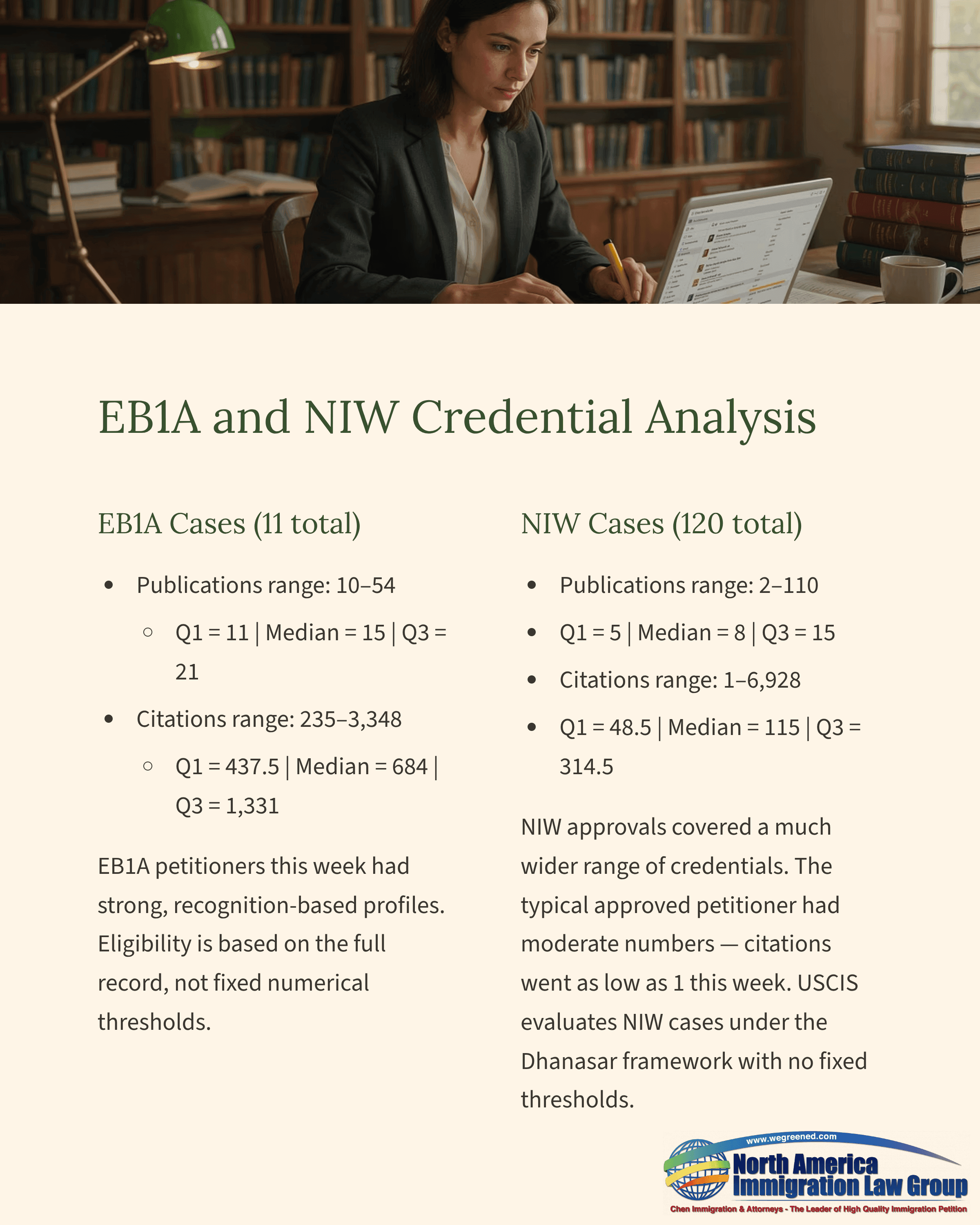
EB1A petitioners this week showed relatively concentrated recognition-based profiles. Publications ranged from 10 to 54 (Q1: 11, median: 15, Q3: 21), while citations ranged from 235 to 3,348 (Q1: 437.5, median: 684, Q3: 1,331). Although the approved group contained meaningful variation, the quartiles indicate that most EB1A petitioners had substantial publication and citation records. As in previous weeks, these figures are most useful as context rather than fixed thresholds, since EB1A eligibility ultimately depends on whether the complete record demonstrates sustained recognition and top-level standing in the field.
NIW approvals again reflected a substantially broader evidentiary spectrum. Publications ranged from 2 to 110 (Q1: 5, median: 8, Q3: 15), while citations ranged from 1 to 6,928 (Q1: 48.5, median: 115, Q3: 314.5). The high upper values were driven by established researchers, while the quartiles show that the typical approved petitioner had considerably more moderate credentials. Most notably, this week’s group extended all the way down to 1 citation. This should not be interpreted as a new numerical benchmark, but it reinforces that NIW adjudication evaluates how the proposed endeavor, the petitioner’s positioning, and the expected national benefit fit together under Dhanasar rather than applying a fixed publication or citation requirement.
Insights on Petitioner Backgrounds and Fields
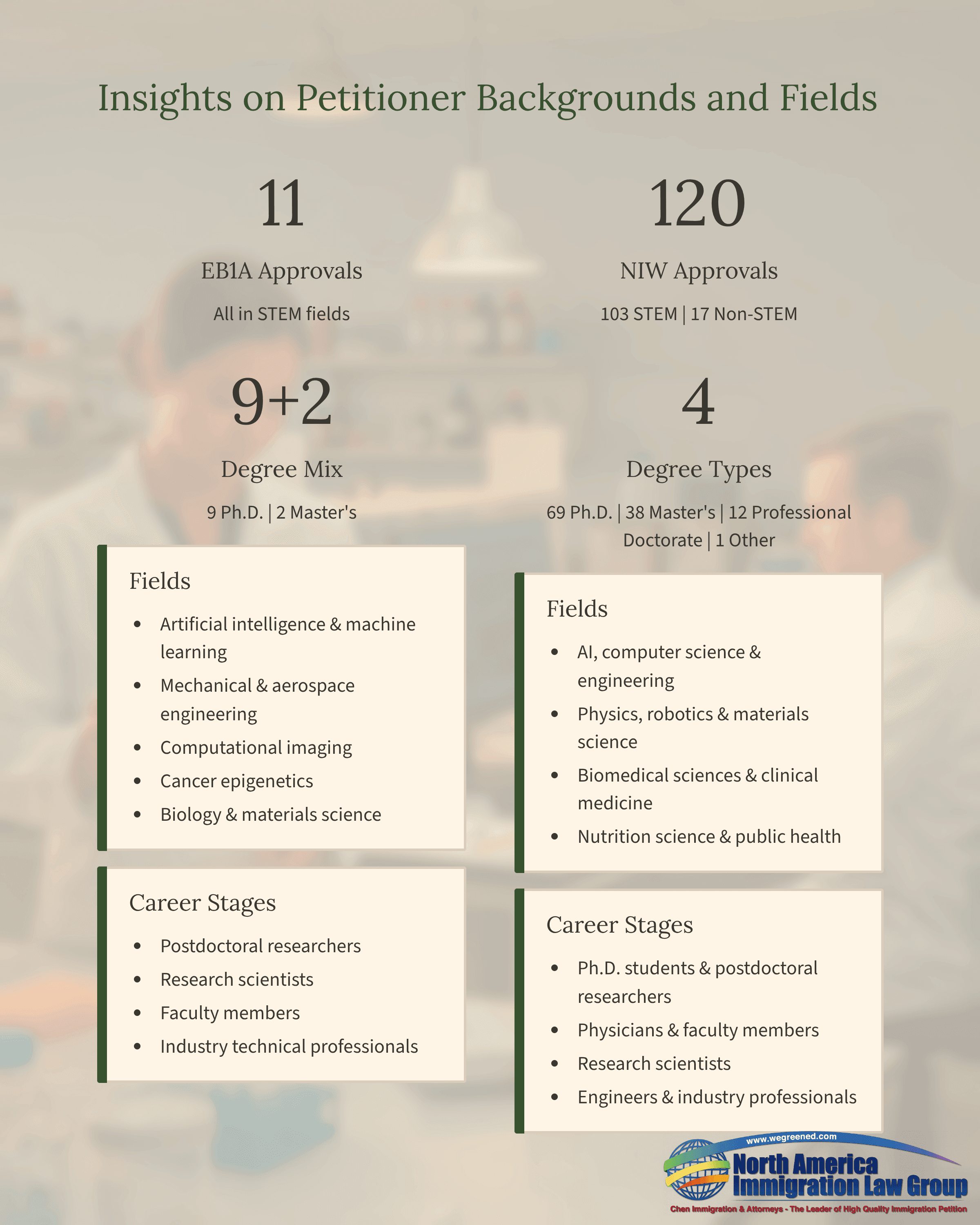
All 11 EB1A approvals this week were in STEM fields. Approved areas included artificial intelligence, machine learning, mechanical and aerospace engineering, computational imaging, cancer epigenetics, biology, and materials science. The approved group included postdoctoral researchers, research scientists, faculty members, and industry-based technical professionals. The degree mix consisted of 9 Ph.D. holders and 2 master’s-level petitioners. This week’s group therefore remained concentrated among advanced-degree applicants, although the approvals continued to span both academic and industry settings.
NIW approvals were also predominantly STEM-oriented but substantially broader in both educational background and career stage, with 103 STEM approvals and 17 non-STEM approvals. Approved fields included artificial intelligence, computer science, engineering, physics, materials science, robotics, biomedical sciences, clinical medicine, nutrition science, and public health. The degree mix consisted of 69 Ph.D. holders, 38 master’s-level petitioners, 12 professional doctorate holders, and 1 petitioner without an advanced degree. The approved group included Ph.D. students, postdoctoral researchers, physicians, faculty members, research scientists, engineers, and industry professionals, continuing to illustrate the wider range of professional pathways represented in NIW approvals.
Highlighted Case: NIW Approval After RFE With 3 Publications and Only 1 Citation
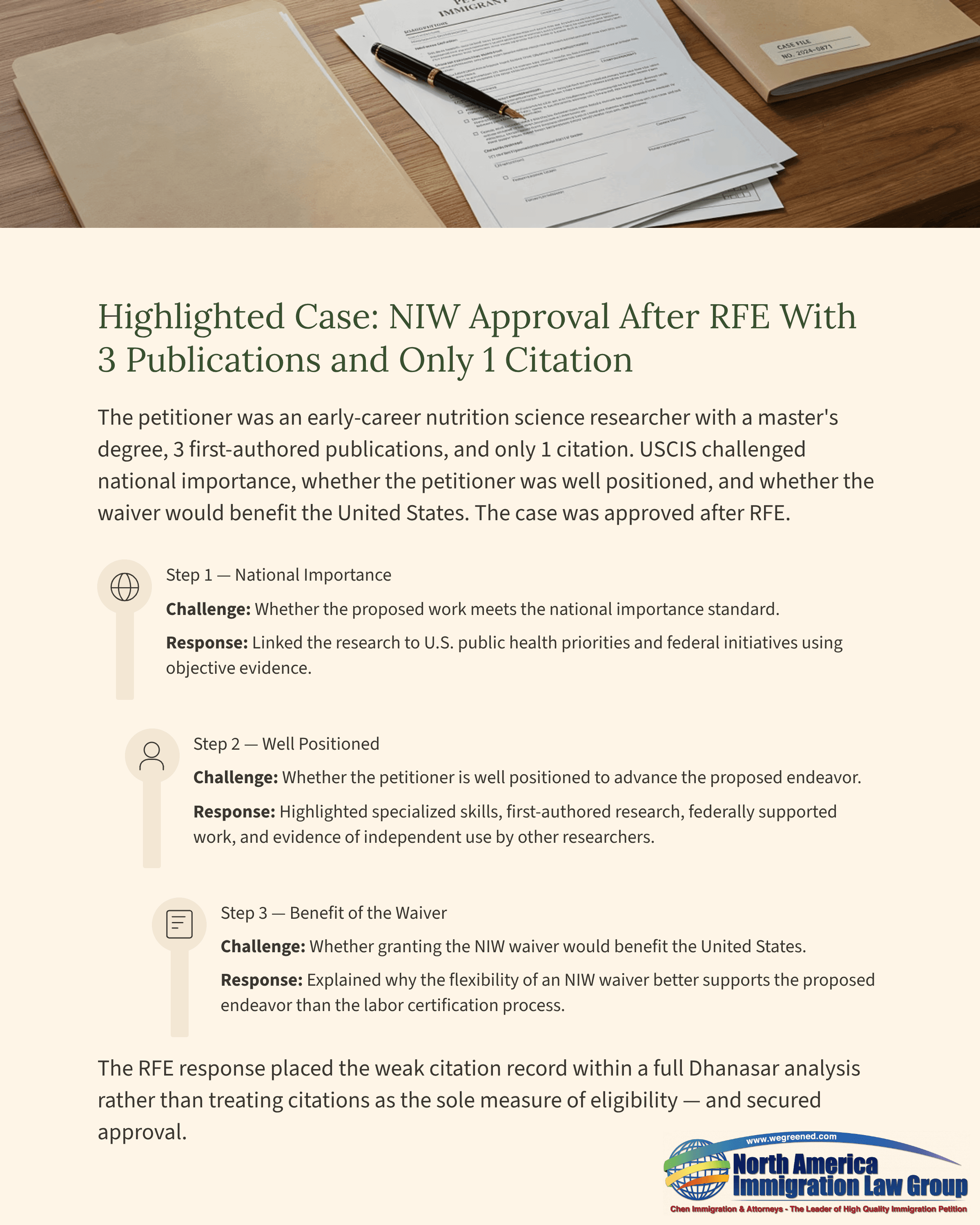
One of this week’s most notable NIW approvals involved an early-stage researcher in nutrition science with a master’s degree, 3 first-authored peer-reviewed publications, and only 1 citation. USCIS issued an RFE that accepted the substantial merit of the proposed endeavor but challenged national importance, whether the petitioner was well positioned to advance the endeavor, and whether the waiver would benefit the United States. The officer also specifically questioned the petitioner’s limited citation record and whether the evidence demonstrated sufficient influence beyond the petitioner’s immediate research activities.
Our RFE strategy did not try to make 1 citation appear stronger than it was. Instead, we separated the officer’s concerns by Dhanasar prong and redirected the analysis to the correct legal questions. For national importance, we emphasized the prospective impact of the proposed endeavor, rather than using the petitioner’s past citation count as a proxy for national significance. We strengthened the record with objective evidence connecting the proposed work to major U.S. public health priorities, federal initiatives, and broader economic and societal benefits.
For the well-positioned prong, we built a broader evidentiary record around the petitioner’s specialized skills, first-authored research, field-relative productivity, federally supported work, and concrete plans to continue the proposed endeavor. Most importantly, we supplemented the numerical record with qualitative evidence showing that independent researchers had already relied on and implemented the petitioner’s findings. This allowed the response to address the officer’s citation concern directly without treating citation volume as the only measure of progress or influence.
For the final prong, we connected the petitioner’s continuing work to broader U.S. interests and explained why the flexibility provided by a waiver would better support the proposed endeavor than the traditional labor certification process. The approval is therefore notable not simply because the case had only 1 citation, but because the RFE required a careful restructuring of the legal and evidentiary record. By identifying the officer’s actual concerns, responding to each prong separately, and supplementing weak conventional metrics with objective evidence of progress, independent use, external support, and future plans, we were able to present a much stronger overall case under Dhanasar.
Adjudication Trends and Policy Observations
This week’s approvals again show the different evidentiary logic of EB1A and NIW. EB1A remained considerably more concentrated among applicants with established recognition records, with a median of 684 citations, compared with 115 for NIW. At the same time, the NIW citation range extended from 1 to 6,928, illustrating why neither the minimum nor the maximum should be treated as a representative eligibility threshold. For NIW, publication and citation records remain relevant evidence, but they must be considered together with the petitioner’s education, specialized skills, prior progress, future plans, third-party interest, and other evidence showing that the petitioner is well positioned to advance the proposed endeavor.
The highlighted approval is therefore best understood as an outlier that illustrates the flexibility of the NIW evidentiary framework, rather than a lowering of the standard. Most petitioners approved this week had substantially stronger citation records, but this case shows why applicants should not automatically rule themselves out based on one weak conventional metric. Particularly when an RFE focuses heavily on citations or scholarly influence, an effective response may need to clarify the legal inquiry and demonstrate impact through other objective evidence, including independent use, field-relative research productivity, external support, documented progress, and concrete plans for continuing the proposed endeavor.