

WeGreened Weekly Approval Summary: Week of August 17 to August 23, 2026
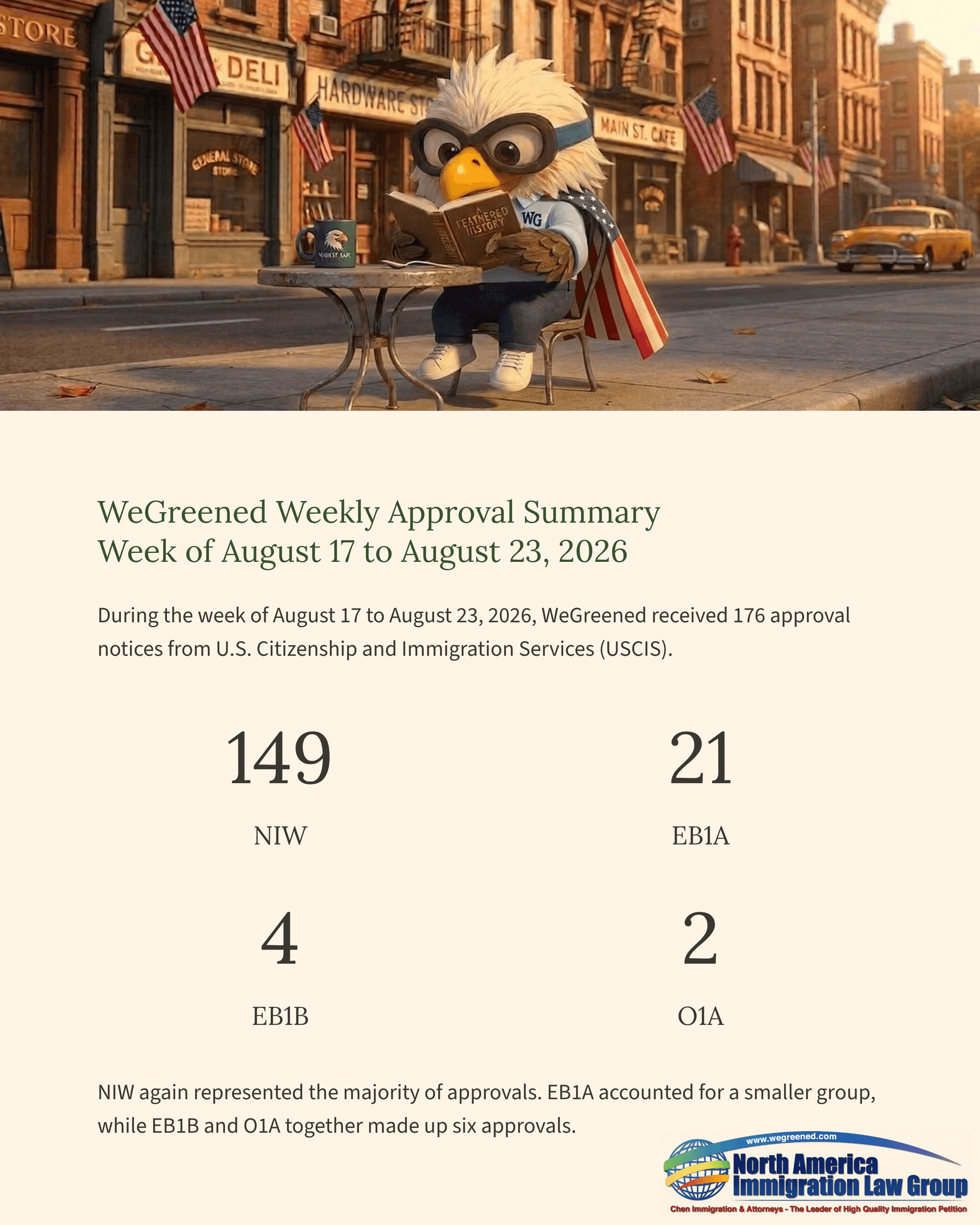
During the week of August 17 to August 23, 2026, WeGreened received 176 approval notices from U.S. Citizenship and Immigration Services (USCIS). Of the 176 approvals, 149 were for NIW (National Interest Waiver), 21 were for EB1A (Alien of Extraordinary Ability), 4 were for EB1B (Outstanding Professors or Researchers), and 2 were for O1A (Individuals with Extraordinary Ability or Achievement).
NIW again represented the majority of approvals. EB1A accounted for a smaller group, while EB1B and O1A together made up six approvals.
EB1A and NIW Credential Analysis
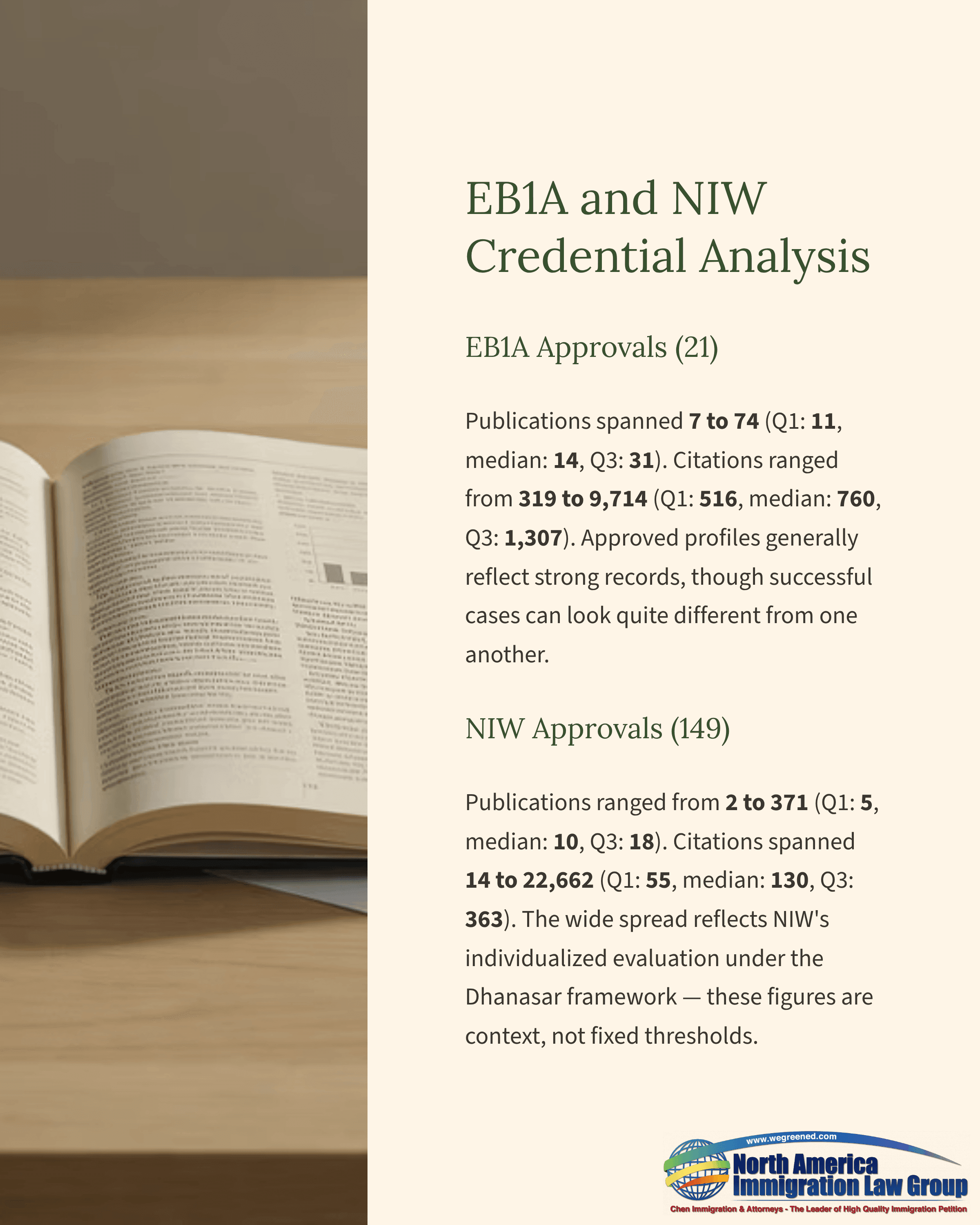
Among the 21 EB1A approvals, publication counts ranged from 7 to 74, with a first quartile (Q1) of 11, a median of 14, and a third quartile (Q3) of 31. Citation counts ranged from 319 to 9,714, with Q1 at 516, the median at 760, and Q3 at 1,307. These figures reflect the relatively strong publication and citation records commonly seen among approved EB1A petitioners, while the overall range also shows that successful cases can present substantially different evidentiary profiles.
The 149 NIW approvals showed a broader distribution. Publication counts ranged from 2 to 371, with Q1 at 5, a median of 10, and Q3 at 18. Citation counts ranged from 13 to 22,662, with Q1 at 55, a median of 130, and Q3 at 363. The wider distribution remains consistent with the individualized nature of NIW adjudication under the Dhanasar framework. Publication and citation records may help demonstrate prior progress and impact, but these figures should not be interpreted as fixed thresholds for approval. Instead, their significance depends on how they fit within the broader record concerning the proposed endeavor and the petitioner’s ability to advance it.
Insights on Petitioner Backgrounds and Fields
This week’s EB1A approvals covered a range of research-intensive fields, including artificial intelligence, computer science, neuroscience, nutritional epidemiology, materials engineering, computational science, gastroenterology, medical image analysis, chemistry, semiconductor engineering, remote sensing, electrical power engineering, and data science. Approved petitioners included postdoctoral researchers, scientists, physicians, engineers, research associates, and industry professionals, reflecting representation from both academic and private-sector settings.
The NIW approvals covered an even broader range of disciplines, including artificial intelligence, machine learning, computer science, electrical and mechanical engineering, biomedical engineering, neuroscience, molecular biology, cancer research, biochemistry, public health, medicine, dentistry, materials science, physics, transportation engineering, and environmental research. Petitioners ranged from Ph.D. students and postdoctoral researchers to faculty members, physicians, scientists, engineers, consultants, and industry professionals. The range of backgrounds represented this week again illustrates that NIW adjudication is not limited to a particular career stage or employment setting. It also provides useful context for this week’s highlighted case, which examines how an industry-based petitioner established the significance of a proposed endeavor beyond the scope of a single employer.
Highlighted Case: Demonstrating Impact Beyond the Employer in an Industry-Based NIW
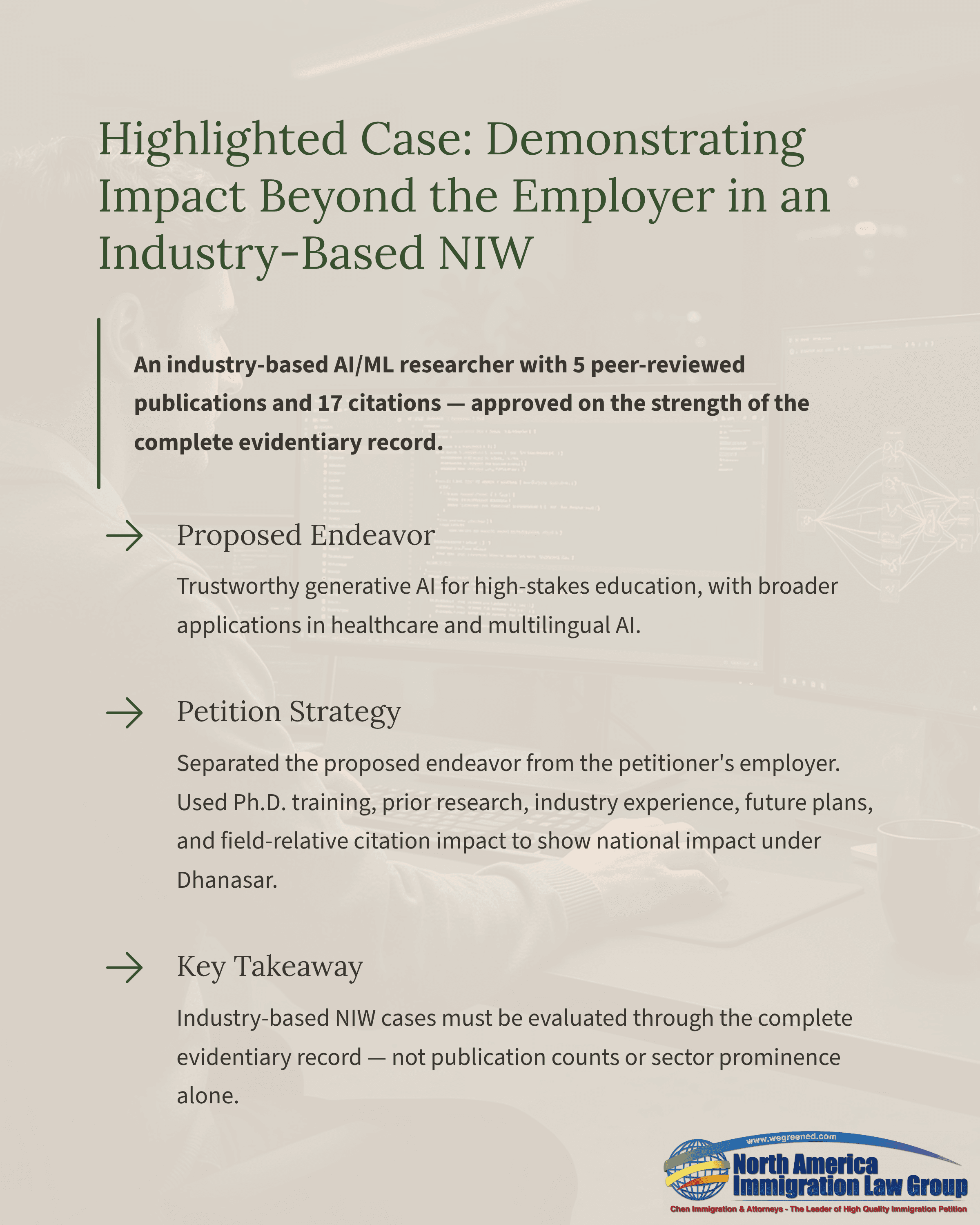
One notable NIW approval this week involved an artificial intelligence and machine learning researcher working in industry, with 5 peer-reviewed publications and 16 citations. The petitioner proposed to develop evaluation-driven and measurement-aligned frameworks for trustworthy generative AI, particularly for high-stakes applications in education, with broader relevance to healthcare and multilingual AI systems. Rather than making the petitioner’s publication or citation record the central feature of the case, the petition addressed a broader question relevant to many industry-based NIW cases: how to demonstrate that a proposed endeavor extends beyond current job duties and the interests of a single employer.
Under the first Dhanasar prong, the petition distinguished the proposed endeavor from the petitioner’s current employment. Rather than relying on the general importance of artificial intelligence or the petitioner’s industry position, the petition connected the specific endeavor to broader U.S. interests in responsible AI, educational integrity, healthcare reliability, multilingual accessibility, and technological competitiveness. It further explained how the petitioner could advance this work through continued research, publication, and technical applications relevant to stakeholders across academia, industry, and government. In this way, the national importance argument focused on the prospective impact of the specific endeavor rather than the importance of the employer or the AI field in general.
For the second prong, the petition relied on the petitioner’s Ph.D. training, prior research, industry experience, future plans, and evidence of independent use to demonstrate that the petitioner was well positioned to advance the endeavor. The 5 publications and 16 citations were placed in context rather than presented as standalone measures of impact. For example, a recent publication with 2 citations ranked within the top 20% of cited Computer Science papers from its publication year, while specific citation examples showed independent reliance on the petitioner’s earlier work. The record also connected prior research in multilingual NLP and clinical AI with the proposed work in trustworthy generative AI, demonstrating continuity between past progress and future plans.
Under the third prong, the petition emphasized the benefit of allowing the petitioner to continue pursuing research and collaboration across evolving AI applications without tying the proposed endeavor to a single position or organization. Taken together, the approval illustrates why an industry-based NIW case should be evaluated through the complete evidentiary record rather than publication and citation counts alone, and why employment in an important technology sector does not by itself establish eligibility. In this case, the petition defined an endeavor beyond ordinary job duties, demonstrated prospective impact beyond a single employer, and used the petitioner’s education, prior progress, industry experience, independent impact, and future plans to establish the ability to advance that endeavor.
Adjudication Trends and Policy Observations
This week’s approval data continued to show different credential distributions between EB1A and NIW petitioners. The median EB1A approval had 14 publications and 760 citations, compared with 10 publications and 130 citations among NIW approvals. The middle 50% of EB1A approvals had between 516 and 1,307 citations, while the corresponding range for NIW approvals was 55 to 363 citations. These distributions are consistent with the different legal frameworks governing the two categories. EB1A adjudication focuses on sustained national or international acclaim and the totality of the record at Final Merits, whereas NIW adjudication evaluates the proposed endeavor and the petitioner’s evidence under the three Dhanasar prongs.
The highlighted case also illustrates an important distinction for industry-based NIW petitions. Establishing the importance of a broad field such as artificial intelligence, or the significance of the petitioner’s employer, is different from demonstrating the national importance of the specific proposed endeavor. For petitioners whose strongest evidence comes from industry experience rather than a traditional academic record, the types of supporting evidence may differ, but the underlying Dhanasar inquiry remains the same: what the petitioner proposes to do, why that specific endeavor matters at a broader level, and whether the record demonstrates a credible ability to advance it. Viewed alongside this week’s broad NIW credential distribution, the case reinforces the importance of evaluating each petitioner’s evidence in relation to the specific proposed endeavor and the three Dhanasar prongs, rather than treating any single credential or employment setting as independently determinative.