

WeGreened Weekly Approval Summary: Week of August 24 to August 30, 2026
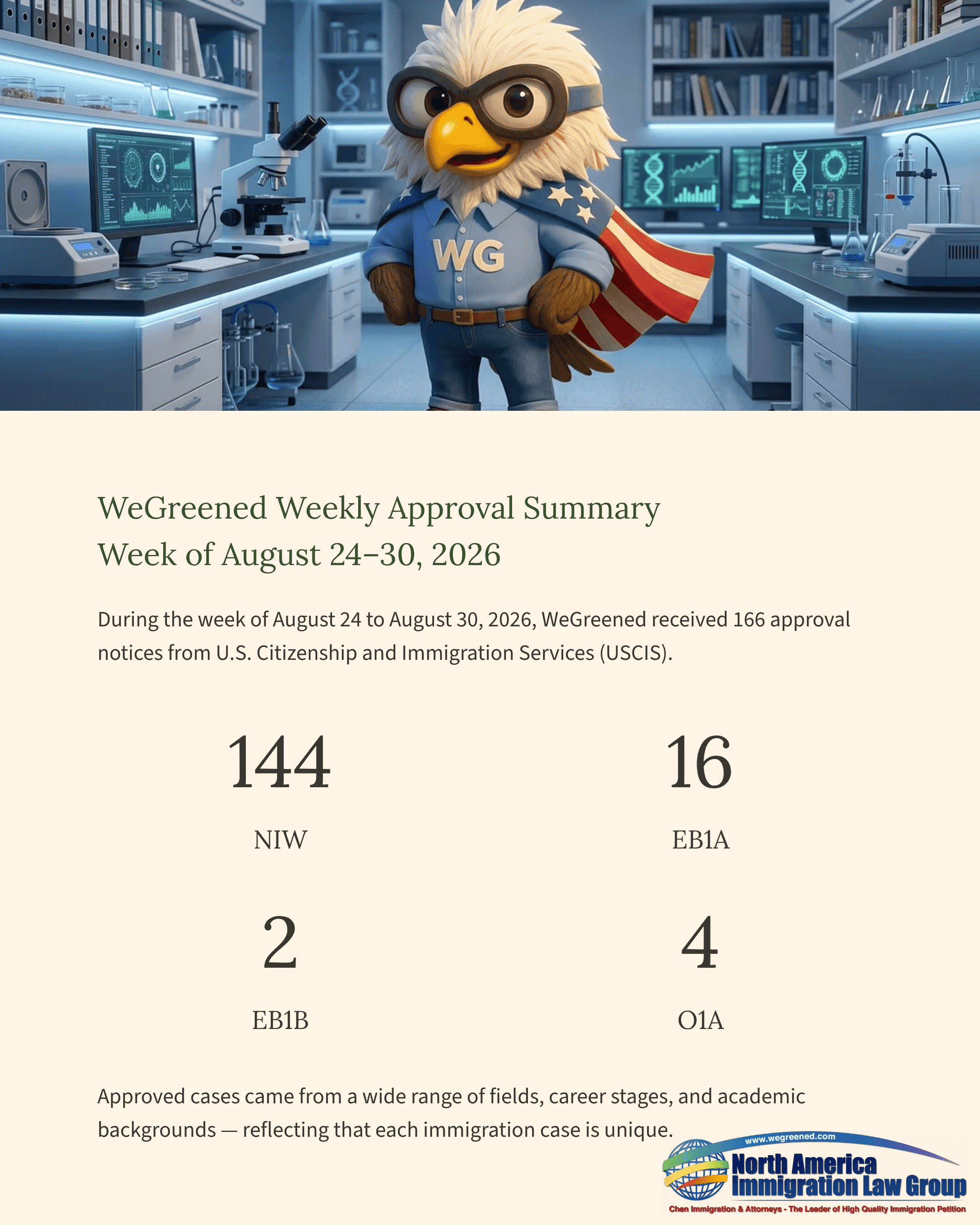
During the week of August 24 to August 30, 2026, WeGreened received 166 approval notices from U.S. Citizenship and Immigration Services (USCIS). Of these approvals, 144 were for NIW (National Interest Waiver), 16 were for EB1A (Alien of Extraordinary Ability), 2 were for EB1B (Outstanding Professors or Researchers), and 4 were for O1A (Individuals with Extraordinary Ability or Achievement).
NIW continued to account for the large majority of approvals this week. The approved cases also reflected substantial variation in academic credentials, research impact, career stage, and field, reinforcing that the evidentiary record for employment-based petitions is highly individualized.
EB1A and NIW Credential Analysis
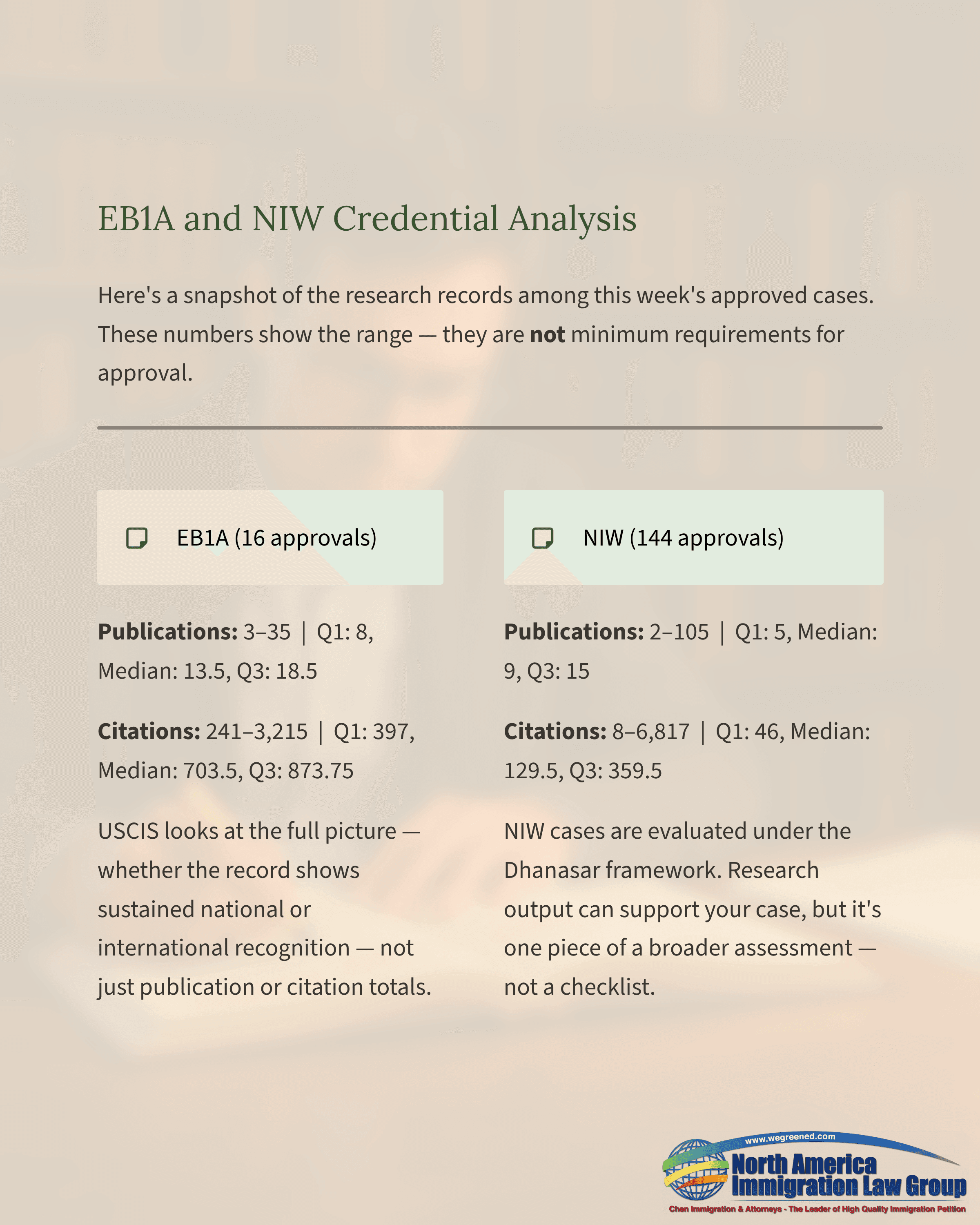
Among the 16 EB1A approvals, publication counts ranged from 3 to 35, with a first quartile (Q1) of 8, a median of 13.5, and a third quartile (Q3) of 18.5. Citation counts ranged from 241 to 3,215, with Q1 at 397, the median at 703.5, and Q3 at 873.75. Although most approved cases had substantial research records, the overall range again illustrates that publication and citation totals alone do not determine EB1A eligibility. USCIS ultimately evaluates whether the record as a whole demonstrates sustained national or international acclaim and recognition of the petitioner’s achievements under the Final Merits Determination.
The 144 NIW approvals reflected an even broader evidentiary spectrum. Publication counts ranged from 2 to 105, with Q1 at 5, a median of 9, and Q3 at 15. Citation counts ranged from 8 to 6,817, with Q1 at 46, a median of 129.5, and Q3 at 359.5. These figures should not be interpreted as fixed thresholds for NIW eligibility. Research output and citation impact may help demonstrate a petitioner’s prior progress and ability to advance a proposed endeavor, but they are evaluated within the broader requirements of the underlying EB-2 classification and the Dhanasar framework.
Insights on Petitioner Backgrounds and Fields
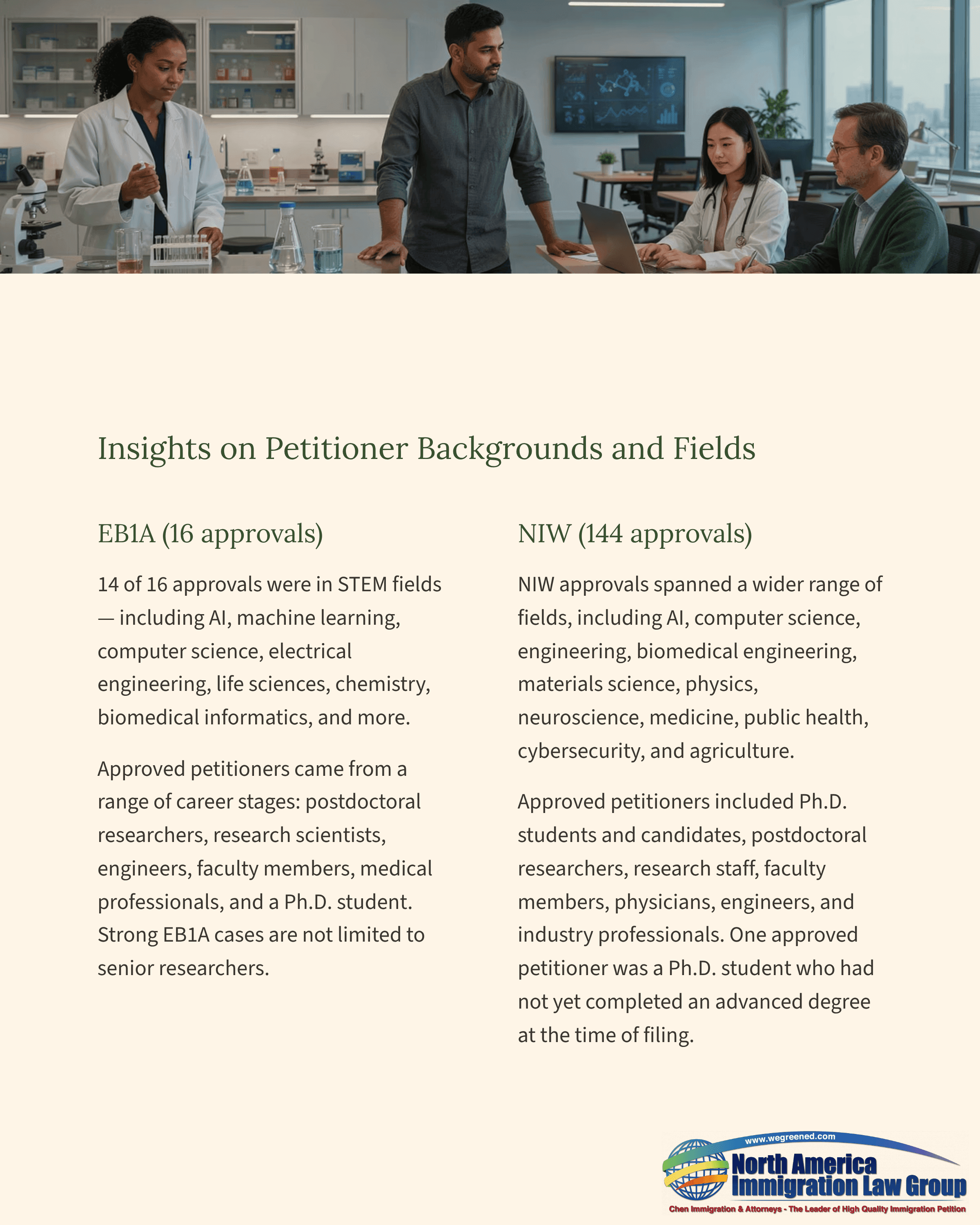
This week’s EB1A approvals were predominantly STEM-based, with 14 of the 16 approvals involving STEM fields. Approved areas included artificial intelligence, machine learning, computer science, computer vision, computer engineering, computer security, electrical engineering, metabolic biology, life sciences, chemistry, biomedical informatics, observational cosmology, veterinary anatomical pathology, and translational medicine. The approved petitioners included postdoctoral researchers, research scientists, engineers, faculty members, medical professionals, and a Ph.D. student, demonstrating that successful EB1A records can develop across different career stages and professional settings.
NIW approvals covered an even wider range of disciplines and professional backgrounds, including artificial intelligence and machine learning, computer science, electrical and mechanical engineering, biomedical engineering, materials science, chemistry, physics, molecular biology, neuroscience, medicine, public health, structural engineering, transportation, environmental engineering, cybersecurity, and agriculture. Approved petitioners included Ph.D. students and candidates, postdoctoral researchers, research staff, faculty members, physicians, engineers, and industry professionals. This range is particularly relevant to this week’s highlighted case, which involved a Ph.D. student who had not yet completed an advanced degree at the time of filing.
Highlighted Case: NIW Approval for a Ph.D. Student Without an Advanced Degree at Filing
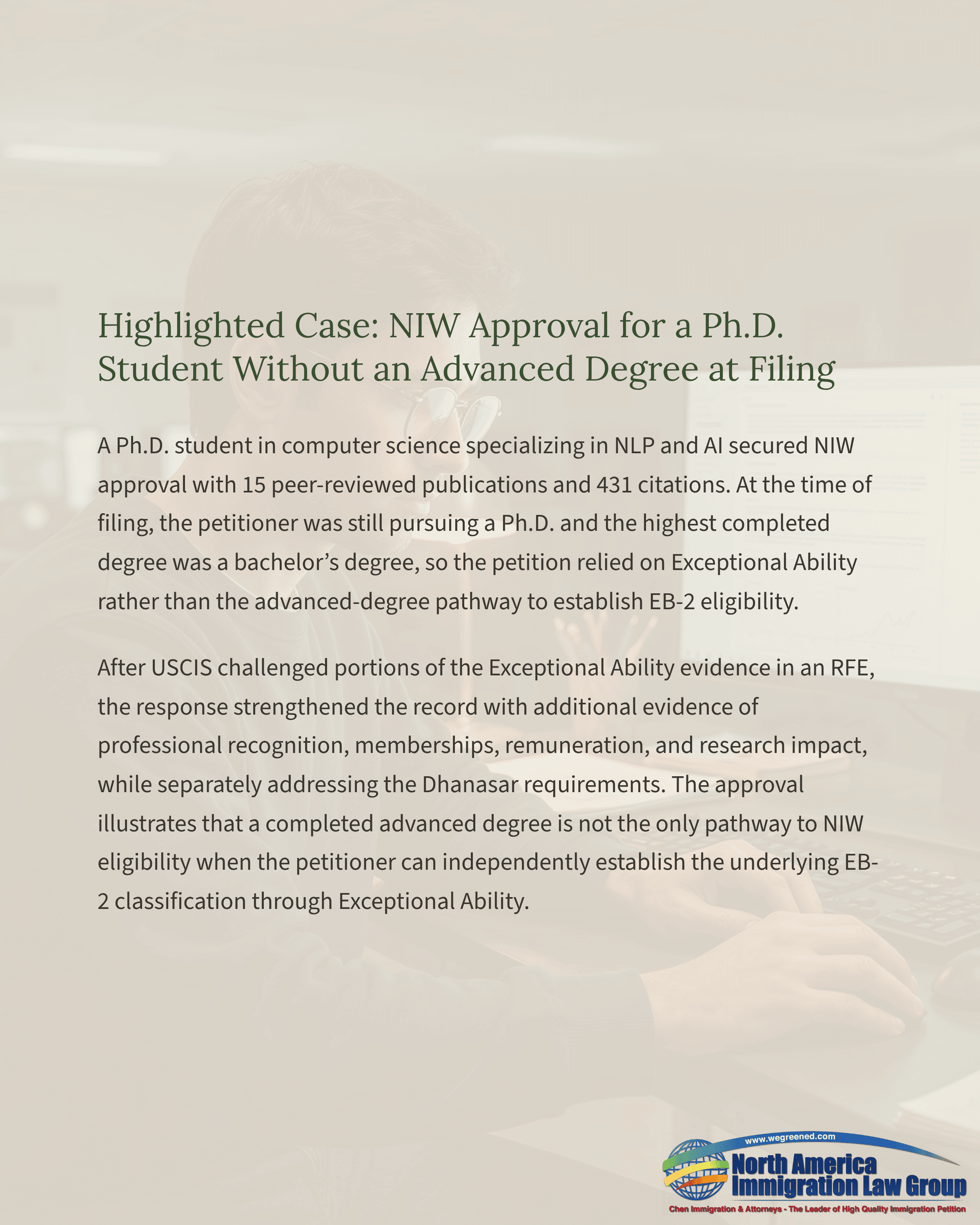
One notable NIW approval this week involved a computer science researcher specializing in natural language processing and artificial intelligence who was still pursuing a Ph.D. at the time of filing. The petitioner had 15 peer-reviewed publications and 431 citations, but the highest completed degree was a bachelor’s degree. Rather than waiting until the doctoral degree was completed, the petition sought to establish the underlying EB-2 classification through Exceptional Ability.
This case illustrates an important distinction in NIW eligibility: an advanced degree is not the only pathway to the underlying EB-2 classification. Applicants may alternatively qualify through Exceptional Ability if they can demonstrate a degree of expertise significantly above that ordinarily encountered in the field. Here, the petition relied on evidence across the applicable Exceptional Ability criteria to establish this alternative basis for EB-2 eligibility, while the NIW requirements under Dhanasar were addressed separately.
USCIS nevertheless challenged portions of the petitioner’s showing of Exceptional Ability in an RFE, including evidence relating to professional association membership and recognition for achievements and significant contributions. In response, our firm developed a targeted evidentiary strategy to address each issue rather than relying solely on the petitioner’s publication and citation record. We obtained and organized additional documentation concerning the petitioner’s professional memberships and professional recognition, while also presenting compensation records and comparative wage evidence to support the criterion relating to remuneration for services demonstrating Exceptional Ability.
Our firm separately strengthened the Dhanasar analysis by connecting the petitioner’s research record to the proposed endeavor and documenting the broader significance and practical implementation of the petitioner’s work. The response included evidence of independent research impact, implementation of the petitioner’s work, peer review, research support, expert testimony, and concrete plans to continue the proposed endeavor. Together, these materials strengthened the record under both the Exceptional Ability and NIW frameworks, despite the absence of a completed advanced degree at filing.
This approval should not be interpreted to mean that a bachelor’s degree alone is sufficient for NIW eligibility. Rather, it illustrates that the absence of a completed advanced degree does not necessarily preclude NIW eligibility when a petitioner can independently establish the underlying EB-2 classification through Exceptional Ability.
Adjudication Trends and Policy Observations
This week’s approval data again reflect the broad range of credentials seen across successful EB1A and NIW cases. These classifications are evaluated under different legal frameworks: EB1A requires evidence of extraordinary ability and sustained national or international acclaim, while NIW requires both eligibility for the underlying EB-2 classification and satisfaction of the Dhanasar framework. Accordingly, publication and citation counts should be viewed as part of the overall evidentiary record rather than as standalone indicators of eligibility under either classification.
The highlighted case also underscores an aspect of NIW analysis that can sometimes be overlooked: Dhanasar is not the only eligibility inquiry. A petitioner must first qualify for the underlying EB-2 classification, either as an advanced-degree professional or as an individual of Exceptional Ability. These are distinct pathways with different evidentiary requirements. Accordingly, degree status is only one part of the eligibility analysis, and the petitioner’s broader record must be evaluated in determining whether the requirements of the applicable EB-2 pathway have been satisfied.