

WeGreened Weekly Approval Summary: Week of August 3 to August 9, 2026
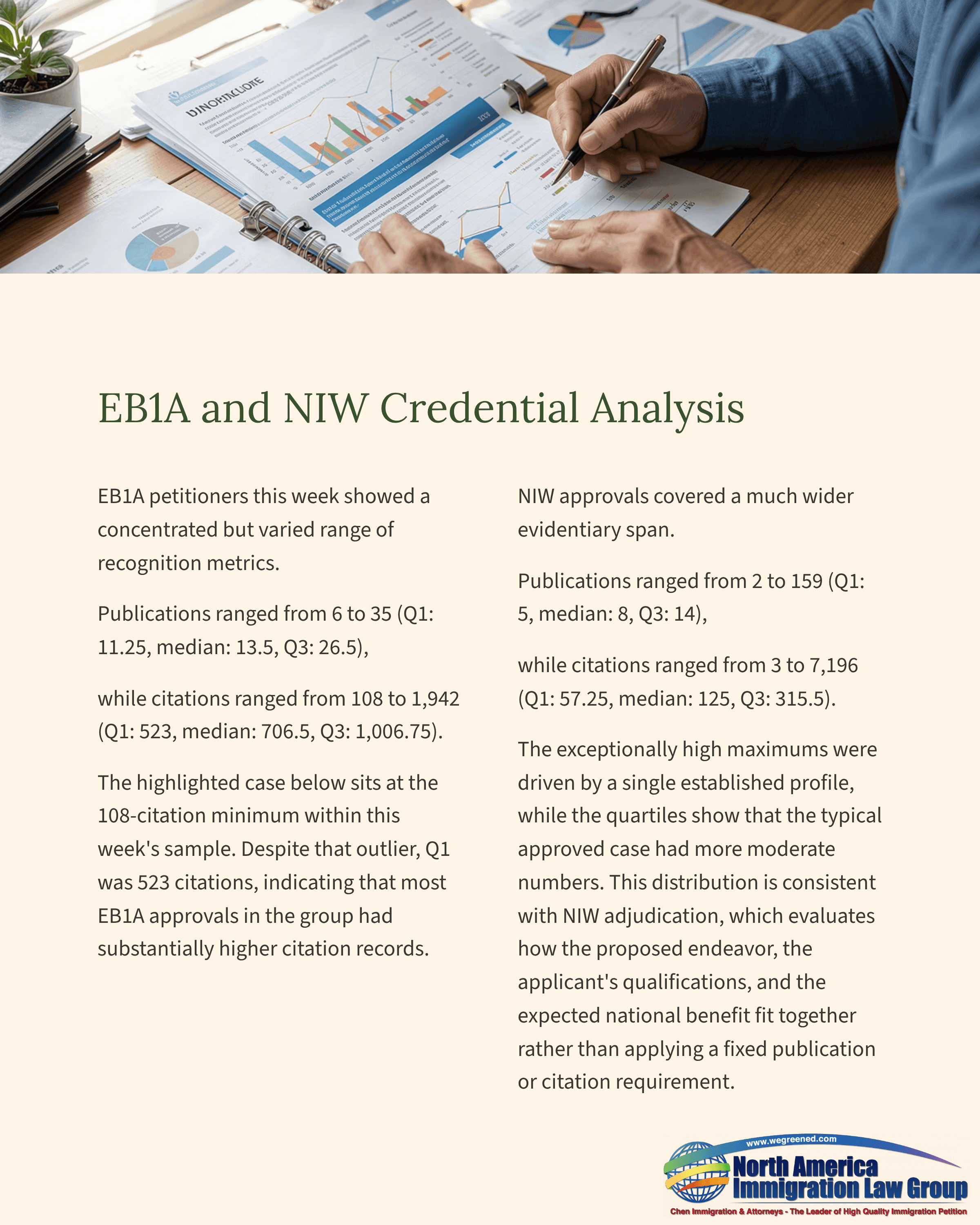
During the week of August 3 to August 9, 2026, WeGreened received 141 approval notices from U.S. Citizenship and Immigration Services (USCIS). Of the 141 approvals, 122 were for NIW (National Interest Waiver), 14 were for EB1A (Alien of Extraordinary Ability), 3 were for EB1B (Outstanding Professors or Researchers), and 2 were for O1A (Individuals with Extraordinary Ability or Achievement).
NIW again represented the majority of approvals. EB1A accounted for a smaller group, while EB1B and O1A together made up five approvals.
EB1A and NIW Credential Analysis
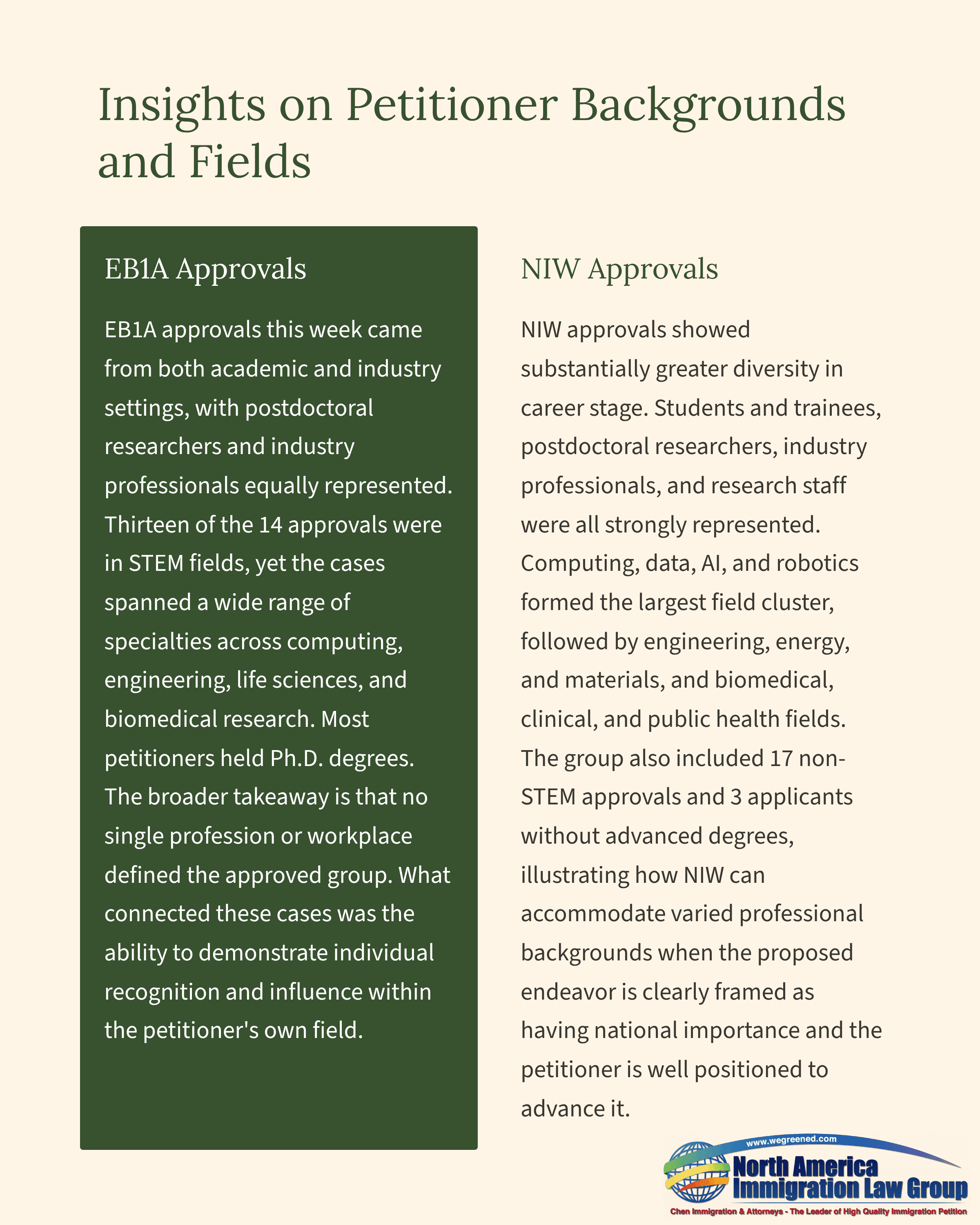
EB1A petitioners this week showed a concentrated but varied range of recognition metrics. Publications ranged from 6 to 35 (Q1: 11.25, median: 13.5, Q3: 26.5), while citations ranged from 108 to 1,942 (Q1: 523, median: 706.5, Q3: 1,006.75). The highlighted case below sits at the 108-citation minimum within this week’s sample. Despite that outlier, Q1 was 523 citations, indicating that most EB1A approvals in the group had substantially higher citation records.
NIW approvals covered a much wider evidentiary span. Publications ranged from 2 to 159 (Q1: 5, median: 8, Q3: 14), while citations ranged from 3 to 7,196 (Q1: 57.25, median: 125, Q3: 315.5). The exceptionally high maximums were driven by a single established profile, while the quartiles show that the typical approved case had far more moderate numbers. This distribution is consistent with NIW adjudication, which evaluates how the proposed endeavor, the applicant’s qualifications, and the expected national benefit fit together rather than applying a fixed publication or citation requirement.
Insights on Petitioner Backgrounds and Fields
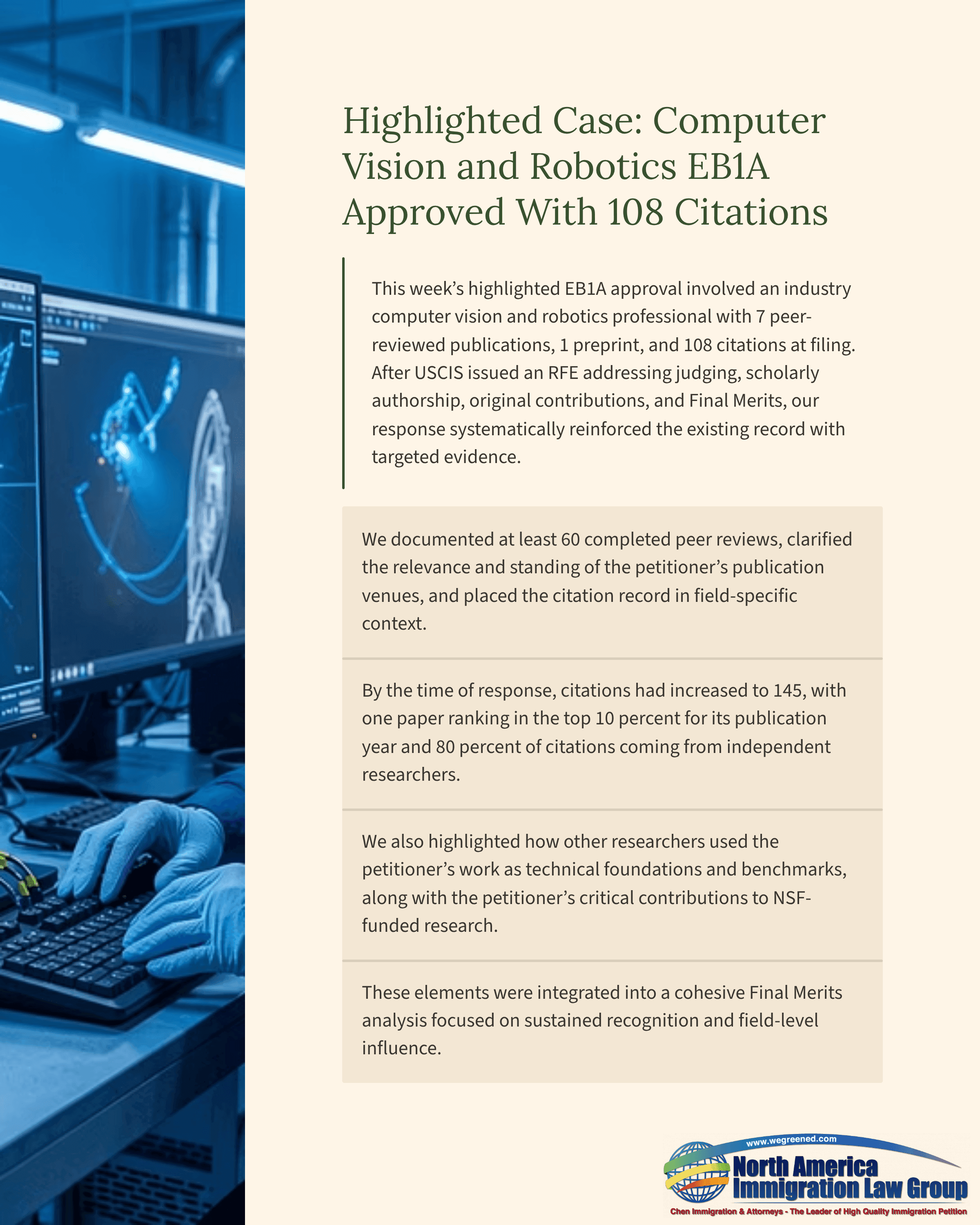
EB1A approvals this week came from both academic and industry settings, with postdoctoral researchers and industry professionals equally represented. Thirteen of the 14 approvals were in STEM fields, yet the cases spanned a wide range of specialties across computing, engineering, life sciences, and biomedical research. Most petitioners held Ph.D. degrees. The broader takeaway is that no single profession or workplace defined the approved group. What connected these cases was the ability to demonstrate individual recognition and influence within the petitioner’s own field.
NIW approvals showed substantially greater diversity in career stage. Students and trainees, postdoctoral researchers, industry professionals, and research staff were all strongly represented. Computing, data, AI, and robotics formed the largest field cluster, followed by engineering, energy, and materials, and biomedical, clinical, and public health fields. The group also included 17 non-STEM approvals and 3 applicants without advanced degrees, illustrating how NIW can accommodate varied professional backgrounds when the proposed endeavor is clearly framed as having national importance and the petitioner is well positioned to advance it.
Highlighted Case: Computer Vision and Robotics EB1A Approved With 108 Citations
One of this week’s most instructive approvals involved an industry computer vision and robotics professional with seven peer-reviewed publications, one preprint, and 108 citations at the time of filing. USCIS issued a Request for Evidence seeking further clarification regarding the three regulatory criteria presented in the petition: judging the work of others, authorship of scholarly articles, and original contributions of major significance. The RFE also raised questions relevant to the Final Merits Determination.
Our response built on the original record by addressing each issue identified in the RFE. For the judging criterion, we highlighted review records, certificates, and emails documenting that the petitioner had completed at least 60 reviews, not merely received invitations. We also explained why computer vision and robotics fall within computer science or closely allied fields, and why the reviewed journals and conferences were directly relevant. For scholarly authorship, we reinforced the record with additional documentation regarding venue aims, scope, rankings, and selection standards to demonstrate that the petitioner’s conference papers qualified as peer-reviewed scholarly articles in the field.
For original contributions, the RFE response placed particular emphasis on contextualizing the petitioner’s impact rather than relying on the raw citation total alone. The response updated the citation record to 145 and showed that one article ranked within the top 10 percent of computer science papers from its publication year, with approximately 2.55 times the field-average citation rate. We also documented that 116 citations, representing 80 percent of the updated total, came from independent researchers. Selected citing papers demonstrated how other teams used the petitioner’s research as technical foundations, experimental benchmarks, and methodological guidance in robot navigation, embodied AI, and uncertainty-aware perception.
Beyond bibliometric evidence, the response emphasized the petitioner’s critical contributions to National Science Foundation-funded research, including work that resulted in three of the four publications identified as outcomes of the funded project. The six expert letters submitted with the original filing, including five independent opinions, were integrated with objective evidence of peer review, scholarly authorship, normalized citation impact, independent research use, and federally funded contributions. Together, these different forms of evidence supported a cohesive Final Merits analysis.
This approval illustrates the importance of identifying the officer’s precise concerns, clarifying how evidence already in the record addresses those concerns, reinforcing key points with targeted objective documentation, and connecting the complete record to both the regulatory criteria and the final merits standard.
Adjudication Trends and Policy Observations
The current adjudication environment for EB1A and NIW reflects heightened scrutiny. Recent USCIS data show EB1A and NIW approval rates remaining below FY2025 levels, while recent analyses of RFE patterns identify recurring scrutiny of sustained acclaim, original contributions, national importance, and the connection between a petitioner’s credentials and the applicable legal standard. For highly accomplished applicants, strong credentials alone may therefore be insufficient unless the record clearly explains their significance within the governing adjudicatory framework.
Timing has also become an important procedural consideration. USCIS guidance generally provides an 84-day response period for RFEs involving Form I-140, but adjudicators may shorten that period on a case-by-case basis with supervisory concurrence. The deadline stated in the individual RFE ultimately controls. A compressed response window can leave substantially less time to assemble third-party documentation, contextualize citation or impact evidence, coordinate expert support, and prepare a comprehensive response. For complex EB1A and NIW cases, advance evidence organization and response readiness therefore carry increasing practical importance.