
WeGreened Weekly Approval Summary: Week of July 6, 2026
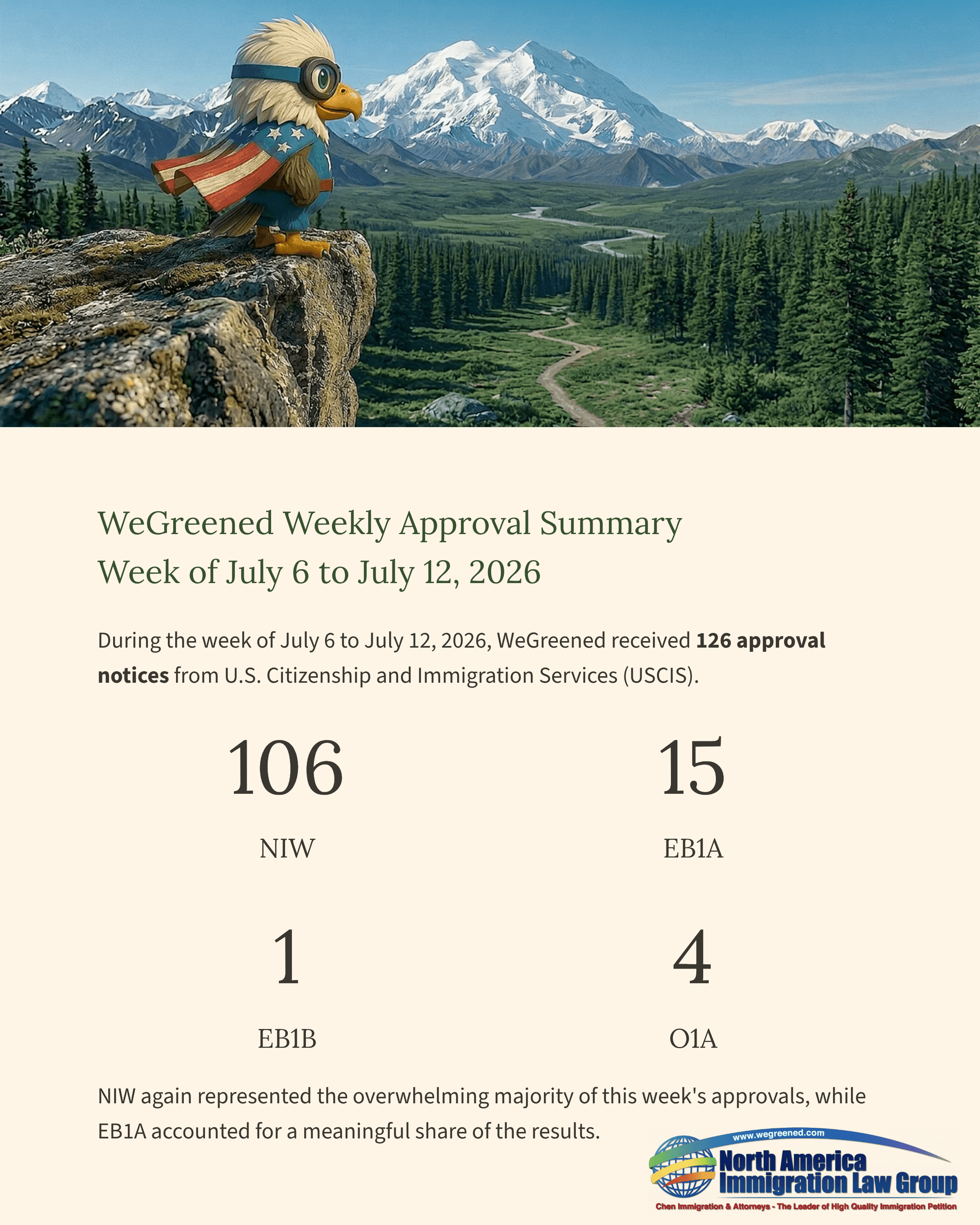
During the week of July 6 to July 12, 2026, WeGreened received 126 approval notices from U.S. Citizenship and Immigration Services (USCIS). Of the 126 approvals, 106 were for NIW (National Interest Waiver), 15 were for EB1A (Alien of Extraordinary Ability), 1 were for EB1B (Outstanding Professors or Researchers), and 4 were for O1A (Individuals with Extraordinary Ability or Achievement).
NIW again represented the overwhelming majority of this week's approvals, while EB1A accounted for a meaningful share of the results. O1A approvals appeared in slightly greater numbers than in several recent weeks, whereas EB1B approvals remained limited.
EB1A and NIW Credential Analysis
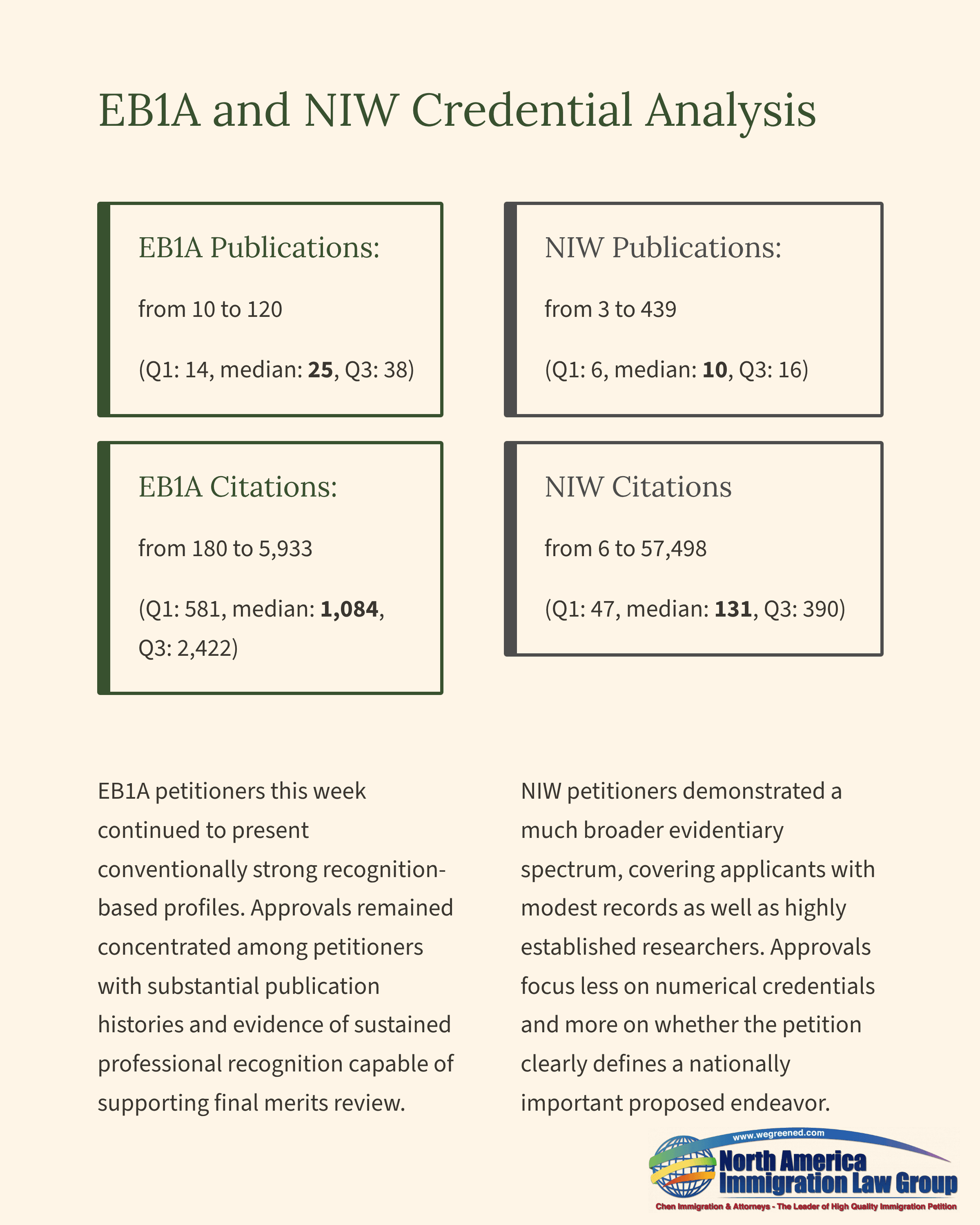
EB1A petitioners this week continued to present conventionally strong recognition-based profiles. Publications ranged from 10 to 120 (Q1: 14, median: 25, Q3: 38), while citations ranged from 180 to 5,933 (Q1: 581, median: 1,084, Q3: 2,422). As in previous weeks, EB1A approvals remained concentrated among petitioners with substantial publication histories, significant citation impact, and evidence of sustained professional recognition capable of supporting final merits review.
NIW petitioners again demonstrated a much broader evidentiary spectrum. Publications ranged from 3 to 439 (Q1: 6, median: 10, Q3: 16), while citations ranged from 6 to 57,498 (Q1: 47, median: 131, Q3: 390). Although the upper end of the citation distribution was influenced by an exceptionally highly cited outlier, approvals once again covered applicants with modest publication and citation records as well as highly established researchers. Recent patterns confirm that NIW approvals focus less on numerical credentials alone and more on whether the petition clearly defines a nationally important proposed endeavor, establishes that the petitioner is well positioned to advance that endeavor, and persuasively explains why a waiver of the labor certification requirement benefits the United States.
Insights on Petitioner Backgrounds and Fields
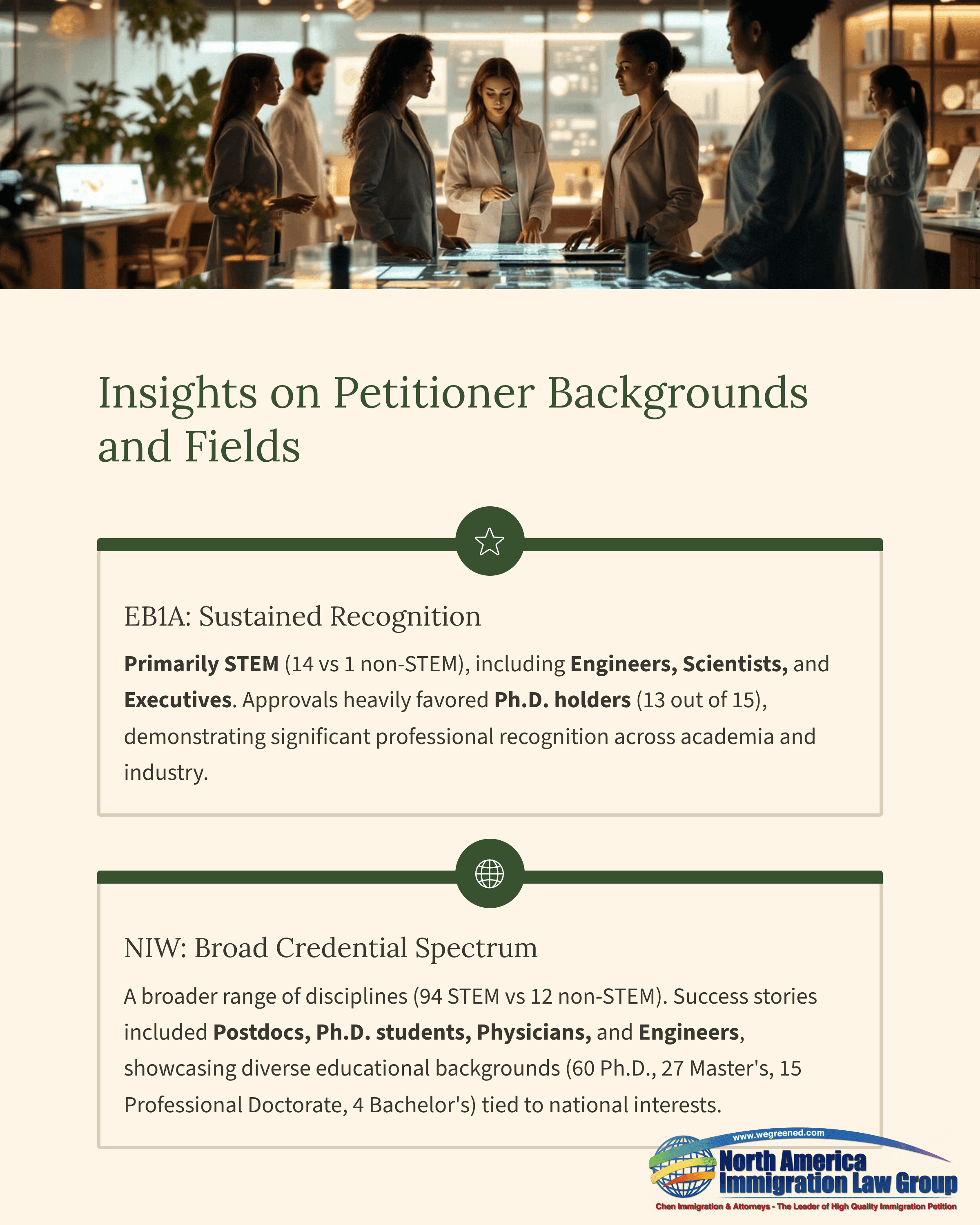
EB1A approvals this week were predominantly STEM-oriented, with 14 STEM approvals and 1 non-STEM approval. Approved fields included mechanical engineering, pharmaceutical sciences, computer science, food science, and epidemiology. The approved petitioners represented diverse professional backgrounds, including postdoctoral fellows, research scientists, assistant professors, research engineers, and industry executives. The degree mix consisted of 13 Ph.D. holders, 1 master's-level petitioner, and 1 professional doctorate holders, illustrating that EB1A approvals continued to concentrate on applicants with substantial professional recognition across both academia and industry.
NIW approvals again covered a much broader range of disciplines and career stages while remaining predominantly STEM-focused, with 94 STEM approvals and 12 non-STEM approvals. Major approved fields included artificial intelligence, mechanical engineering, environmental science, genomics, agriculture, clinical medicine, and physics. The approved group included postdoctoral researchers, Ph.D. students, assistant professors, research scientists, engineers, and physicians. The educational background was likewise broad, including 60 Ph.D. holders, 27 master's-level petitioners, 15 professional doctorate holders, and 4 bachelor's-level petitioners, reinforcing that NIW continues to accommodate a wide variety of educational and professional backgrounds when the proposed endeavor is clearly tied to important national interests.
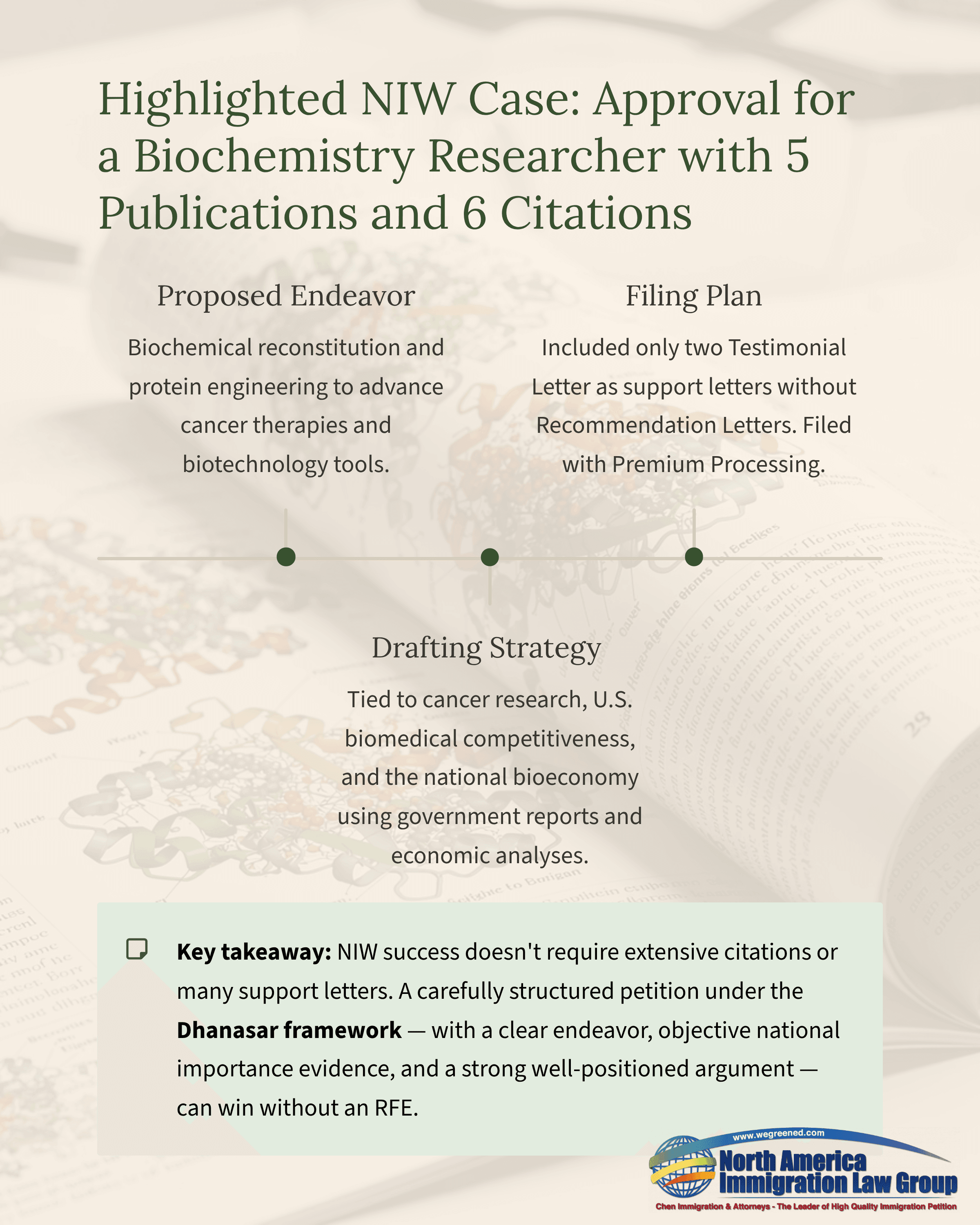
Highlighted NIW Case: Approval for a Biochemistry Researcher with 5 Publications and 6 Citations
This week's highlighted NIW approval involved a researcher specializing in molecular biochemistry, whose petition was approved with 5 peer-reviewed publications and only 6 citations at the time of filing. The petition was filed directly with Premium Processing, and approved in 64 days without Request for Evidence (RFE). The petition centered on the petitioner's proposed endeavor of developing biochemical reconstitution and protein engineering approaches to advance cancer therapies and biotechnology tools.
To establish substantial merit and national importance, the filing connected the proposed work to multiple U.S. priorities, including cancer research, biomedical competitiveness, and the national bioeconomy. Government reports, National Cancer Institute initiatives, and economic analyses were incorporated to demonstrate that the proposed endeavor would generate benefits extending well beyond any individual employer.
For the well-positioned prong, the petition emphasized doctoral training, high-quality peer-reviewed publications, documented research accomplishments, future research plans, and concrete examples showing that independent laboratories had already adopted the petitioner's methodologies. The two testimonial letters further corroborated the petitioner's technical contributions and practical impact within the field, reinforcing that the petitioner had already established meaningful professional recognition despite being at an earlier stage of an academic career.
The waiver analysis further argued that cutting-edge biotechnology and cancer research require flexibility, interdisciplinary collaboration, and the ability to pursue rapidly evolving scientific opportunities across institutions. The petition explained that the labor certification process could unnecessarily delay research directly supporting nationally important priorities in precision biotechnology innovation. This approval demonstrates that NIW success does not depend on extensive citation records or a large number of support letters. Even with a developing citation record and without submitting recommendation letters, a carefully structured petition that clearly defines the proposed endeavor, supports national importance with objective evidence, demonstrates that the petitioner is well positioned to advance the work, and organizes the evidence under the Dhanasar framework can achieve approval efficiently without an RFE.
Adjudication Trends and Policy Observations
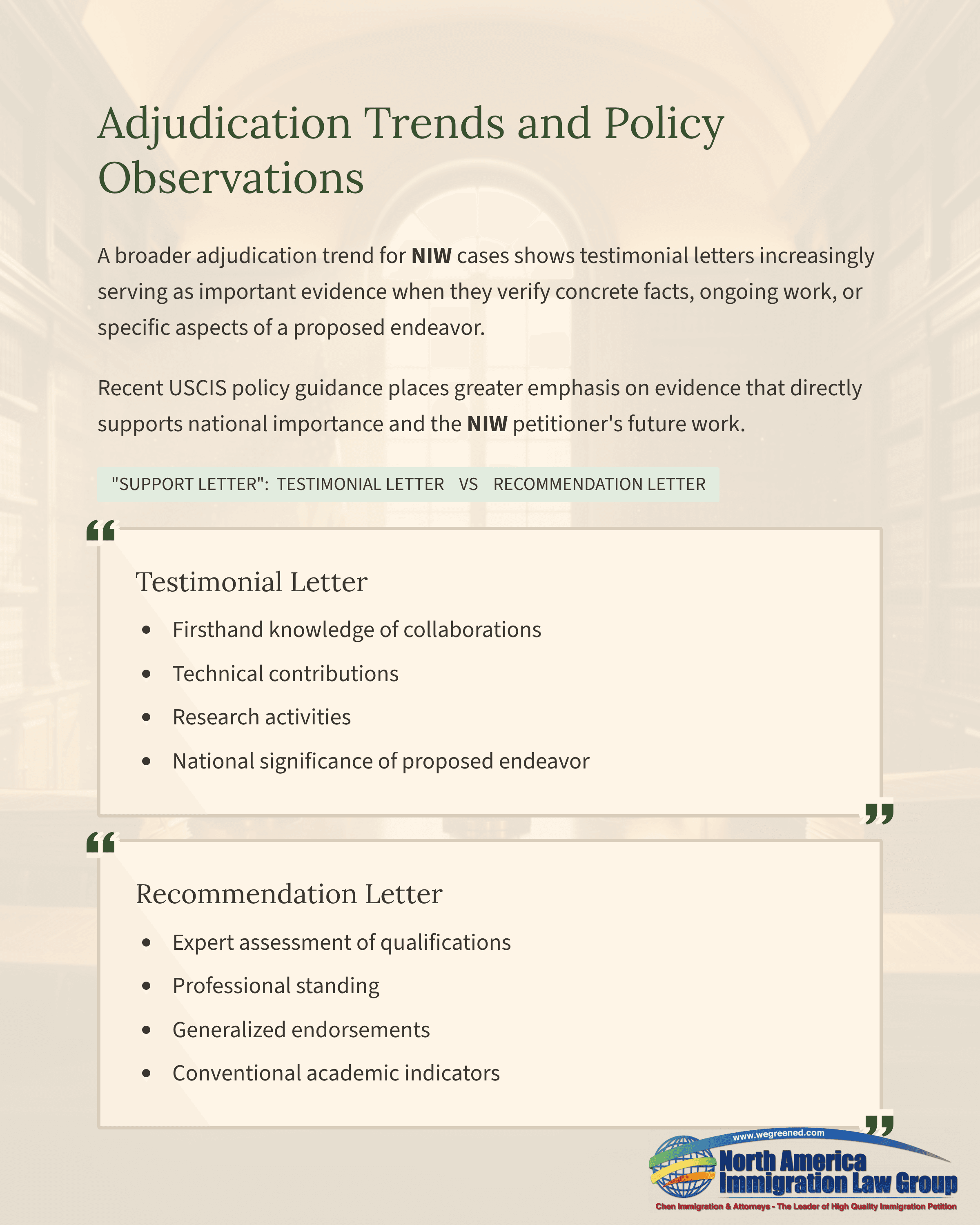
This week's approvals continue to demonstrate that USCIS evaluates NIW petitions based on how persuasively the evidence is organized under the Dhanasar framework rather than on publication or citation metrics alone. The highlighted case is particularly instructive because it was approved with two testimonial letters and no recommendation letters, reflecting a broader adjudication trend in which testimonial letters are increasingly serving as important evidence for NIW petitions when they verify concrete facts, ongoing work, or specific aspects of a proposed endeavor. Unlike traditional recommendation letters, which primarily provide an expert assessment of a petitioner's qualifications and professional standing, testimonial letters focus on firsthand knowledge of collaborations, technical contributions, research activities, or the national significance of the proposed endeavor.
Recent USCIS policy guidance has also placed greater emphasis on evidence that directly supports national importance and the petitioner's future work. Accordingly, testimonial letters from government or quasi-government entities discussing the national importance of a proposed endeavor, as well as letters from supervisors or collaborators describing ongoing or planned research, can provide particularly persuasive support when grounded in firsthand knowledge. This week's approval further illustrates that successful NIW petitions increasingly rely on presenting objective, case-specific evidence that directly addresses each Dhanasar prong, rather than relying solely on conventional academic indicators or generalized endorsements.