

WeGreened Weekly Approval Summary: Week of June 1, 2026
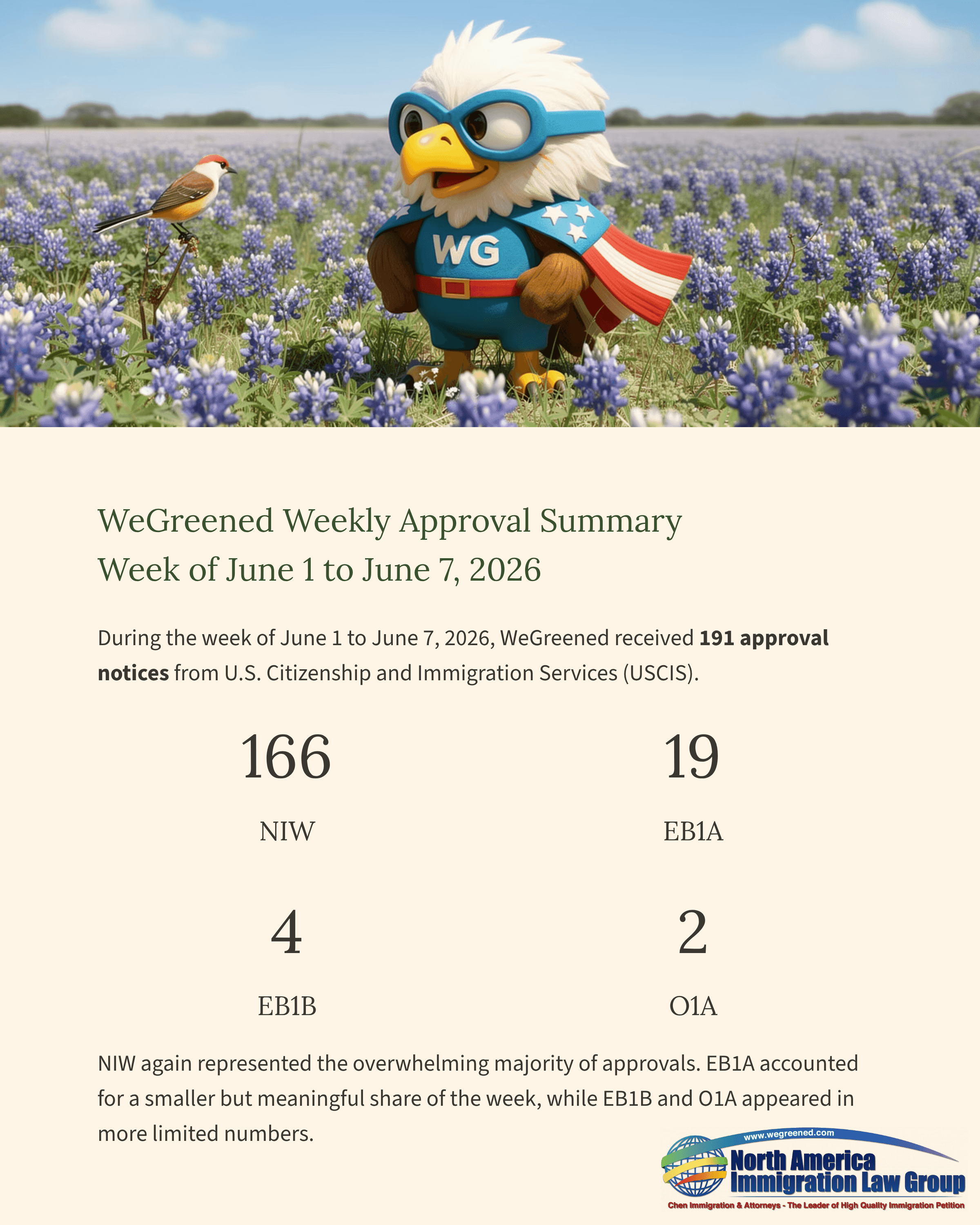

During the week of June 1 to June 7, 2026, WeGreened received 191 approval notices from U.S. Citizenship and Immigration Services (USCIS). Of the 191 approvals, 166 were for NIW (National Interest Waiver), 19 were for EB1A (Alien of Extraordinary Ability), 4 were for EB1B (Outstanding Professors or Researchers), and 2 were for O1A (Individuals with Extraordinary Ability or Achievement).
NIW again represented the overwhelming majority of approvals. EB1A accounted for a smaller but meaningful share of the week, while EB1B and O1A appeared in more limited numbers.
EB1A and NIW Credential Analysis
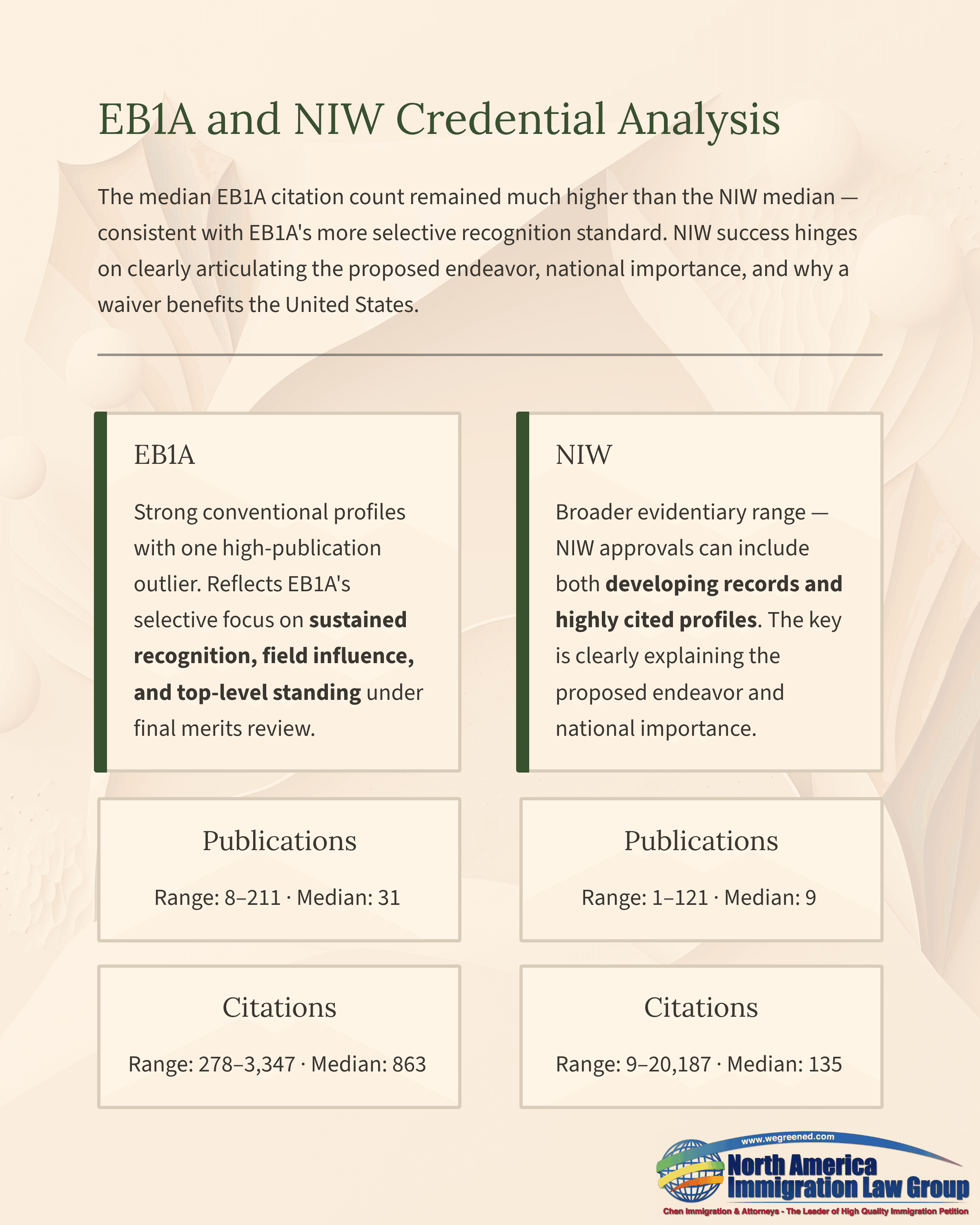
EB1A petitioners this week showed strong conventional profiles overall, with one high-publication outlier. Publications ranged from 8 to 211 (Q1: 18.5, median: 31, Q3: 40), and citations ranged from 278 to 3,347 (Q1: 551, median: 863, Q3: 1,613.5). The median citation count remained much higher than the NIW median, which is consistent with EB1A’s more selective focus on sustained recognition, field influence, and top-level standing under final merits review.
NIW petitioners reflected a broader evidentiary range. Publications ranged from 1 to 121 (Q1: 6, median: 9, Q3: 16), and citations ranged from 9 to 20,187 (Q1: 53, median: 135, Q3: 378.5). The very low minimum and very high maximum again show that NIW approvals can include both developing records and highly cited profiles. The key distinction is whether the petition clearly explains the proposed endeavor, national importance, the petitioner’s ability to advance the endeavor, and why a waiver would benefit the United States.
Insights on Petitioner Backgrounds and Fields
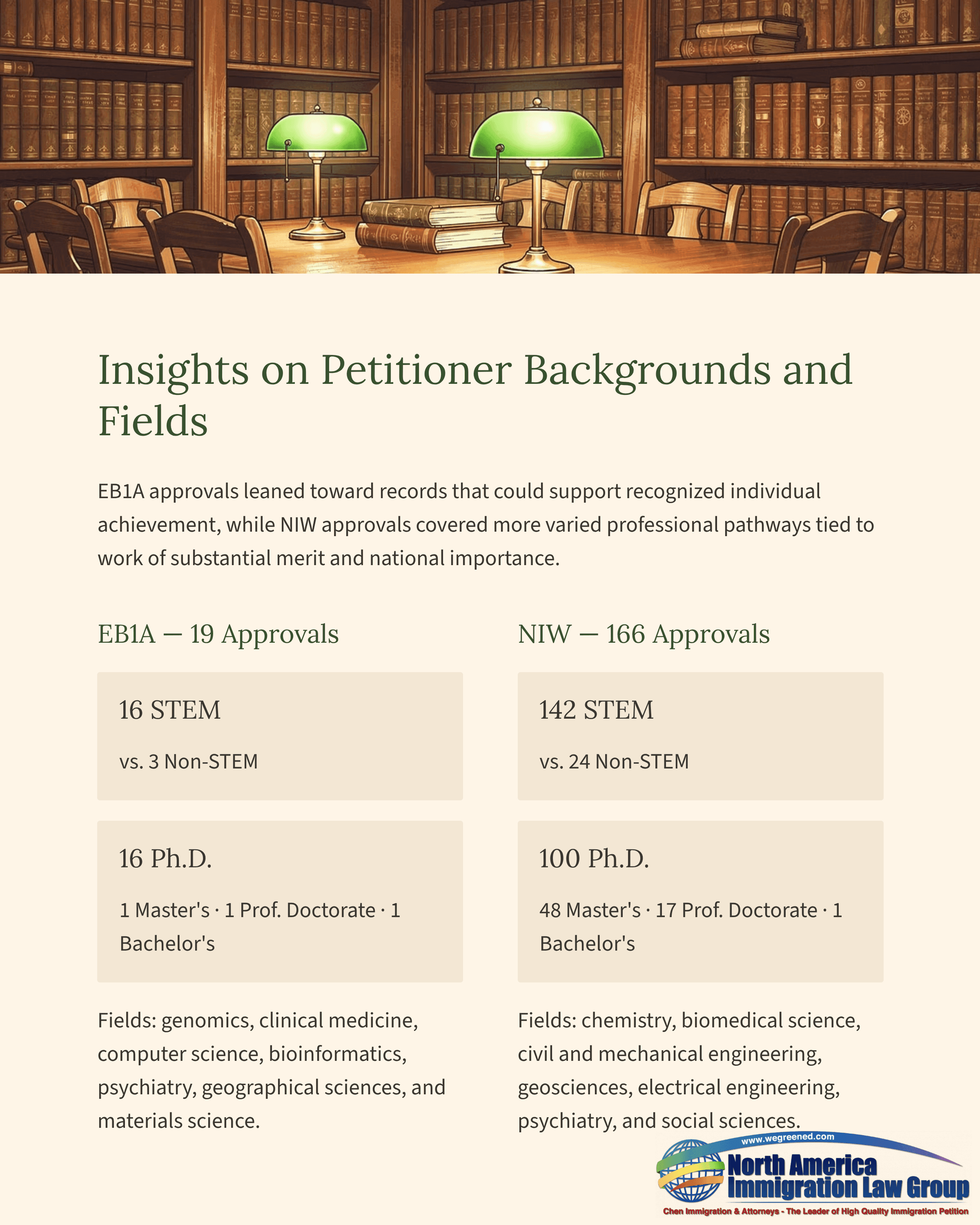
This week’s EB1A approvals were strongly STEM-centered, with 16 STEM approvals and 3 non-STEM approvals. Approved fields included genomics, civil engineering, clinical medicine, computer science, bioinformatics, psychiatry, geographical sciences, materials science, animal sciences, pharmacy, environmental engineering, nanotechnology, artificial intelligence, and water resources engineering. The degree mix was advanced-degree-heavy, with 16 Ph.D. holders, 1 master’s-level petitioner, 1 professional doctorate holder, and 1 bachelor’s-level petitioner.
NIW approvals were broader across both fields and career stages. The category remained strongly STEM-oriented, with 142 STEM approvals and 24 non-STEM approvals. Strong themes included chemistry, biomedical science, civil engineering, mechanical engineering, geosciences, artificial intelligence, computer science, machine learning, materials science, electrical engineering, public health, medicine, pathology, psychiatry, environmental engineering, renewable energy, biotechnology, neuroscience, physics, and social sciences. The degree mix included 100 Ph.D. holders, 48 master’s-level petitioners, 17 professional doctorate holders, and 1 bachelor’s-level petitioner.
Together, these results again show the practical distinction between EB1A and NIW. EB1A approvals leaned toward records that could support recognized individual achievement and final merits strength, while NIW approvals covered more varied professional pathways tied to work of substantial merit and national importance.
Highlighted NIW Case: Approval With 4 Publications and 9 Citations for an Advanced Materials Researcher
One notable NIW approval this week involved a researcher working on sustainable materials and green chemistry applications for biomedical and environmental use. At the time of filing, the record included 4 publications and 9 citations, reflecting an early-stage but technically focused research profile. Despite modest academic indicators, the case was approved through a well-structured NIW strategy emphasizing national relevance and applied impact.
Strategically, the petition was built around the Dhanasar framework, with the strongest emphasis on substantial merit and national importance. The filing connected the petitioner’s work to U.S. priorities in plastic waste reduction, sustainable manufacturing, and circular materials design, highlighting how recycling and material systems contribute to environmental and healthcare-related national needs.
For the well-positioned prong, the petition focused less on citation volume and more on technical progression, research execution, and interdisciplinary relevance. Evidence of published work, laboratory contributions, and ongoing development of sustainable material systems was supported by expert letters validating both the novelty and practical significance of the research. These endorsements helped establish that the petitioner’s contributions were already influencing related work in the field.
Third-party expert validation played a key role in strengthening the overall narrative. Independent letters confirmed the importance of the petitioner’s work in advancing sustainable systems and material design, reinforcing the credibility of the proposed endeavor. This case demonstrates that NIW approval is achievable even with limited metrics when the petition clearly frames national importance and is supported by coherent technical and expert evidence.
Adjudication Trends and Policy Observations
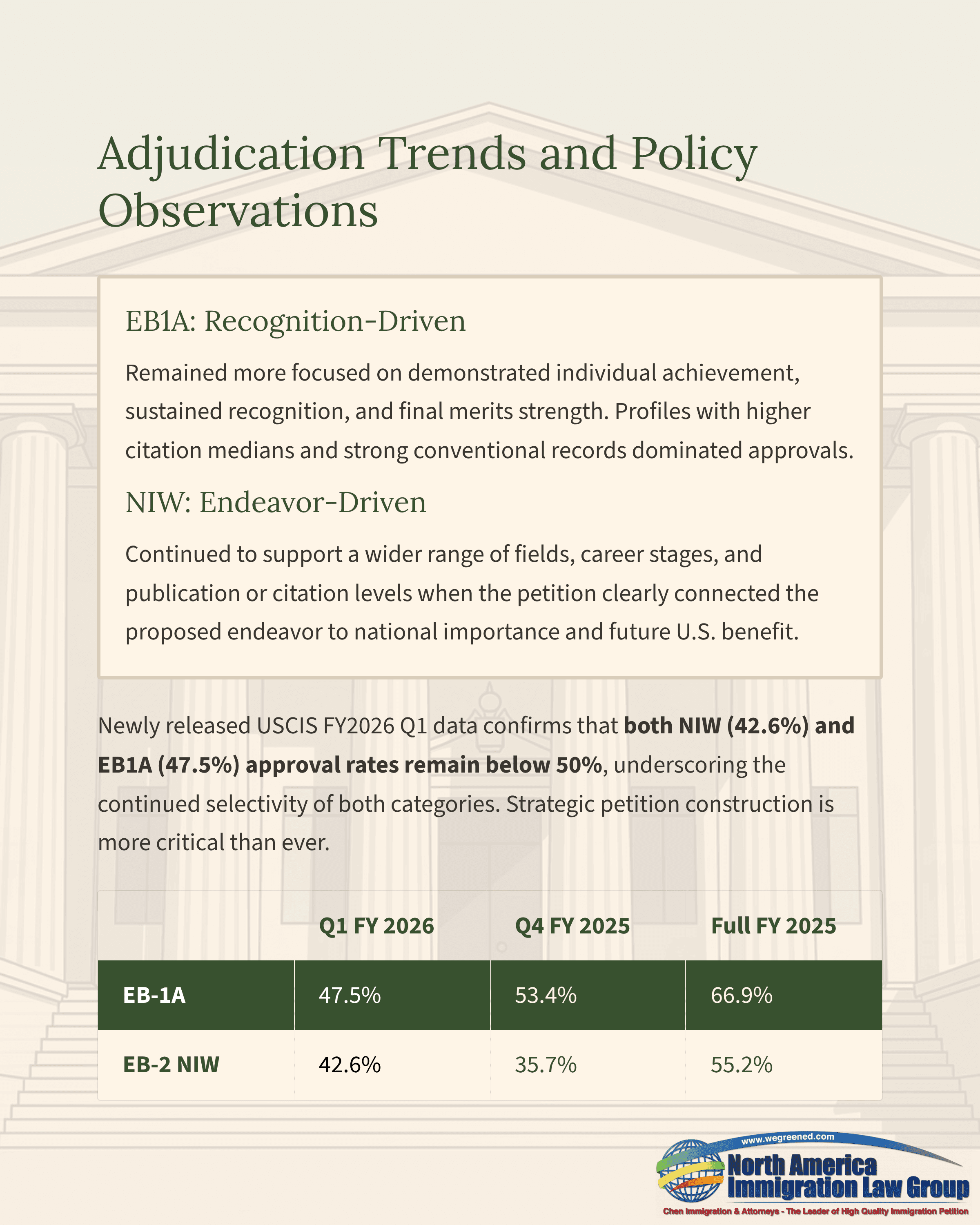
This week’s approvals again show the different logic of EB1A and NIW. EB1A remained more recognition-driven, while NIW continued to support a wider range of fields, career stages, and publication or citation levels when the petition clearly connected the proposed endeavor to national importance and future U.S. benefit.
In parallel, newly released USCIS FY2026 Q1 data indicates that approval rates for both NIW and EB1A remain below 50 percent, at 42.6 percent for NIW and 47.5 percent for EB1A, underscoring the continued selectivity of both categories. Within this environment, citation counts and publication volume remain relevant indicators but are not determinative, particularly where the record demonstrates credible field recognition, independent validation, and sustained, clearly articulated contributions with real-world significance.
The highlighted NIW approval also underlines that, despite the overall approval rate remaining relatively low, NIW outcomes continue to show that well-organized petitions grounded in national relevance and forward-looking impact can succeed across a wide range of academic and professional profiles.