

WeGreened Weekly Approval Summary: Week of June 15, 2026
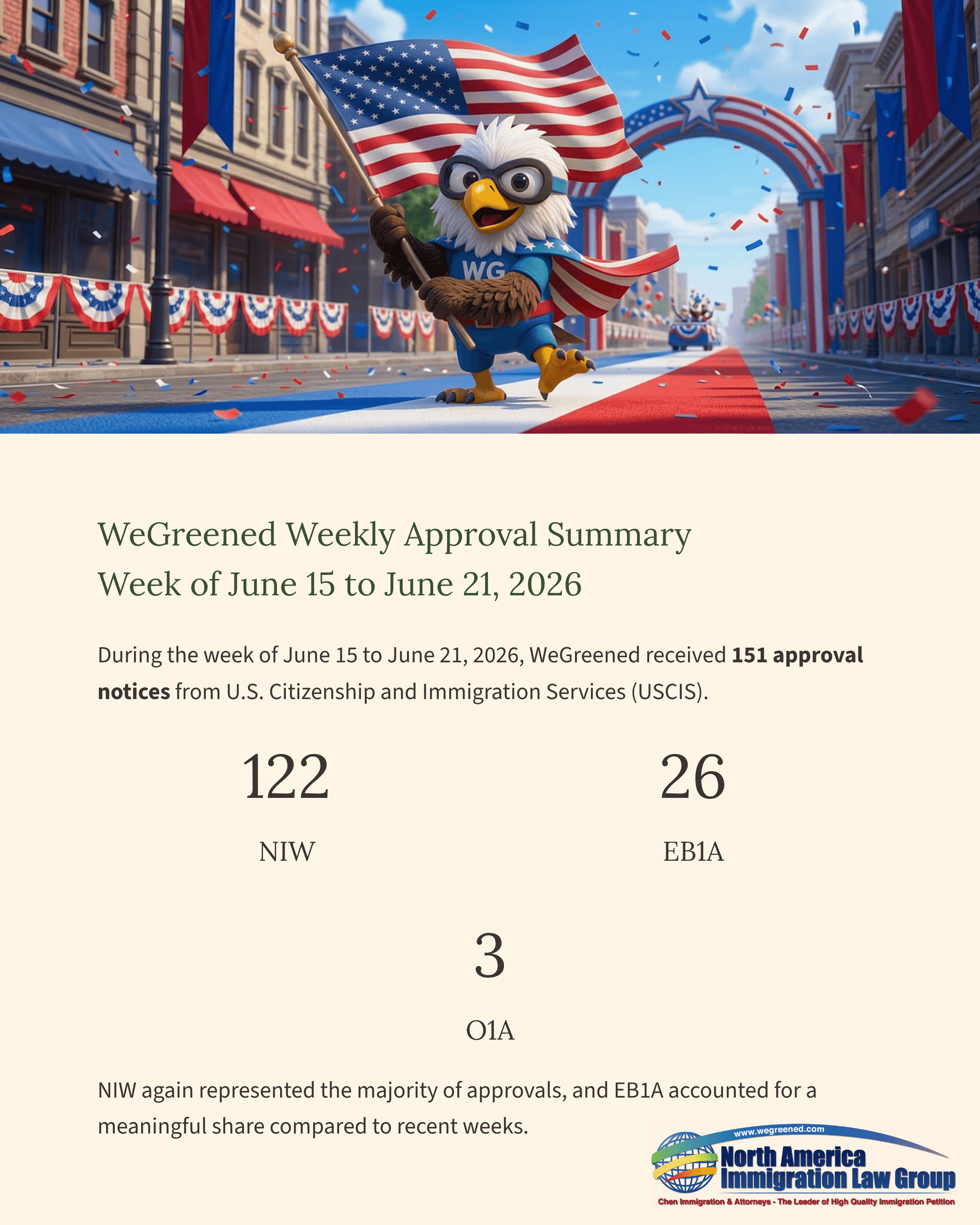
During the week of June 15 to June 21, 2026, WeGreened received 151 approval notices from U.S. Citizenship and Immigration Services (USCIS). Of the 151 approvals, 122 were for NIW (National Interest Waiver), 26 were for EB1A (Alien of Extraordinary Ability), and 3 were for O1A (Individuals with Extraordinary Ability or Achievement).
NIW again represented the majority of approvals, and EB1A accounted for a meaningful share compared to recent weeks. O1A appeared in limited numbers, with approvals concentrated in clinical and medical fields. No EB1B (Outstanding Professors or Researchers) approvals were recorded in this week’s approval batch.
EB1A and NIW Credential Analysis
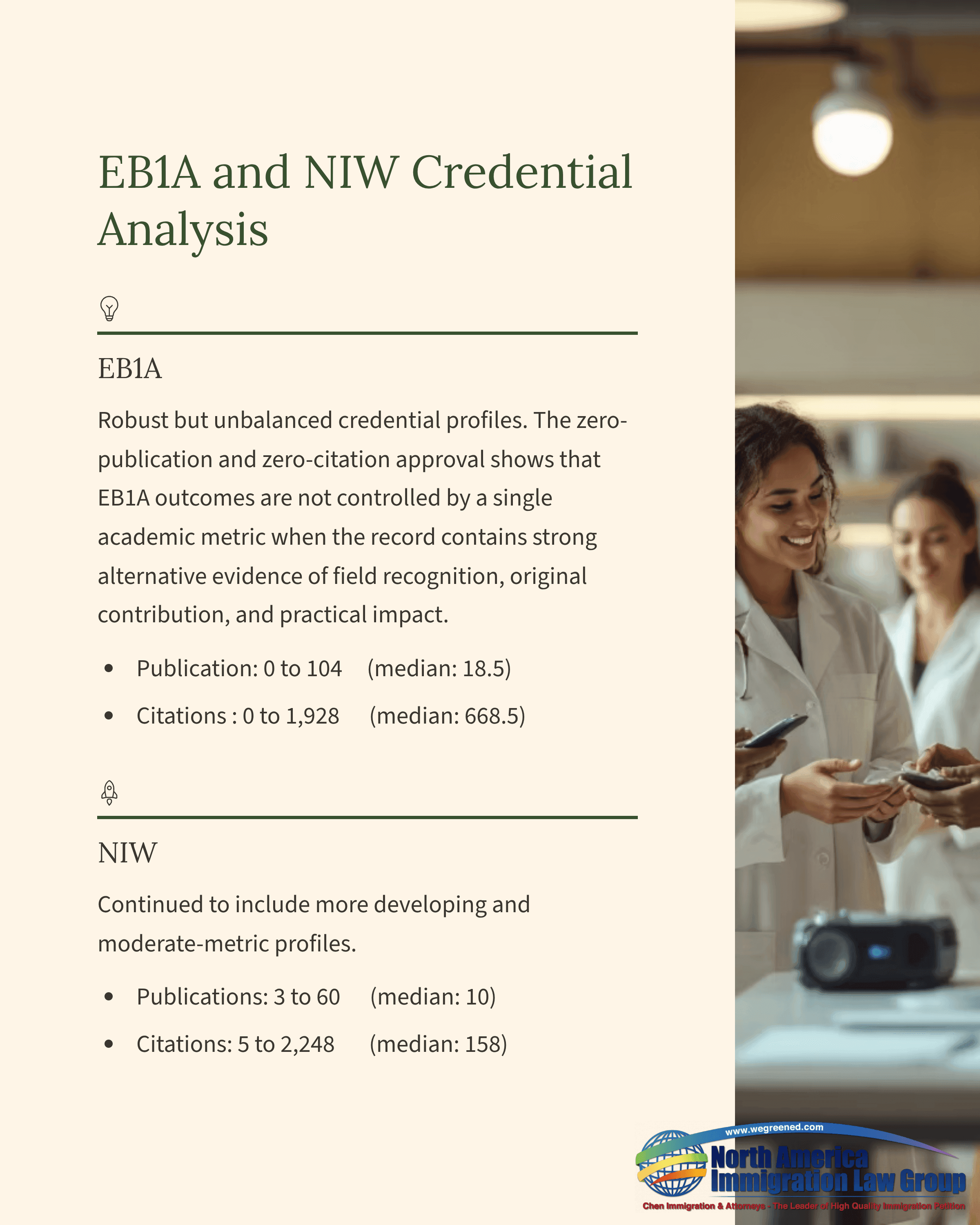
This week, we observed robust but unbalanced credential profiles among EB1A petitioners, with one especially unconventional zero-publication approval. Publications ranged from 0 to 104 (Q1: 12.5, median: 18.5, Q3: 33.25), and citations ranged from 0 to 1,928 (Q1: 433, median: 668.5, Q3: 1,371). Although the EB1A median citation count remained substantially higher than the NIW median, the zero-publication and zero-citation approval shows that EB1A outcomes are not controlled by a single academic metric when the record contains strong alternative evidence of field recognition, original contribution, and practical impact.
NIW petitioners continue to reflect a broad evidentiary range. Publications ranged from 3 to 60 (Q1: 6, median: 10, Q3: 15), and citations ranged from 5 to 2,248 (Q1: 75.25, median: 158, Q3: 311.5). Compared with EB1A, NIW continued to include more developing and moderate-metric profiles, while also including highly cited petitioners. This spread is consistent with NIW’s focus on the proposed endeavor, national importance, the petitioner’s ability to advance the work (well-positioned), and the benefit of waiving the labor certification requirement.
Insights on Petitioner Backgrounds and Fields
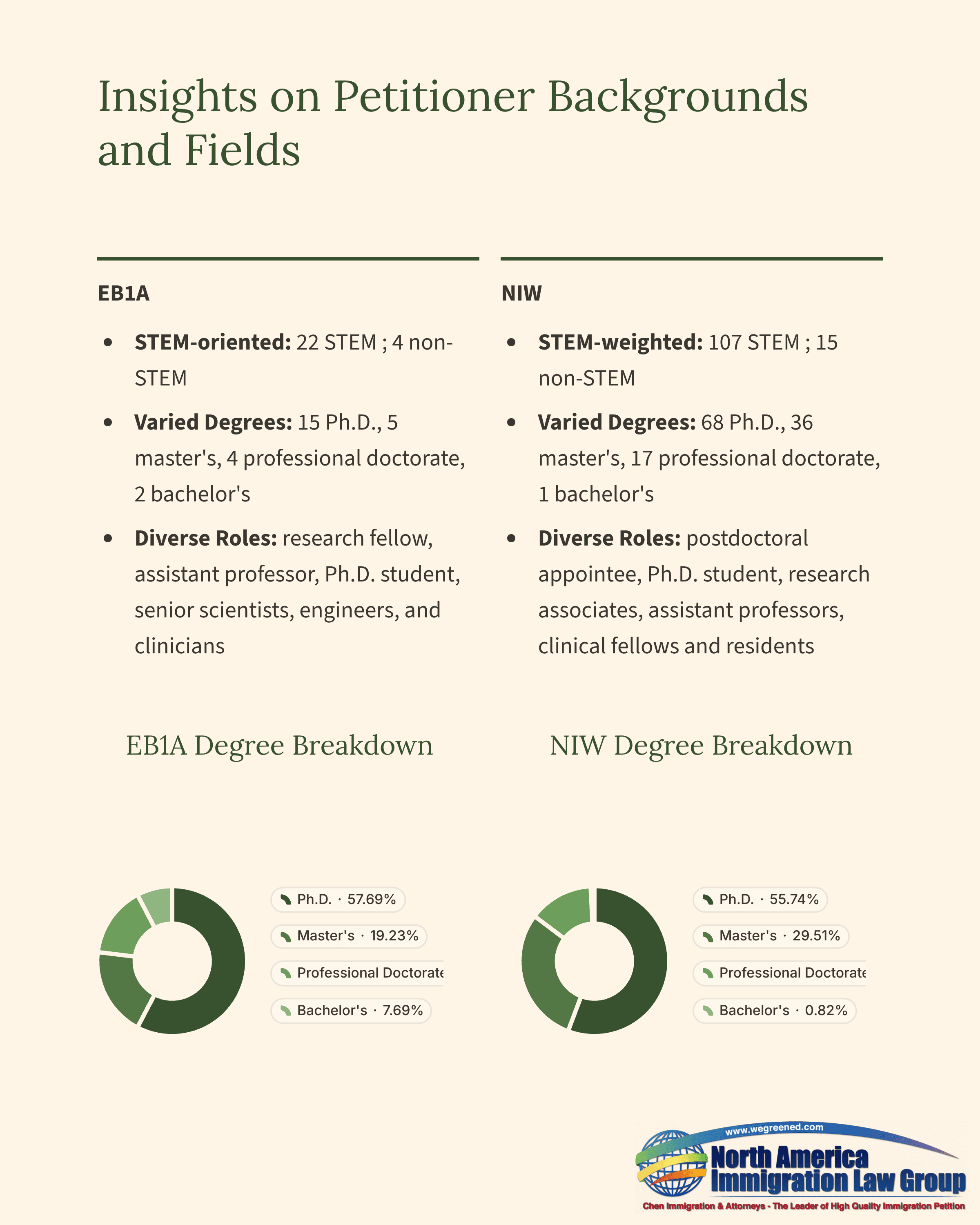
EB1A approvals this week were strongly STEM-oriented, with 22 STEM approvals and 4 non-STEM approvals. Approved fields included computer science, materials science, biotechnology, electrical engineering, and computational biology, along with clinical and medical fields such as surgery, medicine, and biomedical informatics. The degree mix included 15 Ph.D. holders, 5 master’s-level petitioners, 4 professional doctorate holders, and 2 bachelor’s-level petitioners. The group included research staff, faculty, clinicians, engineers, and industry technology leaders, reinforcing that EB1A strength depends on recognized individual achievement rather than job title alone.
NIW approvals were broader across both fields and career stages, while still strongly STEM-weighted, with 107 STEM approvals and 15 non-STEM approvals. Major themes included clinical medicine, computer science, materials science, genomics, environmental engineering, biotechnology, public health, oceanography, and agricultural sciences work. The degree mix included 68 Ph.D. holders, 36 master’s-level petitioners, 17 professional doctorate holders, and 1 bachelor’s-level petitioner. This week’s NIW approvals again show that the category can accommodate varied backgrounds when the petition clearly connects the proposed endeavor to concrete U.S. needs.
Highlighted EB1A Case: Approval With 0 Publications and 0 Citations for a Software Engineering Director
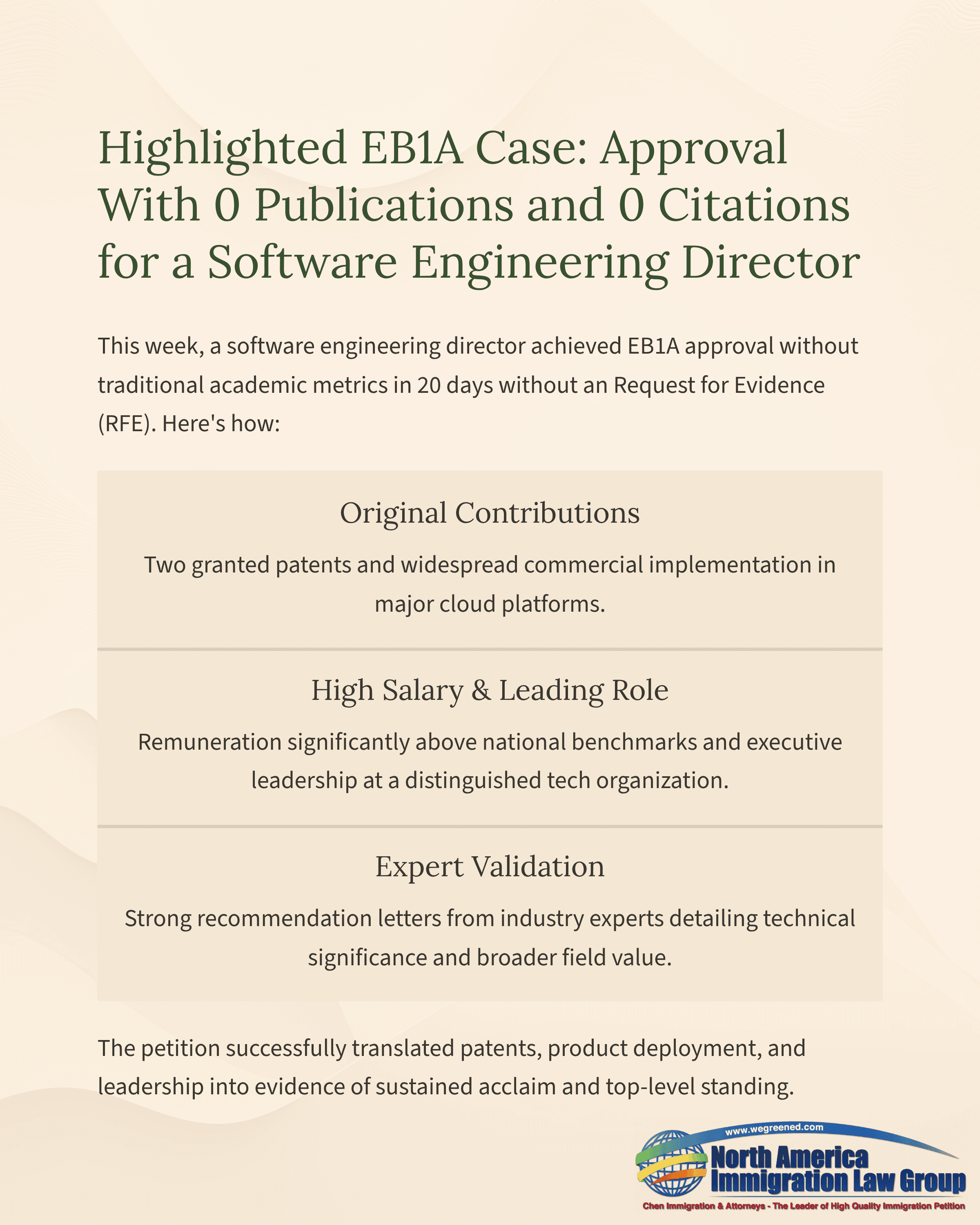
This week, we secured an instructive EB1A approval for a computer science case that achieved success without any publications or citations. The case was filed with Premium Processing and approved in 20 days without a Request for Evidence (RFE). It was notable because it did not fit the conventional academic EB1A profile. Instead of relying on scholarly publications or citation impact, the petition focused on an industry technology leader whose work centered on enterprise-scale software engineering, AI-powered data platforms, and global engineering leadership.
The main challenge was translating a non-academic industry record into EB1A evidence. Our strategy used the Kazarian two-step framework and presented three core EB1A criteria: original contributions of major significance, high salary, and leading or critical role for a distinguished organization. For original contributions, the petition emphasized two granted patents, commercialization of the petitioner’s work, and implementation of the technology in major enterprise cloud platforms used by customers across multiple industries. We also included multiple recommendation letters, including independent advisory opinions and letters from senior industry experts, to explain the technical significance, commercial implementation, and broader field value of the petitioner’s work.
For the high salary and leading or critical role criteria, the petition used objective, role-specific evidence. Compensation evidence showed that the petitioner’s remuneration was significantly higher than relevant national benchmarks for senior software engineering leadership. For the leading or critical role criterion, the petition emphasized executive-level engineering responsibilities at a distinguished technology organization, including leadership over cross-functional delivery, product reliability, and technical strategy for data platform systems. These materials helped show that the petitioner’s role was not merely senior in title, but central to the success and growth of a major cloud product.
The final merits strategy tied these pieces together into a coherent extraordinary-ability narrative. The petition argued that the petitioner had reached the top of the cloud engineering field through patented innovation, commercial implementation, customer adoption, high remuneration, leadership at a distinguished organization, and expert validation through carefully drafted support letters. This approval is a strong reminder that EB1A can succeed quickly, even for industry professionals with no publications or citations, when the petition identifies the correct impact indicators and translates patents, product deployment, enterprise adoption, technical leadership, and third-party validation into evidence of sustained acclaim and top-level standing.
Adjudication Trends and Policy Observations
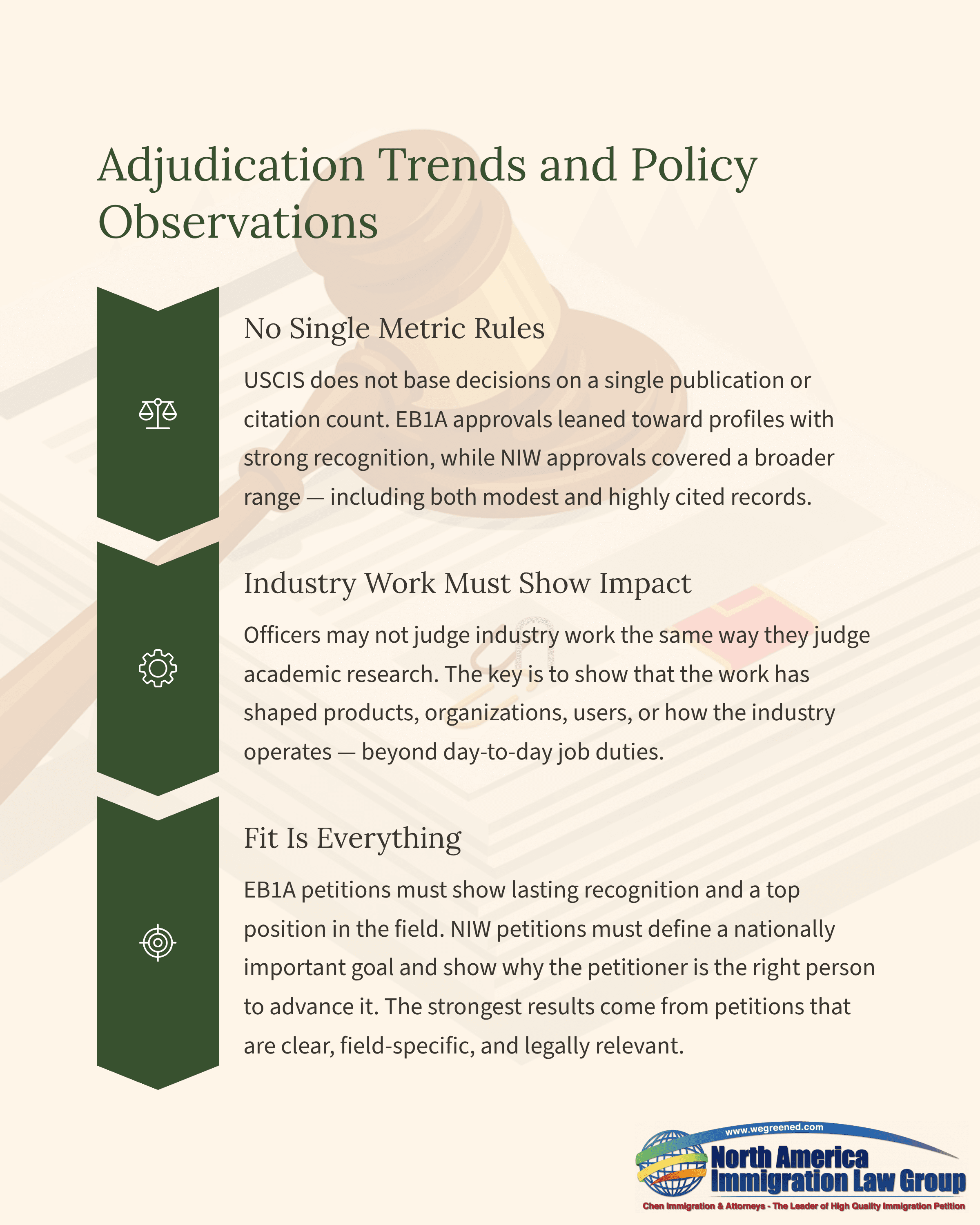
This week’s approvals again show that USCIS outcomes are not driven by a single publication or citation threshold. EB1A approvals remained more concentrated in recognition-oriented profiles, while NIW approvals covered a wider range of metrics, including both modest and highly cited records.
The highlighted EB1A approval also reinforces an important drafting lesson for industry EB1A petitions. Officers may not always evaluate industry technology work through the same indicators used for academic research. The key is to show that the work has significance beyond internal job duties and has influenced products, organizations, users, or industry practice.
Across both EB1A and NIW, this week’s results reinforce the same practical point: strong petitions depend on fit. EB1A filings must explain why the total record demonstrates sustained recognition and top-level standing in the petitioner’s actual field, while NIW filings must define a nationally important endeavor and explain why the petitioner is well positioned to advance it. The strongest outcomes continue to come from petitions that make the evidence coherent, field-specific, and legally relevant to the standard USCIS is applying.