

WeGreened Weekly Approval Summary: Week of June 22, 2026
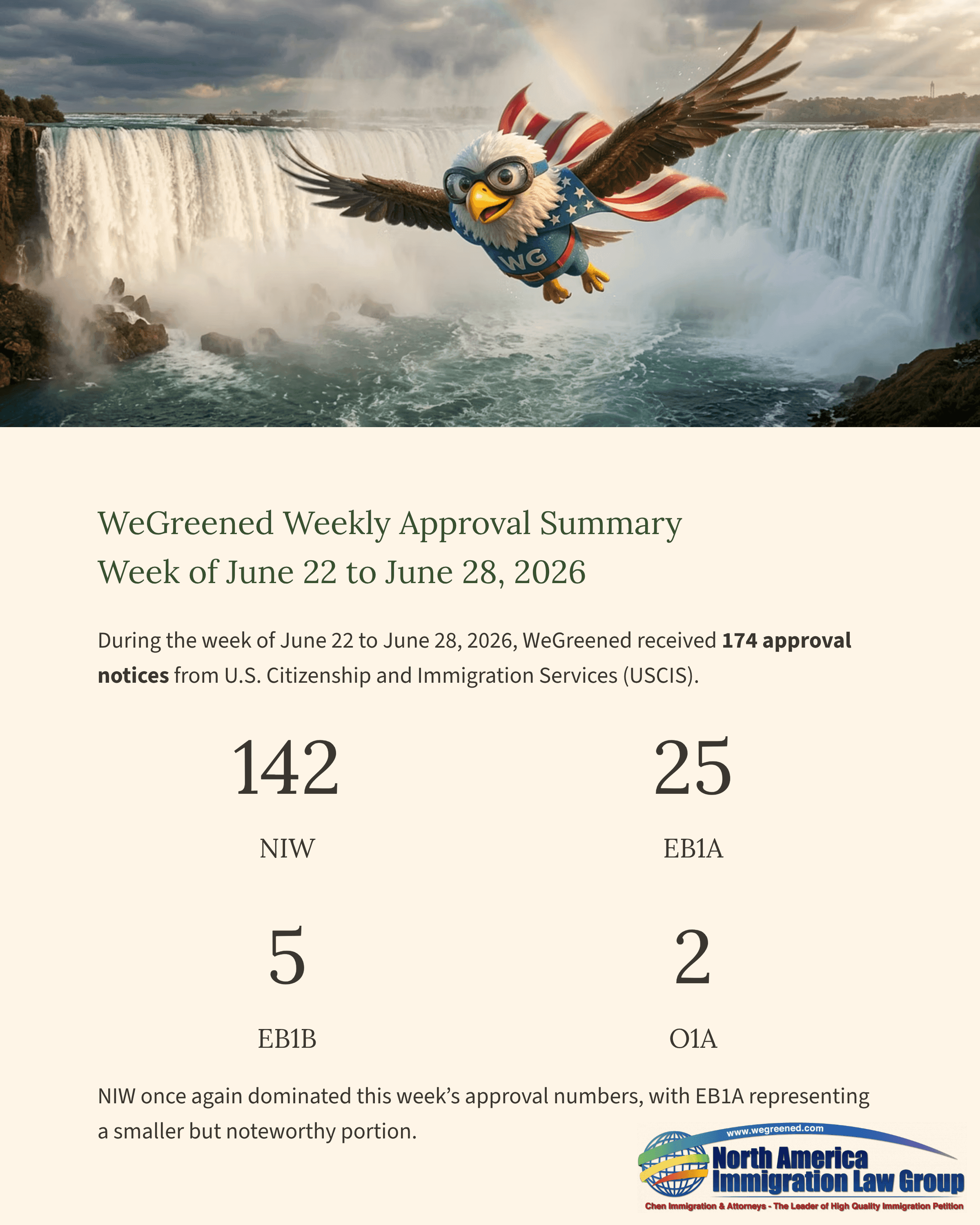
During the week of June 22 to June 28, 2026, WeGreened received 174 approval notices from U.S. Citizenship and Immigration Services (USCIS). Of the 174 approvals, 142 were for NIW (National Interest Waiver), 25 were for EB1A (Alien of Extraordinary Ability), 5 were for EB1B (Outstanding Professors or Researchers), and 2 were for O1A (Individuals with Extraordinary Ability or Achievement).
NIW once again dominated this week’s approval numbers, with EB1A representing a smaller but noteworthy portion, while EB1B appeared more visibly than in some recent weekly batches. O1A remained limited in number.
EB1A and NIW Credential Analysis
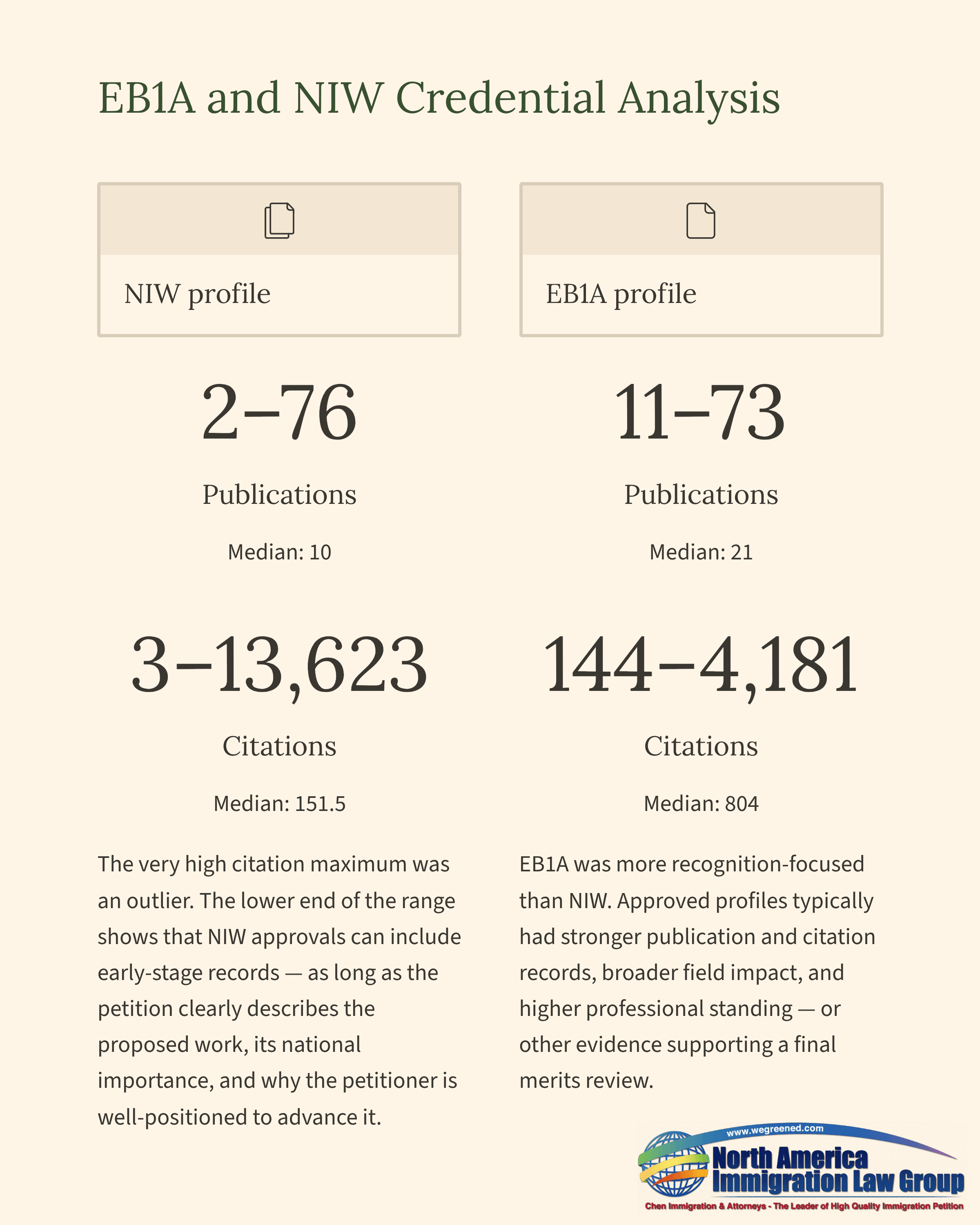
EB1A petitioners this week showed stronger and more concentrated conventional metrics. Publications ranged from 11 to 73 (Q1: 17, median: 21, Q3: 33), and citations ranged from 144 to 4,181 (Q1: 435, median: 804, Q3: 1,609). Compared with NIW, EB1A remained more recognition-driven, with approved profiles generally supported by stronger publication and citation records, field impact, professional standing, or other evidence that could support final merits review.
NIW petitioners this week reflected a broad evidentiary range. Publications ranged from 2 to 76 (Q1: 6, median: 10, Q3: 17), and citations ranged from 3 to 13,623 (Q1: 59, median: 151.5, Q3: 343.75). The very high citation maximum came from an outlier, but the lower end of the range again shows that NIW approvals can include developing records when the petition clearly defines the proposed endeavor, establishes national importance, and explains why the petitioner is well positioned to advance the work.
Insights on Petitioner Backgrounds and Fields
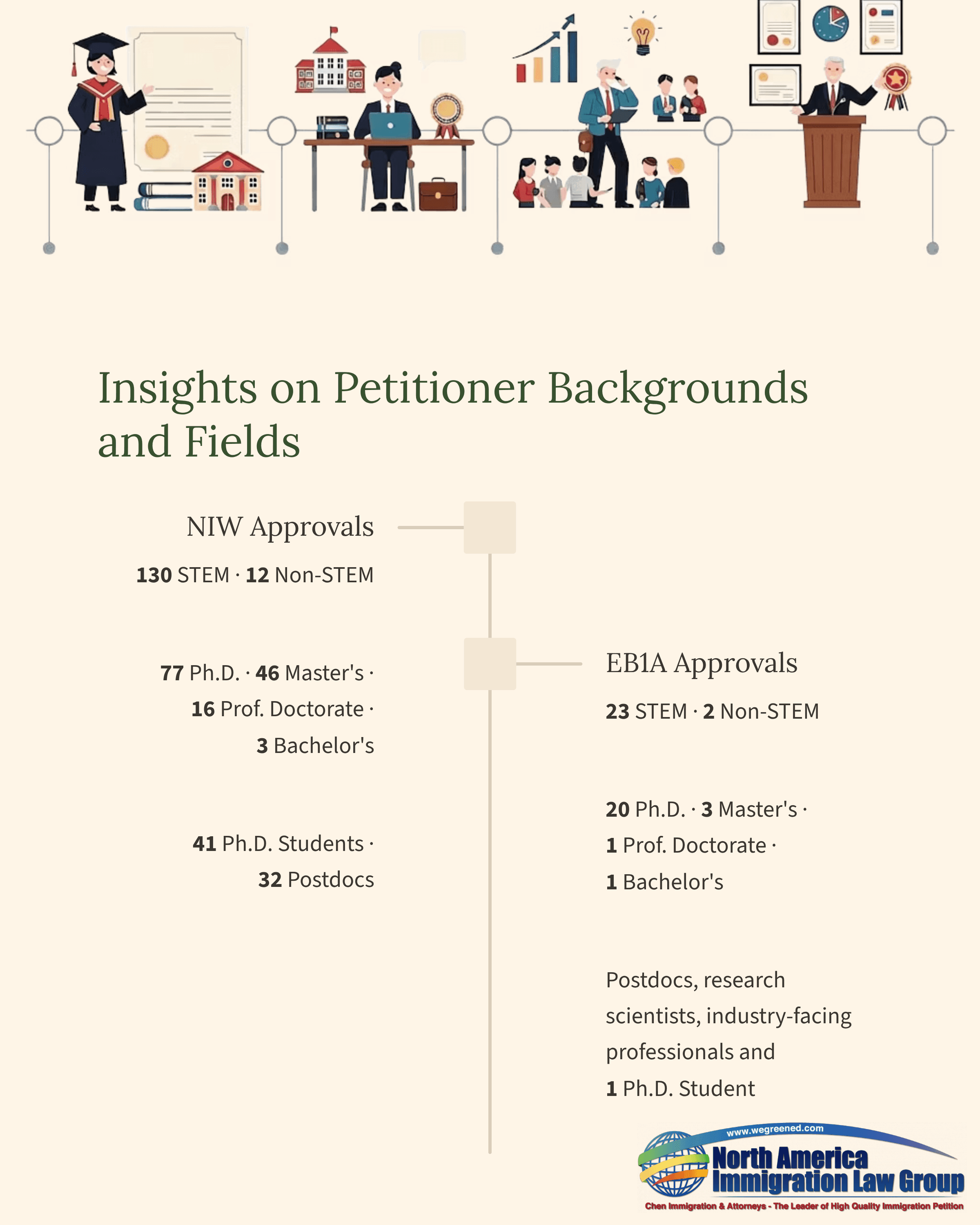
EB1A approvals this week were strongly STEM-centered, with 23 STEM approvals and 2 non-STEM approvals. Approved fields included biomedical science, computer science, biology, physics, biomedical engineering, epidemiology, atmospheric science, and public policy. The degree mix remained advanced-degree-heavy, with 20 Ph.D. holders, 3 master’s-level petitioners, 1 professional doctorate holder, and 1 bachelor’s-level petitioner. Employment backgrounds included postdoctoral researchers, research scientists, faculty members, engineers, a Ph.D. student, and industry-facing professionals, reinforcing that EB1A is not limited to one employment setting when the record supports sustained recognition and field-level influence.
While NIW approvals span a wide range of fields and career stages, the majority are in STEM fields, with 130 STEM approvals compared to 12 non-STEM. Major themes included mechanical engineering, clinical medicine, artificial intelligence, molecular biology, public health, applied economics, surgery, water resources engineering, and agricultural sciences. The degree mix included 77 Ph.D. holders, 46 master’s-level petitioners, 16 professional doctorate holders, and 3 bachelor’s-level petitioners. The current-job distribution also showed NIW’s flexibility, including 41 Ph.D. students and 32 postdoctoral appointees, along with assistant professors, research scientists, engineers, clinicians, lecturers, managers, and other applied industry or institutional roles.
Highlighted NIW Case: Approval With 2 Publications and 15 Citations for a Ph.D. Student in Electrical Engineering
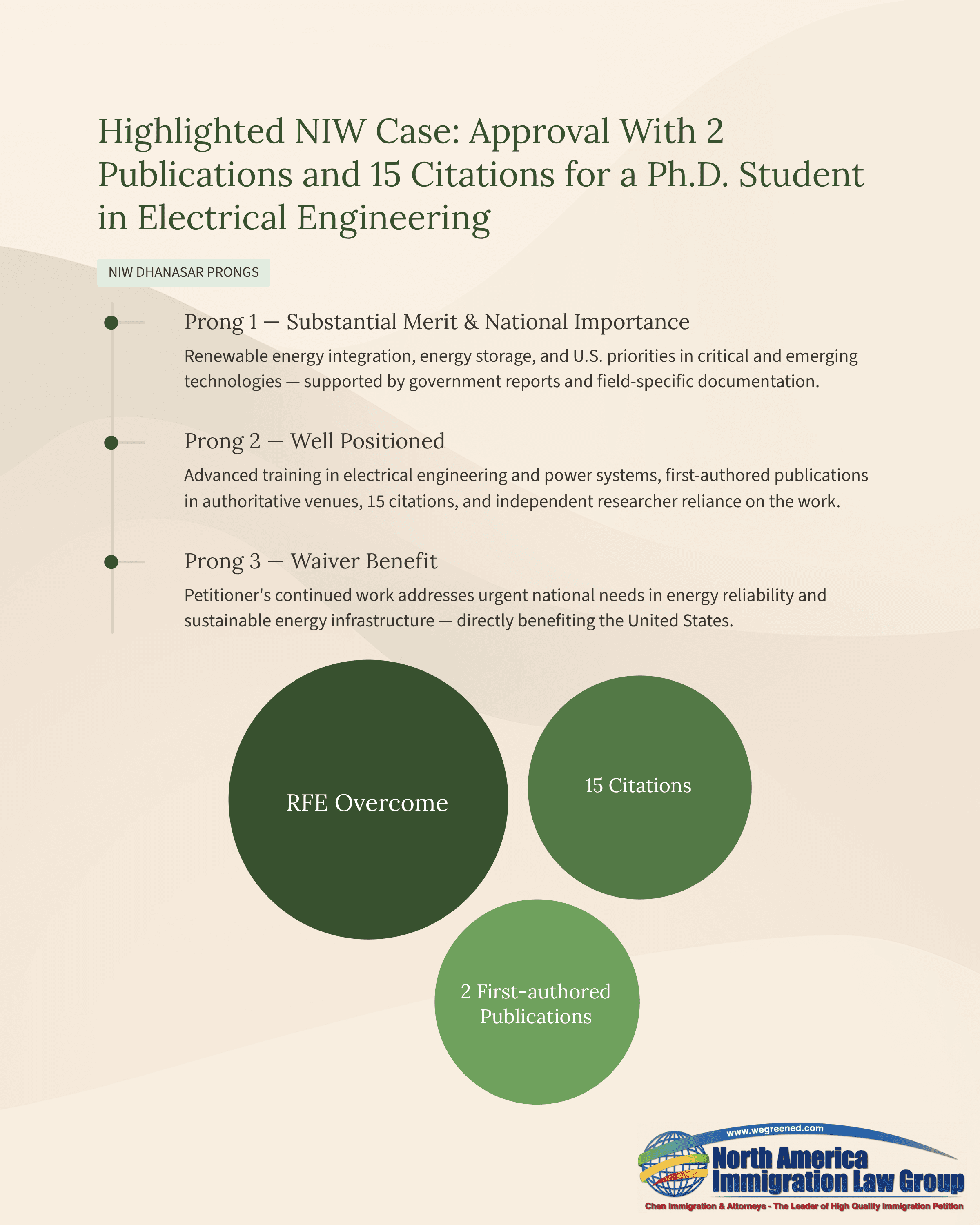
One of our most illustrative NIW approvals this week was in electrical engineering and electric power systems, with a profile of two first-authored publications and 15 citations. The proposed endeavor focused on designing advanced control schemes and algorithms for inverter-based resources. The case was notable because it involved a relatively modest publication and citation record, and the petition later faced an RFE challenging all three Dhanasar prongs. The main challenge was not whether the work had technical value, but whether the petition could make the national importance and waiver logic clear enough under a heightened RFE review.
For substantial merit and national importance, the petition connected the work to renewable energy integration, energy storage, and U.S. priorities in critical and emerging technologies. Our strategy emphasized the need to use objective evidence, government reports, funding evidence, and field-specific documentation to show that the endeavor had significance beyond the petitioner’s immediate workplace. For the well-positioned prong, the filing could not rely on publication volume alone. Instead, the petition emphasized the petitioner’s advanced training in electrical engineering and power systems, first-authored publications in authoritative venues, 15 citations, detailed examples of how independent researchers relied on the work, and technical contributions involving energy flexibility and real-time energy trading. The petition also highlighted project-specific outcomes.
The RFE strategy further strengthened the case by directly addressing the officer’s concerns under each prong rather than simply repeating the original petition. For Prong 1, the response focused on clarifying the specific proposed endeavor and tying it to urgent U.S. energy priorities. For Prong 2, the strategy pushed back against an overly high standard and emphasized that Dhanasar requires evidence of progress and positioning, not proof of guaranteed future success. For Prong 3, the waiver argument explained that the petitioner’s continued work would benefit the United States because the endeavor addressed urgent national needs in energy reliability and sustainable energy infrastructure. This approval shows that a lower-metric NIW case can still succeed after RFE when the response makes the proposed endeavor precise, organizes the evidence under Dhanasar, and connects technical progress to national energy priorities.
Adjudication Trends and Policy Observations
This week’s approvals again reflect a stricter adjudication environment for both NIW and EB1A, where officers may request more detailed documentation even when the original filing is substantively strong. RFEs are not always a sign that the petition was weak; in many cases, they reflect officer-specific concerns, discretionary preferences, or a demand for more explicit connections between the evidence and the legal standard.
The highlighted NIW approval also reflects that, the successful strategy was not simply to repeat the original filing, but to clarify the proposed endeavor, reinforce national importance with objective energy and grid-resilience evidence, reorganize the petitioner’s modest publication and citation record around concrete technical progress, and explain why waiver flexibility would benefit the United States. This kind of response is particularly important when an officer appears to apply a heightened or metrics-heavy view of NIW eligibility.
The broader drafting lesson is that approvals increasingly depend on how clearly the petition guides the officer through the final analysis. For NIW, that means aligning the proposed endeavor, national importance, well-positioned evidence, and waiver argument under Dhanasar. For EB1A, it means translating achievements into sustained recognition and top-level standing under final merits. Across both categories, strong outcomes continue to favor petitions that are not only well supported, but also carefully framed, responsive to officer concerns, and specific to the petitioner’s field, record, and future work.