

WeGreened Weekly Approval Summary: Week of June 8, 2026
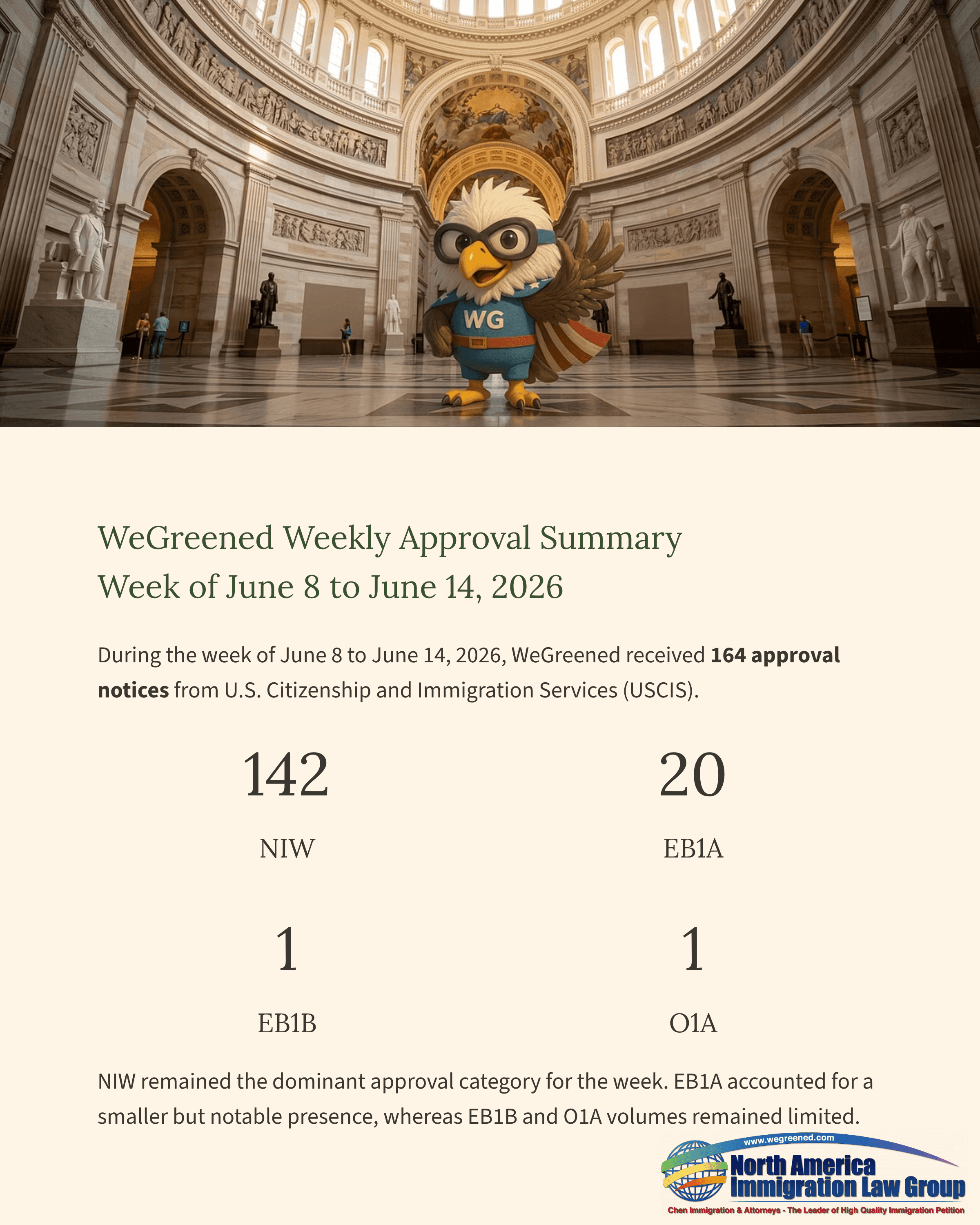
During the week of June 8 to June 14, 2026, WeGreened received 164 approval notices from U.S. Citizenship and Immigration Services (USCIS). Of the 164 approvals, 142 were for NIW (National Interest Waiver), 20 were for EB1A (Alien of Extraordinary Ability), 1 was for EB1B (Outstanding Professors or Researchers), and 1 was for O1A (Individuals with Extraordinary Ability or Achievement).
NIW remained the dominant approval category for the week. EB1A accounted for a smaller but notable presence, whereas EB1B and O1A volumes remained limited.
EB1A and NIW Credential Analysis
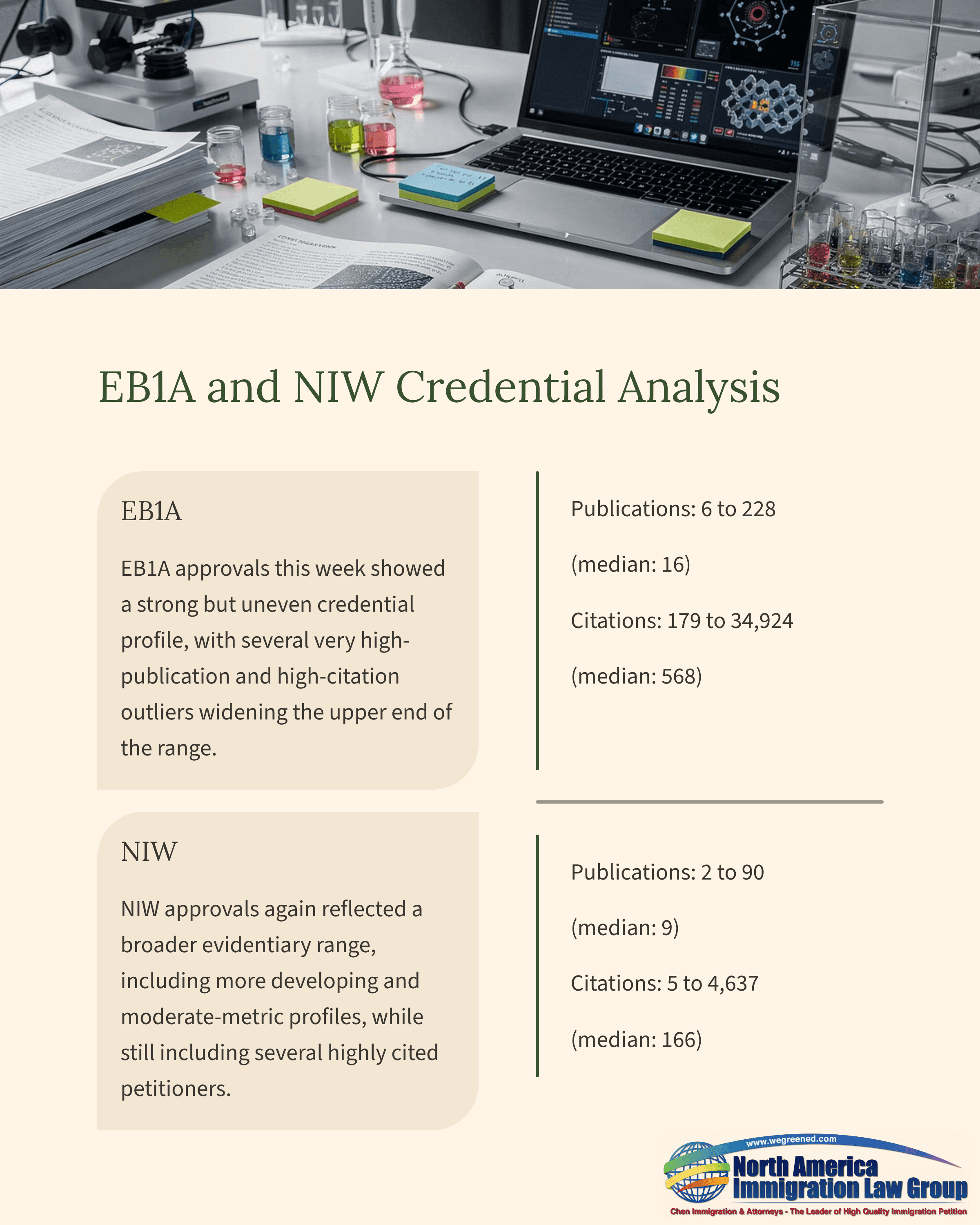
EB1A petitioners this week showed a strong but uneven credential profile, with several very high-publication and high-citation outliers widening the upper end of the range. Publications ranged from 6 to 228 (Q1: 10.75, median: 16, Q3: 34.5), and citations ranged from 179 to 34,924 (Q1: 318.75, median: 568, Q3: 4,053.5). The upper citation range was especially high this week, but the lower end also shows that EB1A approvals did not depend on a single citation threshold.
NIW approvals again reflected a broader evidentiary range. Publications ranged from 2 to 90 (Q1: 5, median: 9, Q3: 16.75), and citations ranged from 5 to 4,637 (Q1: 58.25, median: 166, Q3: 357.25). Compared with EB1A, the NIW group included more developing and moderate-metric profiles, while still including several highly cited petitioners.
Insights on Petitioner Backgrounds and Fields
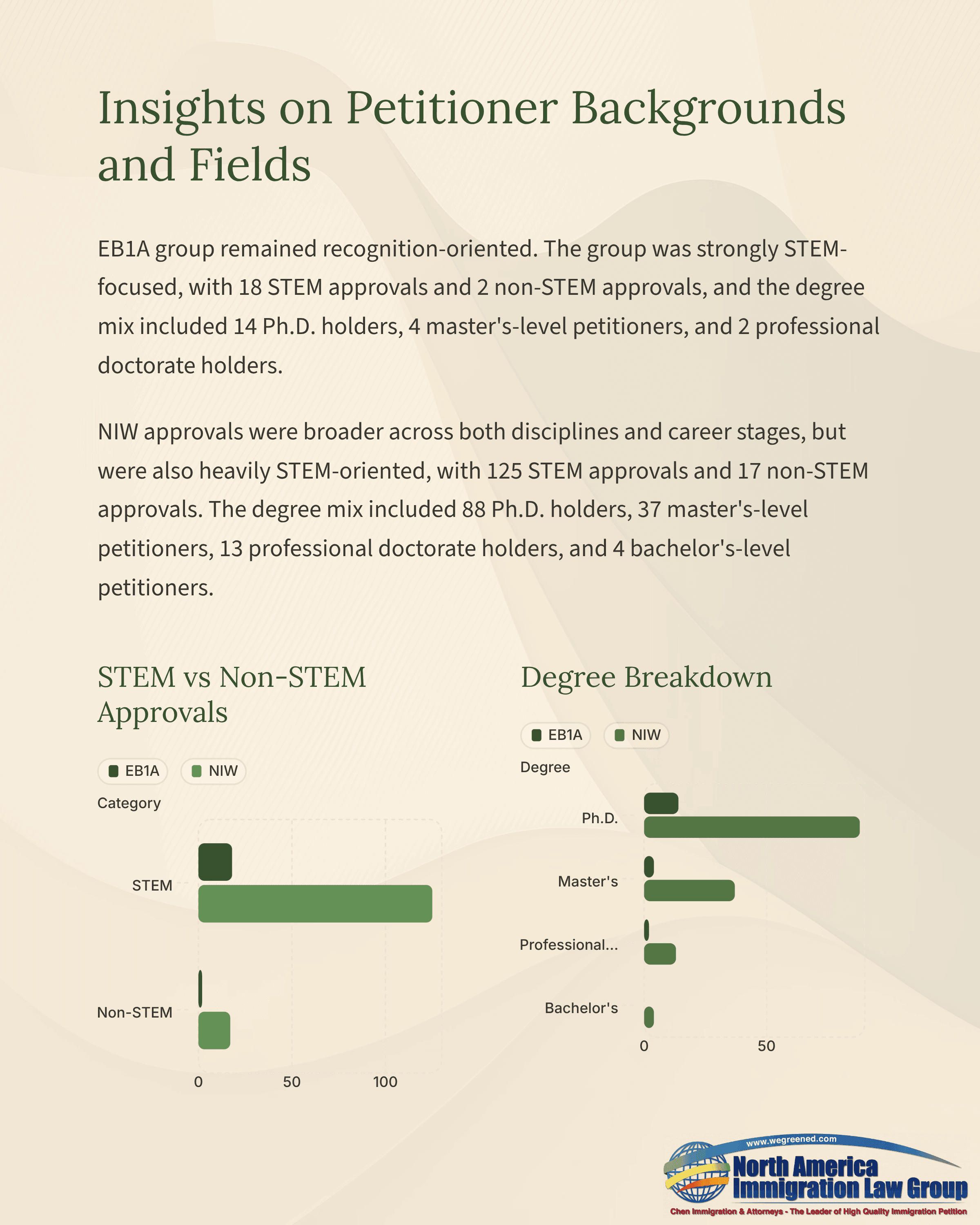
EB1A approvals this week were concentrated in STEM and recognition-driven fields, including computer science, physics, medicine, biotechnology, astrophysics, and food science. Overall, the EB1A group remained recognition-oriented. The group was strongly STEM-focused, with 18 STEM approvals and 2 non-STEM approvals, and the degree mix included 14 Ph.D. holders, 4 master’s-level petitioners, and 2 professional doctorate holders. Most approvals involved records that could support final merits arguments through publications, citations, field impact, professional role, or other evidence of individual recognition.
NIW approvals were broader across both disciplines and career stages. Major themes included artificial intelligence, electrical engineering, cancer research, chemistry, forestry, statistics, agricultural sciences, management, and public health-related fields. NIW was also heavily STEM-oriented, with 125 STEM approvals and 17 non-STEM approvals. The degree mix included 88 Ph.D. holders, 37 master’s-level petitioners, 13 professional doctorate holders, and 4 bachelor’s-level petitioners.This spread is consistent with NIW’s focus on the proposed endeavor rather than publication or citation numbers alone. The strongest NIW filings are those that clearly define the proposed work, explain its national importance, show that the petitioner is well positioned to advance it, and connect the waiver request to broader U.S. benefit.
Highlighted NIW Case: Approval With 4 Publications and 5 Citations for a Materials Science Researcher
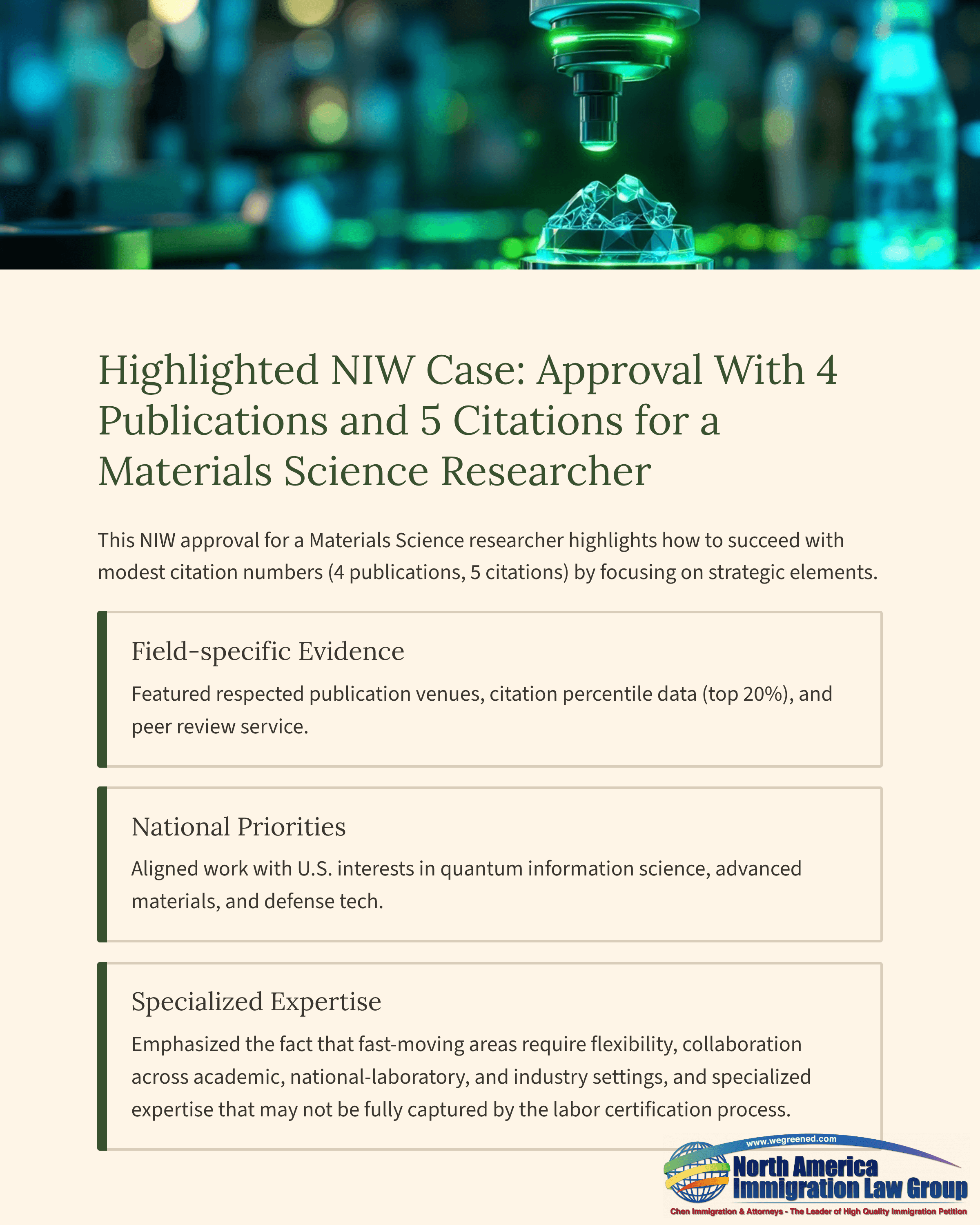
This week's approvals included an especially instructive NIW case in materials science, which featured only 5 citations across 4 peer-reviewed publications. The proposed endeavor focused on conducting experimental research on the nanoscale fabrication of devices, with the goal of accelerating materials discovery for quantum information technology. The case was notable because the petitioner had a strong STEM background and highly specialized technical expertise, but the raw citation count was modest and the petitioner’s current work was in an industry-facing semiconductor role rather than a traditional academic research appointment.
The main challenge was showing that the case should not be evaluated through citation numbers alone. Our strategy focused on explaining why the petitioner’s work was nationally important in light of U.S. priorities in quantum information science, advanced materials, and defense-related technology. Rather than presenting the endeavor as general materials research, the petition framed it as work that addresses a key bottleneck in quantum technology: the need for reliable, reproducible, device-ready materials and scalable fabrication methods.
For the well-positioned prong, the petition emphasized field-specific evidence of ability and progress. We highlighted the petitioner’s Ph.D. training, expertise in nanoscale fabrication, and current semiconductor manufacturing experience. To manage the low citation count, the filing relied on contextual evidence rather than raw numbers alone, including publication in respected venues, citation percentile evidence showing that one paper ranked among the top 20% most-cited Materials Science articles for its publication year, peer review service, Department of Energy-supported research, and letters from experts confirming the importance of the petitioner’s planned work and collaborations.
The waiver argument tied these points together by explaining why continued work in this area would benefit the United States. The petition stressed that quantum materials and device fabrication are fast-moving areas that require flexibility, collaboration across academic, national-laboratory, and industry settings, and specialized expertise that may not be fully captured by the labor certification process. This approval shows that even with modest citation numbers, an NIW case can succeed when the proposed endeavor is precisely defined, aligned with national technology priorities, and supported by field-specific evidence showing the petitioner’s ability to advance a strategically important area.
Adjudication Trends and Policy Observations
This week’s approvals again show that USCIS outcomes are not controlled by a single publication or citation threshold. EB1A filings must support sustained recognition and final merits review, while NIW filings must define a nationally important endeavor and explain why the petitioner is well positioned to advance it.
The highlighted case approval also reinforces the importance of field-specific evidence. For emerging technology areas, raw citation numbers may not fully capture the petitioner’s future value. The broader drafting lesson is that strong outcomes depend on fit. For EB1A cases, the petition must show why the record as a whole demonstrates recognized individual achievement. For NIW cases, especially those involving lower publication numbers or moderate citation counts, the petition must translate the applicant’s work into a clear national-interest narrative under Dhanasar. Across both categories, the approval results reinforce the importance of making the evidence coherent, specific, and legally relevant to the standard USCIS is applying.