

WeGreened Weekly Approval Summary: Week of May 11, 2026
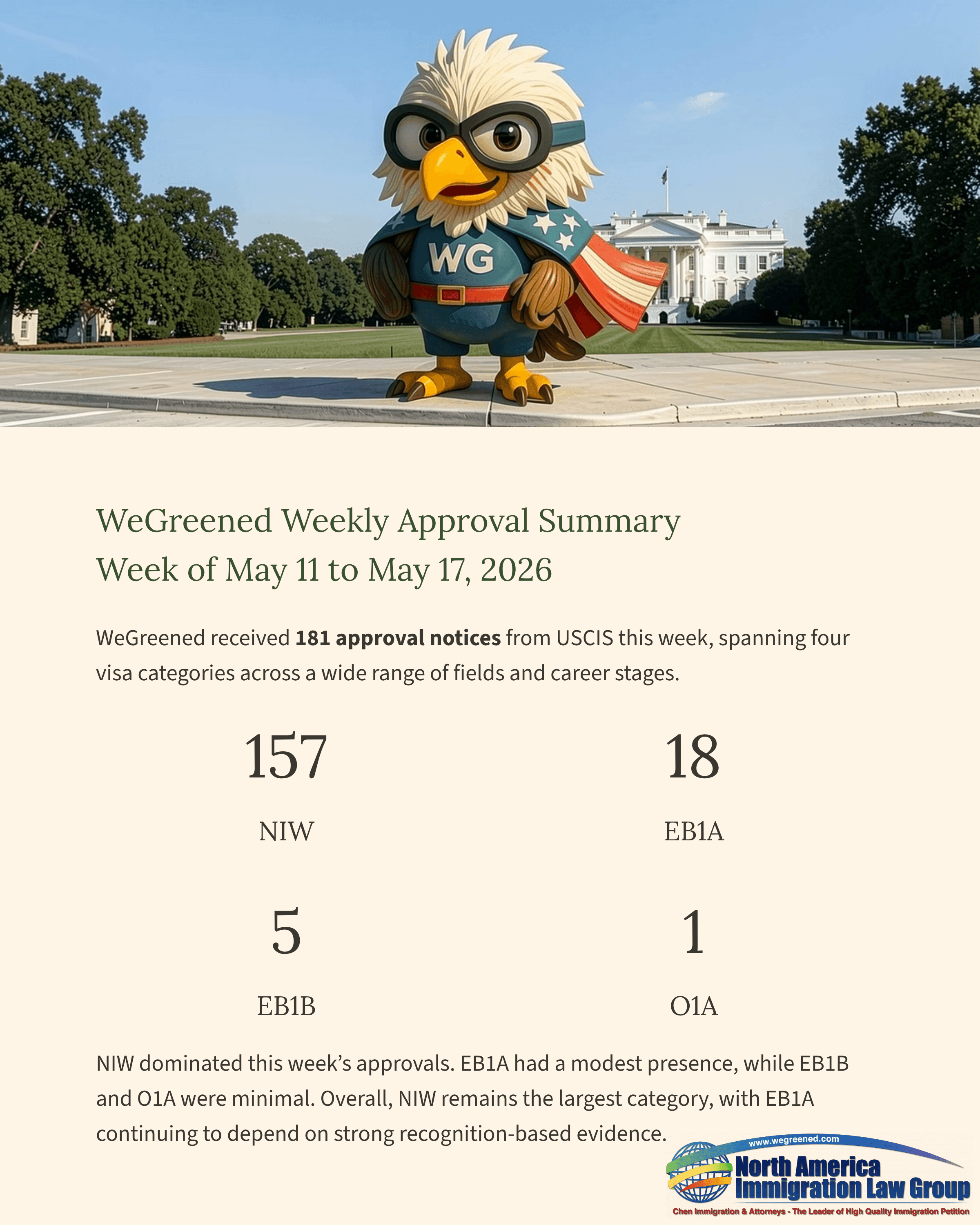
During the week of May 11 to May 17, 2026, WeGreened received 181 approval notices from U.S. Citizenship and Immigration Services (USCIS). Of the 181 approvals, 157 were for NIW (National Interest Waiver), 18 were for EB1A (Alien of Extraordinary Ability), 5 were for EB1B (Outstanding Professors or Researchers), and 1 was for O1A (Individuals with Extraordinary Ability or Achievement).
NIW continued to make up the overwhelming majority of this week’s approvals. EB1A was also relatively visible, with 18 approvals, while EB1B appeared in a smaller but steady number and O1A was represented by one approval. Overall, this week’s batch again shows that NIW remains the largest approval category, while EB1A continues to require a more recognition-focused evidentiary presentation.
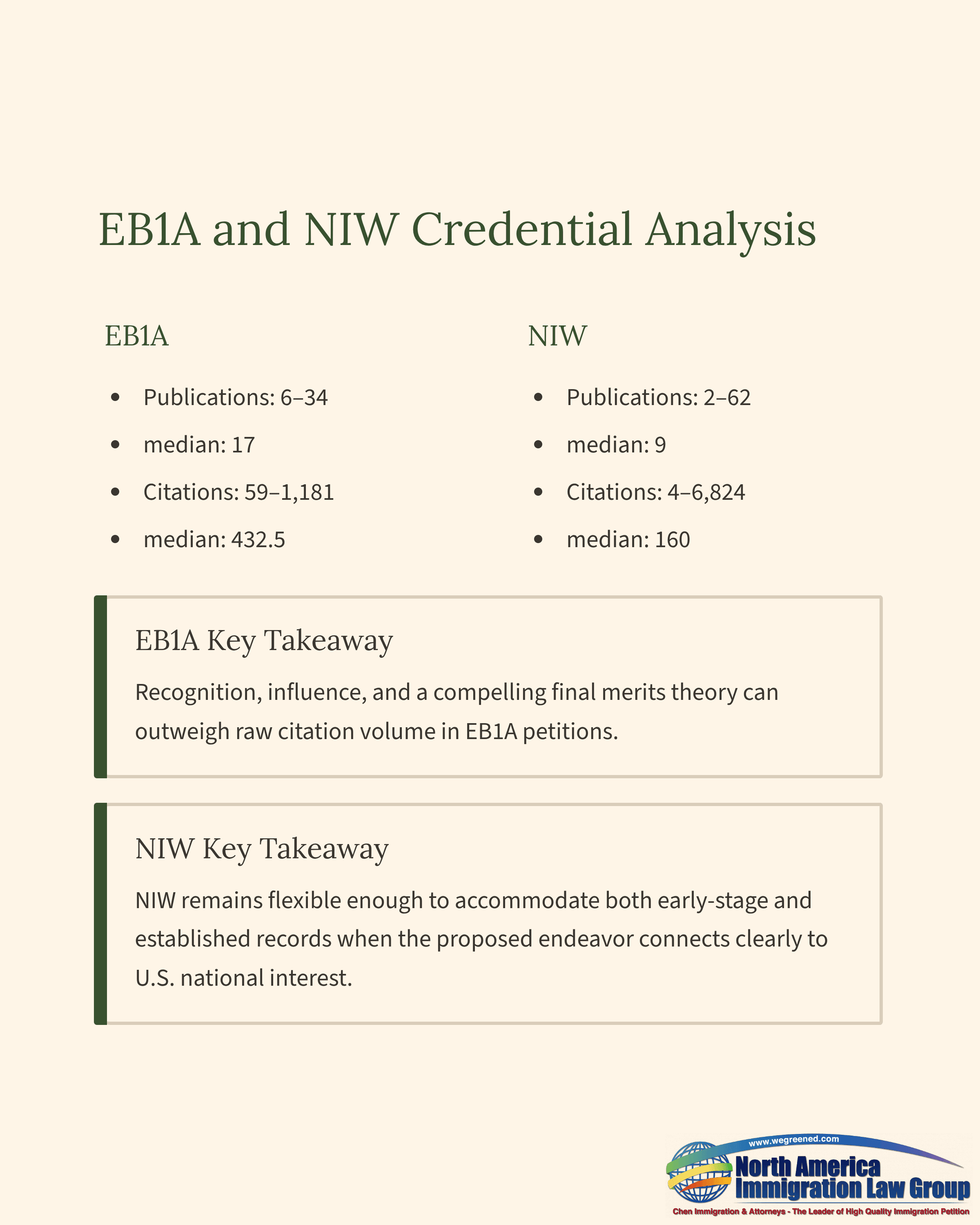
EB1A and NIW Credential Analysis
EB1A petitioners this week showed a moderately strong credential profile, but without the very high-citation outliers seen in some previous approval batches. Publications ranged from 6 to 34 (Q1: 15, median: 17, Q3: 23.75), and citations ranged from 59 to 1,181 (Q1: 264.5, median: 432.5, Q3: 590.75). The minimum citation count is especially notable because it shows that EB1A approval was possible even for a petitioner whose citation record was below the typical EB1A median, when the petition could demonstrate field-specific recognition, original contributions of major significance, and a strong final merits theory.
NIW approvals again reflected a broader evidentiary range. Publications ranged from 2 to 62 (Q1: 5, median: 9, Q3: 15), while citations ranged from 4 to 6,824 (Q1: 62, median: 160, Q3: 346). Compared with EB1A, NIW continued to include more developing profiles, lower-metric cases, and applicants at different career stages. At the same time, the NIW batch also included highly cited researchers, confirming that NIW remains flexible enough to accommodate both early-stage and more established records when the proposed endeavor is clearly tied to national importance and the petitioner is well-positioned to advance it.
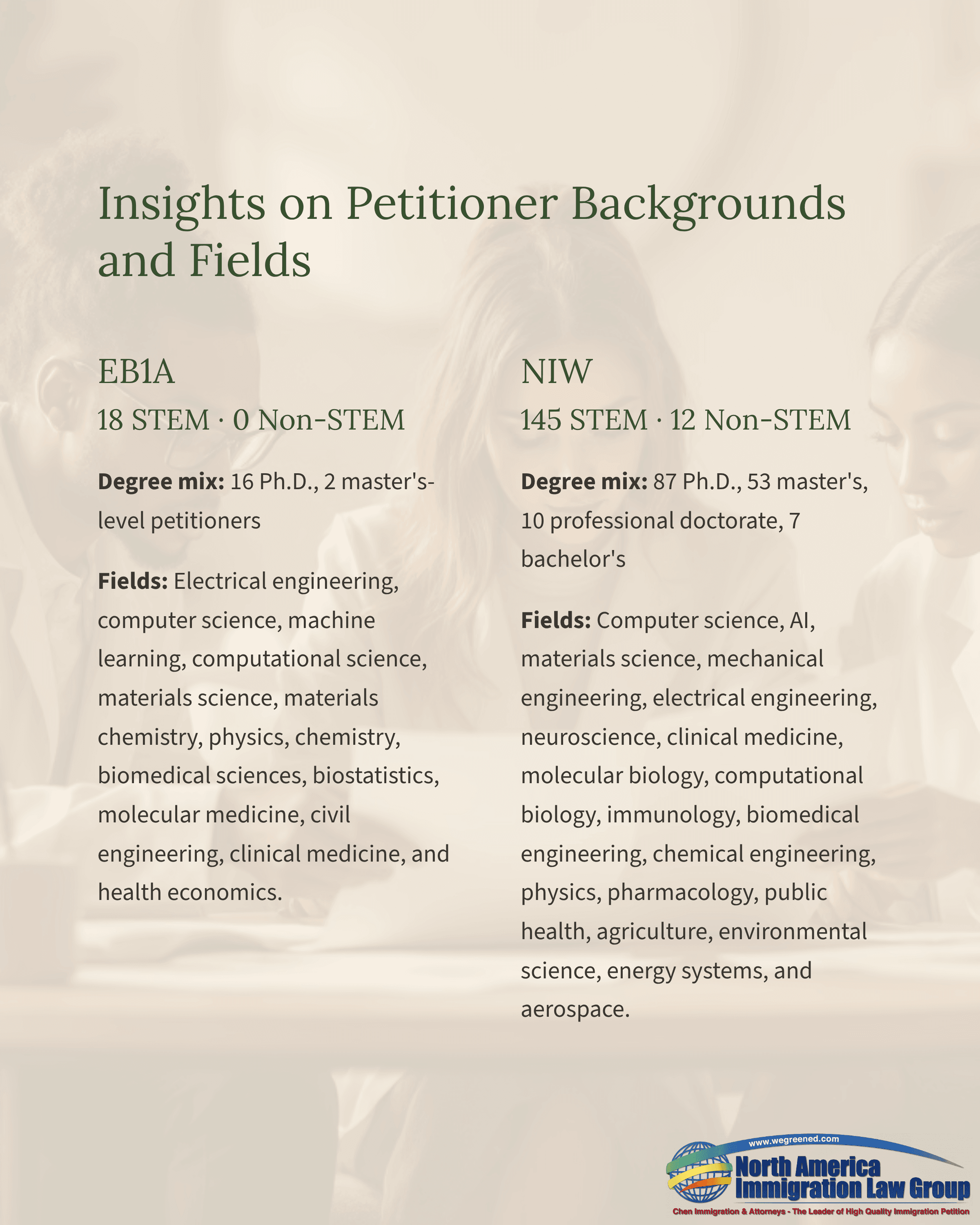
Insights on Petitioner Backgrounds and Fields
EB1A approvals this week were entirely STEM-oriented, with 18 STEM approvals and no non-STEM approvals. Approved fields included electrical engineering, computer science, machine learning, computational science, materials science, materials chemistry, physics, chemistry, biomedical sciences, biostatistics, molecular medicine, civil engineering, clinical medicine, and health economics. The degree mix remained advanced-degree-heavy, including 16 Ph.D. holders and 2 master’s-level petitioners. Overall, EB1A approvals continued to favor profiles that could support recognized contributions, sustained influence, and a strong final merits presentation across different professional settings.
NIW approvals were broader across both field and career stage, while still strongly STEM-weighted, with 145 STEM approvals and 12 non-STEM approvals. Major themes included computer science, artificial intelligence, materials science, mechanical engineering, electrical engineering, computer engineering, neuroscience, clinical medicine, molecular biology, computational biology, immunology, biomedical engineering, chemical engineering, physics, chemistry, pharmacology, public health, agriculture, environmental science, energy systems, and aerospace-related work. The degree mix was also wider than EB1A, including 87 Ph.D. holders, 53 master’s-level petitioners, 10 professional doctorate holders, and 7 bachelor’s-level petitioners, reinforcing that NIW can accommodate varied backgrounds when the petition clearly connects the proposed endeavor to concrete U.S. needs.
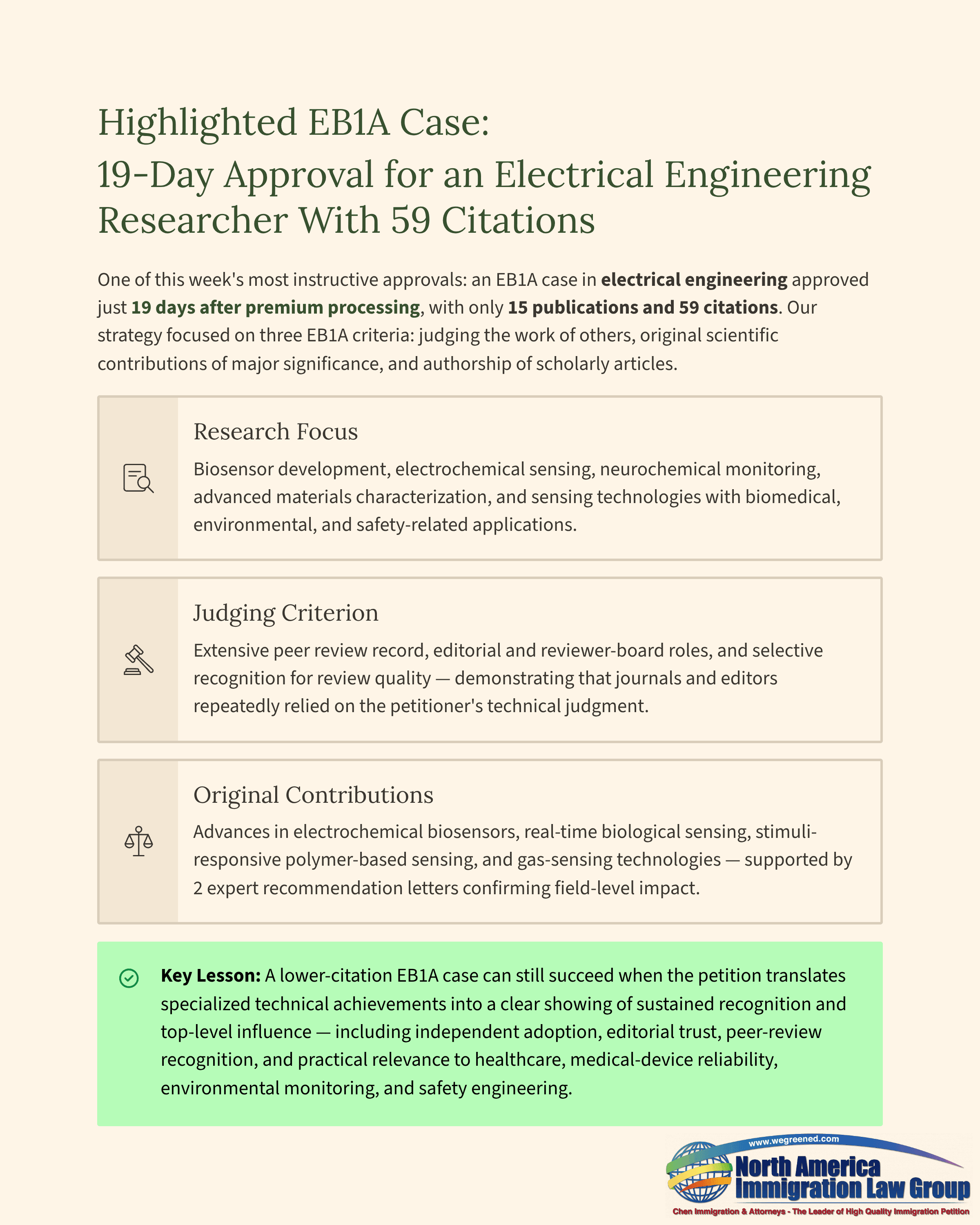
Highlighted EB1A Case: 19-Day Approval for an Electrical Engineering Researcher With 59 Citations
One of this week’s most instructive approvals was an EB1A case in electrical engineering that was approved 19 days after premium processing. The petitioner had 15 publications and 59 citations, with work focused on biosensor development, electrochemical sensing, neurochemical monitoring, advanced materials characterization, and sensing technologies with biomedical, environmental, and safety-related applications. Because the citation count was relatively modest for EB1A, the petition could not rely on citation volume alone and instead needed to show field-specific recognition and influence.
Our strategy focused on three EB1A criteria: judging the work of others, original scientific contributions of major significance, and authorship of scholarly articles. For judging, we emphasized the petitioner’s extensive peer review record, editorial and reviewer-board roles, and selective recognition for review quality. This helped show that journals and editors in the field repeatedly relied on the petitioner’s technical judgment.
For original contributions, we organized the case around concrete technical impact rather than a simple list of publications and citations. The petition explained how the petitioner’s work advanced electrochemical biosensors, real-time biological sensing, stimuli-responsive polymer-based sensing methods, and gas-sensing technologies. We also used two expert recommendation letters to explain the technical importance of the petitioner’s work, confirm how the work had been recognized or relied upon by others, and connect the petitioner’s specialized achievements to broader field-level impact.
The final merits argument tied the evidence together by showing that the petitioner’s achievements reflected more than routine academic output. Although the citation count was not high by traditional EB1A standards, the record showed independent adoption, editorial trust, peer-review recognition, publication in respected venues, expert validation, and practical relevance to healthcare, medical-device reliability, environmental monitoring, and safety-related engineering applications. This approval shows that a lower-citation EB1A case can still succeed when the petition translates specialized technical achievements into a clear showing of sustained recognition and top-level influence in the field.
Adjudication Trends and Policy Observations
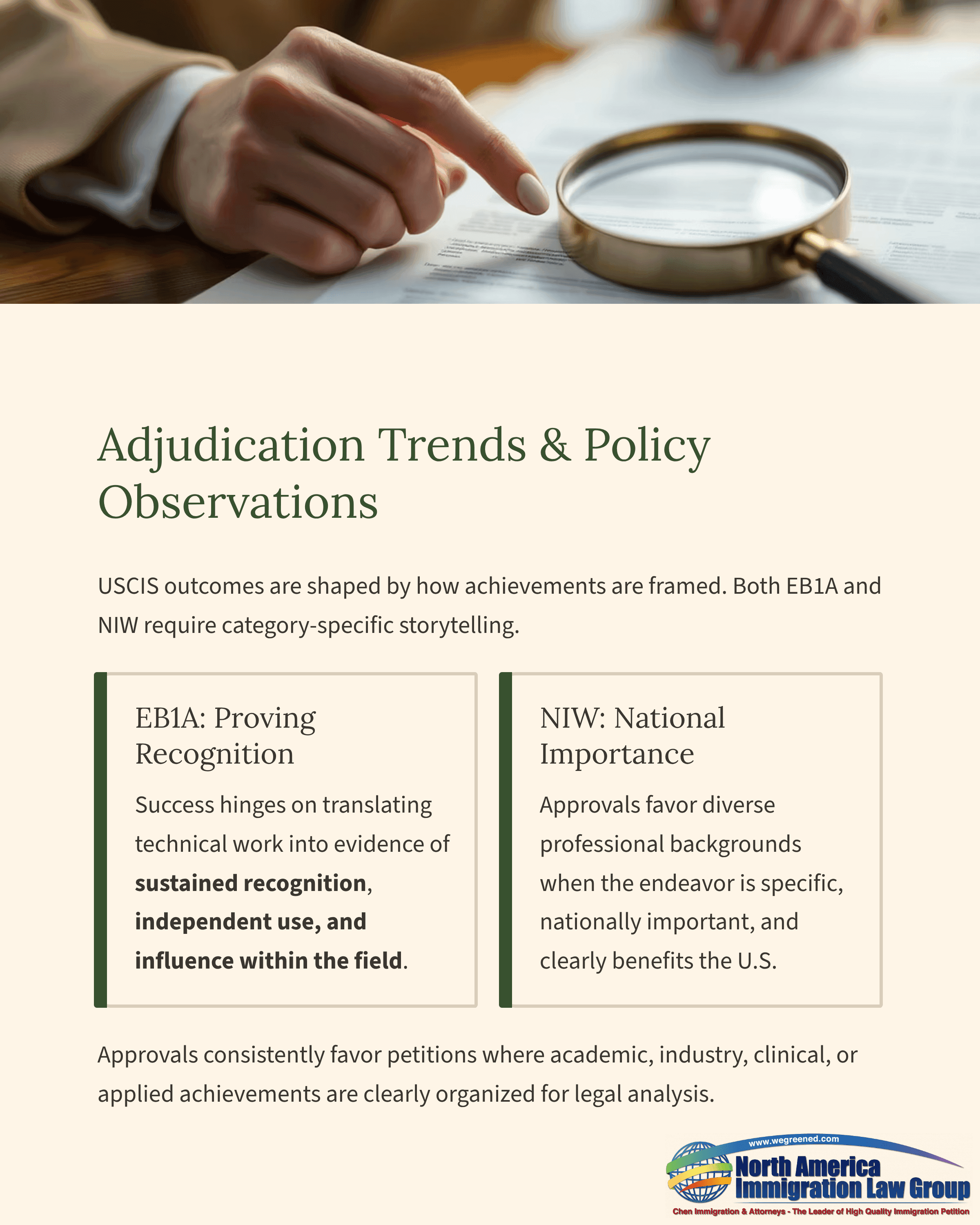
This week’s approvals again show that USCIS outcomes are not driven by a single credential type or professional background. EB1A approvals remained concentrated in profiles with strong evidence of recognition and field influence, but the highlighted case demonstrates that the key question is how the petitioner’s achievements are translated into EB1A language. In technical and applied fields, recognition may be shown through peer-review selection, editorial service, independent use of methods, comparative technical advantages, expert support, publication venue quality, practical implementation, and evidence that the petitioner’s work has shaped how others approach problems in the field.
For NIW, this week’s data again reflected a wide range of professional and academic backgrounds. The broader degree mix, including master’s-level, professional doctorate, and bachelor’s-level petitioners, confirms that NIW can accommodate varied career paths when the proposed endeavor is specific, nationally important, and supported by evidence that the petitioner is well positioned to advance it. The central issue is not whether the petitioner fits a traditional academic profile, but whether the petition clearly connects the petitioner’s work to concrete U.S. needs and explains why the waiver would benefit the United States.
The broader drafting lesson from this week is that both EB1A and NIW cases require category-specific framing. EB1A filings must do more than count three regulatory criteria; they must show that the total record supports sustained recognition and final merits review. NIW filings must define the proposed endeavor clearly and connect it to national importance, future contributions, and the benefit of waiving labor certification. This week’s results suggest that approvals continue to favor petitions where academic, industry, clinical, or applied achievements are organized in a way that makes the officer’s legal analysis clear.