

WeGreened Weekly Approval Summary: Week of October 19 to October 25, 2026
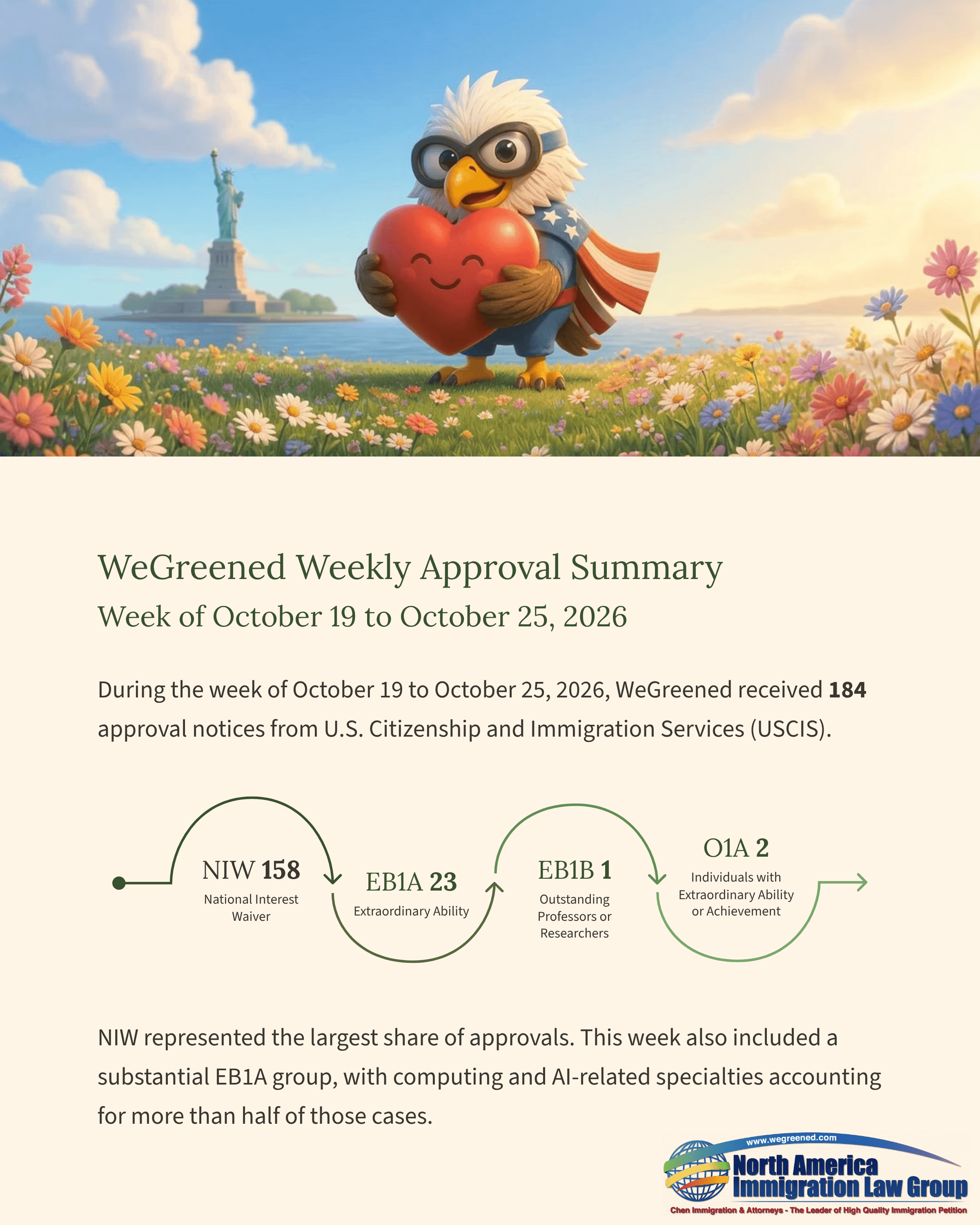
During the week of October 19 to October 25, 2026, WeGreened received 184 approval notices from U.S. Citizenship and Immigration Services (USCIS). Of these approvals, 158 were for NIW (National Interest Waiver), 23 were for EB1A (Alien of Extraordinary Ability), 1 was for EB1B (Outstanding Professors or Researchers), and 2 were for O1A (Individuals with Extraordinary Ability or Achievement).
NIW represented the largest share of approvals. This week also included a substantial EB1A group, with computing and AI-related specialties accounting for more than half of those cases.
EB1A and NIW Credential Analysis
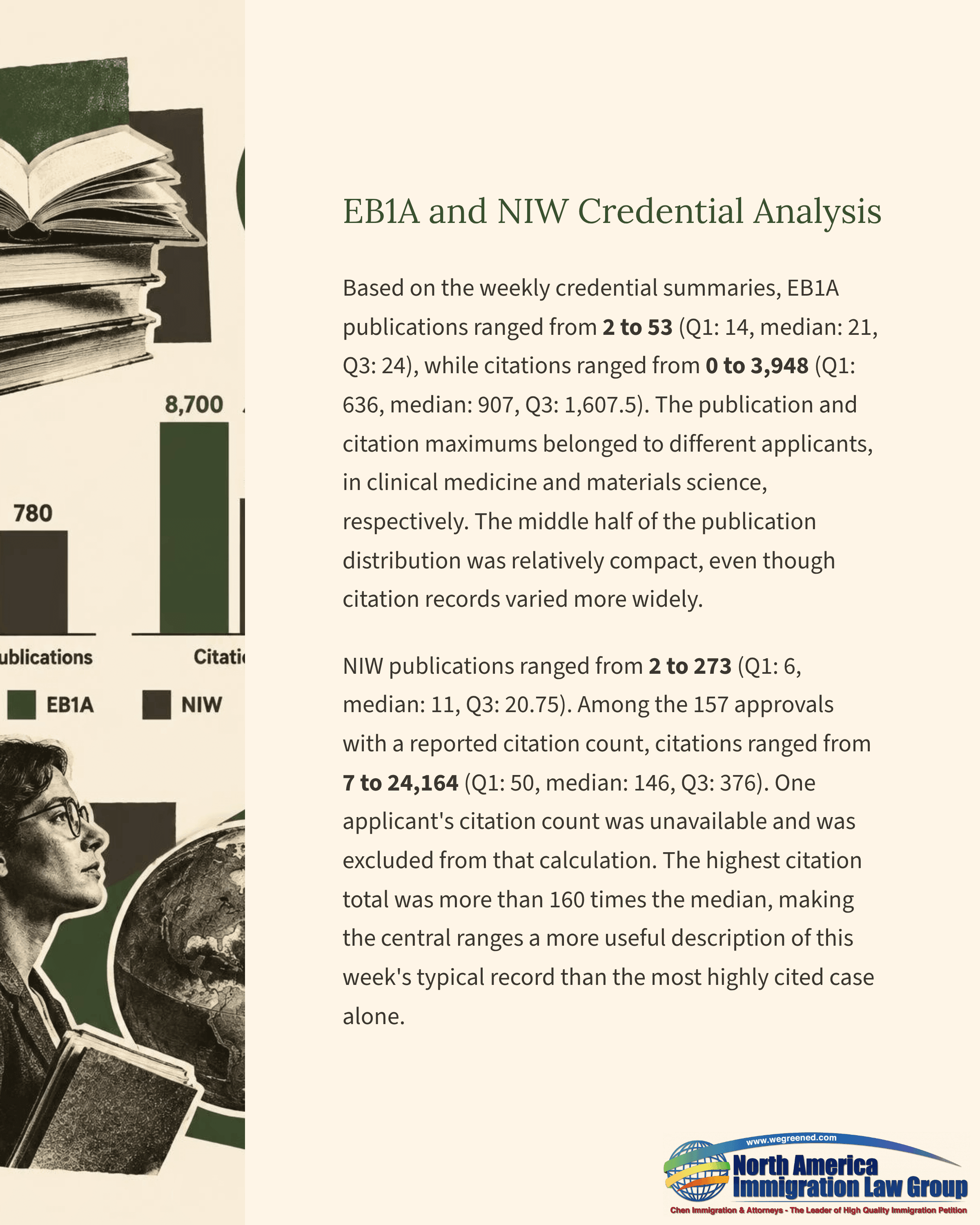
Based on the weekly credential summaries, EB1A publications ranged from 2 to 53 (Q1: 14, median: 21, Q3: 24), while citations ranged from 0 to 3,948 (Q1: 636, median: 907, Q3: 1,607.5). The publication and citation maximums belonged to different applicants, in clinical medicine and materials science, respectively. The middle half of the publication distribution was relatively compact, even though citation records varied more widely.
NIW publications ranged from 2 to 273 (Q1: 6, median: 11, Q3: 20.75). Among the 157 approvals with a reported citation count, citations ranged from 7 to 24,164 (Q1: 50, median: 146, Q3: 376). One applicant’s citation count was unavailable and was excluded from that calculation. The highest citation total was more than 160 times the median, making the central ranges a more useful description of this week’s typical record than the most highly cited case alone.
Insights on Petitioner Backgrounds and Fields
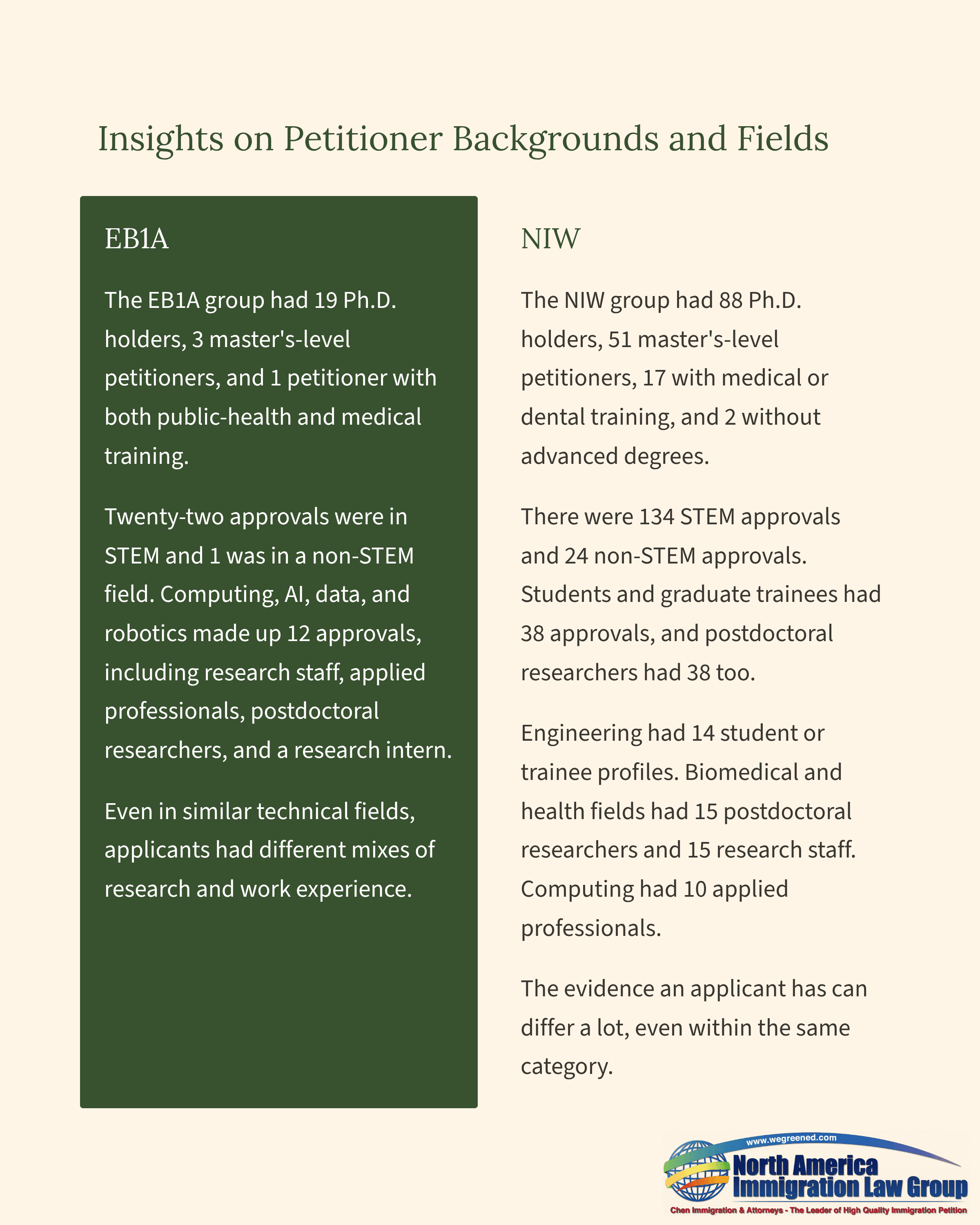
The EB1A group included 19 Ph.D. holders, three master’s-level petitioners, and one petitioner with both public-health and medical qualifications. Twenty-two approvals involved STEM fields and one involved a non-STEM field. Computing, AI, data, and robotics contributed 12 approvals, spanning research staff, applied professionals, postdoctoral researchers, and a research intern. This concentration shows that even within a closely related group of technical specialties, applicants brought different combinations of research experience and professional responsibility.
NIW included 88 Ph.D. holders, 51 master’s-level petitioners, 17 applicants with medical or dental qualifications, and two without advanced degrees. There were 134 STEM and 24 non-STEM approvals. Students and graduate trainees and postdoctoral researchers each accounted for 38 approvals, but their distribution varied by field. Engineering included 14 student or trainee profiles, while biomedical and health-related fields included 15 postdoctoral researchers and 15 research staff members. Computing had a comparatively strong applied-professional component, with ten such approvals. These distinctions help explain why the evidence available to an applicant can differ substantially even within the same petition category.
Highlighted EB1A Case: Industry Software Engineer Approved Without RFE Through Documented Technical Impact
One of this week’s most notable EB1A approvals involved a senior software engineer with a master’s degree whose work focused on AI-driven automation, cloud infrastructure reliability, and cybersecurity. The petition was initially filed under regular processing and later upgraded to premium processing. USCIS approved the case without issuing a Request for Evidence (RFE).
Rather than relying primarily on citation totals, our petition presented a comprehensive record across six EB1A evidentiary criteria, including original contributions of major significance, professional memberships, judging, scholarly authorship, leading or critical roles, and high remuneration. A central part of our strategy was demonstrating how the applicant’s technical responsibilities translated into measurable achievements. The record documented automation systems performing more than 28,000 tests per release cycle, over 50 critical defects identified before deployment, and substantial improvements in engineering efficiency. These results helped establish the importance of the applicant’s individual contributions within major technology organizations.
To reinforce the applicant’s recognition beyond the workplace, we incorporated four independent expert opinions evaluating the significance of the applicant’s engineering innovations. Three additional employer testimonial letters provided detailed accounts of the applicant’s responsibilities and impact. We also documented judging experience involving more than 70 manuscripts across ten conferences, together with scholarly publications, professional recognition, and compensation comparisons. Each category of evidence served a distinct purpose while contributing to a consistent picture of the applicant’s professional achievements.
Finally, we connected these accomplishments under the Final Merits Determination, demonstrating how the applicant’s technical innovations, critical responsibilities, and independent professional recognition supported a record of sustained acclaim. The petition was approved without an RFE.
This case illustrates how a carefully structured EB1A petition can present industry achievements in terms that directly address USCIS requirements. Rather than depending on one impressive metric, our approach connected objective engineering results, independent expert evaluations, and documented professional recognition to demonstrate the applicant’s standing in the field.
Adjudication Trends and Policy Observations
On October 14, 2026, DHS finalized its earlier policy change ending automatic extensions for certain Employment Authorization Document (EAD) renewal applications filed on or after October 30, 2025. DHS estimated that 20,000 to 33,000 EADs could lapse over a modeled 18-month period, highlighting potential work-authorization gaps for affected applicants. Existing qualifying extensions and statutory exceptions remain unaffected.
For professionals pursuing EB1A or NIW, this development underscores the importance of planning beyond I-140 approval. Both categories allow eligible applicants to self-petition without employer-sponsored labor certification, offering greater independence in establishing a long-term immigration pathway. Filing a qualifying petition can establish an earlier priority date, while certain I-140 filings or approvals may also support eligible H1B workers seeking extensions beyond the usual six-year limit. However, neither EB1A nor NIW approval automatically grants immigration status or employment authorization.
The key takeaway is that immigration planning involves more than choosing a petition category. Establishing a priority date, maintaining lawful status and work authorization, and preparing a supportable petition should be considered together. Early planning can provide greater flexibility and help avoid unnecessary gaps while waiting for permanent residence.