

WeGreened Weekly Approval Summary: Week of October 26 to November 1, 2026
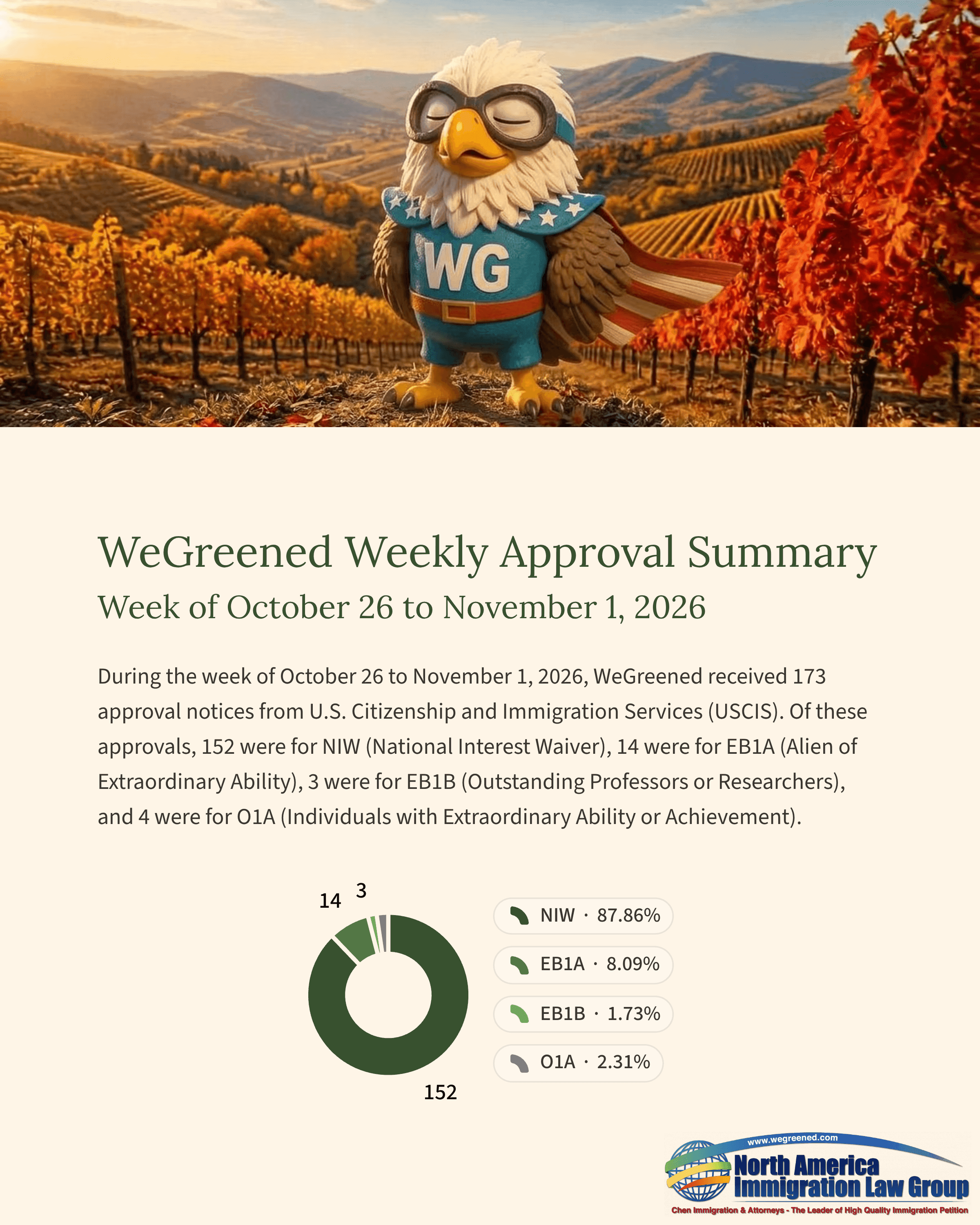
During the week of October 26 to November 1, 2026, WeGreened received 173 approval notices from U.S. Citizenship and Immigration Services (USCIS). Of these approvals, 152 were for NIW (National Interest Waiver), 14 were for EB1A (Alien of Extraordinary Ability), 3 were for EB1B (Outstanding Professors or Researchers), and 4 were for O1A (Individuals with Extraordinary Ability or Achievement).
EB1A and NIW Credential Analysis
EB1A publications ranged from 7 to 51 (Q1: 11.25, median: 13.5, Q3: 18.75). Among the 13 approvals with a reported citation count, citations ranged from 138 to 4,444 (Q1: 412, median: 831, Q3: 2,387). One citation count was unavailable and was excluded from that calculation. The applicant with the most publications had 412 citations, exactly at the first quartile of the citation distribution. This contrast shows why publication volume and citation accumulation should be examined separately rather than treated as interchangeable measures.
NIW publications ranged from 1 to 154 (Q1: 7, median: 11, Q3: 19), while citations ranged from 2 to 4,418 (Q1: 64, median: 194, Q3: 395). The highest publication count came from biomedical informatics, while the highest citation count came from physics. The middle half of the group had 7 to 19 publications and 64 to 395 citations, providing a more representative picture of the approved profiles than either maximum alone.
Insights on Petitioner Backgrounds and Fields
The EB1A group included 9 Ph.D. holders and 5 master’s-level petitioners, with 13 STEM approvals and 1 non-STEM approval. Research staff and fellows accounted for 7 approvals, applied technical professionals for 4, postdoctoral researchers for 2, and a doctoral student for 1. Computing and AI-related specialties represented half the group. The master’s-level cases included both doctoral study and established technical employment, illustrating why completed degree and current career stage should not be treated as the same measure.
NIW included 77 Ph.D. holders, 51 master’s-level petitioners, 22 applicants with medical qualifications, and 2 without advanced degrees. There were 131 STEM and 21 non-STEM approvals. Postdoctoral researchers formed the largest employment group with 41 approvals, followed by 35 students and graduate trainees. Career patterns differed by specialty: 14 of the 45 engineering, energy, and materials cases involved students or trainees, while 11 of the 26 computing-related cases involved applied technical professionals. The largest field group, biomedical, clinical, and public health, contained 56 approvals spanning research and clinical work. These differences help explain why an effective evidence presentation must reflect the applicant’s actual professional setting.
Highlighted EB1A Case: Industry Cloud Engineering Leader Approved After RFE Through Documented Technology Adoption
This week’s highlighted EB1A approval involved a technology manager with a master’s degree whose work focused on AI-enabled cloud systems and financial infrastructure. The petition was filed with premium processing and approved after a Request for Evidence (RFE). Although the applicant had scholarly publications, the case connected those outputs to practical technology adoption and professional responsibility rather than relying on a citation total alone. USCIS accepted judging and scholarly authorship, while requesting further support for original contributions, professional membership, leading or critical roles, high remuneration, and the overall Final Merits Determination.
For original contributions, our response emphasized what happened when the applicant’s technology was used outside the immediate workplace. A separate technology company had implemented an AI-based approach to diagnosing system failures described in the applicant’s published patent application. The adopting company reported that incident-detection time fell from approximately 2 hours to 10 minutes, while resolution time fell from about 4 hours to under 45 minutes. We connected these reported results to the specific methods the applicant developed, helping distinguish an individual technical contribution from general statements about the importance of cloud computing.
The response also included 4 additional recommendation letters explaining specific uses of the applicant’s methods in subsequent research. We paired these explanations with the underlying studies and presented updated citation evidence as supporting context. The emphasis was on how others used the work, not simply how often it appeared in a reference list. This gave the officer several complementary ways to assess influence beyond the applicant’s employers.
For the leading or critical role criterion, we connected the organizational chart and employer records to the applicant’s authority over technical personnel, architecture, security, and the operation of important payment platforms. Separate evidence addressed the organization’s distinguished reputation. For high remuneration, we compared base salary with salary-only benchmarks for comparable technical-management roles and treated bonuses and other benefits separately. This kept the comparison aligned with the responsibilities and compensation components USCIS had questioned.
Finally, we brought the accepted judging and authorship evidence together with technology implementation, external recognition, leadership, compensation, and completed keynote presentations under the Final Merits Determination. The petition was approved on October 29, 2026. The case demonstrates how our team can organize an industry professional’s achievements into an individualized EB1A record, making both the applicant’s personal contribution and its broader significance clear.
Adjudication Trends and Policy Observations
The White House announced on November 6, 2026 that Stephen Miller would become Chief of Staff following the midterm elections. For employment-based immigration applicants, the important question is how leadership priorities translate into published agency rules and adjudication instructions.
For EB1A and NIW petitions, a priority date is generally established when a complete petition is properly filed. Our focus is therefore on whether the applicant’s current evidence supports a filing, what remains to be documented, and how that timing fits the broader immigration plan. An early assessment can distinguish a case that is ready from one that needs further development, without confusing timely preparation with a rushed submission.