

WeGreened Weekly Approval Summary: Week of September 28 to October 4, 2026
 During the week of September 28 to October 4, 2026, WeGreened received 149 approval notices from U.S. Citizenship and Immigration Services (USCIS). Of these approvals, 131 were for NIW (National Interest Waiver), 14 were for EB1A (Alien of Extraordinary Ability), and 4 were for O1A (Individuals with Extraordinary Ability or Achievement).
NIW again represented the majority of approvals, while EB1A and O1A accounted for smaller groups across academic, research, clinical, and applied professional backgrounds.
EB1A and NIW Credential Analysis
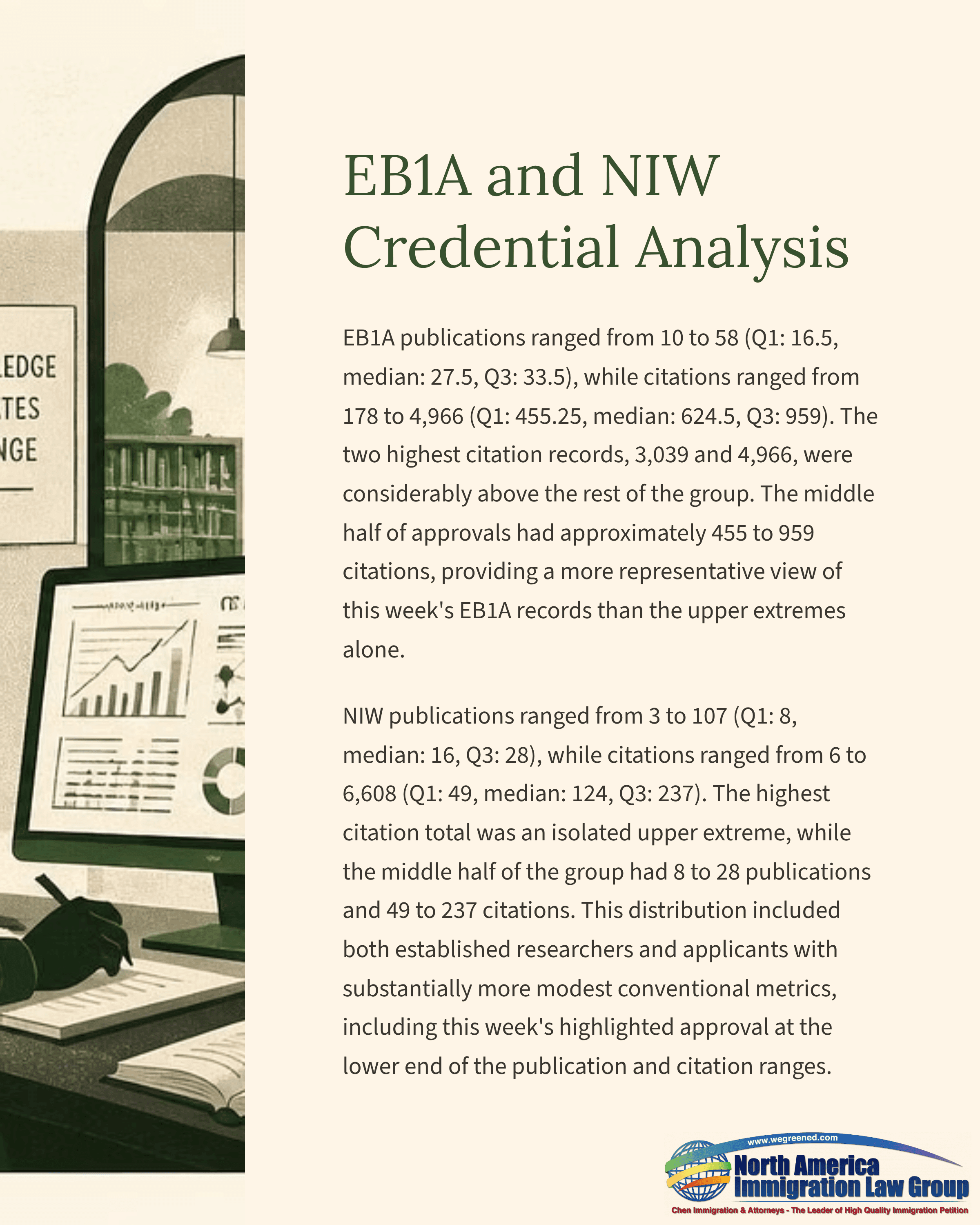
EB1A publications ranged from 10 to 58 (Q1: 16.5, median: 27.5, Q3: 33.5), while citations ranged from 178 to 4,966 (Q1: 455.25, median: 624.5, Q3: 959). The two highest citation records, 3,039 and 4,966, were considerably above the rest of the group. The middle half of approvals had approximately 455 to 959 citations, providing a more representative view of this week’s EB1A records than the upper extremes alone.
NIW publications ranged from 3 to 107 (Q1: 8, median: 16, Q3: 28), while citations ranged from 6 to 6,608 (Q1: 49, median: 124, Q3: 237). The highest citation total was an isolated upper extreme, while the middle half of the group had 8 to 28 publications and 49 to 237 citations. This distribution included both established researchers and applicants with substantially more modest conventional metrics, including this week’s highlighted approval at the lower end of the publication and citation ranges.
Insights on Petitioner Backgrounds and Fields
The EB1A group included 11 Ph.D. holders and 3 master’s-level petitioners. Nine approvals were classified as STEM and five as non-STEM. Postdoctoral researchers formed the largest employment group, followed by faculty members, research professionals, applied technical professionals, and earlier-career profiles. Approved fields spanned life sciences, computing, engineering, biomedical work, and physical sciences. The group again showed that EB1A evidence must be evaluated within the conventions of the petitioner’s own field rather than through one uniform academic profile.
NIW covered a much broader range of educational and professional backgrounds. The group included 59 Ph.D. holders, 55 master’s-level petitioners, 10 applicants with medical qualifications, and 7 petitioners without graduate degrees. Students and graduate trainees formed the largest employment group with 42 approvals, followed by 30 postdoctoral researchers and 28 research staff or fellows. Engineering, energy, and materials accounted for 33 approvals, followed by life sciences with 30, computing and AI with 27, and biomedical and clinical fields with 24. NIW also included 37 non-STEM approvals, reflecting a broader field distribution than EB1A.
Highlighted NIW Case: Bachelor’s Degree AI Professional Approved Without RFE With 6 Citations
One of this week’s most instructive NIW approvals involved an applied machine learning and trustworthy AI professional with a bachelor’s degree. At filing, the record included 3 peer-reviewed conference papers, 1 preprint, 6 citations, and at least 18 completed peer reviews. The petition was initially filed under regular processing and later upgraded to premium processing. USCIS approved the case without issuing a Request for Evidence (RFE).
Because the applicant did not hold a graduate degree, we first established the underlying EB2 qualification through the exceptional-ability pathway. The petition organized the applicant’s relevant education, peer-review service, publication record, professional recognition, and applied industry experience into a cohesive showing of expertise above that ordinarily encountered in the field. We then addressed the NIW requirements separately rather than assuming that work in a prominent area such as artificial intelligence was sufficient by itself.
For national importance, we defined the proposed endeavor around developing trustworthy AI methods for interpretability, biomedical information retrieval, and safety testing of agentic systems. The petition explained how this work could improve the reliability of AI in clinical decision-making and cloud infrastructure while advancing broader U.S. priorities in AI accountability, risk management, and critical technologies. Public research and open-source contributions further demonstrated that the potential benefits extended beyond the applicant’s immediate employer.
To show that the applicant was well positioned, we presented the publication record in the context of computer science, where peer-reviewed conference papers and technical artifacts can be important forms of research output. One article ranked within the top 10 percent of computer science papers from its publication year, and we documented how another research team used the applicant’s work in subsequent research. The record also included at least 18 completed peer reviews. Our firm prepared four testimonial letters that corroborated the applicant’s planned projects and collaborations and explained how the applicant’s technical background supported continued progress in trustworthy AI.
Finally, we explained why waiving the job offer and labor certification requirements would benefit the United States. The argument connected the applicant’s combination of AI research, biomedical applications, and cloud-deployment experience to work requiring flexibility across research, open-source development, industry implementation, and collaboration. This approval shows that modest publication and citation metrics do not tell the entire story. A clearly established EB2 pathway, a focused proposed endeavor, documented progress, and carefully coordinated testimonial support can together form a persuasive NIW case.
Adjudication Trends and Policy Observations
This week’s four O1A approvals make a recent Department of Homeland Security proposal particularly relevant. On October 14, 2026, DHS published a proposed rule that would remove the current requirement for USCIS to give deference to a prior eligibility determination when reviewing a Form I-129 extension involving the same parties and the same underlying facts. Because O1A petitions and extensions are filed on Form I-129, the proposal would apply to this category. The rule has not been finalized, so the existing deference requirement remains in effect during the rulemaking process.
More generally, the proposal reflects a possible shift toward a more independent, case-by-case review of Form I-129 extension requests. If finalized, USCIS officers could still consider a prior approval where relevant, but they would no longer be required to begin their review from a position of deference. The petitioner would continue to bear the burden of establishing eligibility in each filing. The proposal does not change the substantive eligibility criteria for O1A classification, and its practical effect will depend on the language of any final rule and subsequent implementation guidance.