

WeGreened Weekly Approval Summary: Week of September 7 to September 13, 2026
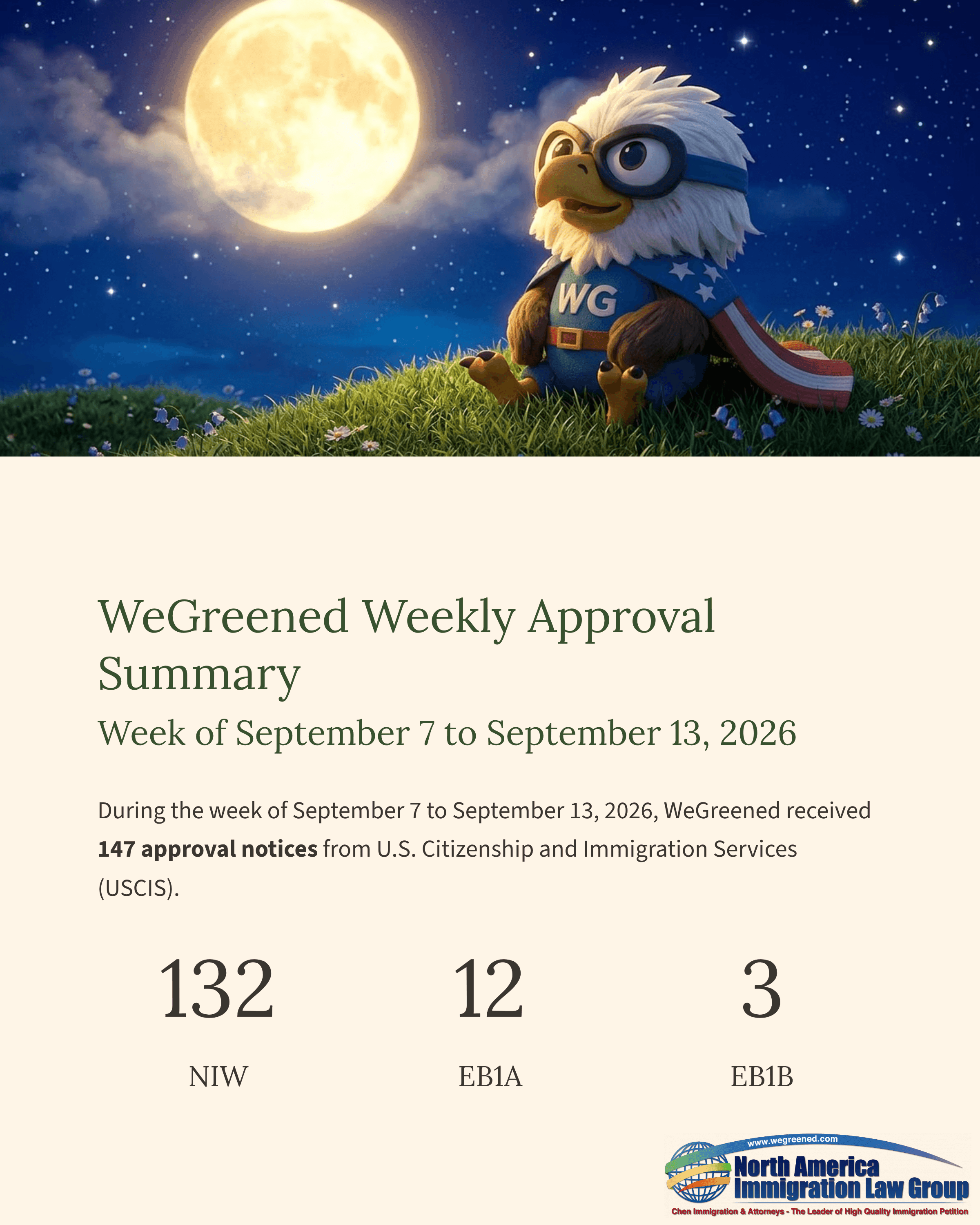
During the week of September 7 to September 13, 2026, WeGreened received 147 approval notices from U.S. Citizenship and Immigration Services (USCIS). Of these approvals, 132 were for NIW (National Interest Waiver), 12 were for EB1A (Alien of Extraordinary Ability), and 3 were for EB1B (Outstanding Professors or Researchers).
EB1A and NIW Credential Analysis
EB1A publications ranged from 8 to 146 (Q1: 11, median: 17, Q3: 25), while citations ranged from 312 to 2,929 (Q1: 454.5, median: 694, Q3: 1,008.5). The publication maximum belonged to an electrical engineering faculty member and was well above the rest of the group. The middle half of approvals had 11 to 25 publications, offering a more representative view of this week’s publication records than the upper extreme alone.
NIW publications ranged from 1 to 120 (Q1: 5, median: 7, Q3: 13), while citations ranged from 5 to 4,933 (Q1: 38.75, median: 116.5, Q3: 297.5). Unlike EB1A, the highest publication and citation counts belonged to different petitioners, one in space science and the other in immunology. Publication volume and citation impact therefore did not move together uniformly, even among the most established records in this week’s group.
Insights on Petitioner Backgrounds and Fields
All 12 EB1A approvals involved STEM fields, including engineering, biomedical research, life sciences, and computational psychology. Ten petitioners held Ph.D. degrees and two held master’s degrees. Research staff and fellows formed the largest employment group, but the approvals also included faculty, applied technical professionals, a postdoctoral researcher, and a doctoral student. The master’s-level approvals came from different career settings, underscoring the value of evaluating educational background alongside professional experience rather than in isolation.
NIW’s largest employment group was students and graduate trainees, with 38 approvals. Career-stage concentrations varied by specialty. Applied technical roles accounted for 12 of the 26 computing, AI, data, and robotics cases, while students represented 9 of the 18 physical sciences, chemistry, and mathematics cases. The group included 118 STEM and 14 non-STEM approvals, with 69 Ph.D. holders, 49 master’s-level petitioners, 11 petitioners with medical or veterinary qualifications, and three without advanced degrees. These differences show how distinct professional pathways can exist within the same weekly approval group.
Highlighted NIW Case: Mechanical Engineering Researcher Approved After RFE With 5 Citations
This week’s highlighted NIW approval involved a mechanical engineering researcher pursuing doctoral studies after earning a master’s degree. The initial petition documented 4 peer-reviewed papers, a book chapter, and 5 citations. The proposed work focused on developing more energy-efficient cooling technologies. USCIS accepted the applicant’s advanced-degree qualification and the value of the research but issued a Request for Evidence (RFE) seeking further support for its broader importance, the applicant’s ability to advance it, and the reasons for granting the waiver.
The first question was whether the proposed work could benefit more than the applicant’s employer and its customers. Our response built on the original research plan, distinguishing the development of a technology from the responsibilities of a particular job. We paired project documentation with expert explanations showing how the work could support energy efficiency and practical applications beyond one company. This gave the officer a concrete basis for evaluating the potential public benefits.
The second question concerned the applicant’s personal contributions and ability to carry the work forward. We identified what the applicant had developed and tested, then connected those achievements to supporting records and letters from collaborators and independent experts. Rather than relying on general praise, the letters explained the applicant’s specific role, why the results mattered, and how they supported continued research. This presentation distinguished individual accomplishments from the achievements of the wider research team.
Finally, we explained why the United States would benefit from waiving the job offer and labor certification requirements. We connected the applicant’s specialized skills, ongoing collaborations, and future plans to the value of continuing this particular work. The argument addressed why those contributions would remain beneficial even if other qualified U.S. workers were available, rather than relying on a general shortage of engineers.
The petition was ultimately approved after the RFE response. This case illustrates how a modest citation record can be supported by evidence of practical achievements, outside interest, and concrete plans for continued work. Our team connected those elements to the specific questions USCIS raised, explaining both what the applicant had accomplished and why the proposed work mattered beyond a single employer. The response presented the applicant’s qualifications through documented progress, rather than citation numbers alone.
Adjudication Trends and Policy Observations
As discussed last week, the national NIW approval rate increased from approximately 48.1 percent in Q2 FY2026 to 55.3 percent in Q3, measured among approval and denial decisions. This week, WeGreened received 132 NIW approvals, including three petitioners without advanced degrees and the highlighted engineering researcher with five citations. These profiles present different legal questions. For applicants without advanced degrees, our assessment starts with whether their education and experience or evidence of exceptional ability establish the underlying EB2 qualification. Demonstrating that their proposed work is important cannot replace that requirement. The three approvals therefore highlight the importance of identifying the correct eligibility pathway rather than treating the absence of a graduate degree as an automatic disqualification.
The five-citation case illustrates a separate challenge. USCIS accepted the applicant’s advanced-degree qualification and the research’s substantial merit, but sought further evidence of broader benefits and the applicant’s ability to advance the work. Our response connected identifiable technical achievements to documented outside interest, showing why the applicant’s contribution mattered rather than relying on membership in a funded research team. From a drafting perspective, this distinction is critical: a project’s importance and an applicant’s contribution to it require related but separate explanations. For research and industry petitioners alike, we prioritize records showing what the individual accomplished, how others have responded, and who could benefit from the proposed work. This week’s cases illustrate why that individualized assessment is more useful than screening applicants by degree level or citation count alone.