





EB-2 NIW Adjudication Trends 2026: What USCIS Is Approving and Challenging in National Interest Waiver (NIW) Cases Now
WeGreened · https://www.wegreened.com/insights/eb-2-niw-adjudication-trends-2026
How USCIS decides National Interest Waiver (NIW) petitions changes over time, sometimes in a matter of weeks. The same record can draw an approval in one period and a Request for Evidence (RFE) in another, depending on current policy, the service center, and the individual officer.
Understanding those trends is one of the biggest advantages an applicant can have.
At North America Immigration Law Group (Chen Immigration Law Associates), we track every approval, RFE, and denial our clients receive, and our attorneys review the RFE notices that come in each week. With more than 130,000 immigration approvals, including more than 70,000 Employment-Based First Preference (EB-1A and EB-1B), EB-2 NIW, and O-1 approvals, our database shows us patterns that no single case can. Here is what we are seeing in NIW adjudication in late 2026, and how we prepare petitions in response.
The Standard Has Not Changed, but How It Is Applied Has
Every NIW petition is still judged under the three prongs in the USCIS Policy Manual (opens in a new tab) : national importance of the specific endeavor (Prong 1), whether the petitioner is well positioned to advance it (Prong 2), and whether a waiver benefits the United States on balance (Prong 3). What has shifted is how strictly officers apply each prong and what happens when a record falls short.
Trend 1: The First Filing Matters More Than Ever
Under the August 2026 update (opens in a new tab) to the Policy Manual's evidence chapter, officers may deny a petition without first issuing an RFE, set each RFE response period case by case up to 12 weeks, and treat any response as a request for a decision. The Policy Manual also states that an RFE is not meant to cure a deficiency, because eligibility must exist on the filing date. In practice, a petition no longer gets a reliable second chance. We prepare every petition to be complete and decision-ready on the day it is filed.
Trend 2: Requests for Evidence (RFEs) Usually Challenge More Than One Prong
The RFEs we review rarely raise a single issue. Most question two or more prongs at once, and Prong 3 is frequently among them, often with standard language that labor certification protects U.S. workers. Much of this wording is standardized and appears across many fields and service centers, and in our weekly reviews we also see notices with internal contradictions or facts that appear to come from another case.
Trend 3: Officers Separate the Field From the Endeavor
Officers consistently distinguish between the importance of a field and the importance of the petitioner's specific proposed work. Petitions that describe the importance of artificial intelligence, cancer research, or semiconductors in general, without tying that importance to what the petitioner will actually do, draw Prong 1 challenges. We define each client's endeavor as a specific contribution to a specific problem, then build the evidence around it.
Trend 4: Matter of Dhanasar Has Become the Yardstick for Researchers
Because Dr. Dhanasar was a postdoctoral researcher with a defined research plan and funded grant proposals when he filed, officers increasingly compare students, postdocs, and early-career scientists directly to his record. That comparison shapes how officers read a researcher's role, funding, and independence, and we account for it when we present an academic record.
Trend 5: Recent Work and the Filing Date Both Count
In our recent approvals, a large share of researchers had a paper published in 2025 or 2026. When the latest work is several years old, we see more questions about whether the petitioner is still advancing the endeavor. At the same time, work completed after filing cannot establish eligibility, so timing the filing around the strongest current record matters.
Trend 6: Modest Records Still Win
Citation counts alone do not decide cases. Our recent approvals include PhD students with fewer than 30 citations and industry professionals with only a few publications. What these cases share is a clearly defined endeavor, evidence of how the work is used, and letters from both first-hand colleagues and independent experts.
Trend 7: A Request for Evidence (RFE) Is Not the End of the Case
Approvals after an RFE remain a regular part of our results across students, physicians, and industry professionals. Under current policy, though, the time to respond may be shorter, and the right response depends on the specific notice, the officer's reasoning, and the record already filed.
Trends by Applicant Group
PhD students. Prong 2 is where most student cases are won or lost. Officers ask what the student personally contributed under an advisor and whether the planned next role is realistic. Endeavors tied to a concrete next step, such as a postdoctoral or research scientist position, fare well, and claims of exceptional ability by students without a master's degree face close review.
Postdoctoral researchers. Officers often view a postdoc as a temporary training position under a principal investigator. They question who owns the funding, how independent the postdoc's work is, and whether the role reaches beyond one lab, frequently with direct comparisons to Dhanasar.
Physicians. Officers separate clinical care for individual patients from work with national reach. Physicians whose endeavors center on research, clinical innovation, or technology, such as imaging AI or transplant outcomes, continue to win approvals, including doctors practicing abroad and those with foreign medical degrees.
Industry professionals. Prong 1, substantial merit and national importance, is a bigger hurdle in industry than in academia. Substantial merit is rarely the problem, since most engineering and applied science work has clear value. The challenge is national importance: the petition must show that the specific proposed endeavor, not the industry or the employer as a whole, has potential impact well beyond one company. Examples include advancing a technology used widely across a field, strengthening critical infrastructure or public safety, or producing tools, methods, or standards that others adopt. Officers ask whether the work matters beyond one employer and its customers, how proprietary work could benefit the field, and why the employer could not use labor certification. Job titles do not carry the case; a specific technical contribution does.
Applicants outside the United States. Officers look for a clear plan for work in the United States, foreign degree equivalency, and properly certified translations. Petitioners abroad also no longer receive extra mailing time for RFE responses beyond the standard 3 days, which makes preparation before filing even more important.
Recent Success Stories From Our Clients
Names, schools, employers, and specific proposed endeavors are withheld to protect our clients' privacy.
Research assistant in developmental immunology with moderate credentials, born in Nepal: approved without a Request for Evidence (RFE). The client held a master's degree, not a PhD, and was working as a research assistant, a staff role that officers do not always associate with independent research. The proposed endeavor was to continue research in developmental immunology in the same position. At filing, the record included 6 publications and 27 citations, with a paper published in 2026. Rather than relying on citation numbers, the petition centered on a specific research problem and the client's own contributions to it. Premium processing was requested at filing, and the petition was approved on November 12, 2026.
What this case shows: research staff with a master's degree and fewer than 30 citations can win when the endeavor is specific, the client's role is clear, and the work is current.
Industry mechanical engineer, born in South Korea: approved without an RFE. The client held a PhD and planned to continue as a mechanical engineer at a private company. Industry petitions face a harder Prong 1 question, because officers ask whether the work matters beyond one employer's products. At filing, the record included 7 publications and 39 citations, with a paper published in 2026, which helped show the client was still contributing to the field beyond internal company work. Premium processing was requested at filing, and the petition was approved on November 2, 2026.
What this case shows: engineers in industry can establish national importance when the petition ties their technical work to a problem that reaches beyond one company.
Resident physician in kidney medicine, born in Mexico: approved without an RFE. The client held an MD and was in residency training, with a proposed endeavor in kidney medicine. Officers often view residents as trainees whose work serves one hospital's patients, so the petition had to show contributions with broader reach. At filing, the record included 31 publications and 121 citations, with a paper published in 2025, a substantial research record for a physician still in training. Premium processing was requested at filing, and the petition was approved on November 12, 2026.
What this case shows: physicians do not need to finish residency before filing when their research already shows impact beyond their own patients.
PhD student in experimental physics moving to a postdoctoral position, born in Pakistan: approved without an RFE. The client held a master's degree and was a PhD student, with plans to continue the research as a postdoctoral scholar at another institution after graduation. The record was small: 3 publications and 27 citations, with the latest paper from 2023. Officers usually ask what a student personally contributed under an advisor and whether the next role is realistic, so a clearly defined postdoctoral plan in the same research area was an important part of the case. Premium processing was requested at filing, and the petition was approved on November 11, 2026.
What this case shows: even a small or older publication record can succeed when the student's own contributions and next role are clearly presented.
Postdoctoral researcher in psychology, born in Canada: approved without an RFE. The client held a PhD in psychology, a field outside the STEM designation, and was working as a postdoctoral researcher with plans to continue in the same role. Non-STEM petitions do not receive the added considerations the USCIS Policy Manual describes for STEM degree holders, and postdocs are often compared to Dr. Dhanasar's own record, so the case had to show national importance and the client's independent standing on its own terms. At filing, the record included 18 publications and 483 citations, with the latest paper from 2023, showing that other researchers relied on the work. The petition was upgraded to premium processing and approved on November 12, 2026.
What this case shows: researchers outside STEM fields continue to win NIW approvals when the record shows the field is using their work.
Recent Success Stories From Our Clients Outside the United States
A National Interest Waiver (NIW) does not require the petitioner to be in the United States. Each of these clients was living and working abroad when we filed, and applicants in this position can complete the green card process through a U.S. consulate. Names, schools, employers, and specific proposed endeavors are withheld to protect our clients' privacy.
University professor abroad moving to a U.S. research role in radio-frequency integrated circuits, born in Taiwan: approved without a Request for Evidence (RFE). The client held a PhD and was a professor at a university outside the United States, with plans to continue the research as a research scholar at a U.S. institution. For applicants abroad, officers look for a clear plan for how the work will continue in the United States, and the planned U.S. position gave the endeavor a concrete next step. At filing, the record included 80 publications and 636 citations, with a paper published in 2025. The petition was upgraded to premium processing and approved on November 10, 2026.
What this case shows: established faculty abroad can use the NIW to move their research program to the United States.
Industry scientist abroad moving to a U.S. faculty position in chemical process engineering, born in China: approved without an RFE. The client held a PhD and was a senior scientist at a company outside the United States, with plans to join a U.S. university as an assistant professor. Officers often question whether work done for a foreign employer will benefit the United States, so the petition tied the client's industry expertise to the research and teaching planned in the new role. At filing, the record included 15 publications and 615 citations, with a paper published in 2026. Premium processing was requested at filing, and the petition was approved on November 9, 2026.
What this case shows: a move from foreign industry to U.S. academia can support a strong endeavor when the new role builds directly on past work.
Postdoctoral fellow in Europe moving to a U.S. postdoctoral position in analytical chemistry, born in Iran: approved without an RFE. The client held a PhD and was a postdoctoral fellow in Europe, with plans to continue as a postdoctoral research fellow at a U.S. institution. Postdocs abroad face the same Prong 2 questions as postdocs in the United States, along with questions about how the research will continue here. At filing, the record included 6 publications and 116 citations, with a paper published in 2025. The petition was upgraded to premium processing and approved on November 8, 2026.
What this case shows: early-career researchers abroad do not need a long publication list when the next U.S. role is clear and continues the same research.
Orthopedic surgeon abroad moving to a U.S. research fellowship, born in Turkey: approved without an RFE. The client held an MD and was practicing as an orthopedic surgeon outside the United States, with plans to join a U.S. institution as a postdoctoral research fellow in orthopedics. Officers separate clinical care for individual patients from work with national reach, so the endeavor centered on research rather than surgical practice. At filing, the record included 17 publications and 35 citations, with a paper published in 2026. Premium processing was requested at filing, and the petition was approved on November 6, 2026.
What this case shows: physicians abroad can qualify through a research-focused endeavor even with a modest citation count.
Industry engineer abroad moving to a U.S. research scientist role in embodied artificial intelligence, born in China: approved without an RFE. The client held a PhD and was working as a solutions architect at a company outside the United States, with plans to join a U.S. company as a research scientist in robotics and embodied artificial intelligence. Industry petitions must show that the work will matter beyond one employer, and the client's research record helped show influence on the wider field. At filing, the record included 15 publications and 451 citations, with a paper published in 2026. Premium processing was requested at filing, and the petition was approved on November 6, 2026.
What this case shows: professionals abroad can file based on a planned U.S. industry role when the endeavor continues their published research.
What This Means for You
- File a complete, decision-ready petition: USCIS may now deny without an RFE.
- Define a specific endeavor rather than relying on the importance of your field.
- Show your own contributions and how others have used your work.
- Keep your record current, with recent publications or presentations, before you file.
- Expect closer review of Prong 3 and be ready to explain why a waiver serves the United States.
- If you receive an RFE, act quickly: response periods are now set case by case.
Why Work With Our Firm
- One of the largest approval records in the country. Our firm has more than 130,000 immigration approvals, including more than 70,000 Employment-Based First Preference (EB-1A and EB-1B), EB-2 National Interest Waiver (NIW), and O-1 approvals. From October 2025 through June 2026, our clients received about 41.7% of all EB-2 National Interest Waiver (NIW) approvals USCIS issued nationwide, and 49.5% in the most recent quarter, so we see a large and current sample of how USCIS decides these petitions.
- A detailed database of adjudication trends. We track every approval, RFE, and denial our clients receive, including how individual officers and service centers have decided similar cases and how their decisions shift over time.
- Up to date case preparation strategy. We adjust our strategy as new decisions come in, so your petition addresses the issues officers are raising now.
- Honest evaluations. We tell you plainly how strong your case is, what would make it stronger, and when another category or more time may serve you better.
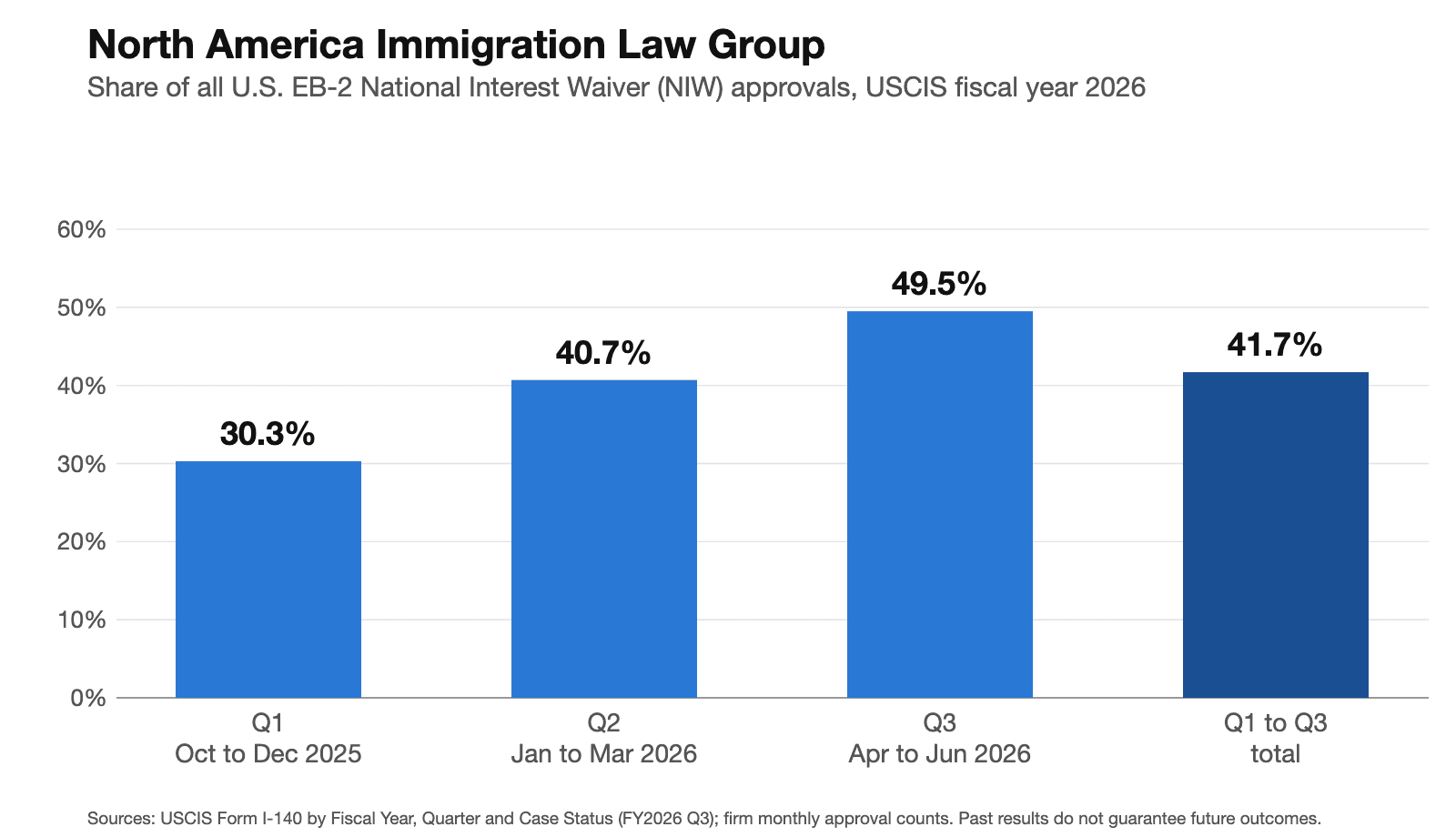
Our share of all U.S. EB-2 National Interest Waiver (NIW) approvals, USCIS fiscal year 2026 (October 2025 to June 2026). Sources: USCIS Form I-140 data and our firm's monthly approval counts.
How We Can Help
Our attorneys prepare NIW, EB-1A, EB-1B, and O-1 petitions and RFE responses for clients in every field, in the United States and abroad. Cases can be prepared and filed quickly, with premium processing available. To see how your record fits current adjudication trends, request a free evaluation.
No guarantee of results: Past outcomes do not guarantee a similar result in any other case. Each petition is decided on its own record by the adjudicating officer.