





Employment-Based Second Preference (EB-2) National Interest Waiver (NIW) in 2026: Requirements, Adjudication Trends, and Recent Approvals
WeGreened · https://www.wegreened.com/insights/eb-2-niw-in-2026
The Employment-Based Second Preference (EB-2) National Interest Waiver (NIW) remains one of the most valuable green card options for researchers, engineers, physicians, and other professionals. It lets you petition for permanent residence on your own, without an employer sponsor, a job offer, or the labor certification process.
It is also the category our firm knows best. North America Immigration Law Group (Chen Immigration Law Associates) has more than 130,000 immigration approvals, including more than 70,000 Employment-Based First Preference (EB-1A and EB-1B), EB-2 NIW, and O-1 approvals, one of the largest approval records in the country, and our attorneys review every approval, Request for Evidence (RFE), and denial our clients receive.
2026 has brought real changes to how USCIS handles NIW petitions: new evidence rules that allow denials without an RFE, shorter response periods, higher premium processing fees, and closer review of every prong. At the same time, our clients continue to win approvals across a wide range of fields and backgrounds, including students with only a few publications, physicians still in residency, industry engineers, and professionals living outside the United States.
This guide covers everything you need to know about the NIW in 2026: who qualifies, the standard officers apply, what changed in 2025 and 2026, the adjudication trends we are seeing in our own cases, how the process works, and recent approvals from our clients.
Who Qualifies: Employment-Based Second Preference (EB-2) Eligibility Comes First
Under the USCIS Policy Manual (opens in a new tab) , a petitioner must first qualify for the underlying EB-2 category before the waiver is considered. There are three ways to do that:
- An advanced degree. A U.S. master's degree or higher, or a foreign equivalent.
- A bachelor's degree plus five years of progressive experience. The experience must be in the specialty, and USCIS decides case by case whether the occupation is a profession.
- Exceptional ability. A degree of expertise significantly above that ordinarily encountered in the field, shown by meeting at least three regulatory criteria. The exceptional ability must relate to the proposed endeavor.
USCIS made this order explicit in its January 2025 NIW policy update (opens in a new tab) . In our practice, we confirm EB-2 eligibility, including any foreign degree equivalency, before we build the rest of the petition.
The Three Prongs Officers Apply
Once EB-2 eligibility is established, the petition must meet the three-prong framework from Matter of Dhanasar:
Prong 1: Substantial merit and national importance. Substantial merit is usually the easier half: work in research, engineering, medicine, education, and many other fields has clear value. National importance is where officers focus. The question is not whether the field matters, but whether the specific endeavor the petitioner proposes has potential prospective impact beyond one employer, one institution, or one group of patients or customers. Endeavors with broad implications for a field, such as improved technologies, medical advances, or methods that others can adopt, are the strongest.
Prong 2: Well positioned to advance the endeavor. Officers look at the petitioner's education, skills, and knowledge; a record of success in related work; a model or plan for future activities; progress toward the endeavor so far; and the interest of potential users, customers, funders, or others in the work. Letters of support are considered, but officers give more weight to letters that describe specific contributions and to independent evidence that others rely on the work.
Prong 3: On balance, a waiver benefits the United States. The petition must show why the United States is better served by waiving the job offer and labor certification for this person. Officers may consider whether labor certification would be impractical, whether the United States would benefit even if qualified U.S. workers are available, and whether the national interest in the petitioner's contributions is urgent enough to forgo the labor certification process.
The Policy Manual also explains how these prongs apply to petitioners with advanced degrees in science, technology, engineering, and math (STEM) fields, and how officers weigh letters of support and business plans. Our petitions are built around this framework, prong by prong.
What Changed for the National Interest Waiver (NIW) in 2025 and 2026
Clearer, stricter NIW guidance (January 2025). USCIS's January 2025 Policy Manual update (opens in a new tab) confirmed that EB-2 eligibility must be shown first, added examples of how officers judge national importance, and explained how they weigh letters of support and business plans. It also made clear that broad claims about economic benefits or job creation will not, on their own, qualify an entrepreneur. A separate technical update the same month confirmed that NIW-based adjustment applicants can use job portability after their adjustment application has been pending for 180 days.
Denials without an RFE and shorter response periods (August 2026). USCIS's August 2026 evidence policy (opens in a new tab) restored officers' full discretion to deny a petition without first issuing an RFE or a Notice of Intent to Deny when the record does not establish eligibility or required initial evidence is missing. Under the updated Policy Manual evidence chapter (opens in a new tab) , officers set each RFE response period case by case, up to a maximum of 12 weeks, and the extra mailing time for petitioners abroad has been reduced to 3 days. Any response, even a partial one, is treated as a request for a decision, so the complete response must be filed at one time. The Policy Manual also states that an RFE is not issued to cure a deficiency: the petitioner must be eligible as of the filing date.
Higher premium processing fees (March 2026). Effective March 1, 2026, premium processing (opens in a new tab) for an NIW Form I-140 rose from $2,805 to $2,965. USCIS commits to taking action on a premium NIW petition within 45 business days.
What this means in practice. The first filing now carries far more weight than it did a few years ago. A petition with gaps may be denied outright, and an RFE may come with less time to respond. That is why we build every petition to be complete and decision-ready on the day it is filed.
National Interest Waiver (NIW) Adjudication Trends in 2026
How USCIS decides NIW petitions changes over time, sometimes in a matter of weeks. The same record can draw an approval in one period and an RFE in another, depending on current policy, the service center, and the individual officer. Because we track every approval, RFE, and denial our clients receive, and our attorneys review the RFE notices that come in each week, our database shows us patterns that no single case can. Here is what we are seeing in late 2026.
Trend 1: The First Filing Matters More Than Ever
Under the August 2026 evidence policy, a petition no longer gets a reliable second chance. Officers may deny without an RFE, response periods are shorter and set case by case, and evidence created after filing cannot fix a gap in eligibility. We prepare every petition to be complete and decision-ready on the day it is filed, with the endeavor, the evidence, and the letters all aligned before submission.
Trend 2: Requests for Evidence (RFEs) Usually Challenge More Than One Prong
The RFEs we review rarely raise a single issue. Most question two or more prongs at once, and Prong 3 (whether, on balance, a waiver benefits the United States) is frequently among them, often with standard language that labor certification exists to protect U.S. workers. Much of this wording is standardized and appears across many fields and service centers. In our weekly reviews, we also see notices with internal contradictions or facts that appear to come from another case, which is one reason every RFE deserves a careful, case-specific reading.
Trend 3: Officers Separate the Field From the Endeavor
Officers consistently distinguish between the importance of a field and the importance of the petitioner's specific proposed work. Petitions that describe the importance of artificial intelligence, cancer research, clean energy, or semiconductors in general, without tying that importance to what the petitioner will actually do, draw Prong 1 (substantial merit and national importance) challenges. Background reports and statistics about an industry are not enough on their own. We define each client's endeavor as a specific contribution to a specific problem, then build the evidence around it.
Trend 4: Matter of Dhanasar Has Become the Yardstick for Researchers
Dr. Dhanasar was a postdoctoral researcher with a defined research plan and funded grant proposals when he filed. Officers increasingly compare students, postdocs, and early-career scientists directly to his record, asking about the petitioner's own role, funding, and independence. The Dhanasar framework does not require every petitioner to match the facts of that case, but we account for the comparison whenever we present an academic record.
Trend 5: Recent Work and the Filing Date Both Count
In our recent approvals, a large share of researchers had a paper published in 2025 or 2026. When the latest work is several years old, we see more questions about whether the petitioner is still advancing the endeavor, although our approvals below show that older records can still succeed when the rest of the case is strong. Because work completed after filing cannot establish eligibility, timing the filing around the strongest current record matters.
Trend 6: Modest Records Still Win
Citation counts alone do not decide cases. Our recent approvals include Doctor of Philosophy (PhD) students with fewer than 15 citations, research staff with a master's degree, and industry professionals with only a few publications. What these cases share is a clearly defined endeavor, evidence of how the work is used, and letters from both first-hand colleagues and independent experts.
Trend 7: A Request for Evidence (RFE) Is Not the End of the Case
Approvals after an RFE remain a regular part of our results across students, physicians, and industry professionals. Under current policy, though, the time to respond may be shorter, the complete response must be filed at once, and the right response depends on the specific notice, the officer's reasoning, and the record already filed.
Who Files for a National Interest Waiver (NIW) in 2026, and What Officers Look For
Our firm files NIW petitions for clients at every career stage and in nearly every field. Each group draws its own set of questions from officers.
PhD students and recent graduates. Many students file before graduating. Prong 2 (whether the petitioner is well positioned to advance the endeavor) is where most student cases are won or lost: officers ask what the student personally contributed under an advisor and whether the planned next role is realistic. Endeavors tied to a concrete next step, such as a postdoctoral or research scientist position, fare well. Students without a master's degree can qualify through exceptional ability, but those claims face close review.
Postdoctoral researchers. Officers often view a postdoc as a temporary training position under a principal investigator. They question who owns the funding, how independent the postdoc's work is, and whether the role reaches beyond one lab, frequently with direct comparisons to Dr. Dhanasar, who was a postdoc when he filed. We show the postdoc's own role, contributions, and influence on the field.
University faculty and research scientists. Professors, lecturers, and research staff can file on their own, alongside or instead of an employer-sponsored Employment-Based First Preference (EB-1B) petition for outstanding professors and researchers. Officers look past titles to whether the research has shaped the field and whether teaching or service duties reach beyond one campus.
Industry engineers and scientists. Prong 1 (substantial merit and national importance) is a bigger hurdle in industry than in academia. Officers ask whether the work matters beyond one employer and its customers, how proprietary work could benefit the field, and why the employer could not use labor certification. Job titles do not carry the case; a specific technical contribution with broader reach does.
Physicians. Doctors can use the general NIW or the separate physician NIW (opens in a new tab) for shortage areas and U.S. Department of Veterans Affairs (VA) facilities, and we choose the right path at the start. Under the general NIW, officers separate clinical care for individual patients from work with national reach, so endeavors centered on research, clinical innovation, or technology are strongest.
Professionals outside the United States. An NIW does not require you to be in the United States. Officers look for a clear plan for work in the United States, foreign degree equivalency, and properly certified translations. Petitioners abroad also no longer receive extra mailing time for RFE responses beyond the standard 3 days, which makes preparation before filing even more important.
The NIW also fits professionals without a PhD, including engineers with a bachelor's degree and five years of progressive experience. What matters is a specific endeavor with national importance and a record that shows you can carry it forward.
How the National Interest Waiver (NIW) Process Works in 2026
- Form I-140 petition. The petitioner files Form I-140 (opens in a new tab) with the NIW request, supporting evidence, and letters. Under the current USCIS fee schedule (opens in a new tab) , the filing fee is $715 by paper or $665 online, plus an Asylum Program Fee, which is $300 for a self-petitioner who employs 25 or fewer full-time employees.
- Premium processing (optional). With Form I-907 and the $2,965 premium fee, USCIS takes action within 45 business days. A petition filed together with premium processing must be filed by mail, and a pending petition can be upgraded later.
- Decision. USCIS approves, issues an RFE, or, under the August 2026 policy, may deny without an RFE.
- Green card stage. Once the I-140 is approved and the priority date is current, the petitioner applies for adjustment of status in the United States or an immigrant visa through a U.S. consulate. When the date is current at filing, the adjustment application can be filed together with the I-140.
Priority dates and visa backlogs. The filing date of the I-140 becomes your priority date. Applicants born in some countries, such as China and India, wait longer for the green card stage because of per-country limits. USCIS publishes each month which Visa Bulletin chart (opens in a new tab) adjustment applicants may use. Because the priority date is locked in when the I-140 is filed, filing as early as the record allows is often the most important timing decision.
Recent National Interest Waiver (NIW) Approvals From Our Clients
The cases below were all approved in late October and November 2026, under the current evidence rules, and none required a Request for Evidence (RFE). Names, schools, employers, and specific proposed endeavors are withheld to protect our clients' privacy.
Doctor of Philosophy (PhD) Students
PhD student in biomedical science moving to a postdoctoral fellowship, born in Ghana: approved without a Request for Evidence (RFE). The client held a master's degree and was a graduate research assistant, with plans to continue the research as a postdoctoral research fellow at another institution. The record was very small: 4 publications and 9 citations, with the latest paper from 2025. Because the citation count could not carry the case, the petition had to show the specific research problem, the client's own role in solving it, and how the postdoctoral position would carry the work forward. Premium processing was requested at filing, and the petition was approved on November 4, 2026.
What this case shows: a student with fewer than 10 citations can win when the endeavor and the next role are clearly defined.
PhD student in biostatistics moving to a faculty position, born in Bangladesh: approved without an RFE. The client held a master's degree and was a PhD student working as a graduate research assistant, with plans to join a U.S. university as an assistant professor. Faculty plans draw closer questions about whether a student is ready for an independent role, and the record included 8 publications and 14 citations, with a paper published in 2026. The petition was upgraded to premium processing and approved on November 2, 2026.
What this case shows: students planning a faculty career can succeed when the record shows steady, current research.
PhD student in biological sciences without a master's degree, born in Iran: approved without an RFE. The client did not yet hold an advanced degree, so the petition relied on exceptional ability for EB-2 eligibility, a claim officers review closely. The proposed endeavor was to continue the research as a researcher after the PhD. At filing, the record included 4 publications and 84 citations, with the latest paper from 2024. The petition was upgraded to premium processing and approved on November 2, 2026.
What this case shows: students without a master's degree can qualify when each exceptional ability criterion is documented thoroughly.
PhD student in experimental physics moving to a postdoctoral position, born in Pakistan: approved without an RFE. The client held a master's degree and was a PhD student, with plans to continue the research as a postdoctoral scholar at another institution. The record included 3 publications and 27 citations, with the latest paper from 2023. A clearly defined postdoctoral plan in the same research area was an important part of the case. Premium processing was requested at filing, and the petition was approved on November 11, 2026.
What this case shows: a small or older publication record can succeed when the student's contributions and next role are clearly presented.
Postdoctoral Researchers and Research Staff
Postdoctoral researcher in psychology, born in Canada: approved without an RFE. The client held a PhD in psychology, a field outside the STEM designation, and planned to continue as a postdoctoral researcher. Non-STEM petitions do not receive the added considerations the USCIS Policy Manual describes for STEM degree holders, and postdocs are often compared to Dr. Dhanasar's own record, so the case had to show national importance and the client's independent standing on its own terms. At filing, the record included 18 publications and 483 citations, with the latest paper from 2023. The petition was upgraded to premium processing and approved on November 12, 2026.
What this case shows: researchers outside STEM fields continue to win when the record shows the field is using their work.
Agricultural research specialist in plant pathology, born in South Africa: approved without an RFE. The client held a PhD and worked as a research specialist, a staff role rather than a faculty or postdoctoral position, with plans to continue the same work. The record included 10 publications and 353 citations, but the latest paper was from 2020. Officers often question older records, so the petition had to show that the client was still actively advancing the endeavor. The petition was upgraded to premium processing and approved on November 3, 2026.
What this case shows: an older publication record can still succeed when the petition shows the work is ongoing and widely used.
University Faculty
University lecturer in civil engineering, born in Bangladesh: approved without an RFE. The client held a PhD and was a lecturer, a teaching-focused faculty role, with plans to continue in the same position. Officers often view teaching as benefiting one campus, so the petition centered on the research endeavor rather than classroom duties. At filing, the record included 5 publications and 17 citations, with a paper published in 2025. Premium processing was requested at filing, and the petition was approved on November 3, 2026.
What this case shows: teaching-focused faculty with modest records can qualify when the endeavor is framed around research with broader reach.
Industry Professionals
Structural engineer in infrastructure resilience, born in Iran: approved without an RFE. The client held a PhD and was a senior professional in structural engineering at a private firm, with work focused on fluid-structure interaction and infrastructure resilience. An endeavor tied to the safety of infrastructure helped show impact beyond one employer's projects. At filing, the record included 28 publications and 152 citations, with the latest paper from 2024. The petition was upgraded to premium processing and approved on November 4, 2026.
What this case shows: industry engineers can meet Prong 1 (substantial merit and national importance) when the endeavor addresses a public problem such as infrastructure safety.
Construction engineer with a non-STEM master's degree, born in Nigeria: approved without an RFE. The client held a master's degree in construction science, a field outside the STEM designation, and worked as an assistant engineer at a private company. The record included 8 publications and 32 citations, with a paper published in 2026. Without the STEM considerations or a PhD, the petition had to establish national importance and the client's standing directly. The petition was upgraded to premium processing and approved on November 3, 2026.
What this case shows: industry professionals with a master's degree outside STEM fields can win with a well-defined endeavor.
Industry mechanical engineer, born in South Korea: approved without an RFE. The client held a PhD and planned to continue as a mechanical engineer at a private company. Industry petitions face a harder Prong 1 (national importance) question, and a paper published in 2026 helped show the client was still contributing to the field beyond internal company work. At filing, the record included 7 publications and 39 citations. Premium processing was requested at filing, and the petition was approved on November 2, 2026.
What this case shows: engineers in industry can establish national importance when their work reaches beyond one company.
Physicians
Anesthesiology resident in perioperative medicine, born in Germany: approved without an RFE. The client held a Doctor of Medicine (MD) degree and was in residency training, with a proposed endeavor in perioperative medicine. Officers often view residents as trainees whose work serves one hospital, but this client had already built a substantial research record: 39 publications and 579 citations, with a paper published in 2026. Premium processing was requested at filing, and the petition was approved on October 30, 2026.
What this case shows: residents do not need to finish training before filing when their research already reaches the wider field.
Resident physician in kidney medicine, born in Mexico: approved without an RFE. The client held an MD and was in residency training, with a proposed endeavor in kidney medicine. The petition had to show contributions with reach beyond one hospital's patients. At filing, the record included 31 publications and 121 citations, with a paper published in 2025. Premium processing was requested at filing, and the petition was approved on November 12, 2026.
What this case shows: a strong research record lets physicians in training qualify for the general NIW.
Radiology resident with a Bachelor of Medicine, Bachelor of Surgery (MBBS) degree and a modest record, born in India: approved without an RFE. The client held an MBBS, a foreign medical degree, and was a radiology resident planning to continue in the same role. The record was modest: 6 publications and 33 citations, with the latest paper from 2022. The petition had to establish EB-2 eligibility through the foreign medical degree and show national importance despite an older, smaller record. The petition was upgraded to premium processing and approved on October 29, 2026.
What this case shows: foreign-trained physicians with modest records can still win when the endeavor and degree equivalency are well presented.
Clients Outside the United States
Each of these clients was living and working abroad when we filed, and applicants in this position can complete the green card process through a U.S. consulate.
Assistant professor in Asia moving to a U.S. faculty position in artificial intelligence-driven biomedical informatics, born in Bangladesh: approved without an RFE. The client held a PhD and was a specially appointed assistant professor at a university outside the United States, with plans to join a U.S. university as an assistant professor. The record was extensive: 154 publications and 3,636 citations, with a paper published in 2025. The planned U.S. faculty role gave officers a clear picture of how the work would continue here. The petition was upgraded to premium processing and approved on November 1, 2026.
What this case shows: faculty abroad can move their research program to the United States through the NIW, without an employer sponsor.
Biopharmaceutical executive abroad moving to a U.S. product development role, born in South Korea: approved without an RFE. The client held a PhD and was a senior director leading a manufacturing and controls team at a company outside the United States, with plans to take a director-level product development role at a U.S. company. The publication record was small and older: 4 publications and 75 citations, with the latest paper from 2019. The case rested on the client's leadership and technical contributions in computational biopharmaceutical engineering rather than recent publications. Premium processing was requested at filing, and the petition was approved on November 3, 2026.
What this case shows: senior industry professionals abroad can qualify based on their technical leadership, even without a recent publication record.
University professor abroad moving to a U.S. research role in radio-frequency integrated circuits, born in Taiwan: approved without an RFE. The client held a PhD and was a professor at a university outside the United States, with plans to continue the research as a research scholar at a U.S. institution. At filing, the record included 80 publications and 636 citations, with a paper published in 2025. The petition was upgraded to premium processing and approved on November 10, 2026.
What this case shows: established faculty abroad can use the NIW to bring their research to the United States.
Orthopedic surgeon abroad moving to a U.S. research fellowship, born in Turkey: approved without an RFE. The client held an MD and was practicing as an orthopedic surgeon outside the United States, with plans to join a U.S. institution as a postdoctoral research fellow. Because officers separate clinical care from work with national reach, the endeavor centered on research rather than surgical practice. At filing, the record included 17 publications and 35 citations, with a paper published in 2026. Premium processing was requested at filing, and the petition was approved on November 6, 2026.
What this case shows: physicians abroad can qualify through a research-focused endeavor even with a modest citation count.
What This Means for You
- Confirm your EB-2 eligibility first, including any foreign degree equivalency or exceptional ability claim.
- Define a specific endeavor rather than relying on the importance of your field or your job title.
- Show your own contributions and how others have used your work; citation counts alone do not decide cases.
- Keep your record current, with recent publications or presentations, before you file.
- File a complete, decision-ready petition from the start: in 2026, USCIS may deny without an RFE.
- Expect closer review of Prong 3 (whether, on balance, a waiver benefits the United States) and be ready to explain why a waiver serves the United States.
- If you receive an RFE, act quickly: response periods are now set case by case, and the full response must be filed at once.
- Do not wait for a perfect record if yours is ready now: your priority date is set when you file.
Why Work With Our Firm
- One of the largest approval records in the country. Our firm has more than 130,000 immigration approvals, including more than 70,000 Employment-Based First Preference (EB-1A and EB-1B), EB-2 National Interest Waiver (NIW), and O-1 approvals. From October 2025 through June 2026, our clients received about 41.7% of all EB-2 National Interest Waiver (NIW) approvals USCIS issued nationwide, and 49.5% in the most recent quarter, so we see a large and current sample of how USCIS decides these petitions.
- A detailed database of adjudication trends. We track every approval, RFE, and denial our clients receive, including how individual officers and service centers have decided similar cases and how their decisions shift over time.
- Up to date case preparation strategy. We adjust our strategy as new decisions and policies come in, so your petition addresses the issues officers are raising now.
- Honest evaluations. We tell you plainly how strong your case is, what would make it stronger, and when another category or more time may serve you better.
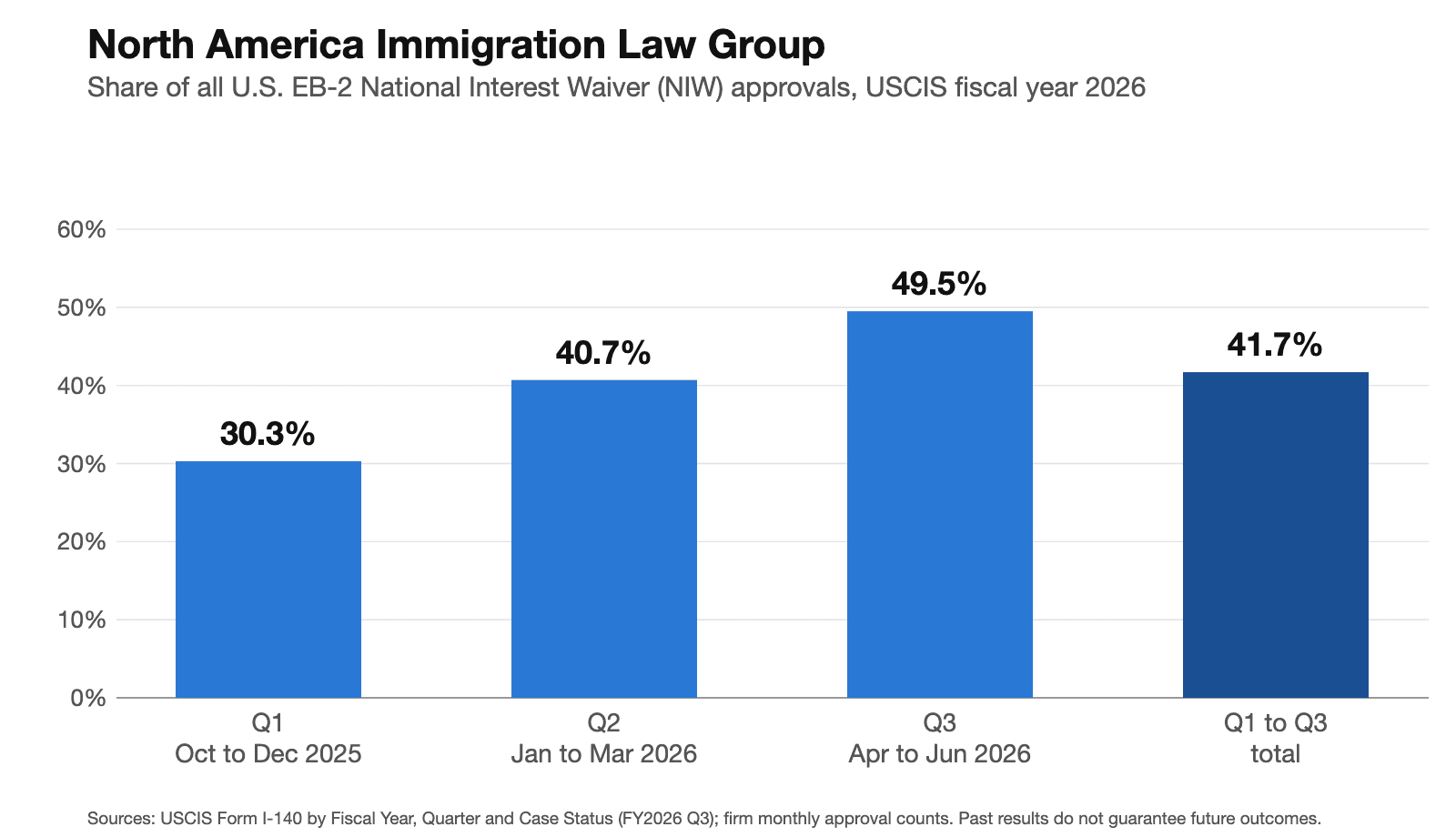
Our share of all U.S. EB-2 National Interest Waiver (NIW) approvals, USCIS fiscal year 2026 (October 2025 to June 2026). Sources: USCIS Form I-140 data and our firm's monthly approval counts.
How We Can Help
Our attorneys prepare National Interest Waiver (NIW), Employment-Based First Preference (EB-1A and EB-1B), and O-1 extraordinary ability visa petitions for clients in the United States and abroad. Cases can be prepared and filed quickly, with premium processing available. To find out whether your record is ready for an NIW in 2026, request a free evaluation.
No guarantee of results: Past outcomes do not guarantee a similar result in any other case. Each petition is decided on its own record by the adjudicating officer.