





A Green Card Strategy for PhD Students: NIW During the PhD, O-1 After, Then the Green Card
WeGreened · https://www.wegreened.com/insights/green-card-strategy-for-phd-students
Build credentials during the program, file the NIW before graduating, use an O-1 while waiting if needed, then file the I-485 when the priority date is current.
Many international PhD students wait until graduation to think about a green card, then find themselves racing a job search, OPT limits, and a work visa lottery at the same time. A better plan starts earlier. For many students, the strongest path is to build credentials during the program, file a National Interest Waiver (NIW) before graduating, use an O-1 work visa while waiting if needed, and file for the green card once the priority date is current. Here is how that plan works and where each step can go wrong, based on our experience with more than 130,000 immigration approvals, including more than 70,000 Employment-Based First Preference (EB-1A and EB-1B), EB-2 NIW, and O-1 approvals.
Why the NIW Fits PhD Students
The NIW lets a petitioner file without an employer and without a labor certification. The petitioner must first qualify for EB-2, usually through an advanced degree, and then show three things under the USCIS Policy Manual: the proposed endeavor has substantial merit and national importance (Prong 1), the petitioner is well positioned to advance it (Prong 2), and on balance it would benefit the United States to waive the job offer and labor certification (Prong 3).
Because no employer is required, a student can file while still in school. A student who already holds a master's degree, or a U.S. equivalent, can qualify for EB-2 on that degree before the PhD is finished. A student with only a bachelor's degree generally needs to wait until an advanced degree is awarded, unless another EB-2 basis applies.
Step 1: Build Credentials Early
Officers judge Prong 2 on the record, so the years before filing matter. Students who plan ahead tend to build:
- First-author papers in respected journals and conferences, with at least one recent publication.
- Citations by independent research groups, not only by the student's own lab.
- Peer review invitations, conference talks, and awards.
- Relationships with researchers outside the lab who can later write independent expert letters.
The endeavor should be specific and connected to the dissertation research, and it should still make sense after graduation, whether the student stays in academia or moves to industry.
Step 2: File the NIW During the PhD
Once the record is ready, filing before graduation starts the clock on the priority date early. Some practical points:
- An NIW filing usually does not affect a student's ability to use OPT after graduation. A pending or approved I-140 is a separate matter from the student's work authorization.
- Premium processing is available for NIW petitions, which shortens the wait for a decision on the I-140.
- Since USCIS's August 2026 update to the evidence chapter of the Policy Manual, officers may deny without first issuing a Request for Evidence. The petition should be complete when filed.
- An approved NIW is not tied to one employer, but the endeavor must stay the same after graduation and any job change.
Students who plan to travel abroad and renew a student visa should speak with us first, since an immigrant petition can raise questions at a consular interview.
Step 3: Use an O-1 While Waiting, If Needed
An approved NIW does not by itself give work authorization. If the priority date is not yet current when OPT runs out, the student needs a work status. The O-1A visa for individuals with extraordinary ability is often a good fit, because it is not subject to an annual lottery.
An O-1 requires a U.S. employer or agent to file the petition. The criteria overlap heavily with an NIW record: original contributions, scholarly articles, judging the work of others, awards, and published material about the work. In our experience, most of the evidence assembled for the NIW, including expert letters, can be updated and reused for the O-1, which saves time and cost.
Step 4: File the I-485 When the Priority Date Is Current
The green card itself comes through Form I-485, adjustment of status, which can be filed once the priority date is current under the Visa Bulletin chart USCIS designates for that month. Waits differ by country of birth and change monthly.
If the priority date becomes current while the student is still in the PhD program, the student can file the I-485 then. Being enrolled in a PhD program does not by itself hurt I-485 approval. Adjustment of status is a discretionary benefit, and USCIS has recently emphasized that officers weigh the whole record, so maintaining lawful status and following the rules of each status throughout is essential. We review each client's history before filing.
When EB-1A May Be an Option
Students with an unusually strong record, such as major awards or widely cited work, may also qualify for EB-1A, which has its own visa queue. We assess both paths at the evaluation stage.
Checklist for PhD Students
- Confirm the EB-2 basis: an advanced degree or its equivalent.
- Define a specific endeavor tied to the research, and keep it consistent.
- Build publications, independent citations, and review service.
- File the NIW when the record is ready, before graduation if possible.
- Plan the work status after OPT, such as an O-1, well in advance.
- Track the priority date and prepare the I-485 before it becomes current.
Why Work With Our Firm
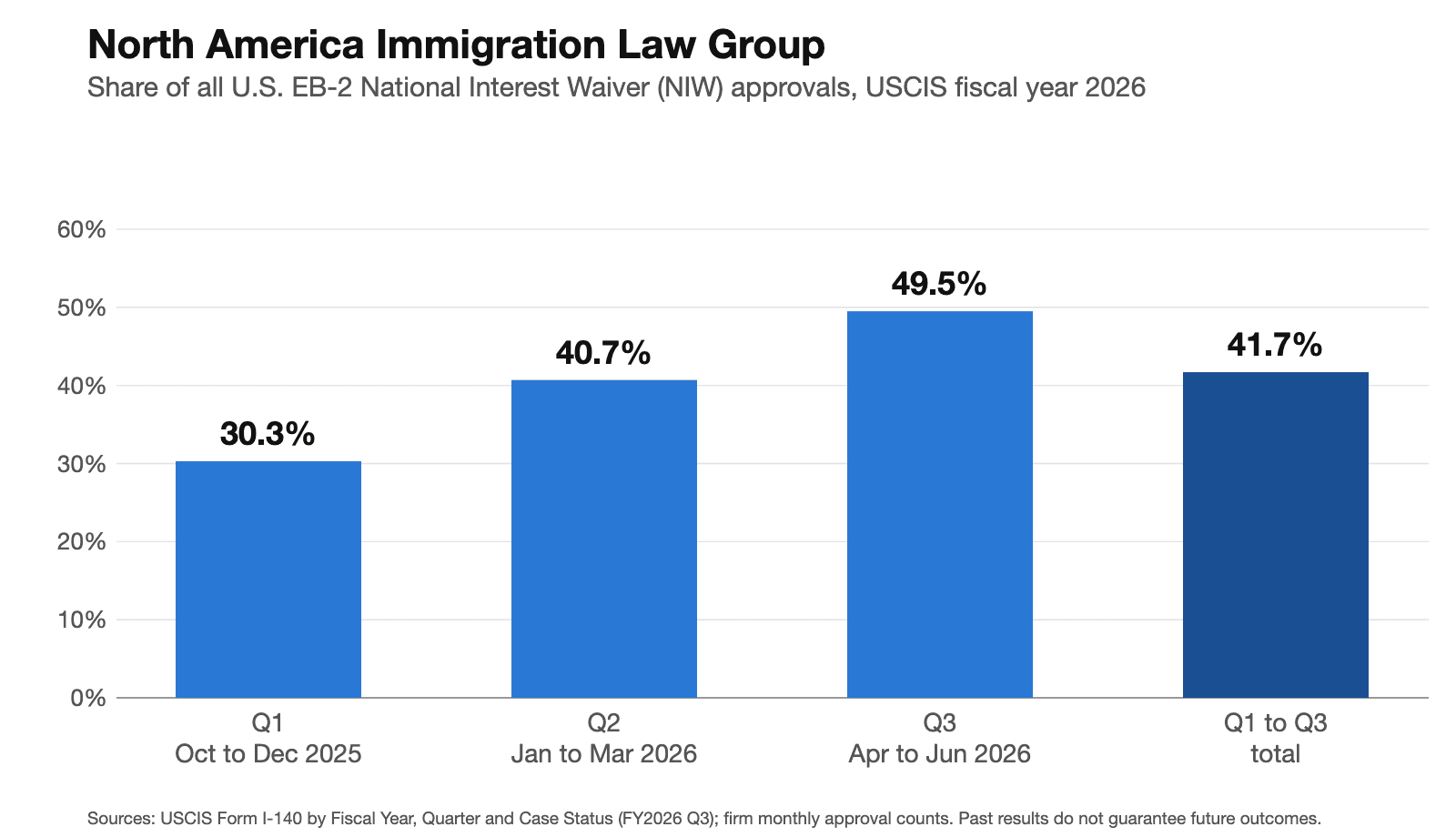
- One of the largest approval records in the country. Our firm has more than 130,000 immigration approvals, including more than 70,000 Employment-Based First Preference (EB-1A and EB-1B), EB-2 National Interest Waiver (NIW), and O-1 approvals. From October 2025 through June 2026, our clients received about 41.7% of all EB-2 National Interest Waiver (NIW) approvals USCIS issued nationwide, and 49.5% in the most recent quarter, so we see a large and current sample of how USCIS decides these petitions.
Related Reading
- EB-2 National Interest Waiver (NIW) services
- NIW for PhD Students: How to Qualify Before You Graduate
- Common NIW RFEs for PhD Students: What USCIS Challenges and Why
- NIW Adjudication Trends for PhD Students: What USCIS Is Focusing On Now
Sources
- USCIS Policy Manual, Volume 6, Part F, Chapter 5: Advanced Degree or Exceptional Ability
- USCIS: Employment-Based Immigration: Second Preference EB-2
- USCIS: O-1 Visa: Individuals with Extraordinary Ability or Achievement
- USCIS Policy Manual, Volume 2, Part M: Nonimmigrants of Extraordinary Ability or Achievement (O)
- USCIS: Green Card for Employment-Based Immigrants
- USCIS Policy Manual, Volume 1, Part E, Chapter 6: Evidence
How We Can Help
Our attorneys help PhD students in science, engineering, medicine, and the social sciences plan the full sequence, from the NIW to the O-1 to the green card. Cases can be prepared and filed quickly, with premium processing available. To see where your record stands, request a free evaluation.
No guarantee of results: Past outcomes do not guarantee a similar result in any other case. Each petition is decided on its own record by the adjudicating officer.