

WeGreened Weekly Approval Summary: Week of November 2 to November 8, 2026
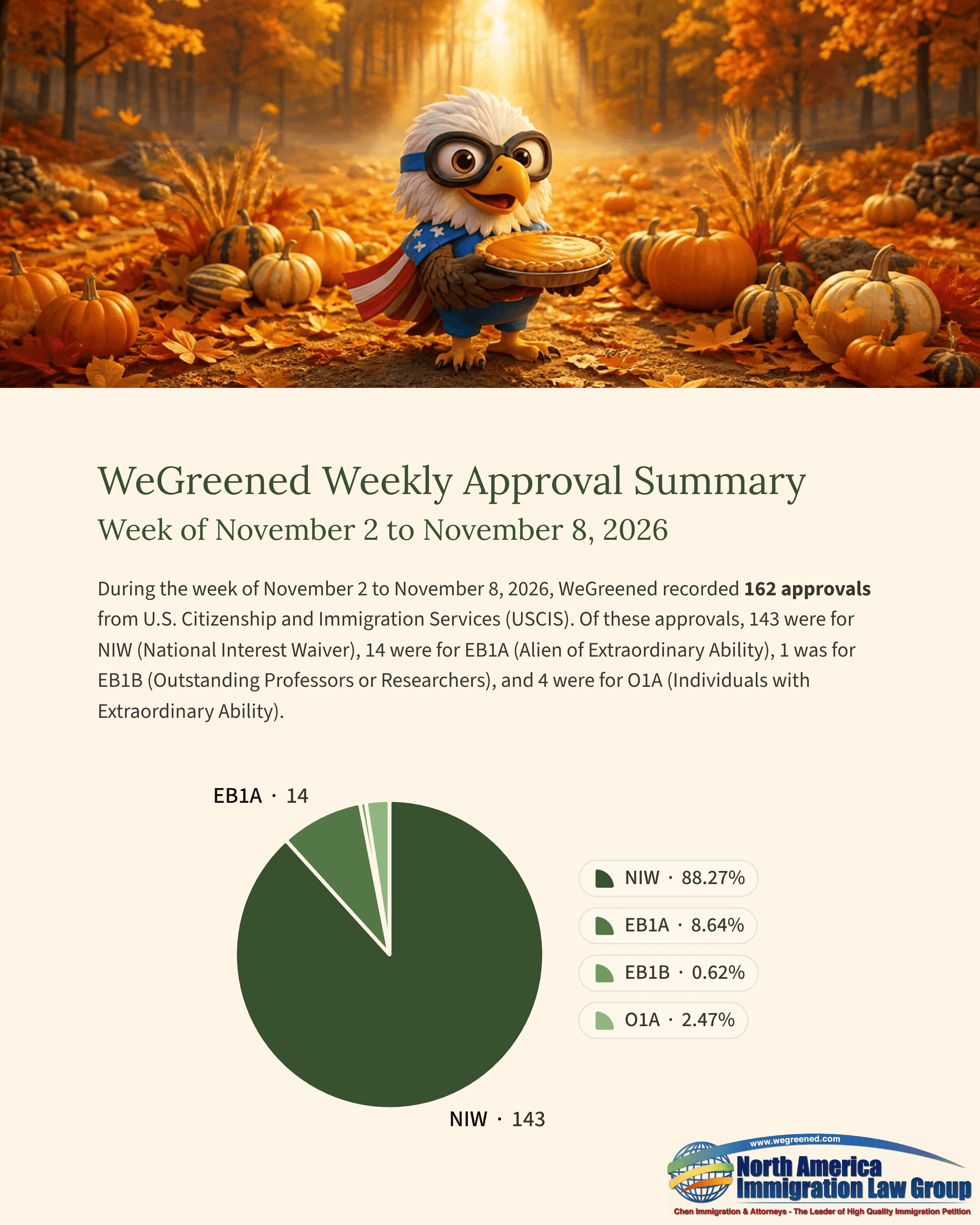
During the week of November 2 to November 8, 2026, WeGreened recorded 162 approvals from U.S. Citizenship and Immigration Services (USCIS). Of these approvals, 143 were for NIW (National Interest Waiver), 14 were for EB1A (Alien of Extraordinary Ability), 1 was for EB1B (Outstanding Professors or Researchers), and 4 were for O1A (Individuals with Extraordinary Ability).
EB1A and NIW Credential Analysis
EB1A publications ranged from 3 to 165 (Q1: 12, median: 18, Q3: 24), while citations ranged from 152 to 24,254 (Q1: 564.25, median: 1,405.5, Q3: 2,444). The highest publication count belonged to a solid mechanics researcher, while the highest citation count came from an artificial intelligence professional. The 2 largest publication records and the 2 largest citation records were statistical outliers. The middle half of the group therefore provides a more useful reference for understanding this week’s approved records than the upper extremes alone.
NIW publications ranged from 2 to 116 (Q1: 6, median: 10, Q3: 17). Among the 142 approvals with a numeric citation count in the spreadsheet, citations ranged from 9 to 4,239 (Q1: 61, median: 141.5, Q3: 281). One citation count was unavailable and was excluded from the citation calculation. The highest publication count came from accounting information systems, while the highest citation count came from computer science. The middle half of the group had 6 to 17 publications and 61 to 281 reported citations, reflecting records considerably more moderate than either maximum.
Insights on Petitioner Backgrounds and Fields
The EB1A group included 11 Ph.D. holders, 2 master’s-level petitioners, and 1 petitioner listed without an advanced degree. All 14 approvals were classified as STEM in the spreadsheet. Research staff and fellows accounted for 4 approvals, followed by 3 applied technical professionals, 3 postdoctoral researchers, 2 faculty members or instructors, 1 doctoral student, and 1 applicant who was not currently employed. Computing, AI, data, and robotics contributed 6 approvals. The 2 master’s-level petitioners were at different career stages: 1 was a doctoral student, and 1 worked as a staff engineer. Their records reinforce the importance of distinguishing a completed degree from a current job or educational stage.
NIW included 79 Ph.D. holders, 50 master’s-level petitioners, 11 applicants with medical or dental qualifications, and 3 listed without advanced degrees. The spreadsheet classified 128 approvals as STEM and 15 as non-STEM. Students and academic assistants, including research and teaching assistants, formed the largest employment group with 44 approvals, followed by 30 postdoctoral researchers, 25 research staff members or fellows, and 23 applied technical professionals. The employment mix differed by field: 27 of the 52 engineering, energy, and materials cases involved students or academic assistants, while the 47 biomedical and health-related cases included 15 postdoctoral researchers and 12 research staff members. Computing-related fields contributed 18 approvals, including 7 applied technical professionals. These differences show why a petition’s evidence should reflect the applicant’s actual work and professional setting.
Highlighted O1A Case: Medicinal Chemistry Scientist Approved With Documented Research Impact and Independent Recognition
This week’s highlighted O1A approval involved an industry scientist with a Ph.D. in medicinal chemistry. The record presented with this filing included 6 peer-reviewed journal articles, 88 citations, and at least 20 completed journal peer reviews. The petition was filed with premium processing and approved during this reporting week.
Our team structured the petition around 3 evidentiary criteria: original contributions of major significance, scholarly authorship, and judging the work of others. For original contributions, we explained the applicant’s work in designing molecules for targeted therapies and investigating how potential drug compounds interact with biological targets. We then connected those findings to specific examples of subsequent research. One example involved an independent team that drew on the applicant’s findings when developing molecular imaging tracers. This gave the officer a concrete explanation of how the applicant’s research had informed later scientific work.
We reinforced this presentation with 2 independent expert opinions from scientists who knew the applicant’s work through published research and had not collaborated with the applicant. Their assessments were presented alongside the publications and representative citing studies, allowing the expert explanations and underlying research records to support one another. Our presentation connected the applicant’s individual contributions with recognition from researchers outside the applicant’s immediate professional circle.
The authorship evidence included 4 first-authored articles within the 6-journal-article total, together with 7 separately documented conference abstracts. For judging, we submitted records confirming completed journal peer reviews. The petition also documented invitations to review federal research-grant applications, providing additional context for the applicant’s professional recognition.
Employment materials described the scientist’s ongoing drug-discovery responsibilities and an offered promotion to senior scientist, connecting the applicant’s expertise with the work the employer sought to support. We then brought the research contributions, authorship, reviewing activities, and independent expert assessments together to explain the applicant’s sustained recognition in medicinal chemistry.
The petition was ultimately approved. This case illustrates how our team presents specialized scientific achievements in terms that directly address USCIS requirements. By explaining what the applicant contributed, how others responded to the work, and how the supporting records fit together, we developed an individualized account of the applicant’s professional standing.
Adjudication Trends and Policy Observations
O1A adjudication considers both the individual evidentiary criteria and the complete record of sustained national or international acclaim. Each achievement needs documentation that addresses the particular requirement it is intended to establish.
Another O1A approval this week illustrates this distinction. USCIS indicated that the computer-vision applicant’s original contributions and scholarly authorship appeared to meet their criteria, but requested stronger award documentation. Our response explained the competitions’ selection procedures, number of recipients, and scope of recognition. We also documented a critical industry role held before filing, using employer testimony and signed project records, alongside separate evidence of the organization’s reputation.
Together, these cases show why O1A preparation should reflect each applicant’s actual achievements. Research influence, completed reviews, competitive awards, and industry responsibilities can support different criteria. Our role is to identify which requirements the existing record can establish and assemble the specific documentation needed to present those qualifications clearly.