




New Trends in I-140 Petitions for FY2026 Q3
NIW approval rates rose for a third straight quarter and EB-1A fell for a sixth, as the line of pending petitions kept growing.
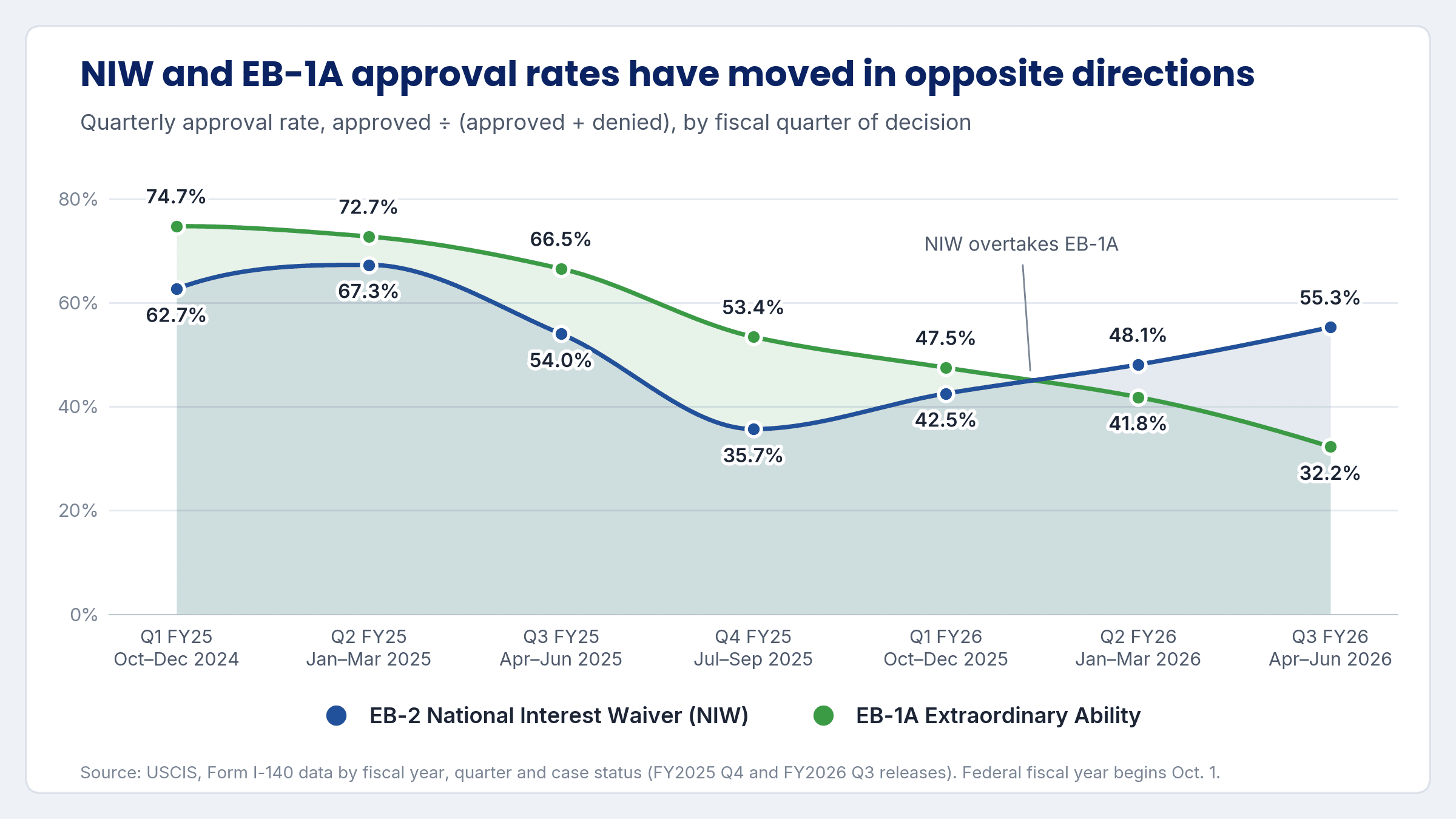
The two self-petition green card categories are now moving in opposite directions. From April through June 2026, USCIS approved 55.3% of the EB-2 National Interest Waiver (NIW) petitions it decided, up from 35.7% nine months earlier. EB-1A extraordinary ability petitions fell to 32.2%.
Key Takeaways
- NIW approval rates have risen for three consecutive quarters, to 55.3%.
- Pending I-140 petitions reached 203,204, including 96,297 NIW cases.
- EB-1A approval rates fell for a sixth straight quarter, and NIW has overtaken it.
- Employer-sponsored categories, including EB-1B and I-129 filings, remain steady around 90%.
- Approvals for countries under a USCIS hold nearly stopped in Q2 and partly recovered in Q3.
NIW approval rates are climbing
NIW approvals bottomed out at 35.7% in July–September 2025, then rose to 42.5%, 48.1% and 55.3%. USCIS approved 3,835 NIW petitions in Q3, the most this fiscal year, while denials eased to 3,103.
What it means: Odds have improved, but they remain below the 67.3% of early 2025, and nearly 45% of decided cases were still denied. A well-documented and strategically argued case for national importance remains decisive.
EB-1A and NIW are moving in opposite directions
EB-1A approval rates have fallen every quarter since late 2024, from 74.7% to 32.2%. In Q3, USCIS issued 2,832 EB-1A denials and 1,348 approvals, roughly two denials for every approval. NIW overtook EB-1A in January–March 2026, and the gap has widened to 23 points.
The EB-1A decline is broad and has hit almost every country. For India-born petitioners, EB-1A approvals fell from 29.8% of receipts in Q2 to 21.4% in Q3; for China, from 26.4% to 21.6%.
What it means: USCIS appears to be applying a higher bar to EB-1A. Applicants with strong but not exceptional records may want to weigh NIW, or filing both, before committing to EB-1A alone.
The I-140 queue keeps growing
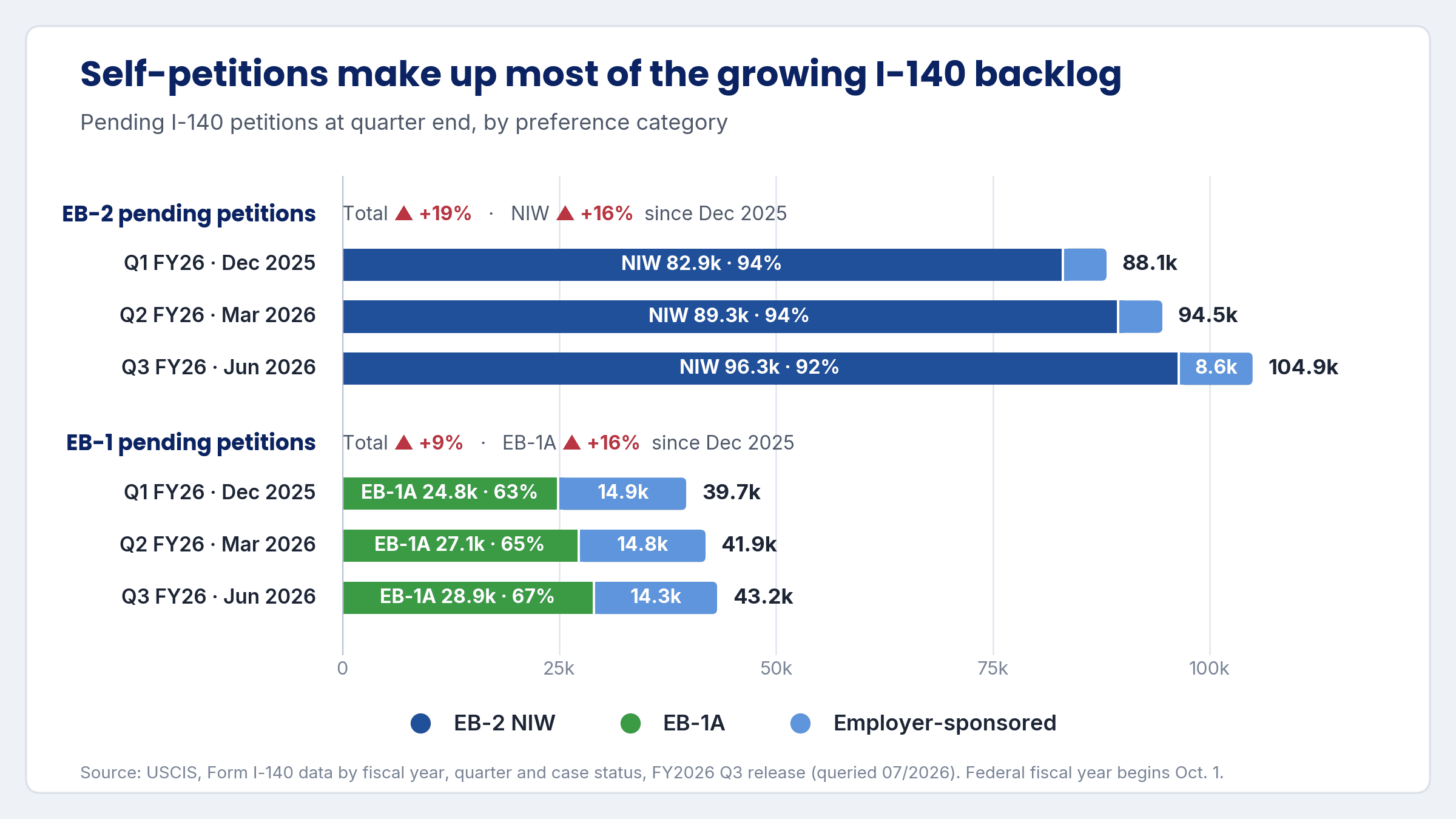
Pending I-140 petitions reached 203,204 at the end of June, up 10% from March. NIW accounts for nearly half: 96,297 cases, up 70% from the end of 2024.
USCIS received 13,831 NIW petitions in Q3 but decided only 6,938. At that pace, clearing the backlog would take about three and a half years with no new filings.
What it means: Petitioners using regular processing should plan for longer waits. Premium processing can shorten decision times. Petitioners can also look to non-immigrant visa petitions, such as an O-1, to secure a faster entry.
Employer-sponsored categories hold steady
USCIS approved 93.0% of EB-1B outstanding researcher petitions and 97.4% of EB-1C multinational manager petitions in Q3. I-129 approvals held near 90% for a third straight quarter across all I-129 worker petitions, including H-1B, O-1, L-1, and other specialty categories.
What it means: Applicants with employer support face more predictable outcomes. If that is a viable option, EB-1B or O-1 is worth considering alongside or in place of a self-petition.
Hold countries: near zero in Q2, a partial recovery in Q3
In December 2025 and January 2026, USCIS paused decisions on pending benefit requests from nationals of 39 countries under presidential travel restrictions. For petitioners born in those countries, I-140 approvals fell from 1,736 in Q1 to 21 in Q2. A federal court ruled the pause unlawful on June 8, 2026, though an appeal is expected. This may have resulted in a rebound to 1,080 approvals in Q3.
However, the rebound was uneven across self-petition and employer sponsored categories. Employer-sponsored EB-2 approvals equaled 65% of receipts from affected countries, versus 7% for NIW and 5% for EB-1A.
What it means: Applicants from affected countries may have continued delays, particularly for self-petitions. Fourth-quarter data will be the first to fully show the ruling's effect.
Weighing your options? We've guided petitioners through over 69,000 EB-2 NIW, EB-1A, EB-1B and O-1 cases. Submit a free evaluation to find out which path best fits your profile.