





Common NIW RFEs for Industry Professionals With a PhD: What USCIS Challenges and Why
WeGreened · https://www.wegreened.com/insights/common-niw-rfes-for-industry-professionals-with-a-phd
A PhD settles the degree question but not the petition. These are the RFE issues USCIS raises most for industry scientists and engineers with a PhD.
PhD holders working in industry, from research scientists to engineers and technical leads, are a large and growing share of the National Interest Waiver (NIW) clients we represent, and our attorneys review the Request for Evidence (RFE) notices our clients receive every week. A PhD settles the degree question, but it does not settle the petition. At North America Immigration Law Group (Chen Immigration Law Associates), here is what we are seeing: the most common RFE issues for industry PhDs, why officers raise them, and examples of the wording that appears in these notices.
The Standard Officers Apply
Under the USCIS Policy Manual, the petition must show that the proposed endeavor has substantial merit and national importance (Prong 1), that the petitioner is well positioned to advance it (Prong 2), and that on balance a waiver of the job offer and labor certification benefits the United States (Prong 3).
A note on timing. USCIS updated the evidence chapter of its Policy Manual in August 2026. Officers may now deny a petition without first issuing an RFE, and they set each RFE response period case by case, up to a maximum of 12 weeks. The complete response must be submitted at one time.
| Prong | Common RFE issues |
|---|---|
| Prong 1 | RFE 1: Company Research Serves the Company RFE 2: Proprietary Work Cannot Reach the Field RFE 3: The Approach Is Not Shown to Be New |
| Prong 2 | RFE 4: Citations and Letters Do Not Show Influence |
| Practical questions | RFE 5: How Will a Full-Time Employee Pursue the Endeavor? |
| Prong 3 | RFE 6: The Employer Can Sponsor Instead |
RFE 1: Company Research Serves the Company (Prong 1)
Why officers raise it for industry PhDs. Officers accept that the research field matters, but question whether research done for one company benefits the field or the public, or mainly the employer's products.
Examples of RFE language we have seen:
"The petitioner has not shown the petitioner's proposed endeavor in this case stands to sufficiently extend beyond an organization and its clients to impact the industry or field more broadly."
Customized services or proprietary research help specific companies, but "by nature, they do not represent broadly applicable measures that a wide range of companies can readily adopt."
RFE 2: Proprietary Work Cannot Reach the Field (Prong 1)
Why officers raise it for industry PhDs. Much industry research is confidential. Some officers ask whether work that stays inside a company could ever have national importance.
Example of RFE language we have seen:
Officers have asked for proof that "internal research discoveries conducted during employment would be made publicly available rather than maintained as proprietary information."
RFE 3: The Approach Is Not Shown to Be New (Prong 1)
Why officers raise it for industry PhDs. When an endeavor applies an established method in a new setting, officers may ask what sets the petitioner's approach apart from existing work.
Example of RFE language we have seen:
"The listed evidence appears intended to establish the relevance and potential national importance of this approach, rather than to document that the methodology itself is novel, unique, or unavailable through existing ... research and practices."
RFE 4: Citations and Letters Do Not Show Influence (Prong 2)
Why officers raise it for industry PhDs. Industry PhDs often rely on publications from graduate school and letters from managers and colleagues. Officers question whether citations are independent and treat letters as advisory without other evidence behind them.
Examples of RFE language we have seen:
"The record does not show that the research has been widely accepted or implemented in the field, that it served as an impetus for progress in (or generated substantial positive discourse) in the endeavor ..."
"The submission of letters from experts supporting the petition is not presumptive evidence of eligibility."
RFE 5: How Will a Full-Time Employee Pursue the Endeavor?
Why officers raise it for industry PhDs. Some officers treat the endeavor as separate from the petitioner's job and ask how much time a full-time employee can devote to it.
Example of RFE language we have seen:
"It is not known how much time the self-petitioner would devote to the proposed research endeavor while also performing duties for her employer ..."
RFE 6: The Employer Can Sponsor Instead (Prong 3)
Why officers raise it for industry PhDs. Because the petitioner already has an employer, officers often say the standard labor certification process is available, and that general shortages in STEM fields do not change that.
Example of RFE language we have seen:
"An occupational shortage does not eliminate the benefits of a process designed to protect U.S. workers."
What These RFEs Have in Common
Much of the language in these notices is standardized and appears across many cases. In our weekly reviews, we also see notices with internal contradictions or facts that appear to come from another case. An RFE is not a denial, and the right response depends on the specific notice, the officer's reasoning, and the record already filed. Our firm's recent approvals after an RFE include industry PhDs in machine learning and computational urban planning.
Why Work With Our Firm
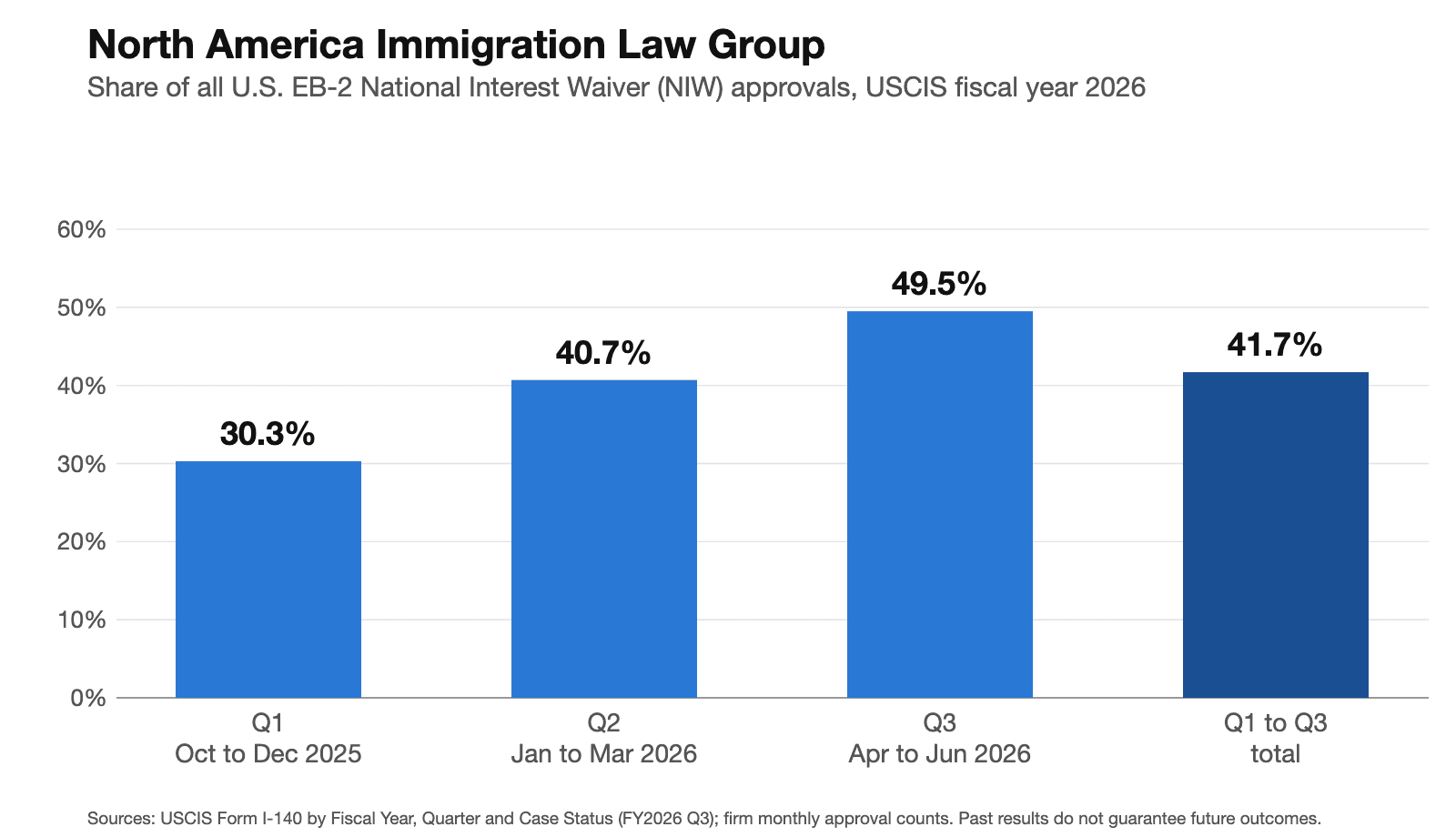
- One of the largest approval records in the country. Our firm has more than 130,000 immigration approvals, including more than 70,000 Employment-Based First Preference (EB-1A and EB-1B), EB-2 National Interest Waiver (NIW), and O-1 approvals. From October 2025 through June 2026, our clients received about 41.7% of all EB-2 National Interest Waiver (NIW) approvals USCIS issued nationwide, and 49.5% in the most recent quarter, so we see a large and current sample of how USCIS decides these petitions.
- A detailed database of adjudication trends. We review every RFE, approval, and denial our clients receive, including how individual officers and service centers have decided similar cases and how their decisions shift over time.
- Up to date case preparation strategy. We adjust our strategy as new notices come in, so your petition or RFE response addresses the issues officers are raising now.
- Honest evaluations. We tell you plainly how strong your case is, what would make it stronger, and when another category or more time may serve you better.
Related Reading
- NIW RFE Response: Challenges & Strategies
- Our EB-2 NIW practice
- Common NIW RFEs for PhD Students: What USCIS Challenges and Why
- Common NIW RFEs for Postdocs: What USCIS Challenges and Why
- Common NIW RFEs for Physicians: What USCIS Challenges and Why
- Common NIW RFEs for Industry Professionals Without a PhD: What USCIS Challenges and Why
How We Can Help
Received an NIW RFE? Our attorneys prepare RFE responses for industry scientists and engineers with a PhD, and every response is tailored to the specific notice and the officer's reasoning. Whether you filed on your own or with another law firm, complete our NIW RFE questionnaire and include your response deadline so we can assess the matter and the time available.
No guarantee of results: Past outcomes do not guarantee a similar result in any other case. Each petition is decided on its own record by the adjudicating officer.