





Common NIW RFEs for Physicians: What USCIS Challenges and Why
WeGreened · https://www.wegreened.com/insights/common-niw-rfes-for-physicians
The RFE issues residents, fellows, and attending physicians face in NIW petitions, including the mix-up between the general NIW and the physician NIW.
Our firm represents residents, fellows, attending physicians, and physician scientists for the National Interest Waiver (NIW), and our attorneys review the Request for Evidence (RFE) notices our clients receive every week. Physician petitions draw a distinct set of questions from USCIS. At North America Immigration Law Group (Chen Immigration Law Associates), here is what we are seeing: the most common RFE issues for physicians, why officers raise them, and examples of the wording that appears in these notices.
The Standard Officers Apply
Physicians can pursue two different NIW paths. The general NIW follows the three prongs in the USCIS Policy Manual: national importance of the proposed endeavor (Prong 1), being well positioned to advance it (Prong 2), and a waiver that benefits the United States on balance (Prong 3). A separate physician NIW applies to doctors who agree to practice full time in a designated shortage area or at a Veterans Affairs facility. The two paths have different standards, and RFEs sometimes reflect confusion between them.
A note on timing. USCIS updated the evidence chapter of its Policy Manual in August 2026. Officers may now deny a petition without first issuing an RFE, and they set each RFE response period case by case, up to a maximum of 12 weeks. The complete response must be submitted at one time.
RFE 1: Clinical Practice Is Not National Importance (Prong 1)
Why officers raise it for physicians. Treating patients matters, but officers often view one physician's clinical work as benefiting a hospital and its patients rather than the nation. They separate the importance of medicine as a field from the specific endeavor.
Examples of RFE language we have seen:
"In determining national importance, the relevant question is not the importance of the field, industry, or profession ... instead USCIS must focus on 'the specific endeavor that the foreign national proposes to undertake.'"
"The petitioner has not shown the petitioner's proposed endeavor in this case stands to sufficiently extend beyond an organization and its clients to impact the industry or field more broadly."
RFE 2: A Physician Shortage Does Not Justify a Waiver (Prong 3)
Why officers raise it for physicians. Many petitions point to national physician shortages. Under the general NIW, officers reject that argument, because the labor certification process exists to address shortages.
Example of RFE language we have seen:
"An occupational shortage does not eliminate the benefits of a process designed to protect U.S. workers and therefore does not tilt the balancing test in the petitioner's favor."
RFE 3: The Research Record Does Not Show Influence (Prong 2)
Why officers raise it for physicians. Residents and fellows often have a growing but modest publication record. Officers treat publications and citations as expected of academic physicians and look for evidence that others have relied on the work.
Examples of RFE language we have seen:
"The record does not show that the research has been widely accepted or implemented in the field, that it served as an impetus for progress in (or generated substantial positive discourse) in the endeavor ..."
"Not every individual who possesses the necessary educational and professional credentials, skills, training, and experience ... will be found to be well positioned to advance the proposed endeavor."
RFE 4: Confusion Between the Two Physician Paths
Why officers raise it for physicians. We have seen notices on general NIW petitions that question whether the physician will work in a medically underserved area, even though the physician NIW was never claimed. These challenges apply the wrong standard to the case.
RFE 5: The Medical Degree and the Planned Role
Why officers raise it for physicians. Officers check whether a foreign medical degree is equivalent to a U.S. medical degree, and whether the role listed in the petition matches what the physician will actually do. A petition that describes a research role while the physician plans to practice clinically can create problems at the I-140 stage or later at the green card stage.
Example of RFE language we have seen:
"USCIS will consult with the American Association of Collegiate Registrars and Admissions Officers' (AACRAO's) Electronic Database for Global Education (EDGE) database to determine whether the self-petitioner's foreign education is comparable to any U.S. degree."
What These RFEs Have in Common
Much of the language in these notices is standardized and appears across many cases. In our weekly reviews, we also see notices with internal contradictions or facts that appear to come from another case. An RFE is not a denial, and the right response depends on the specific notice, the officer's reasoning, and the record already filed. Our firm's recent approvals after an RFE include physicians in interventional radiology, neuroradiology, and transplant outcomes research.
Why Work With Our Firm
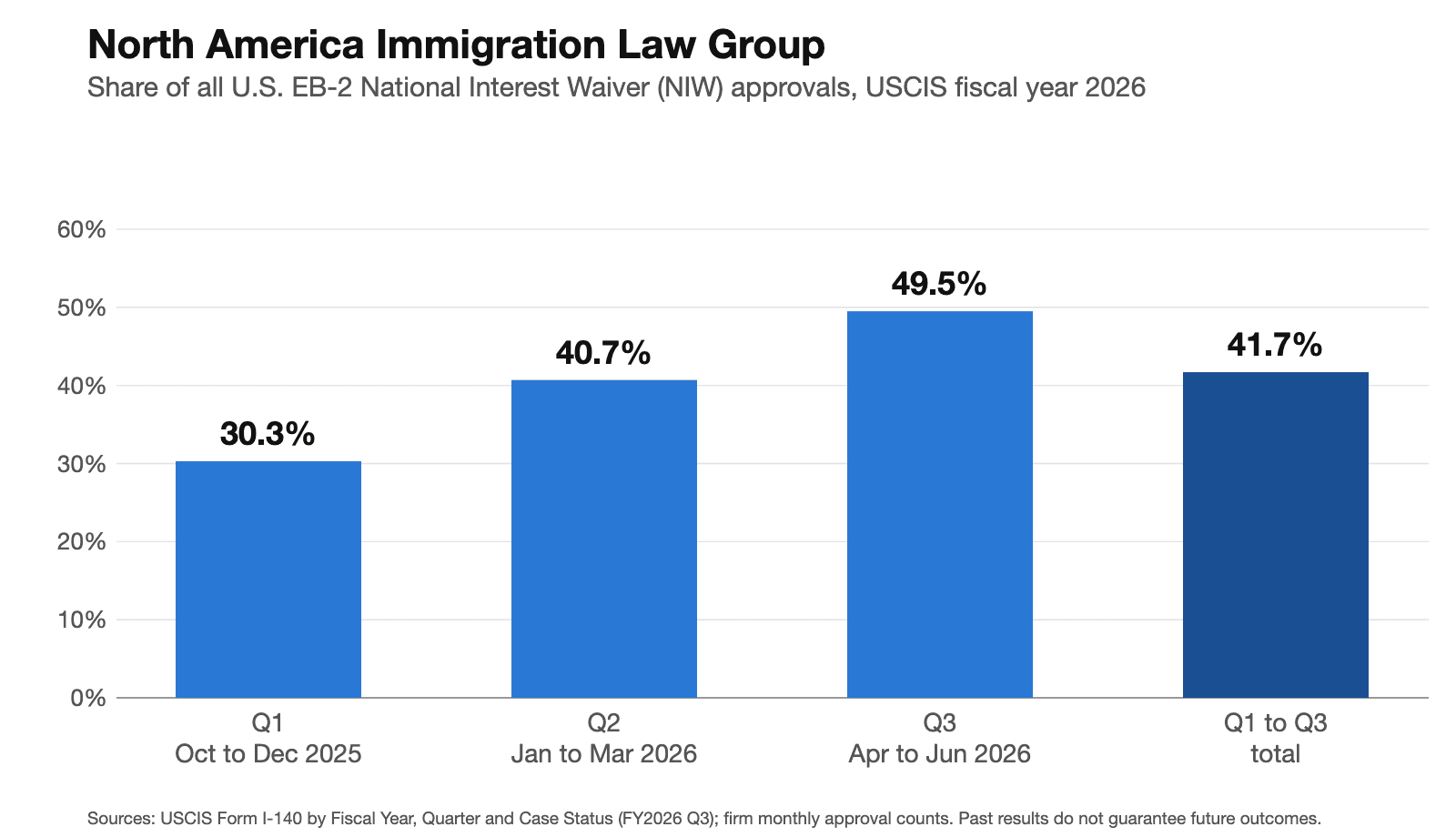
- One of the largest approval records in the country. Our firm has more than 130,000 immigration approvals, including more than 70,000 Employment-Based First Preference (EB-1A and EB-1B), EB-2 National Interest Waiver (NIW), and O-1 approvals. From October 2025 through June 2026, our clients received about 41.7% of all EB-2 National Interest Waiver (NIW) approvals USCIS issued nationwide, and 49.5% in the most recent quarter, so we see a large and current sample of how USCIS decides these petitions.
- A detailed database of adjudication trends. We review every RFE, approval, and denial our clients receive, including how individual officers and service centers have decided similar cases and how their decisions shift over time.
- Up to date case preparation strategy. We adjust our strategy as new notices come in, so your petition or RFE response addresses the issues officers are raising now.
- Honest evaluations. We tell you plainly how strong your case is, what would make it stronger, and when another category or more time may serve you better.
Related Reading
- NIW RFE Response: Challenges & Strategies
- EB-2 NIW for researchers and physicians
- Common NIW RFEs for PhD Students: What USCIS Challenges and Why
- Common NIW RFEs for Postdocs: What USCIS Challenges and Why
- Common NIW RFEs for Industry Professionals Without a PhD: What USCIS Challenges and Why
- Common NIW RFEs for Industry Professionals With a PhD: What USCIS Challenges and Why
How We Can Help
Received an NIW RFE? Our attorneys prepare RFE responses for physicians in every specialty, and every response is tailored to the specific notice and the officer's reasoning. Whether you filed on your own or with another law firm, complete our NIW RFE questionnaire and include your response deadline so we can assess the matter and the time available.
No guarantee of results: Past outcomes do not guarantee a similar result in any other case. Each petition is decided on its own record by the adjudicating officer.