





Common NIW RFEs for Industry Professionals Without a PhD: What USCIS Challenges and Why
WeGreened · https://www.wegreened.com/insights/common-niw-rfes-for-industry-professionals-without-a-phd
For engineers, data scientists, and analysts with a master’s degree: the NIW RFE issues USCIS raises most, why, and the wording officers use.
Engineers, data scientists, analysts, and other industry professionals with a master's degree win National Interest Waiver (NIW) approvals with our firm regularly, and our attorneys review the Request for Evidence (RFE) notices our clients receive every week. Industry petitions draw a different set of questions than academic ones. At North America Immigration Law Group (Chen Immigration Law Associates), here is what we are seeing: the most common RFE issues for industry professionals without a PhD, why officers raise them, and examples of the wording that appears in these notices.
In This Article
- The Work Benefits Only the Employer (Prong 1)
- Industry Reports Are Not Evidence About the Petitioner (Prong 1)
- Doing the Job Well Is Not Enough (Prong 2)
- Questions About the Degree or Experience
- Time, Resources, and the Endeavor
- Why Not Use Labor Certification? (Prong 3)
The Standard Officers Apply
Under the USCIS Policy Manual, a petitioner must first show EB-2 eligibility through an advanced degree, a bachelor's degree plus five years of progressive experience, or exceptional ability. The petition must then show that the proposed endeavor has substantial merit and national importance (Prong 1), that the petitioner is well positioned to advance it (Prong 2), and that on balance a waiver of the job offer and labor certification benefits the United States (Prong 3).
A note on timing. USCIS updated the evidence chapter of its Policy Manual in August 2026. Officers may now deny a petition without first issuing an RFE, and they set each RFE response period case by case, up to a maximum of 12 weeks. The complete response must be submitted at one time.
RFE 1: The Work Benefits Only the Employer (Prong 1)
Why officers raise it for industry professionals. This is the most common issue we see for industry petitions. Officers accept that fields like AI, semiconductors, or cybersecurity matter, but they question whether one employee's work at one company reaches the field as a whole.
Examples of RFE language we have seen:
"While the petitioner's role as a [Title] and his assigned projects are important to his employer, the issue here is not the broader implications of the petitioner's employer, but rather the potential prospective impact of the petitioner's specific proposed endeavor ..."
"The petitioner has not shown the petitioner's proposed endeavor in this case stands to sufficiently extend beyond an organization and its clients to impact the industry or field more broadly."
RFE 2: Industry Reports Are Not Evidence About the Petitioner (Prong 1)
Why officers raise it for industry professionals. Many industry petitions cite market reports, federal initiatives, and statistics about a booming field. Officers treat that material as background that says little about the petitioner's own endeavor.
Example of RFE language we have seen:
"Reliance on background information and statistics concerning various topics is generally not probative."
RFE 3: Doing the Job Well Is Not Enough (Prong 2)
Why officers raise it for industry professionals. Without a long publication record, industry petitions often rely on job performance, promotions, and project results. Officers view these as expected of a skilled employee.
Example of RFE language we have seen:
"Competent execution of past job duties, even successfully, does not automatically render a person well positioned."
RFE 4: Questions About the Degree or Experience
Why officers raise it for industry professionals. Officers check whether the degree relates to the proposed endeavor, and for petitioners relying on a bachelor's degree plus five years of experience, whether the experience letters are credible and detailed. We have seen notices question letters that lacked letterhead or full contact information.
Example of RFE language we have seen:
"The record does not sufficiently explain how the petitioner's advanced degree in psychology is directly related to the proposed endeavor in data engineering ..."
RFE 5: Time, Resources, and the Endeavor
Why officers raise it for industry professionals. Some officers treat the proposed endeavor as separate from the petitioner's job, and then ask how a full-time employee will find time or money to pursue it.
Examples of RFE language we have seen:
"It is not known how much time the self-petitioner would devote to the proposed research endeavor while also performing duties for her employer ..."
"The beneficiary did not submit any evidence of how he will be able to afford his endeavor to include his living expenses."
RFE 6: Why Not Use Labor Certification? (Prong 3)
Why officers raise it for industry professionals. Because an industry professional already has an employer, officers often argue that the employer can sponsor the petitioner through the standard process.
Example of RFE language we have seen:
"The petitioner failed to submit evidence that his knowledge or skills are not easily articulated in a labor certification."
What These RFEs Have in Common
Much of the language in these notices is standardized and appears across many cases. In our weekly reviews, we also see notices with internal contradictions or facts that appear to come from another case. An RFE is not a denial, and the right response depends on the specific notice, the officer's reasoning, and the record already filed. Our firm's recent approvals after an RFE include industry engineers in digital design and computer networking.
Why Work With Our Firm
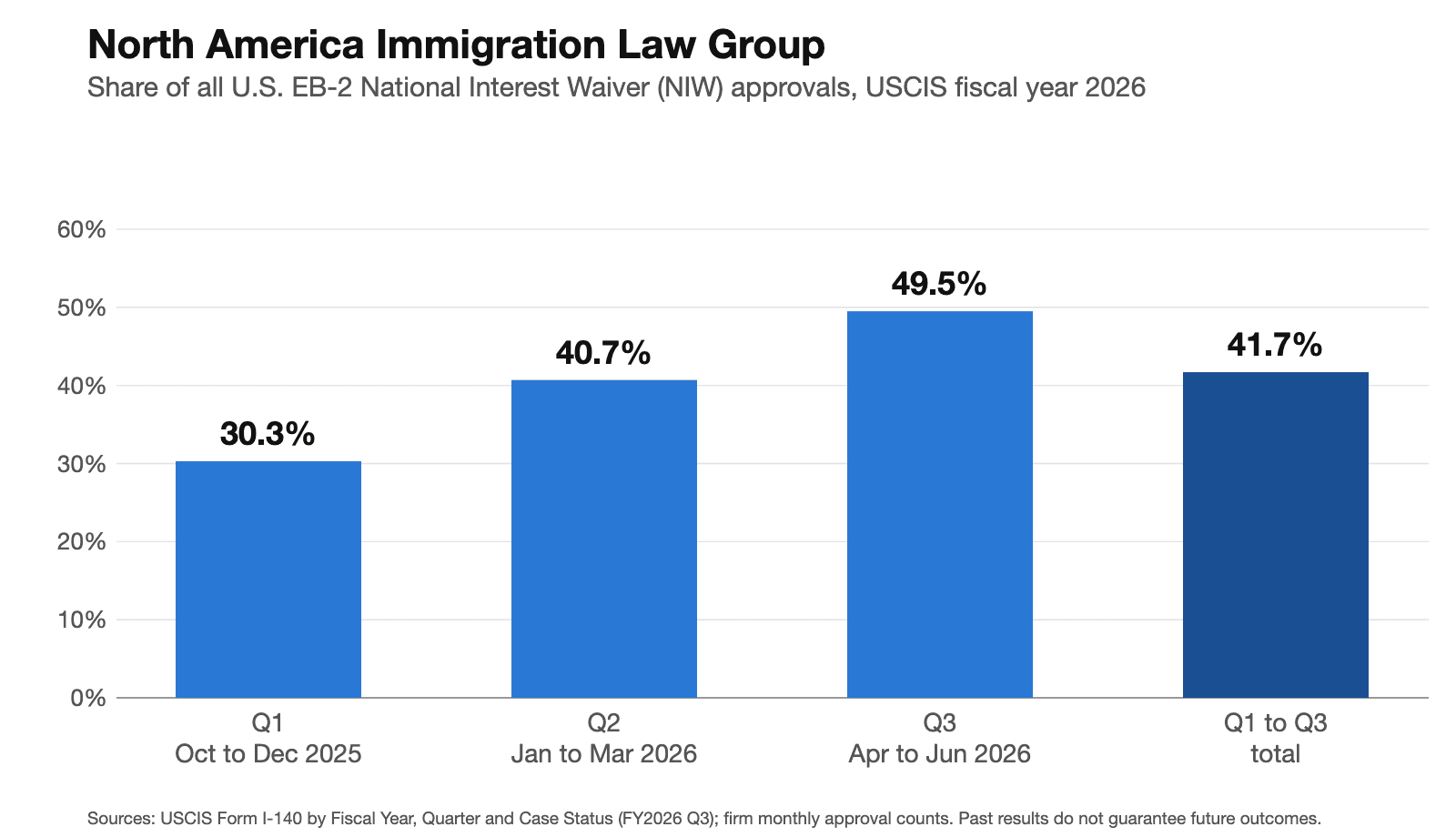
- One of the largest approval records in the country. Our firm has more than 130,000 immigration approvals, including more than 70,000 Employment-Based First Preference (EB-1A and EB-1B), EB-2 National Interest Waiver (NIW), and O-1 approvals. From October 2025 through June 2026, our clients received about 41.7% of all EB-2 National Interest Waiver (NIW) approvals USCIS issued nationwide, and 49.5% in the most recent quarter, so we see a large and current sample of how USCIS decides these petitions.
- A detailed database of adjudication trends. We review every RFE, approval, and denial our clients receive, including how individual officers and service centers have decided similar cases and how their decisions shift over time.
- Up to date case preparation strategy. We adjust our strategy as new notices come in, so your petition or RFE response addresses the issues officers are raising now.
- Honest evaluations. We tell you plainly how strong your case is, what would make it stronger, and when another category or more time may serve you better.
Related Reading
- NIW RFE Response: Challenges & Strategies
- NIW petitions: requirements and our approach
- Common NIW RFEs for PhD Students: What USCIS Challenges and Why
- Common NIW RFEs for Postdocs: What USCIS Challenges and Why
- Common NIW RFEs for Physicians: What USCIS Challenges and Why
- Common NIW RFEs for Industry Professionals With a PhD: What USCIS Challenges and Why
How We Can Help
Received an NIW RFE? Our attorneys prepare RFE responses for industry professionals in every field, and every response is tailored to the specific notice and the officer's reasoning. Whether you filed on your own or with another law firm, complete our NIW RFE questionnaire and include your response deadline so we can assess the matter and the time available.
No guarantee of results: Past outcomes do not guarantee a similar result in any other case. Each petition is decided on its own record by the adjudicating officer.