





New PERM Rules in 2026: EB-2 PERM vs. National Interest Waiver (NIW) vs. Special Handling vs. EB-1B Outstanding Professor or Researcher
WeGreened · https://www.wegreened.com/insights/new-perm-rules-2026-perm-vs-niw-vs-special-handling-vs-eb-1b
DOL proposed a PERM overhaul on November 17, 2026. How the new rules would change EB-2 PERM, and how PERM compares with the NIW, special handling, and EB-1B.
On November 17, 2026, the U.S. Department of Labor (DOL) published a proposed rule that would rewrite the Program Electronic Review Management (PERM) labor certification process. PERM is the first step for most employer-sponsored green cards in the Employment-Based Second Preference (EB-2) and Third Preference (EB-3) categories. The proposal would replace newspaper ads with at least 90 days of online and in-person recruitment, require the full recruitment record at filing, bar filings for two years after related layoffs, and eliminate Schedule A.
The rule is not final, and current PERM rules still apply today. But the direction is clear: PERM is likely to become longer, more document-heavy, and riskier for employers. For many professionals, this is a good time to compare PERM with the routes that do not need labor certification at all. Below, we explain what DOL proposed and compare EB-2 PERM with the EB-2 National Interest Waiver (NIW), the special recruitment procedure for college and university teachers (often called "special handling"), and the Employment-Based First Preference Outstanding Professor or Researcher category (EB-1B).
What DOL Proposed for PERM
The proposal, "Modernizing the Labor Market Test and Improving Protections for U.S. Workers in the PERM Immigrant Visa Program" (91 FR 73916, RIN 1205-AC29, Docket ETA-2026-0133), changes almost every stage of the labor market test. Comments are due January 19, 2027.
| Area | Current PERM rule | Proposed rule |
|---|---|---|
| Advertising | Two Sunday print newspaper ads, a 30-day state job order, and three additional steps for professional jobs | No print newspaper ads. A state job order, the employer's careers website, at least one outside job site, the employer's usual social media, and a job fair, campus event, or placement office posting |
| Recruitment period | Recruitment within the 180 days before filing | Ads run at least 90 days, or longer if that is the employer's usual practice, and end 30 to 60 days before filing |
| Ad content | Limited required content | Wage or wage range, duties, minimum requirements, hours, and whether the job is remote, telework, or hybrid |
| Documents at filing | Recruitment report kept on file and produced if audited | Recruitment report, all recruitment evidence, and every U.S. applicant's résumé filed with the application |
| Recruitment method | Ads and procedures specific to PERM are common | Recruitment must mirror the employer's normal hiring. PERM-only application channels are presumed not in good faith |
| Layoffs | Layoffs in the prior 6 months must be addressed, but do not bar filing | No filing for 2 years after layoffs in the same or similar occupation and area |
| Schedule A | Nurses, physical therapists, and people of exceptional ability in the sciences or arts skip recruitment | Schedule A eliminated, so these cases go through full recruitment |
| Remote jobs | Can be sponsored | DOL asks whether fully remote jobs should remain eligible at all |
| Enforcement | Audits and debarment available | Wider attestations under penalty of perjury, audits of any case with 30 days or less to respond, and debarment of up to 3 years across DOL programs |
When it could take effect. DOL proposes that the final rule take effect 60 days after it is published. Applications filed on or after the 90th day after publication would follow the new rules. Applications filed before then would be processed under the current rules. Comments on the proposal are due January 19, 2027 (Federal Register). DOL has to review those comments before it can publish a final rule, so the date the new rules would apply is not yet known.
A second rule on wages. In a separate proposal published on March 27, 2026, DOL proposed raising all four prevailing wage levels used in PERM and the H-1B program (Federal Register). As of late October 2026, that rule had not been finalized either.
Processing is already slow. As of October 31, 2026, PERM applications decided in analyst review over the previous 90 days had waited an average of 315 days. Before filing PERM, the employer must also obtain a prevailing wage determination, and DOL was then still working on PERM wage requests received in August 2026 (DOL processing times).
PERM vs. NIW vs. Special Handling vs. EB-1B at a Glance
| EB-2 PERM | EB-2 NIW | Special Handling (PERM) | EB-1B | |
|---|---|---|---|---|
| Who files | Employer | You (self-petition) | University employer | Employer |
| Job offer needed | Yes | No | Yes, a teaching role | Yes, a permanent research or tenure-track role |
| Labor certification | Yes, full recruitment | No, waived | Yes, but based on the employer's competitive faculty search | No |
| Core standard | No able, willing, qualified, and available U.S. worker | The three-prong Matter of Dhanasar test | You were more qualified than the other applicants | International recognition, 3 years of experience, and 2 of 6 criteria |
| Affected by the proposed PERM rule | Yes, heavily | No | Yes, partly | No |
| Premium processing for the I-140 | Yes, after the PERM is certified | Yes | Yes, after the PERM is certified | Yes |
| Change employers before the green card | Hard; a new employer usually starts PERM again | Yes, if you keep working in the proposed endeavor | Hard; tied to the university | Hard; tied to the employer |
| Visa queue | EB-2 | EB-2, same as PERM | EB-2 | EB-1, usually shorter |
NIW and EB-2 PERM cases share the same EB-2 visa queue, so a given priority date waits the same time in either route. EB-1B uses the EB-1 queue, which moves faster. EB-1 has been current for applicants born outside China and India. EB-2 for those applicants has some retrogression, but far less than EB-2 China or EB-2 India. For applicants born in China or India, the EB-1 backlog is shorter than the EB-2 backlog. Check the current Visa Bulletin for your country.
The Four Routes Explained
EB-2 PERM: The Employer Tests the U.S. Labor Market
In EB-2 PERM, the employer gets a prevailing wage determination, recruits for the job, and shows DOL that no qualified U.S. worker applied. Only then can it file the Form I-140 petition with U.S. Citizenship and Immigration Services (USCIS). The job must require an advanced degree, or a bachelor's degree plus five years of progressive experience.
Who it fits. Professionals whose employer will sponsor them and who may not meet a self-petition standard yet.
What the proposal changes. Recruitment would take longer, every résumé would be filed with DOL, and any qualified U.S. applicant would still defeat the case. Employers with recent layoffs in the occupation could not file for two years. Fully remote employees may lose eligibility.
EB-2 NIW: No Employer and No Labor Certification
The National Interest Waiver (NIW) lets you skip the job offer and the labor certification if waiving them is in the national interest. You need an advanced degree or exceptional ability, and you must meet the three prongs of Matter of Dhanasar, as applied in the USCIS Policy Manual: your endeavor has substantial merit and national importance, you are well positioned to advance it, and on balance a waiver benefits the United States.
Who it fits. Researchers, engineers, physicians, and other professionals with a clear plan and a record of advancing it, including PhD students and postdocs.
What the proposal changes. Nothing. The proposed rule covers only labor certification under 20 CFR Part 656, and the NIW does not use it.
Special Handling: PERM for College and University Teachers
Under 20 CFR 656.18, a college or university can rely on the competitive search it used to hire a faculty member, instead of running new PERM recruitment. The university must show that the foreign national was more qualified than any U.S. applicant, a lower bar than proving no qualified U.S. worker applied. The current rule requires an ad in a national professional journal and filing within 18 months of selection.
Who it fits. Faculty members whose duties include teaching, hired through a competitive search.
What the proposal changes. DOL proposes to keep special handling and extend it to professional athletes and sports coaches. It would remove the 18-month window in favor of the general 30-day filing rule, allow an electronic journal ad instead of print, and require the recruitment report and all evidence at filing. The 30-day rule could make timing much tighter, so universities should not wait to file.
EB-1B: Outstanding Professors and Researchers
EB-1B needs an employer, but no labor certification. Under 8 CFR 204.5(i), you must be internationally recognized as outstanding in your academic field, have at least three years of teaching or research experience, and meet at least two of six criteria. The criteria include major awards, membership in selective associations, published material about your work, judging others' work, original contributions, and scholarly articles or books. The employer must offer a permanent research position or a tenure-track or tenured teaching position. A private employer must have at least three full-time researchers and documented research accomplishments.
Who it fits. Established researchers and faculty with an employer willing to sponsor, especially applicants from countries with long EB-2 backlogs.
What the proposal changes. Nothing. EB-1B does not use labor certification.
Why Many Professionals Should Consider the NIW Now
If you qualify, the NIW avoids every stage the proposed rule would make harder. It reaches the same EB-2 queue without the wait for a prevailing wage determination and a PERM decision.
- No recruitment and no labor market risk. A qualified U.S. applicant cannot defeat an NIW, and employer layoffs do not bar it.
- No employer needed. You file for yourself, so the case does not depend on an employer's budget, HR policies, or willingness to sponsor.
- Remote work is not a problem. The NIW looks at your endeavor, not a specific worksite, so the proposed limits on remote jobs do not apply.
- Faster to file. With premium processing, USCIS decides the I-140 within 45 business days, instead of the year or more a PERM can take before the I-140 is even filed.
- More career freedom. You can change employers, or move between academia and industry, as long as you keep working in your proposed endeavor.
- It can run in parallel. You can file an NIW while your employer pursues PERM, special handling, or EB-1B, and keep the earliest priority date.
When the NIW may not be the best fit. The NIW requires a well-documented endeavor and a record of progress. Officers scrutinize these cases closely, and Requests for Evidence (RFEs) are common. A professional early in their career, without publications, patents, or a measurable track record, may do better with employer-sponsored PERM for now. A strong researcher born in China or India may also want EB-1B or EB-1A to reach a shorter queue. Many of our clients file more than one petition.
Why Work With Our Firm
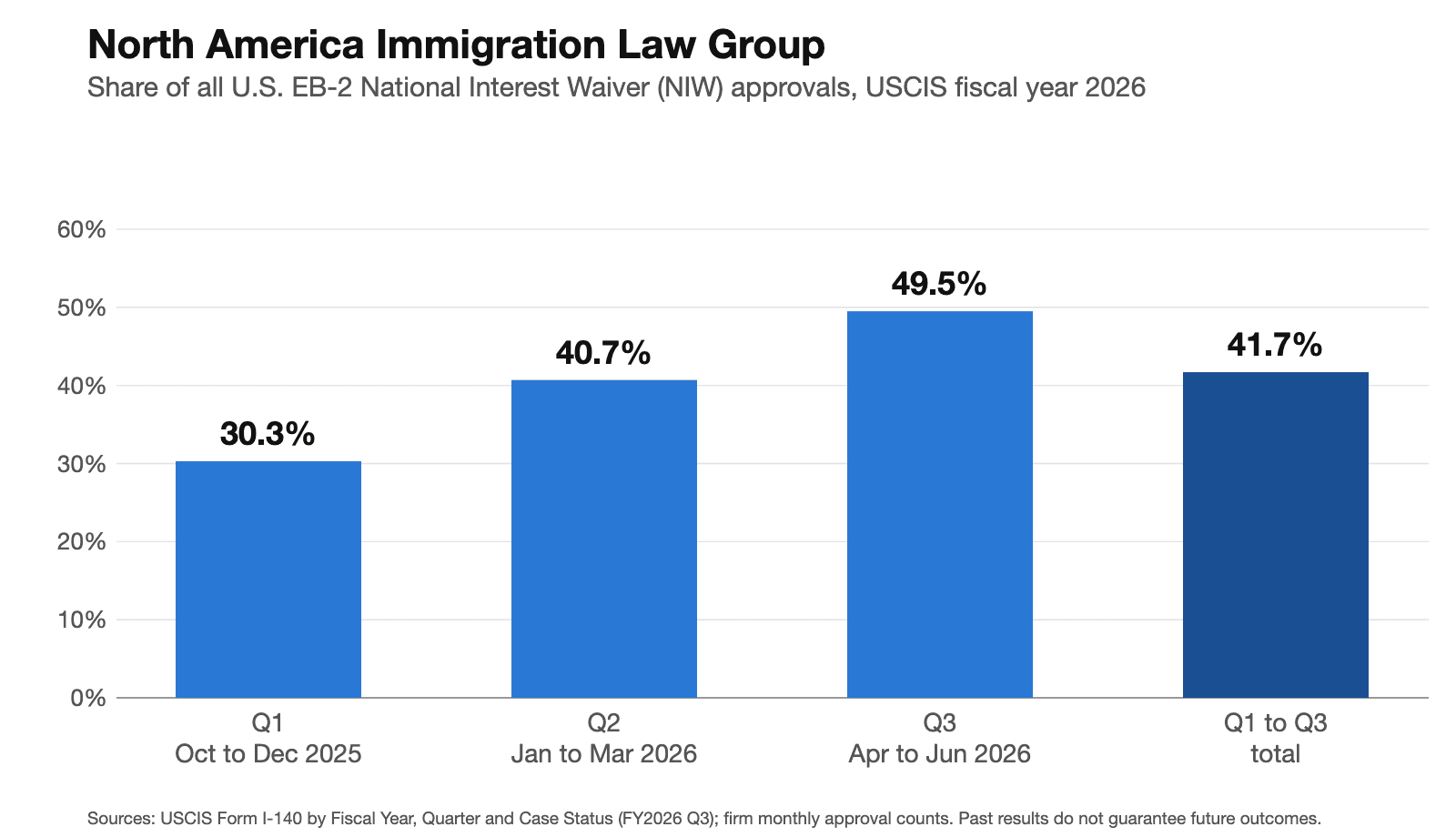
- One of the largest approval records in the country. Our firm has more than 130,000 immigration approvals, including more than 70,000 Employment-Based First Preference (EB-1A and EB-1B), EB-2 National Interest Waiver (NIW), and O-1 approvals. From October 2025 through June 2026, our clients received about 41.7% of all EB-2 National Interest Waiver (NIW) approvals USCIS issued nationwide, and 49.5% in the most recent quarter, so we see a large and current sample of how USCIS decides these petitions.
- A detailed database of adjudication trends. We review every RFE, approval, and denial our clients receive, including how individual officers and service centers have decided similar cases and how their decisions shift over time.
- Up to date case preparation strategy. We adjust our strategy as new notices come in, so your petition or RFE response addresses the issues officers are raising now.
- Honest evaluations. We tell you plainly how strong your case is, what would make it stronger, and when another category or more time may serve you better.
Related Reading
- Our EB-2 National Interest Waiver (NIW) services
- EB-2 NIW: frequently asked questions
- EB-2 NIW in 2026
- A Green Card Strategy for PhD Students
- NIW RFE Response: Challenges & Strategies
Sources
- U.S. Department of Labor, Modernizing the Labor Market Test and Improving Protections for U.S. Workers in the PERM Immigrant Visa Program; Proposed Rule, 91 FR 73916 (November 17, 2026)
- U.S. Department of Labor, Improving Wage Protections for the Temporary and Permanent Employment of Certain Foreign Nationals in the United States, proposed rule (March 27, 2026)
- 20 CFR 656.18, optional special recruitment for college and university teachers
- 8 CFR 204.5, employment-based immigrant petitions
- USCIS Policy Manual, Volume 6, Part F, Chapter 5, applying Matter of Dhanasar, 26 I&N Dec. 884 (AAO 2016)
- U.S. Department of Labor, Office of Foreign Labor Certification, FLAG Processing Times (data as of October 31, 2026)
- U.S. Department of State, Visa Bulletin
How We Can Help
Our attorneys prepare NIW, EB-1A, EB-1B, and O-1 petitions for researchers, engineers, physicians, faculty, and other professionals, so you do not have to rely on an employer's PERM. We will tell you whether you qualify for the NIW or EB-1B today, and what would strengthen your case if you do not. Cases can be prepared and filed quickly, with premium processing available. To find out which route fits you before the new PERM rules take effect, request a free evaluation.
No guarantee of results: Past outcomes do not guarantee a similar result in any other case. Each petition is decided on its own record by the adjudicating officer. This article describes a proposed rule that may change before it is finalized.